

 05/28/2026
  Steve Bearden
The lowest entry price for your manuscript often masks a hidden drain on your long-term royalties. While print-on-demand offers accessibility, relying solely on standard platforms can lead to high unit costs that stifle your growth as an independent creator. Achieving truly cost-effective book printing for indie authors requires a shift from transactional thinking to a strategic production model. You’ve likely felt the frustration of watching Amazon KDP’s fixed costs or IngramSpark’s 1.875% market access fee eat into your hard-earned margins.
We understand that you need more than just a printed page. You need a retail-ready product that competes with traditional houses without sacrificing your profit per book. This guide will show you how to navigate advanced production specs and modern printing technologies to secure professional-grade quality at the lowest possible unit cost. We’ll examine the strategic transition from digital to offset printing, the impact of premium finishes, and how integrated kitting and fulfillment can streamline your path to the reader. By the end of this article, you’ll have a clear roadmap to maximizing your margins through industrial-grade precision and logistical excellence.
Key Takeaways
- Move beyond the POD trap by understanding how production scale transforms your unit costs into a competitive advantage.
- Discover how optimizing paper stock and trim dimensions creates truly cost-effective book printing for indie authors without compromising on retail quality.
- Identify your break-even point between digital and offset printing to ensure you use the most efficient technology for your specific project.
- Learn how professional inventory management and kitting services eliminate the hidden costs and inefficiencies of self-fulfillment.
- Elevate your market positioning by utilizing industrial-grade binding and finishing techniques that signal professional authority to your readers.
Beyond Print-on-Demand: Defining Cost-Effective Book Printing for Indie Authors
The distinction between cheap printing and cost-effective manufacturing is the difference between a hobby and a business. Many authors begin their journey in self-publishing by seeking the lowest possible entry cost, often gravitating toward platforms that require zero upfront investment. While these services provide a vital entry point, they rarely offer a scalable solution for authors who intend to see their work on bookstore shelves or in the hands of thousands of readers. True cost-effective book printing for indie authors isn’t about avoiding an initial invoice. It’s about securing a unit cost that allows for healthy retail margins and sustainable growth.
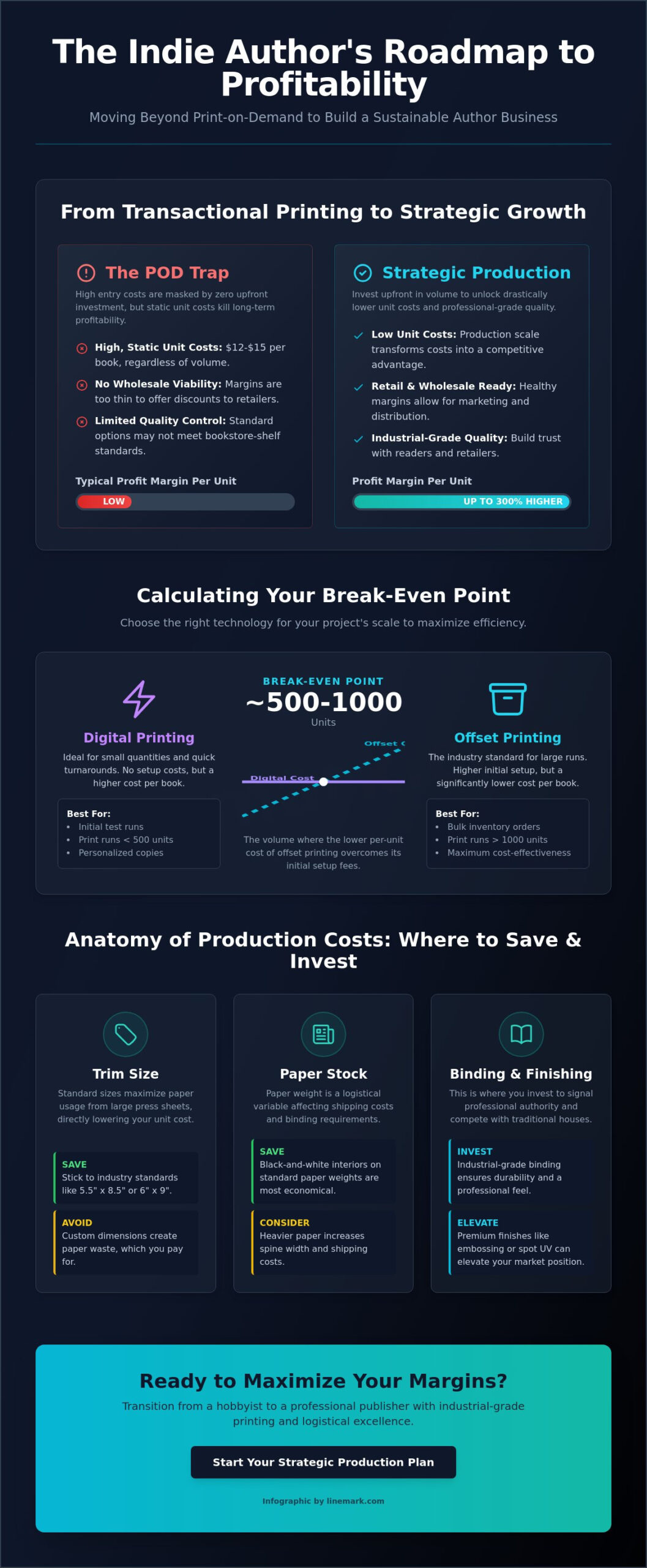
Relying exclusively on standard print-on-demand (POD) models often leads to what professionals call the POD Trap. When your production cost remains static at $12 or $15 per unit regardless of how many books you sell, your ability to offer wholesale discounts to retailers vanishes. Serious indie growth requires a transition to industrial-scale printing. This shift allows you to capture the margins necessary for marketing, distribution, and future acquisitions. As a strategic communications ally, we focus on helping you bridge the gap between a digital manuscript and a high-performance retail product.
To better understand how these production models compare in the modern market, watch this helpful video:
The Unit Cost vs. Total Investment Debate
Calculating the real cost of a book involves more than just the ink and paper. You must account for production quality, shipping logistics, and inventory management. In the 2026 landscape, a professional standard for bookstore shelves requires specific paper weights and binding durability that standard POD often lacks. While a custom production run requires a higher initial investment, it frequently leads to profit margins that are 300% higher per unit sold compared to one-off digital prints. This financial breathing room is what separates successful publishers from struggling authors.
The Value of Scalability in Book Manufacturing
Moving from a “one-off” mindset to a sustainable inventory model is a hallmark of professional maturity. High-capacity operations provide the technological precision of a large-scale facility while maintaining the meticulous attention to detail found in a boutique shop. By leveraging cost-effective book printing for indie authors through higher volume runs, you ensure that every copy meets a rigorous quality standard. This reliability builds trust with your audience and your retail partners alike. Cost-effectiveness is the optimization of per-unit production costs through strategic volume planning.
The Anatomy of Book Production Costs: Where to Save and Where to Invest
Understanding the physical components of your book is essential for managing your budget. While the average cost to self-publish provides a helpful baseline, your specific production choices determine whether you achieve a sustainable profit or a loss. Every millimeter of trim size and every pound of paper weight influences your manufacturing efficiency. Standard trim sizes like 5.5″ x 8.5″ or 6″ x 9″ are industry favorites because they maximize the use of large press sheets. Choosing a custom or unique dimension often results in significant paper waste. You eventually pay for that waste in your unit cost.
Strategic material selection is the foundation of cost-effective book printing for indie authors. Paper stock isn’t just about tactile feel; it’s a logistical variable. Heavier paper increases your shipping costs and changes your spine width, which affects your binding requirements. For interiors, black-and-white printing remains the most economical choice. If your project requires color, consider grouping color pages together or utilizing high-quality digital printing for shorter runs to keep costs manageable. Perfect binding is the standard for paperbacks, while case binding offers the durability required for premium hardcovers and library editions.
Optimizing Materials for Your Genre
Fiction authors usually find success with 55lb cream paper. It offers a classic aesthetic and sufficient opacity without adding unnecessary bulk to the package. Non-fiction titles or technical manuals often require 60lb to 70lb white paper to ensure high readability and minimal ink show-through for charts and diagrams. Your choice here directly impacts your spine width. A thicker spine can provide better shelf presence in a physical bookstore, but it may also increase your binding costs if it exceeds standard machinery thresholds.
Authors focusing on these genres can discover Journeyscript Publishers LLC for insights into how professional educational and business guides are structured for the retail market.
Finishing Touches That Add Value Without Breaking the Bank
Your cover is your primary marketing tool. Choosing a print finish involves balancing aesthetics with long-term durability. Matte finishes provide a sophisticated, modern look, while high-gloss or UV coatings offer superior protection against scuffs during the shipping process. To increase perceived retail value, consider strategic enhancements like spot UV or foil stamping. These features make a standard paperback feel like a premium edition. Additionally, Variable Data Printing allows you to create serialized limited editions or personalized inserts. This turns a standard production run into a high-value collector’s item. Our team can help you evaluate which Binding & Finishing options best align with your specific margin goals.
Digital vs. Offset Printing: Calculating Your Break-Even Point
Choosing the right manufacturing technology is the most critical decision you’ll make when pursuing cost-effective book printing for indie authors. The landscape in 2026 offers two primary paths: Digital and Offset. Digital printing, specifically advanced inkjet technology, has revolutionized short-run production. It’s the ideal solution for initial launches or niche projects requiring 1 to 500 copies. This method eliminates the need for physical plates, allowing for rapid setup and lower upfront costs. If you’re testing a new market or managing a small, dedicated readership, digital provides the agility you need without committing to massive inventory.
Offset printing remains the industrial powerhouse for high-volume efficiency. While the initial setup requires a greater investment in time and resources, the per-unit price drops dramatically as your volume increases. Quality comparisons in 2026 show that digital has nearly closed the gap with offset for standard text and graphics. However, offset still holds a slight edge in ink saturation and color depth for high-end photography or art-heavy books. Balancing manufacturing speed with logistical precision is key. Digital offers faster turnaround for urgent needs, but offset provides the steady, high-capacity output required for major retail distribution.
Finding Your Production Sweet Spot
The math of the “plate” governs your break-even point. In offset manufacturing, creating physical plates for every page is a fixed cost that must be amortized across the entire run. Offset printing typically becomes more cost-effective than digital at the 750-1,000 copy threshold. Many savvy authors now utilize hybrid models to protect their margins. They use digital printing for initial proofs and “soft launches” to gather feedback, then transition to a large offset run once demand is proven. This strategic volume planning ensures you aren’t overpaying for small batches or sitting on stagnant inventory.
Quality Control in High-Volume Manufacturing
Consistency is the hallmark of a professional publisher. Ensuring color consistency across a 5,000-copy print run requires advanced sensory technology and a well-oiled production line. Modern high-capacity presses use automated monitoring to adjust ink flow in real-time, which significantly reduces waste and lowers your overall costs. This level of precision is why industrial-scale partners are essential for serious growth. For a deeper dive into achieving these professional results, see our guide on custom book printing. By aligning your technology choice with your sales projections, you transform your production from a simple expense into a powerful engine for profit.
Scaling Your Success: Strategic Inventory and Fulfillment Logistics
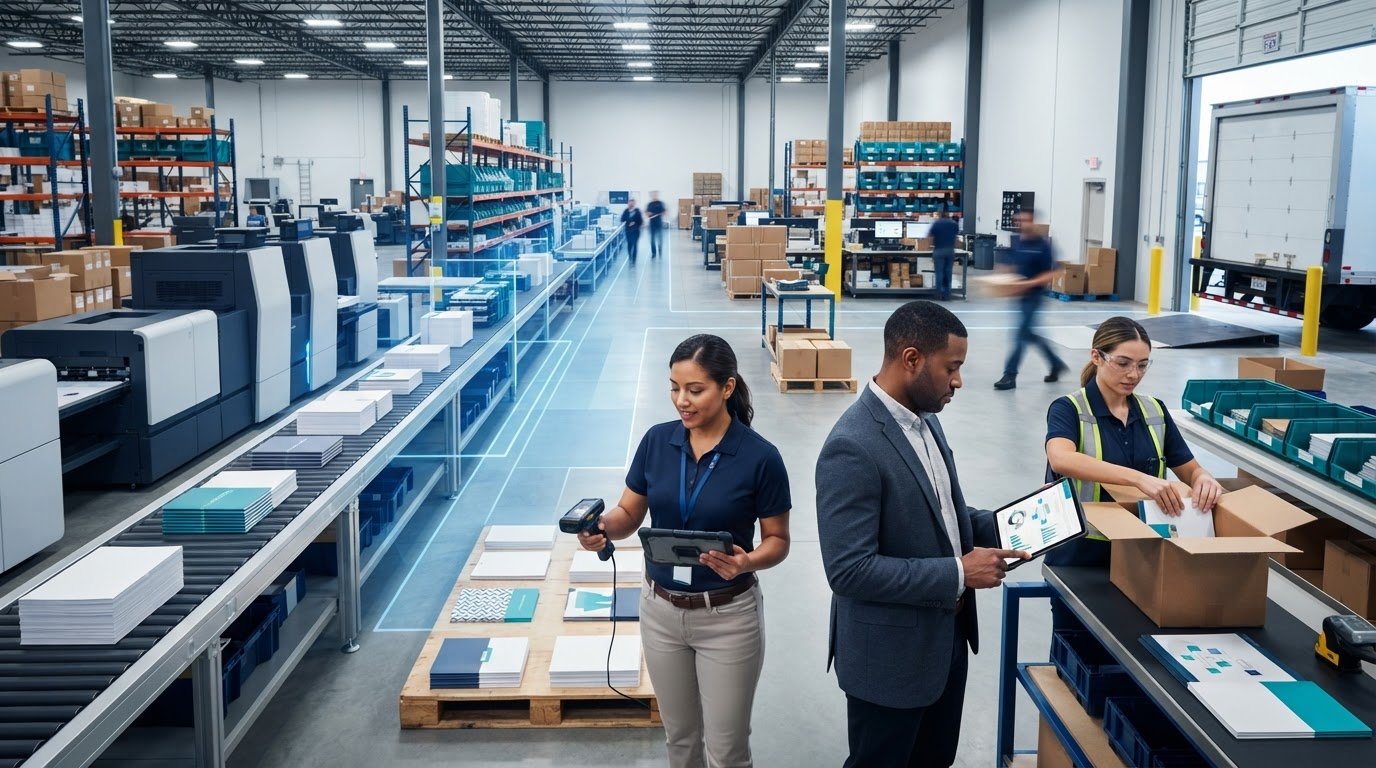
Production is only half the battle. Once your books are manufactured, the challenge shifts to logistics. Many authors fall into the “Garage Problem,” where they attempt to manage inventory and shipping from their own homes. This approach creates a hidden tax on your growth, consuming hours that should be spent on marketing and writing. True scalability requires a shift toward professional inventory management. By leveraging a 90,000-square-foot facility, you gain access to the same high-capacity logistics used by major publishers, ensuring your books are stored in a climate-controlled, secure environment.
Centralizing your production and storage is essential for maintaining cost-effective book printing for indie authors. When your books are stored at the point of manufacture, you eliminate the expense and damage risks associated with secondary transport. Real-time inventory tracking ensures you never miss a sales spike, providing a steady flow of data that informs your next print run. Integrating your sales platform with a professional fulfillment partner allows for a seamless, hands-off operation that scales automatically as your readership grows. This operational excellence is what allows you to focus on your craft while we handle the heavy lifting.
Warehousing as a Competitive Advantage
Centralized storage reduces last-mile shipping costs by positioning your stock within a sophisticated distribution network. Our facility provides the operational breadth needed to handle national distribution without the overhead of a private lease. You’ll benefit from integrated kitting and fulfillment services that ensure every order is processed with precision. This streamlined approach moves your project from a business challenge to a concrete, scalable solution. By reducing the time between a reader’s click and the book’s arrival, you enhance your brand’s reliability and market presence.
Fulfillment and Direct Mail Integration
Building reader loyalty requires a premium experience that begins the moment the box arrives. Specialized kitting and packaging allow you to create an unboxing moment that rivals traditional retail. You can utilize direct mail strategies to launch your next title, sending personalized postcards or newsletters to your most dedicated fans. Variable data printing isn’t just for the books themselves; it’s a tool for creating personalized inserts that make every reader feel like a valued partner. This holistic journey transforms a simple transaction into a lasting relationship, turning one-time buyers into lifelong advocates.
Ready to optimize your distribution and protect your margins? Explore our Kitting & Fulfillment solutions to see how we can streamline your entire delivery process.
Elevating Your Indie Brand with Professional-Grade Book Manufacturing
The transition from author to publisher is a pivotal moment in your career. It requires moving beyond the creative process to embrace the heavy responsibilities of manufacturing and distribution. Readers perceive the value of your work through the physical object they hold in their hands. If the binding is weak or the paper feels flimsy, they’ll question your retail price. Professional-grade manufacturing isn’t just a luxury; it’s a fundamental part of your brand identity. By utilizing cost-effective book printing for indie authors, you ensure your physical product matches the quality of your prose.
Linemark brings over 30 years of industrial experience to your project. This history provides you with a level of precision that smaller, boutique shops simply can’t match. We don’t just print pages; we build a foundation for your business growth. Our high-capacity operations are designed to handle complex projects with the same meticulous attention to detail you put into your manuscript. This ensures that as you scale from a local launch to nationwide distribution, your quality remains consistent copy after copy. Industrial authority becomes your competitive edge in a crowded marketplace.
The Strategic Communications Ally
A unified partnership is always more valuable than a simple transactional exchange. We position ourselves as your strategic communications ally, helping you solve the complex challenges of modern publishing. Whether you’re managing multi-format projects or rapid inventory spikes, our team provides agile problem-solving to keep your business moving. This relationship-driven approach allows you to future-proof your publishing house. You gain the security of knowing your production partner can handle any volume without sacrificing the standards your readers expect. Efficiency and high-touch service aren’t mutually exclusive here.
Final Checklist for Cost-Effective Production
Before you move your manuscript into production, review your specifications one final time. Manufacturing efficiency depends on getting the technical details right from the start. A few small adjustments can significantly impact your total investment and long-term margins. Use this checklist to verify your readiness:
- Confirm your trim sizes align with standard press sheet dimensions to minimize paper waste.
- Verify your paper weight choices balance opacity with your target shipping costs.
- Integrate your fulfillment and storage strategy directly with your production site to reduce transport fees.
- Review binding and finishing options to maximize shelf presence and durability for your specific genre.
Success in the 2026 market belongs to authors who treat their production as a strategic asset. If you’re ready to move from a digital file to a professional retail product, you should contact a project expert for a tailored production quote. We’ll help you find the most efficient path to market while protecting your margins at every stage of the journey.
Secure Your Publishing Future with Strategic Manufacturing
Transitioning from a transactional POD model to a scalable manufacturing strategy is the most effective way to protect your long-term royalties. You now understand that optimizing trim sizes, selecting the appropriate printing technology, and centralizing fulfillment are the pillars of professional success. Achieving cost-effective book printing for indie authors requires this shift in perspective, moving from one-off prints to a sustainable inventory model that supports retail growth and brand authority.
We offer the industrial infrastructure to turn your vision into a market-ready product. With our 90,000-square-foot high-tech production facility and over 30 years of industrial printing expertise, we provide the precision your brand demands. Our integrated warehousing and nationwide fulfillment services ensure your books reach readers without the logistical headaches of self-storage. Partner with Linemark for Scalable, Professional Book Printing and take control of your margins today. Your manuscript represents years of dedication. It deserves a physical form that reflects that commitment and commands authority on every bookstore shelf.
Frequently Asked Questions
How much does it cost to print 1,000 books for an indie author?
The total investment for a 1,000-copy run depends on your specific trim size, page count, and binding choice. At this volume, offset printing typically provides a significantly lower unit cost compared to digital methods. You’ll find that the initial setup cost is amortized across the large run, which maximizes your profit margins for retail distribution. Our experts can help you analyze your specs to ensure your project remains within your target budget.
Is offset printing better than digital for self-publishing?
Offset printing is superior for high-volume projects where unit cost is the primary concern, while digital is better for short runs and rapid testing. Digital technology in 2026 offers quality that rivals offset for most standard genres. However, offset remains the industrial standard for large-scale distribution due to its high-speed efficiency and consistent ink coverage on complex projects. The right choice depends entirely on your sales projections and inventory strategy.
What is the most cost-effective book size for shipping and printing?
Standard trim sizes like 6″ x 9″ or 5.5″ x 8.5″ are the most economical choices because they align with standard press sheet dimensions. These dimensions minimize paper waste during the manufacturing process and fit into standard shipping mailers. Choosing these industry standards is a key component of cost-effective book printing for indie authors who want to avoid the surcharges associated with custom or oversized dimensions.
Can I save money by storing my books at the printing facility?
Storing your inventory at a centralized production facility reduces your total expenditure by eliminating secondary transport costs and minimizing the risk of damage during transit. Professional inventory management allows you to move books directly from the press to the reader. This streamlined approach removes the hidden taxes of self-storage and allows you to scale your operations without increasing your physical footprint or manual labor requirements.
How does paper weight affect the total cost of a book run?
Paper weight directly impacts both your material costs and your long-term shipping expenses. Heavier stocks like 70lb white paper increase the spine width and the total weight of each package, which can lead to higher postal rates. Selecting a standard 55lb or 60lb stock often provides the best balance of opacity and cost-efficiency for high-volume fiction and non-fiction titles. We recommend reviewing paper samples to find the right balance for your brand.
What is the difference between POD and short-run digital printing?
Print-on-demand produces books one at a time as orders arrive, while short-run digital printing involves manufacturing a specific batch of 50 to 500 copies. Short-run digital printing offers more control over paper selection and finishing options than standard POD platforms. This batch-based approach often results in a lower per-unit cost while still providing the agility needed for niche markets, limited releases, or advanced review copies.
How can I get bookstore-quality hardcover books on an indie budget?
Achieving bookstore-quality hardcovers requires utilizing professional binding and finishing techniques such as case binding with matte or gloss lamination. Transitioning from single-copy production to a strategic volume run allows you to access industrial-grade materials at a more manageable price point. This method ensures your hardcover edition possesses the durability and shelf presence necessary to compete with traditional publishing houses without sacrificing your per-unit profit margins.
What is the best way to handle book fulfillment for direct sales?
The most efficient way to manage direct sales is through integrated kitting and fulfillment services located at your printing site. This setup allows for professional packaging and rapid shipping without your direct involvement in the daily logistics. Utilizing cost-effective book printing for indie authors alongside an automated fulfillment partner ensures that your readers receive a premium unboxing experience while you focus on marketing and high-level business growth.