

 05/25/2026
  Steve Bearden
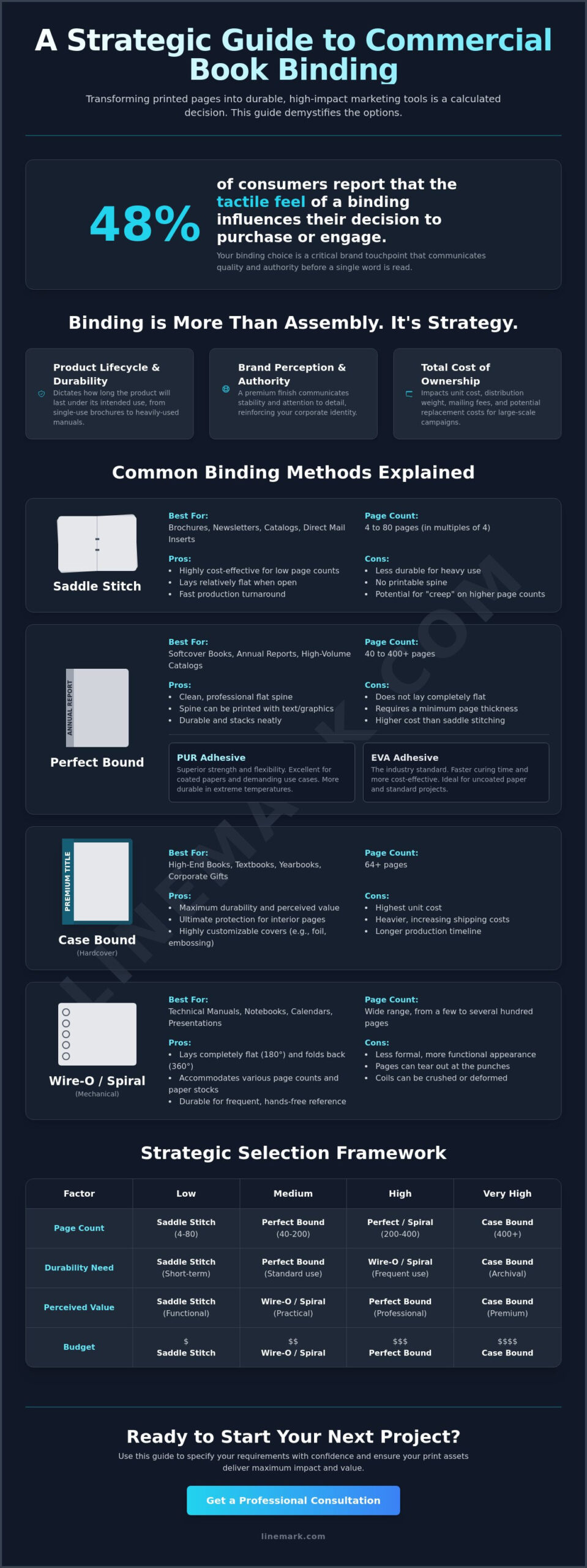
Did you know that 48% of consumers report that the tactile feel of a book binding influences their decision to purchase or engage with a product? It’s a statistic that underscores a vital reality: your choice of finish is a strategic logistics decision that dictates a product’s lifecycle and user experience. Having various book binding options explained isn’t just about technical literacy. It’s about ensuring your annual reports, catalogs, or custom books survive heavy use while maintaining a premium aesthetic that reflects your brand authority.
You’ve likely felt the frustration of dense technical jargon or the fear that a budget-friendly choice might literally fall apart in a client’s hands. We understand that balancing operational excellence with strict financial constraints requires precision. This guide provides a clear decision-making framework to help you specify requirements to your commercial printer with total confidence. We’ll examine the technical nuances between PUR and EVA adhesives, the rise of sustainable materials, and how to select a finish that transforms your print project into a high-capacity marketing tool.
Key Takeaways
- Understand how the various book binding options explained here dictate the lifecycle and professional perception of your corporate assets.
- Distinguish between the efficiency of saddle stitching for brochures and the premium, flat-spine finish of perfect binding for high-volume catalogs.
- Evaluate the durability of case binding versus the versatility of flexibound finishes to align your print projects with specific brand authority goals.
- Identify when to utilize Wire-O or spiral binding to facilitate hands-free usage and functional durability in technical manuals.
- Apply a strategic selection framework that balances page count and paper weight to optimize the total cost of ownership for your campaign.
Understanding the Role of Book Binding in Professional Printing
Book binding is the physical assembly of pages into a cohesive, protected unit. It is the final stage of production where loose printed sheets are transformed into a functional, durable tool. While the history of bookbinding is rooted in manual craftsmanship, modern industrial binding focuses on high-speed precision and structural integrity. Your choice of binding dictates the intended shelf life of the document. A technical reference manual designed for years of daily use requires a different structural approach than a seasonal brochure intended for a single marketing campaign.
Beyond the mechanical function, binding serves as a vital component of your brand’s psychological impact. Tactile quality influences how a recipient perceives your organization’s authority. When a stakeholder holds a perfectly bound annual report, the weight and resistance of the spine communicate stability and attention to detail. Having these book binding options explained allows you to align your physical presentation with your corporate identity. It also informs your design phase. You must account for the “gutter” to ensure that critical text and imagery remain visible and professional after the pages are secured into the spine.
To better understand the physical mechanics of this process, watch this helpful video overview:
The Anatomy of a Bound Book
A professionally bound product is a complex assembly of specific components. The spine serves as the central structural anchor, while hinges allow the cover to open without stressing the interior pages. In high-volume commercial runs, we utilize signatures. These are large sheets folded into groups of pages, typically in multiples of 16 or 32, which are then gathered and secured. Endpapers are often used in premium formats to bond the page block to the cover, providing extra reinforcement. Whether you select a softcover finish or a robust casebound structure, each element must work in harmony to ensure the product survives the rigors of distribution and frequent handling.
Binding as a Strategic Business Decision
Choosing a finish is a logistical calculation that impacts your total cost of ownership. Binding affects the final weight of the product. This directly influences nationwide distribution and mailing costs for large-scale campaigns. For high-use corporate catalogs, you must balance the unit cost with long-term durability. A binding that fails under heavy use leads to higher replacement costs and diminished brand perception. Aligning your choice with your custom book printing goals ensures that the final result acts as a catalyst for growth. By understanding these book binding options explained in a technical context, you can specify requirements that guarantee both professional impact and operational efficiency.
Softcover Binding Options: Saddle Stitch vs. Perfect Bound
In the landscape of high-volume offset production, softcover book binding options explained by technical performance offer the most versatile solutions. Most professional projects utilize either saddle stitching or perfect binding to achieve a polished finish without the weight of a hardcover. While both methods provide a clean look, they serve different operational goals based on page count and paper thickness. Choosing the correct method ensures your marketing collateral remains intact throughout its lifecycle.
The Mechanics of Saddle Stitching
Saddle stitching involves driving wire staples through the fold line of gathered signatures. It’s an efficient choice for brochures, newsletters, and direct mail inserts. However, high-volume production requires careful management of “creep.” Creep occurs when the thickness of the fold pushes the innermost pages outward further than the outer pages. Without precise prepress compensation, your margins will appear inconsistent after the final trim. We typically recommend this method for documents up to 64 pages, though this varies based on your paper stock. It remains a preferred solution for projects requiring a fast turnaround and a lightweight profile for distribution.
Perfect Binding and the PUR Advantage
For thicker annual reports or high-end catalogs, perfect binding provides a sophisticated, flat-spine appearance. The process involves grinding the spine of the page block to create a rough surface for maximum adhesive penetration. At this stage, the choice of glue is paramount. While standard EVA glue is common in basic production, PUR (Polyurethane Reactive) adhesive offers a transformative level of durability. PUR is significantly stronger than EVA and remains flexible across a wide temperature range. This prevents the spine from cracking or pages from falling out during heavy use. When designing for this format, remember that the “tight” spine will consume a portion of your inner margin. Ensuring your layout accounts for this gutter is essential for readability and impact.
The transition from stitching to glue usually occurs when the spine width exceeds 1/8th of an inch. If your document is too thick for staples, perfect binding becomes the logical next step. Our integrated commercial printing and finishing services allow us to guide you toward the most durable, cost-effective choice for your specific page volume. This collaborative approach ensures your project achieves the professional durability required for modern business environments.
Hardcover and Specialty Binding: Case Bound and Flexibound
When your project demands a lifecycle that spans decades rather than months, moving toward hardcover solutions becomes a strategic imperative. While softcover methods offer efficiency, these premium book binding options explained through the lens of structural engineering provide the ultimate in brand authority. Case binding is often associated with luxury editions, but its industrial utility is equally significant. For high-volume technical manuals or educational textbooks, the rigid protection of a board case ensures the internal content remains secure under the most rigorous conditions.
The foundation of any high-durability book is Smyth sewing. This technique involves sewing gathered signatures together with thread before they’re reinforced with adhesives and secured to the cover. It’s the gold standard for custom book manufacturing. Unlike adhesive-only methods, a Smyth-sewn spine allows the book to lay flatter and prevents pages from ever pulling free. As automated binding lines now process up to 15,000 books per hour, this level of precision is accessible even for large-scale commercial runs. It’s a mark of true operational excellence.
Case Bound (Hardback) Construction
Case binding involves creating a rigid “case” from heavy paperboard, which is then wrapped in printed paper, cloth, or leather. The book block is attached to this case using reinforced endpapers. You can choose between a square-back spine for a modern, clean look or a round-back spine for a traditional aesthetic. While coffee table books and commemorative editions are common applications, don’t overlook the value of case binding for reference manuals. The 11% increase in luxury edition sales reported in 2026 reflects a growing consumer preference for tactile, high-quality finishes that stand the test of time.
Flexibound and Hybrid Techniques
Flexibinding serves as a sophisticated middle ground. It features a wrap-around cover that’s heavier than a standard softcover but more flexible than a rigid board. This hybrid approach often utilizes a sewn spine, providing the lay-flat capabilities essential for journals and field manuals. From a cost-benefit perspective, flexibound options offer a premium feel with lower distribution weights than traditional case binding. It’s an agile solution for brands that value durability but need to manage nationwide logistics costs effectively. By integrating these book binding options explained here into your production strategy, you ensure your product achieves maximum impact. Finishing touches like foil stamping, debossing, or custom dust jackets further elevate the final result, transforming a standard document into a high-value brand asset.
Mechanical Binding for Practicality: Wire-O and Spiral Options
Wire-O vs. Spiral: Which to Choose?
Selecting between wire and plastic depends on your distribution environment and desired brand perception. Wire-O binding utilizes double-loop metal wires to create a sophisticated, executive appearance. A primary functional benefit of Wire-O is page alignment; when the book is open, the left and right pages remain perfectly level. This is essential for complex technical drawings or spreadsheets. The metal loops provide a high-end feel that complements corporate annual reports and premium presentations.
Spiral (Coil) binding uses a continuous plastic filament. It’s the more rugged of the two. Plastic coils possess “memory,” allowing the spine to bounce back if it’s compressed during nationwide shipping or heavy field use. While Wire-O may bend under extreme pressure, spiral binding remains resilient. For internal reports or temporary documentation, comb binding remains an economical choice, though it lacks the 360-degree rotation of its counterparts. It’s best suited for documents that may need frequent page updates or temporary storage.
Functional Advantages of Lay-Flat Binding
The versatility of mechanical binding extends to the materials it can hold. You can easily integrate varying paper weights, oversized fold-outs, or heavy tab dividers within a single unit. This makes it the standard for industrial training kits and technical documentation. Because the pages move freely along the coil or wire, there’s less stress on the paper itself, which extends the document’s usable life in high-traffic environments.
Designers must account for the physical gap created by the punch holes. This is particularly important for “crossover” images that span two pages. Unlike the tight gutter of a perfect bound book, mechanical binding removes a small strip of the layout. We recommend a safe zone of at least 0.5 inches from the binding edge to ensure text and critical graphics remain clear. Our Binding & Finishing experts can help you calibrate your files for these specific mechanical tolerances, ensuring a seamless transition from digital design to physical product.
Selection Framework: Matching Binding to Your Project Goals
A strategic selection framework transforms a print project from a simple asset into a scalable business solution. Having these book binding options explained in the context of your specific goals allows you to move beyond surface level aesthetics and focus on operational efficiency. You must consider the Total Cost of Ownership. A lower unit cost for a fragile bind often leads to higher replacement expenses and damaged brand authority if the product fails in the field. By aligning your choice with the document’s lifecycle, you ensure that your investment delivers a professional impact that lasts.
The Page Count and Weight Factor
The “sweet spot” for saddle stitching is typically between 8 and 64 pages. Beyond this volume, the physical displacement of the inner pages makes it difficult to maintain a clean, flush trim. Perfect binding and case binding generally require a minimum spine width of 0.125 inches to ensure the adhesive or signatures have a sufficient surface area for bonding. Remember that paper caliper, or thickness, is just as vital as page count. A high-caliper 40-page document might require perfect binding, while a 60-page document on thin stock could remain a candidate for stitching. We recommend verifying your final spine width with your production partner before finalizing your cover art.
Logistics and Fulfillment Considerations
Your binding choice dictates your kitting and fulfillment efficiency. Case bound books provide maximum protection but increase the physical footprint in your inventory management system. For large-scale campaigns, mailing compliance is a critical factor. Certain mechanical binds may not be compatible with high-speed postal automation, which can lead to higher postage rates. Integrating variable data printing within your bound documents allows for sophisticated, personalized marketing at scale. This ensures each recipient receives a product tailored to their specific data profile, increasing the relevance and ROI of the campaign.
Managing these complex variables across multiple departments requires a centralized, tech-savvy approach. Utilizing MarCom On-Demand portals allows your team to maintain brand consistency while selecting the optimal binding for localized needs. This proactive spirit ensures that your strategic communications remain both efficient and impactful.
Final Checklist: 5 Questions to Ask Before Sign-Off
- What is the final estimated spine width based on the chosen paper caliper?
- Does this binding method meet postal automation requirements for my specific distribution plan?
- Is the adhesive (PUR vs. EVA) appropriate for the expected climate and usage frequency?
- Does the layout provide a sufficient safety zone for the specific binding gutter and punch holes?
- How does this binding choice affect the total kitted weight and subsequent shipping costs?
Secure Your Brand Legacy Through Strategic Binding
Selecting the right finish is more than a final production step. It is a strategic decision that impacts distribution logistics and the end-user experience. Having these book binding options explained through technical performance, from the resilience of PUR adhesives to the flat-opening convenience of Wire-O, ensures your catalogs and reports perform in high-traffic environments. By matching your page count and paper weight to the correct mechanical or adhesive structure, you protect your investment and reinforce your brand authority. Precision in the finishing stage is what separates a standard document from a high-value corporate asset.
At Linemark, we leverage over 30 years of industrial printing expertise to help you navigate these complexities. Our 90,000-square-foot high-capacity production facility is equipped with specialized PUR and Smyth sewing capabilities. This allows us to handle even the most demanding high-volume runs with meticulous precision. We act as your strategic communications ally, focused on operational excellence and transformative results. Request a custom book binding consultation for your next project to see how our collaborative approach can streamline your production. Let’s transform your vision into a durable, high-impact reality that drives growth and establishes lasting authority.
Frequently Asked Questions
What is the most durable book binding for high-use manuals?
Smyth-sewn case binding is the most durable option for high-use industrial manuals because it combines thread-secured signatures with a rigid protective cover. This method ensures pages remain intact even under constant mechanical stress. Alternatively, perfect binding using PUR adhesive offers exceptional strength and flexibility, preventing the spine from cracking in extreme temperatures. Both methods provide the structural integrity required for long-term operational use and heavy daily reference.
How many pages do I need for perfect binding?
Perfect binding generally requires a minimum of 40 to 64 pages to create a spine wide enough for the adhesive to bond effectively. This minimum depends heavily on the caliper, or thickness, of the paper stock you select for your project. If the document is too thin, the spine won’t have enough surface area for the glue to hold the page block securely to the cover. It’s best to verify your final spine width during the design phase.
What is the difference between PUR and EVA glue in book binding?
PUR adhesive is significantly stronger and more flexible than standard EVA glue, making it the superior choice for high-volume commercial projects. While EVA is an economical solution for basic documents, it can become brittle and crack over time. PUR resists temperature extremes and chemical solvents, ensuring pages stay secured even in demanding environments. This technological advancement in book binding options explained by its chemical properties offers a much higher level of durability for professional finishes.
Can I use saddle stitching for a 100-page book?
We don’t recommend saddle stitching for a 100-page book because the thickness of the paper will cause significant “creep” and prevent the document from laying flat. At this page volume, the innermost pages will extend much further than the outer pages, leading to inconsistent margins after trimming. For a project of this size, perfect binding or a mechanical option like Wire-O provides a much more professional and stable finish that maintains its structural integrity.
Which binding option is best for direct mail catalogs?
Saddle stitching is the most efficient choice for slim direct mail catalogs because it keeps the weight low and meets postal automation requirements. If your catalog exceeds 64 pages, perfect binding with PUR adhesive provides a flat-spine look that enhances brand authority and shelf presence. Both methods integrate seamlessly with high-speed mailing equipment, allowing for efficient nationwide distribution. Your selection should balance the total page volume with your desired aesthetic impact and distribution budget.
What is the most cost-effective binding for short-run projects?
Digital perfect binding is often the most cost-effective solution for short-run projects that require a professional, retail-ready appearance. This method allows for high-quality results without the extensive setup requirements of traditional offset production. Mechanical options like spiral binding are also practical for small batches, especially when hands-free usage is a priority. These flexible production models ensure you can achieve a premium finish even when managing limited quantities or on-demand requirements for localized marketing campaigns.
How does binding choice affect the design of my book gutters?
Your binding choice dictates the “safe zone” or gutter required in your layout to ensure text and images aren’t lost in the spine. Perfect bound books require a wider inner margin because the spine is tight and doesn’t lay completely flat. Mechanical binds like Wire-O also need specific clearances to account for the punch holes. Understanding these book binding options explained from a prepress perspective prevents critical design elements from being obscured or cut off during the final assembly stage.
Is Wire-O binding the same as spiral binding?
Wire-O binding is not the same as spiral binding; it uses double-loop metal wires to create a more executive, professional appearance. Spiral binding utilizes a continuous plastic coil that is more resilient to crushing during transit or field use. While both allow for 360-degree page rotation, Wire-O keeps the pages perfectly level when the book is open. This makes it the preferred choice for corporate presentations and high-end technical manuals that require precise page alignment and a premium feel.