

 05/24/2026
  Steve Bearden
Choosing the thickest paper for your project might feel like a mark of quality, but in the current market, it’s often the fastest way to erode your margins without improving the reader experience. Understanding how to choose paper for book printing requires a shift from purely aesthetic preferences to a rigorous engineering mindset. You’ve likely felt the frustration of deciphering the difference between 80 lb text and 120 gsm, or feared that a cost-saving choice will lead to distracting show-through on every page. With hardwood pulp prices reaching $1,300 per ton in May 2026, these technical decisions carry more financial weight than ever.
This guide will help you master the technical and aesthetic nuances of paper selection to ensure your project balances professional quality with cost-effective scalability. We’ll analyze the structural impact of weight, the science of opacity, and the logistics of 2026 shipping trends to help you build a book that feels substantial and remains profitable. By aligning your material choices with your distribution goals, you can secure professional-grade color reproduction and durability without the burden of unexpected overhead.
Key Takeaways
- Learn to distinguish between text and cover weights to ensure your book’s spine remains flexible while maintaining structural integrity.
- Discover how to choose paper for book printing that aligns with your specific content, whether it’s high-contrast coated stock for catalogs or readable uncoated pages for novels.
- Master the technical nuances of opacity to eliminate distracting “ghosting” and select brightness levels that accurately reflect your brand’s visual identity.
- Balance paper weight with shipping logistics to maintain professional quality while optimizing your total cost of production for large-scale distribution.
- Identify the specific paper characteristics required for different genres, from flexible spines in memoirs to durable finishes for corporate annual reports.
Decoding Paper Weight and Caliper for Book Production
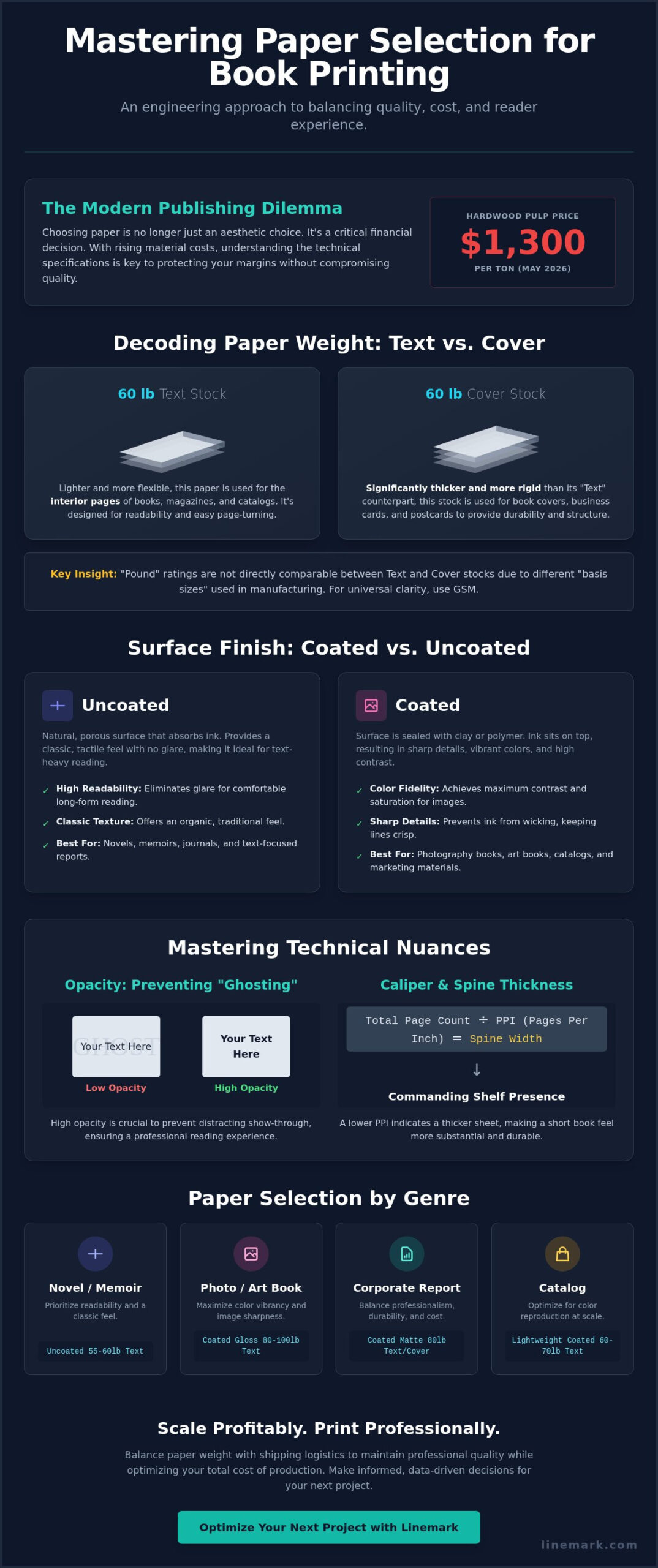
Technical mastery of paper specifications is the baseline for any successful publishing project. When you evaluate how to choose paper for book printing, you’ll immediately encounter two distinct categories: “Text” and “Cover” weights. These terms don’t just describe where the paper goes; they refer to different manufacturing standards and “basis sizes” used during production. A 60lb Text stock is significantly lighter and thinner than a 60lb Cover stock. This distinction is vital because choosing the wrong category can lead to a book that’s either too flimsy to stand on a shelf or too rigid to open comfortably.
Your choice of weight serves as a silent ambassador for your brand. Heavier stocks often suggest a premium, high-authority product, but they also increase production costs and shipping overhead. Striking the right balance requires an understanding of how these materials behave under industrial presses and during the binding process. To better understand these technical nuances, watch this helpful video on selecting the right materials for your project:
Basis Weight vs. Grammage: A Technical Primer
In the United States, paper is measured by its basis weight, which is the weight of 500 sheets at their traditional “basis size.” Because the basis size for text paper differs from cover paper, the pound ratings aren’t directly comparable. For international consistency and precise quality control, many professionals prefer using GSM (Grams per Square Meter). This metric remains constant regardless of the paper’s category, providing a unified standard for global logistics. It’s important to remember that a higher weight doesn’t always translate to higher quality. Some specialized book paper is engineered to be lightweight yet highly opaque, allowing for a portable book that doesn’t sacrifice the reading experience.
The Relationship Between Caliper and Spine Thickness
Caliper refers to the actual thickness of a single sheet of paper, usually measured in thousandths of an inch. In the printing industry, this is often expressed as PPI (Pages Per Inch). This number is the most critical factor when calculating your book’s spine width. To determine the spine thickness for perfect-bound or case-bound books, you simply divide the total page count by the PPI of your chosen stock. A lower PPI indicates a thicker, bulkier sheet, which can make a short book feel more substantial. Proper caliper selection ensures your book possesses a commanding shelf presence while maintaining the structural durability required for frequent handling.
Coated vs. Uncoated Stocks: Choosing the Right Surface
Selecting a surface finish is a strategic decision that balances legibility with visual impact. While weight determines the book’s structure, the finish determines how a reader interacts with the content. When you consider how to choose paper for book printing, you’re choosing between the tactile warmth of uncoated fibers and the precision of a coated surface. Uncoated stocks are the industry standard for text-heavy projects like memoirs and novels because they eliminate glare and provide a classic, organic feel. They suggest a sense of authenticity and tradition that resonates with long-form readers.
Coated stocks are engineered for projects where color fidelity is paramount. By applying a layer of clay or polymer, manufacturers seal the paper’s surface. This prevents the ink from “wicking” or spreading into the paper fibers, which results in sharper images and more vibrant hues. Verified industry trends for 2026 show a resurgence in gloss-coated paper for photography books to achieve maximum contrast and saturation. For high-volume catalogs or corporate reports, this technical advantage is indispensable for maintaining brand consistency.
Uncoated Stocks: Readability and Classic Texture
Uncoated stocks offer a high degree of versatility for long-form reading. “Opaque” varieties are specifically designed to minimize show-through, ensuring that text on the reverse side doesn’t distract the reader. Choosing between white and cream is a matter of brand tone; white provides a modern, high-contrast look, while cream reduces eye strain for long reading sessions. These stocks are the preferred choice for journals, professional manuals, and novels. Understanding the optical properties of paper, including how light interacts with these unsealed fibers, is essential for predicting how your final layout will appear in different lighting conditions.
Coated Stocks: Precision and Visual Impact
Coated papers come in three primary finishes: gloss, matte, and silk. Gloss stocks offer the highest contrast and color saturation, making them ideal for photography-heavy books. To see how these materials are utilized in professional collections, you can discover Albumen Gallery and their selection of curated photography books. Matte stocks provide a sophisticated, non-reflective surface that maintains high detail without the shine. Silk finishes occupy the middle ground, offering a smooth, premium touch that feels more luxurious than standard matte. UV coatings provide a robust protective layer that shields against fingerprints and scuffing while adding a high-end tactile finish. These coatings ensure your project remains durable through high-volume distribution and frequent handling.
The right surface finish acts as a catalyst for your brand’s message. It transforms a simple document into a professional tool that commands attention. If you’re managing a large-scale project, collaborating with a specialist in custom book printing can help you navigate these choices with precision. Deciding how to choose paper for book printing becomes a streamlined process when you align your visual goals with the technical capabilities of the stock.
Aligning Paper Choice with Book Genre and Purpose
Choosing the correct substrate is an exercise in functional design. When you evaluate how to choose paper for book printing, the genre of your project acts as the primary blueprint for every technical decision. A novel requires a different tactile profile than a technical manual or a high-end corporate catalog. For long-form fiction and memoirs, the priority is spine flexibility and reading comfort. These books typically utilize lightweight uncoated stocks that allow the pages to lay open easily without excessive tension on the binding. This ensures a seamless experience for the reader during extended sessions.
Corporate and Association Publications
In the corporate sector, printed materials serve as a tangible representation of organizational stability. Selecting the right paper for annual reports requires balancing a premium feel with the practicalities of high-volume distribution. Heavy-weight coated stocks are often used for covers to provide durability, while the interior pages use a lighter silk or matte finish to maintain high-fidelity color reproduction. For organizations managing complex member communications, integrating Variable Data Printing on specific substrates allows for personalized messaging without sacrificing the professional aesthetic of the main run. This strategic approach ensures that every copy feels tailored to its recipient while maintaining a unified brand identity.
Educational and Technical Manuals
Reference materials and training guides demand a higher level of structural integrity. These documents face frequent handling, highlighting, and note-taking, which means the paper must resist “dog-earing” and surface wear. High-opacity stocks are essential here. They prevent dense diagrams and instructional text from ghosting through to the reverse side, which is critical for clarity. When using spiral or wire-o binding, the paper must have sufficient “tear strength” at the punch points to prevent pages from pulling away from the coil. Understanding how to choose paper for book printing in these contexts means prioritizing utility and longevity over purely aesthetic qualities.
Children’s books and art portfolios represent the other end of the spectrum. These projects require high-caliper, heavy-weight stocks that can support heavy ink coverage and withstand physical interaction. For an art portfolio, a high-brightness white stock ensures colors remain accurate and vibrant. In children’s publishing, thick board-like pages or high-GSM coated sheets provide the tactile feedback and durability necessary for younger audiences. Each genre presents a unique set of logistical and aesthetic challenges that require a tailored manufacturing strategy.
Technical Nuances: Opacity, Brightness, and Grain Direction
Mastering the invisible properties of paper is what separates a standard print job from a high-end publication. While previous sections focused on weight and surface finish, these technical specifications dictate the book’s long-term performance and structural integrity. When you analyze how to choose paper for book printing, you must account for opacity, brightness, and grain direction to ensure the final product survives the rigors of distribution and frequent use. These factors are especially critical for high-volume projects where even minor technical oversights can lead to significant logistical challenges.
Mastering Opacity and Show-Through
Opacity is the measure of light that can pass through a sheet. It’s a common mistake to assume that a heavier sheet is automatically more opaque. In reality, opacity is an engineered property achieved through the addition of fillers like titanium dioxide during the manufacturing process. If you’re printing a text-heavy book with high ink coverage, such as a technical manual with dense diagrams, a low-opacity sheet will cause “ghosting.” This is when the content from the reverse side distracts the reader, compromising legibility. An opacity rating of 90 or higher is the gold standard for professional books because it ensures a clean, distraction-free reading experience regardless of ink density.
Grain Direction: The Secret to a Professional Feel
Grain direction is perhaps the most overlooked factor in book manufacturing, yet it’s the primary cause of structural failure. During the papermaking process, wood fibers align themselves in the direction of the moving wire. In high-speed commercial offset printing, the grain must run parallel to the spine of the book. This is known as “grain long” for most standard formats. When the grain runs perpendicular to the spine, the paper resists folding, leading to “buckling” and a book that refuses to lay flat. This technical alignment is essential for any custom book printing project to ensure the pages turn smoothly and the binding remains intact over time.
Environmental factors like humidity also play a significant role in paper performance. Paper is hygroscopic, meaning it naturally absorbs and releases moisture. If the grain direction is incorrect, humidity changes can cause the paper to expand unevenly, resulting in wavy edges or “cockling.” Furthermore, selecting a paper with high opacity but lower bulk can provide a strategic advantage for high-volume runs. This choice reduces the total thickness of the book, allowing for more units per pallet and significantly lower shipping costs without sacrificing quality. To ensure your technical specifications align with your production goals, consult with the experts at Linemark for a comprehensive review of your project’s engineering.
Scalable Manufacturing: Optimizing Selection for High-Volume Success
High-volume production transforms paper selection from a design choice into a significant logistical variable. When you determine how to choose paper for book printing at scale, you’re managing the intersection of material science and supply chain efficiency. A minor increase in paper weight can lead to thousands of pounds in additional shipping mass across a national distribution run. Strategic selection ensures your project maintains its professional impact without incurring unnecessary overhead. It’s about finding the precise point where quality meets operational economy.
Logistics and the Total Cost of Ownership
The true cost of your book project extends far beyond the initial press run. Paper weight directly dictates your distribution fees and storage requirements. For instance, opting for a high-bulk, low-weight sheet can provide the tactile feel of a thicker book while keeping shipping costs manageable. Integrating your choice with professional Kitting & Fulfillment services allows for a streamlined journey from the press to the end user. By utilizing precision paper sourcing, you reduce waste and ensure that every sheet used contributes to your bottom line. This data-driven approach to materials is essential for maintaining margins in large-scale commercial printing.
The Linemark Advantage: Tech-Savvy Book Manufacturing
Operating out of a 90,000-square-foot facility, we provide the infrastructure necessary to handle complex inventory and diverse paper stocks with precision. A critical part of how to choose paper for book printing involves understanding the different requirements of Digital Printing and Offset Printing. Digital presses often require specifically treated stocks to ensure proper toner adhesion, while offset presses rely on different moisture-balance properties. Our technological breadth allows us to advise on the best substrate for your specific run length and quality requirements, ensuring consistent results across every copy.
Managing reprints and fluctuating demand becomes effortless through our MarCom On-Demand platform. This system allows you to maintain lean inventory levels while ensuring your materials are always available for distribution. We don’t just act as a vendor; we function as a strategic communications ally. By moving beyond a simple transaction, we help you engineer a production roadmap that supports your growth. Your next project deserves a partnership grounded in technical expertise and a proactive spirit. Let’s collaborate to build a scalable solution that reflects the high standards of your brand.
Engineering Your Next High-Impact Publication
Mastering the technical specifications of your substrate is the final step in transitioning from a simple manuscript to a professional-grade product. You’ve learned that how to choose paper for book printing involves more than just selecting a weight; it’s a strategic calculation involving opacity, grain direction, and distribution logistics. By aligning these variables with your specific genre and volume requirements, you ensure a durable book that maintains its structural integrity and visual appeal over time.
Precision in manufacturing requires a partner with the infrastructure to support complex, high-capacity projects. With over 30 years of industrial print expertise and a 90,000-square-foot production facility, we serve as a strategic communications ally for corporations and associations nationwide. Our team is ready to help you manage the complexities of modern production and logistics to achieve a scalable, cost-effective result. Your vision deserves the meticulous attention of a seasoned expert. Request a Professional Custom Book Printing Quote today to begin your production journey with confidence.
Frequently Asked Questions
What is the most common paper weight for book interiors?
Uncoated text paper at 50lb or 60lb is the standard choice for most black-and-white book interiors. For color-intensive projects like catalogs or annual reports, 80lb or 100lb coated text is the industry standard. Selecting the correct weight ensures the book remains portable while providing a durable surface for high-resolution printing and consistent ink coverage.
What is the difference between white and cream paper for books?
White paper provides maximum contrast for crisp text and vibrant color reproduction, while cream paper offers a softer reading experience. Cream, also known as natural, is typically reserved for long-form fiction and memoirs to reduce eye strain during extended reading sessions. White is the preferred choice for technical manuals and corporate publications where color accuracy is a priority.
How do I choose the right paper for a book with many photos?
Coated paper is the essential choice for books featuring high-resolution photography because the coating prevents ink from soaking into the fibers. This keeps images sharp and colors vibrant. When you investigate how to choose paper for book printing for visual portfolios, matte or gloss coated stocks provide the professional finish required for high-fidelity reproduction and visual impact.
Will a heavier paper make my book look more expensive?
Heavier paper adds physical mass, but the “bulk” or caliper is what truly dictates the perceived thickness and value of a book. A high-bulk, lightweight sheet can make a book feel substantial without significantly increasing the weight. True perceived value comes from a balanced combination of opacity, surface texture, and structural integrity rather than weight alone.
What does paper opacity mean and why does it matter?
Opacity measures how much light passes through the paper, preventing the “ghosting” of text from the reverse side of the page. It’s a critical technical nuance that ensures a clean reading experience, especially in books with dense text or heavy imagery. High-opacity sheets are engineered with specific mineral fillers to block light effectively without requiring excessive paper thickness.
How does paper choice affect the binding of my book?
Paper choice dictates the flexibility and longevity of the binding, as the grain must run parallel to the spine for a clean fold. If the paper is too heavy or the grain direction is incorrect, the book won’t lay flat and the spine may crack over time. Proper alignment ensures the pages turn smoothly and the binding remains secure through years of frequent handling.
Can I use different paper stocks for the cover and interior?
Utilizing different stocks for the cover and interior is the standard approach in professional book manufacturing. Covers require a heavier “cover weight” stock to provide protection and structural support for the entire volume. Interior pages use “text weight” stocks that are lighter and more flexible, allowing for easy page-turning and a comfortable reading experience for the end user.
Does paper weight affect the final shipping cost of my book order?
Paper weight is a primary factor in determining the total shipping cost and logistical footprint of your order. A heavier stock increases the overall mass of each unit, which compounds across high-volume runs and impacts distribution fees. Understanding how to choose paper for book printing involves balancing the desired tactile quality with the practical realities of nationwide distribution and inventory management.