

 05/26/2026
  Steve Bearden
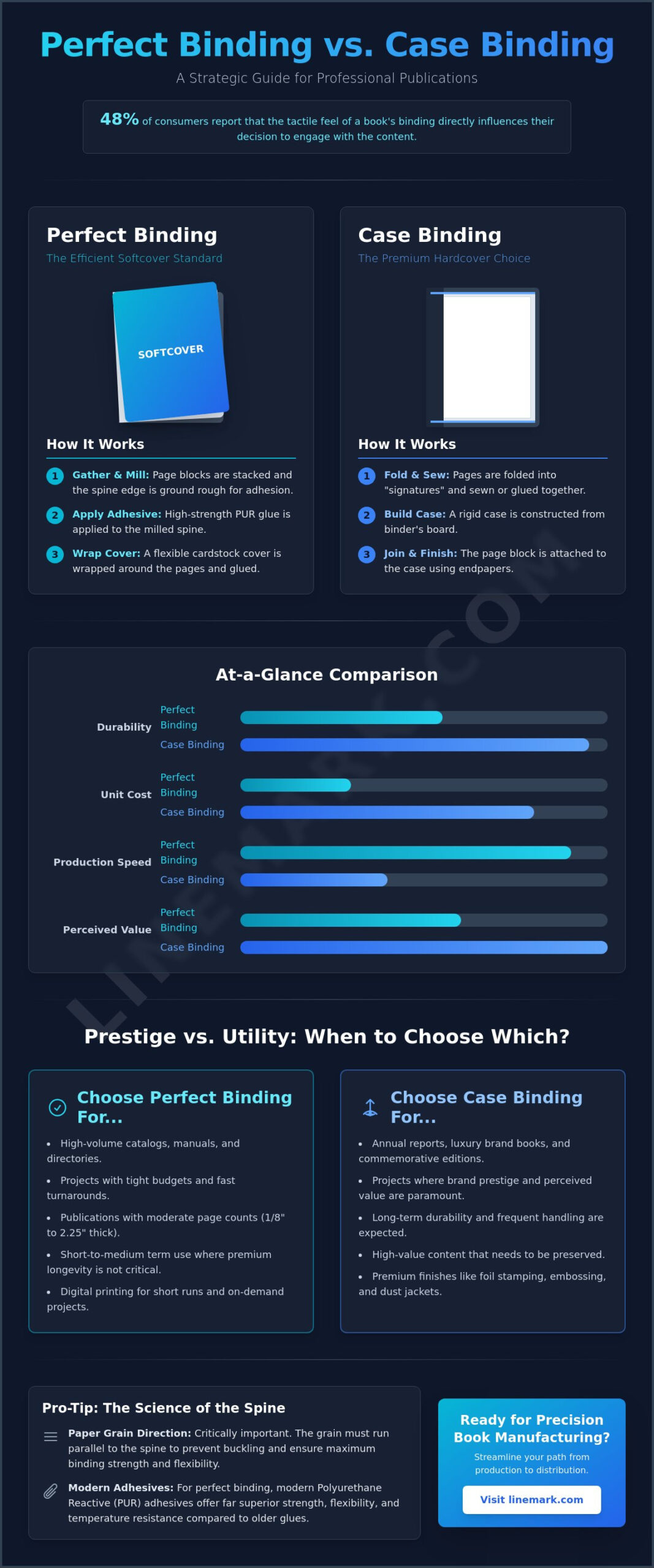
Did you know that 48% of consumers report that the tactile feel of a book’s binding directly influences their decision to engage with the content? You understand that a professional publication is more than a collection of pages; it’s a physical extension of your brand’s authority and attention to detail. When managing complex projects like high-volume catalogs or corporate annual reports, the fear of a spine failing or a finish looking unprofessional is a real concern. Evaluating the choice between perfect binding vs case binding requires a strategic look at how production scalability meets the physical demands of a book’s intended lifecycle.
This guide provides a clear decision framework to help you select the ideal finishing for your project’s durability, cost, and brand impact. You’ll gain a technical understanding of each binding method, including the structural benefits of modern PUR adhesives and the rising demand for premium textured finishes. We’ll explore how to align your binding selection with your specific manufacturing needs, ensuring you have total confidence in the final result. Whether you’re utilizing digital printing for short runs or offset printing for large-scale distribution, we’ll show you how to achieve a product that’s both efficient and transformative for your brand.
Key Takeaways
- Identify the structural differences between adhesive-based softcovers and rigid, sewn hardcovers to establish a professional baseline for your project.
- Evaluate the technical impact of paper weight and grain direction on spine integrity to ensure your publication survives its intended lifecycle.
- Analyze the unit cost and production speed advantages of perfect binding vs case binding to optimize budgets for high-volume commercial runs.
- Apply a strategic “Prestige vs. Utility” framework to select the right finishing method based on your specific page count and audience expectations.
- Discover how advanced manufacturing technology and integrated kitting services can streamline your path from technical production to national distribution.
Defining the Standards: What are Perfect Binding and Case Binding?
Choosing the right finish for a high-volume print project is a strategic decision that impacts both your budget and your brand’s physical presence. The debate between perfect binding vs case binding often centers on the balance between aesthetic prestige and production efficiency. Perfect binding is the industry standard for professional softcover books, characterized by a flexible, wrap-around cover. Case binding represents the premium hardcover standard, utilizing a multi-piece rigid construction that suggests permanence and high value. Each method serves a specific purpose in the lifecycle of a publication, influencing how a reader perceives the authority of the content from the moment they hold it.
For those exploring the historical evolution of Bookbinding methods, the shift from manual craftsmanship to automated industrial production explains the current standards of the market. While both methods provide a professional finish, their mechanical foundations are entirely different. Perfect binding relies on a single unit of cover and pages; case binding is an assembly of distinct components designed for maximum durability. Understanding these technical distinctions allows you to align your production choices with your long-term marketing and logistics goals.
To better understand the physical assembly of these formats, watch this technical overview:
The Mechanics of Perfect Binding
In perfect binding, the interior page block is gathered into a single stack and the spine edge is “milled” or ground down to create a rough surface. This process allows high-strength adhesives, such as modern Polyurethane Reactive (PUR) glue, to penetrate the fibers deeply. A heavy cardstock cover is then wrapped around the block and glued along the spine. This method is highly efficient for high-capacity runs of catalogs and manuals. However, it’s generally restricted to books between 1/8 inch and 2.25 inches thick to maintain structural integrity over time.
The Architecture of Case Binding
Case binding is a more complex engineering feat. It begins with “signatures,” which are large sheets folded into groups of pages. These signatures are either Smyth sewn together or joined with heavy-duty adhesive before being attached to “binder’s board,” a rigid material that forms the front, back, and spine of the case. Endpapers are then used to secure the page block to the case. This architecture allows for premium additions like headbands, tailbands, and foil stamping. It’s the ideal choice for annual reports or luxury editions where durability and a high-touch experience are mandatory.
Durability and Performance: The Science of the Spine
Understanding the physical endurance of a book requires looking past the cover. The choice in perfect binding vs case binding determines whether a publication remains a functional asset or becomes a structural liability over time. A book’s lifecycle is defined by its environment and frequency of use. For instance, a technical manual used in a high-traffic workshop faces different mechanical stresses than a commemorative annual report resting on a boardroom table. Choosing the wrong method can lead to spine failure, which compromises your brand’s image of reliability.
Paper grain direction is a critical technical detail that professionals must consider during the planning phase. If the paper grain isn’t parallel to the spine, the book is prone to buckling and reduced binding strength. Heavier paper weights also demand more robust adhesive solutions to prevent page pull-out. This RIT analysis on binding durability highlights how mechanical stresses vary significantly across different binding styles, emphasizing that the spine is the most vulnerable point of any printed volume.
Environmental factors like temperature and humidity also play a decisive role in performance. Traditional adhesives can become brittle in cold climates or lose their grip in high heat, leading to cracked spines and loose pages. Modern manufacturing has solved many of these issues through advanced chemical engineering, but the choice between a flexible softcover and a rigid hardcover still dictates how the book reacts to its surroundings. If you’re managing a project destined for national distribution, these variables are not optional; they’re foundational to your logistics strategy.
The PUR Adhesive Revolution
Polyurethane Reactive (PUR) glue has transformed modern softcover production by offering a level of resilience previously reserved for hardcovers. Unlike traditional Ethylene Vinyl Acetate (EVA) glue, PUR creates a permanent chemical bond that remains flexible and resists failure in extreme temperature ranges. This makes it the gold standard for heavy-use catalogs and reference guides. It allows for thinner glue applications while providing up to 50% more page-pull strength than standard adhesives. This innovation ensures that even high-volume commercial runs maintain a premium feel throughout their entire service life.
Archival Quality in Case Binding
Case binding remains the superior choice for longevity and archival stability. Smyth sewing, where signatures are stitched together with high-strength thread, creates a structural integrity that adhesive alone cannot match. The “hollow” spine design, featuring a gap between the book block and the case spine, allows the book to open more fully without stressing the materials. This architecture protects the text block from corner dings and shelf wear, ensuring the book survives decades of handling. It’s the definitive choice for legacy documents and luxury editions.
The “lay-flat” factor is another performance differentiator to keep in mind. While perfect binding is exceptionally cost-effective for mass distribution, case-bound books naturally stay open on a desk, which is essential for textbooks or instructional manuals. If your project requires a balance of high-capacity efficiency and long-term resilience, exploring professional binding and finishing options is a vital step in your production journey. Choosing the right spine technology ensures your content remains accessible and intact, regardless of how often it’s opened.
Economic and Logistical Comparison for High-Volume Runs
When you scale a print project from hundreds to thousands of units, the financial differences between perfect binding vs case binding become a primary driver of your production strategy. Perfect binding dominates the high-volume commercial market because of its streamlined manufacturing process and lower material costs. While case binding offers undeniable prestige, the labor-intensive nature of its assembly creates a higher unit cost that can impact your ROI on mass-distributed materials. Understanding the logistical ripple effects of your binding choice is essential for maintaining operational excellence.
The weight of your finished product is a frequently overlooked variable in the total cost of ownership. A case-bound book, with its rigid binder’s boards and additional endpapers, is significantly heavier than a softcover equivalent. For national distribution campaigns, this weight delta translates directly into increased postage and freight expenses. If your project involves a high-volume direct mail component, the cumulative weight of hardcover books can quickly exceed your budget. Softcover options provide a more agile solution for brands that value wide-reach distribution without sacrificing professional appearance.
Production Scalability
Speed is the hallmark of modern softcover manufacturing. High-capacity automated lines can process thousands of units per hour through inline systems that handle everything from gathering to trimming. Case binding requires more touchpoints, including the preparation of the rigid case and the precise alignment of the book block. These extra steps, combined with longer adhesive curing times for hardcover assemblies, can extend your production timeline. For projects with tight market windows, the efficiency of perfect binding ensures you meet deadlines with precision. The break-even point for premium finishing often depends on whether the perceived brand lift justifies the slower production pace.
Distribution and Fulfillment Implications
Logistical planning must account for the physical footprint of your inventory. Case-bound books are bulkier, requiring more pallet space and larger storage facilities. This increased volume also necessitates more robust packaging to protect hardcover corners from impact during nationwide shipping. Effective inventory management becomes more complex as the physical dimensions of your product grow. By contrast, the slim profile of perfect-bound books allows for denser packing and lower fulfillment costs. When your strategy requires a centralized destination for diverse needs, choosing a binding method that optimizes shipping and storage can significantly reduce your overhead.
Strategic Decision Framework: When to Choose Which?
Selecting between perfect binding vs case binding is a strategic calculation of your project’s lifecycle. You must assess the “Prestige vs. Utility” ratio for your specific audience before committing to a manufacturing path. If the goal is high-frequency reference over several years, the investment in a rigid spine pays dividends in brand authority. Conversely, for time-sensitive marketing collateral or high-volume distributions, the speed and cost-efficiency of adhesive-based softcovers are often the superior choice. This decision framework ensures your production budget aligns with the physical reality of how your audience will interact with the material.
Page count and thickness often serve as the physical ceiling for your options. While modern PUR adhesives have expanded the capabilities of softcovers, publications exceeding 2.25 inches in thickness usually require the structural reinforcement of a case-bound assembly to prevent the spine from bowing under its own weight. Beyond physics, consider the psychological impact on your reader. Research from 2026 indicates that 70% of consumers show a preference for books with textured finishes, and 48% state that the “feel” of the binding influences their perception of quality. A premium, textured hardcover suggests a legacy, while a sleek, soft-touch laminated paperback signals modern agility and accessible information.
Ideal Use Cases for Perfect Binding
- High-Volume Catalogs: When you need to distribute thousands of units via direct mail, the reduced weight of perfect binding is a critical logistical constraint that lowers postage costs.
- Event Programs: Professional softcovers offer a polished look for conferences and trade shows where the shelf life is limited to the duration of the event.
- Training Manuals: This method provides the ideal balance of professional appearance and production speed for high-capacity corporate training initiatives.
Ideal Use Cases for Case Binding
- Commemorative Annual Reports: For documents intended for executive-level gifting or archival purposes, the multi-piece rigid construction is essential for long-term brand impact.
- Technical and Medical Manuals: When books face heavy daily use and must stay open on a desk, the structural integrity of a case-bound book provides the necessary performance.
- Limited Edition Brand Books: High-end finishes like foil stamping and embossing transform a simple publication into a permanent, tactile brand asset. This is a strategy often employed by high-end service providers, such as Timberlight Homes, who use premium portfolios to showcase their luxury custom builds.
If you’re ready to align your production with your brand’s growth potential, our team can help you finalize your manufacturing strategy. Visit linemark.com to explore how our high-capacity binding and finishing services can bring your project to life with precision and scale.
Precision Book Manufacturing with Linemark
Finalizing the technical choice between perfect binding vs case binding is only the first stage of a successful production cycle. Execution requires a manufacturing partner with the industrial capacity to translate those strategic decisions into high-performance physical assets. We position ourselves as a strategic communications ally, providing the technological infrastructure necessary to handle complex, high-volume projects with meticulous precision. This collaborative approach ensures that your brand’s authority is maintained through every spine, cover, and page we produce.
Our commitment to innovation means we don’t just act as a service provider; we serve as an extension of your operational team. By leveraging advanced technology and a modern, proactive spirit, we solve the logistical challenges of modern marketing. We understand that your publications are a catalyst for growth, and our facility is designed to scale alongside your ambitions. From specialized finishes like soft-touch lamination to the integration of variable data, our processes are built for speed, accuracy, and brand impact.
Integrated Binding and Finishing Solutions
Our 90,000-square-foot facility is engineered to support diverse binding specifications at an industrial scale. Whether your project demands the high-speed efficiency of automated softcover lines or the structural complexity of hardcover assembly, we maintain consistent quality across every unit. We utilize both digital and offset production capabilities to match your specific volume requirements. This ensures that short-run niche publications receive the same attention to detail as national bulk distributions. This centralized model eliminates the variability often found when managing multiple vendors, providing a unified destination for all your binding and finishing needs.
Beyond the Bind: Fulfillment and Distribution
A book’s value is truly realized when it reaches the hands of your audience. We bridge the gap between production and delivery through integrated kitting and fulfillment services that streamline your time-to-market. Our data-driven strategies for custom book printing are designed to maximize your ROI by optimizing every stage of the supply chain. From inventory management to nationwide shipping, we provide a holistic journey that prioritizes efficiency and reliability. This steady, controlled pace of delivery builds a sense of security, knowing your project is in capable hands from the bindery to the doorstep. Contact Linemark today for a comprehensive binding consultation to see how our scalable solutions can support your next high-volume project.
Elevating Your Brand Through Strategic Finishing
The decision between perfect binding vs case binding is a strategic pivot point that defines your publication’s market impact. You now have the framework to balance the high-speed efficiency of modern PUR adhesives against the archival permanence of rigid hardcover architecture. By aligning these technical specifications with your specific distribution goals, you ensure that every volume reflects the high standards of your organization. Choosing the right method is the first step in creating a transformative tactile experience for your audience.
Success in high-volume production depends on a partner who understands the nuances of industrial logistics. Our team brings over 30 years of expertise and a 90,000-square-foot high-tech facility to every collaboration. We provide a streamlined journey from the bindery to the end-user through comprehensive kitting and nationwide fulfillment. Request a Custom Book Printing Quote today to leverage our precision manufacturing for your next project. We’re ready to help you turn your strategic vision into a scalable, physical reality.
Frequently Asked Questions
Is perfect binding or case binding more durable for heavy use?
Case binding is the superior choice for heavy, long-term use. Its construction involves sewing signatures together and securing them into a rigid case, which prevents the spine from cracking under stress. Perfect binding is professional but better suited for items like catalogs or magazines that have a shorter active lifecycle. If your project requires a book to stay intact after years of frequent handling, the structural integrity of a hardcover is the standard.
Can I use perfect binding for a very thin book?
Perfect binding requires a minimum thickness, usually around 0.125 inches, to provide enough surface area for the adhesive to grip the spine. If a book is too thin, the glue won’t hold the pages securely, and the spine will lack the necessary square edge for titling. For very thin publications, alternative methods like saddle stitching are more appropriate to ensure the document remains functional and professional.
What is the minimum page count for case binding?
Most industrial manufacturers require at least 40 to 64 pages for case binding, though this depends heavily on the paper’s caliper. The book block needs enough bulk to be securely attached to the binder’s boards and endpapers. If the page count is too low, the rigid case may feel disproportionately heavy or hollow. We recommend consulting with a technical expert to determine if your specific page count meets the architectural requirements for a hardcover finish.
How does the choice of binding affect my shipping costs?
The weight and bulk of case binding significantly increase national distribution costs compared to softcover options. Hardcover books include heavy binder’s boards and endpapers that add cumulative weight to every pallet, which directly impacts postage for direct mail campaigns. Perfect-bound books are lighter and more compact, allowing for denser packing and more efficient fulfillment. Balancing the choice of perfect binding vs case binding requires a careful analysis of your total logistical budget.
Can I have a dust jacket on a perfect bound book?
Dust jackets are traditionally designed for case-bound books to protect the rigid cover and add a layer of premium branding. While it’s technically possible to wrap a softcover book, it’s rarely done because the flexible cover doesn’t provide the same structural support. For a similar aesthetic on a perfect-bound project, we suggest French flaps, which extend the cover and fold inward to provide additional space for author bios or marketing copy.
What is PUR binding, and is it better than standard perfect binding?
PUR binding uses Polyurethane Reactive adhesive, which is significantly stronger and more flexible than standard EVA hot-melt glue. It creates a chemical bond that’s resistant to extreme temperatures and prevents pages from pulling out during heavy use. This technology allows softcovers to withstand more stress. For professionals comparing perfect binding vs case binding for durability, PUR is the modern industrial gold standard that offers a high-performance middle ground.
Which binding method is best for a professional annual report?
The best method for a professional annual report depends on your distribution strategy and brand objectives. Case binding is ideal for commemorative editions intended for board members and key stakeholders because it signals permanence and high value. For a wider distribution to shareholders where shipping costs and production speed are priorities, a high-quality perfect-bound finish with soft-touch lamination offers a sophisticated, modern alternative that maintains a professional image.
How long does it take to produce a case bound book compared to perfect bound?
Case binding typically requires a longer production timeline than perfect binding due to the multi-stage assembly process. Hardcover books involve preparing the case, sewing or gluing signatures, and allowing for longer adhesive curing times. Perfect binding is a more streamlined, automated process that can handle thousands of units per hour in a single pass. If your project has a tight market window, the speed of an inline softcover production line is often the most efficient solution.