

 05/07/2026
  Steve Bearden
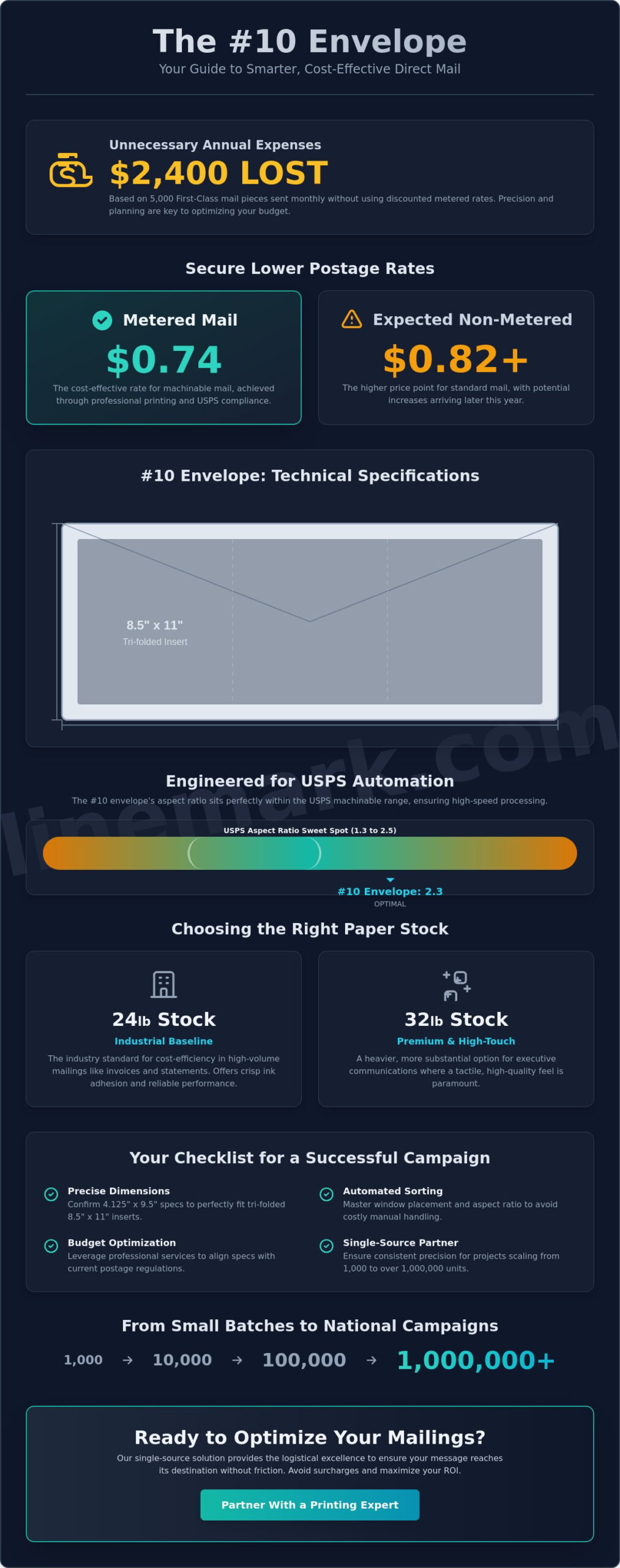
Sending 5,000 pieces of First-Class mail monthly without utilizing metered rates could be costing your business $2,400 in unnecessary annual expenses. While the #10 envelope remains the industry standard for tri-folded 8.5×11 inserts, the gap between a successful campaign and a costly surcharge often comes down to a fraction of an inch. You’ve likely felt the frustration of inconsistent paper weight terminology or the sting of nonmachinable fees that disrupt your marketing budget. Precision is paramount. As your single-source partner, we know that professional business envelope printing services must prioritize logistical excellence to ensure your message reaches its destination without friction.
This guide provides the technical clarity you need to optimize every mailer for speed and delivery. We’ll confirm the exact 4 1/8 inch by 9 1/2 inch specifications required for automated mail sorting and examine the impact of the proposed July 12, 2026, postage increases. You’ll learn how to align your design templates with USPS standards to secure the $0.74 metered mail rate and avoid the $0.82 price point expected later this year. From paper weights to folding mechanics, this is your roadmap to a more scalable and cost-effective direct mail strategy.
Key Takeaways
- Confirm the exact 4.125 inch by 9.5 inch dimensions to ensure your 8.5 x 11 inch inserts fit perfectly with a standard tri-fold.
- Evaluate paper weight options between the 24lb industrial baseline for cost efficiency and premium 32lb stocks for high-touch executive communications.
- Master window placement and aspect ratio rules to guarantee your mailers pass through automated USPS sorting without costly human intervention.
- Optimize your campaign budget by leveraging professional business envelope printing services that align your technical specs with current postage regulations.
- Discover the benefits of a single-source partner capable of scaling projects from 1,000 to over 1,000,000 units with consistent precision.
What is a #10 Envelope? Dimensions and Use Cases
The #10 envelope serves as the cornerstone of professional direct mail logistics, providing a standardized framework for billions of annual communications. Known formally as the standard business envelope size in North America, this format measures exactly 4.125 inches by 9.5 inches, or 4 1/8 x 9 1/2. Its “Commercial” designation isn’t accidental; it has earned its status as the default for American business correspondence because it was engineered to accommodate a standard 8.5 x 11 inch sheet of paper folded into perfect thirds.
When you select business envelope printing services, you’re opting for a tool designed for operational efficiency. This specific footprint ensures that everything from legal notices to multi-page marketing letters arrives without unnecessary bulk. It’s a reliable, scalable solution that bridges the gap between digital design and physical delivery. By adhering to these precise dimensions, organizations maintain a professional image while ensuring their mailings are compatible with high-speed processing equipment.
To better understand the role of custom envelopes in your communication strategy, watch this helpful video:
The Versatility of the 4.125 x 9.5 Format
Why Direct Mail Professionals Prefer the #10
Strategic direct mail professionals choose the #10 because it strikes a perfect balance between marketing real estate and postage economy. It provides enough surface area for bold branding, return addresses, and teaser copy without exceeding the weight or size limits that trigger higher postage rates. Because of its industry ubiquity, we can offer a vast range of paper stocks, from standard 24lb bond to premium textured finishes, along with various security tints to protect sensitive data. Furthermore, the standardized size allows for maximum efficiency in automated kitting and insertion. High-volume inserters can process #10 envelopes at speeds exceeding 10,000 pieces per hour, making it the most scalable option for large-scale outreach.
Technical Specifications: Dimensions, Paper Weights, and Flap Styles
Precision is the foundation of high-capacity production. In the world of business envelope printing services, a #10 isn’t just a size; it’s a set of strict tolerances. While the target dimensions are 4.125 by 9.5 inches, industrial mass production accounts for a +/- 1/16 inch variation. This technical margin might seem negligible, but for high-speed automated insertion equipment, it’s the difference between a seamless run and a mechanical failure. Understanding these nuances helps you select the right substrate, whether you’re opting for a standard Wove finish, a textured Linen for prestige, or a recycled stock to align with corporate sustainability initiatives.
The choice of substrate also dictates how ink interacts with the surface. Wove paper, the industry baseline, offers a smooth, non-directional surface that ensures crisp digital and offset ink adhesion. If you’re looking for a more tactile experience, Linen or vellum finishes provide a distinct “toothy” feel that commands attention the moment it’s retrieved from the mailbox. If you’re unsure which texture aligns with your project goals, you can consult with our technical team to review physical samples before starting a high-volume run.
Flap Styles: Commercial vs. Square vs. Policy
Flap geometry is a critical factor for both aesthetics and logistics. Commercial flaps, characterized by their classic pointed V-shape, are the universal standard for machine-insertable mail. Their design allows for high-speed sealing without the risk of snagging. In contrast, square flaps offer a contemporary, boutique aesthetic often used for high-end invitations or announcements. While visually striking, they may require specific adjustments on the production line. Policy envelopes utilize a side-opening flap, typically used for specialized documents like insurance policies or legal contracts. To avoid surcharges, these choices must always be cross-referenced with USPS machinability standards to ensure the final piece remains compatible with automated sorting equipment.
The Role of Paper Weight in Brand Perception
Paper weight is the primary driver of tactile brand perception. A 24lb bond is the industrial baseline for business envelope printing services, offering the ideal balance of opacity and weight for standard invoices or statements. However, for campaigns requiring a more substantial presence, upgrading to 28lb or 32lb stock provides a high-touch, executive feel that 24lb simply cannot match. This is particularly effective for custom book printing companion mailers or annual reports where the envelope must reflect the quality of the premium content inside. Heavier stocks also offer superior opacity, ensuring that sensitive financial data or confidential marketing materials remain hidden from view until the recipient opens the piece.
Window vs. Regular #10 Envelopes: Choosing the Right Format
Selecting between a regular and a windowed #10 envelope is a strategic decision that affects both your design freedom and your operational overhead. Regular envelopes, often called closed-face, provide the maximum surface area for custom-printed graphics. This makes them the preferred choice for high-impact marketing where brand visibility is the primary goal. Professional business envelope printing services often recommend regular envelopes for campaigns that don’t rely on variable data visible through a window.
Standard windows typically measure 1 1/8 inches by 4 1/2 inches. They’re positioned 7/8 of an inch from the left edge and 1/2 inch from the bottom. This layout is engineered to align with most automated billing software. Double-window envelopes display both the return address and the recipient’s address, which is essential for streamlined invoicing and statement fulfillment. By eliminating the need to print addresses directly on the envelope, you reduce the risk of matching errors during the kitting process.
To protect sensitive data, many organizations opt for a security tint. This is the confetti or blue weave pattern printed on the interior. It prevents the contents from being read through the paper when held up to a light source. This feature is a standard requirement for healthcare, legal, and financial sectors where privacy is non-negotiable.
Window Placement and USPS Compliance
Achieving deliverability requires strict adherence to window positioning. Documents shift during transit. We utilize the “tap test” to ensure that even if the insert moves to its furthest point within the envelope, the full address remains visible. You must also preserve the Barcode Clear Zone. This is a 4 3/4 inch by 5/8 inch area in the bottom right corner of the envelope. If a window or teaser copy encroaches here, you risk non-machinable surcharges that can devastate a campaign budget. Precision in your design template prevents these logistical bottlenecks.
To Tint or Not to Tint?
Security tints significantly influence recipient psychology. For financial or legal mail, a tint can increase open rates by signaling that the contents are confidential. However, adding a tint involves an extra step in the manufacturing process. As an alternative, upgrading to a heavier 28lb stock often provides enough natural opacity to obscure text without the need for an interior pattern. This choice depends on your specific volume and the level of sensitivity of the data being mailed. We help you weigh these options to find the most cost-effective solution for your brand’s specific needs.
Machinability and USPS Standards: Avoiding Surcharges
When evaluating business envelope printing services, understanding the mechanics of the mail stream is vital. Postage remains the largest variable expense in any direct mail campaign, and keeping those costs predictable requires your mailpiece to be classified as “machinable.” This designation means the envelope can pass through high-speed automated sorting equipment without manual intervention. The #10 envelope is the industry’s preferred format because its dimensions are perfectly proportioned for this process. Its aspect ratio of approximately 2.3 falls right in the center of the USPS required range of 1.3 to 2.5, ensuring it moves through rollers and belts without snagging.
Beyond its footprint, a machinable envelope must maintain flexibility. The sorting process involves navigating a series of tight turns within the machinery. If you include rigid inserts, such as thick plastic cards or metal promotional items, the piece becomes nonmachinable and triggers a significant surcharge. Maintaining a balance between creative content and physical flexibility is essential for high-volume efficiency. The postage savings achieved through automation often outweigh the total cost of the envelope itself.
Design Best Practices for Variable Data Printing
Integrating Variable Data Printing (VDP) into your business envelope printing services allows for hyper-personalized messaging that increases engagement. However, this technology must be applied with technical discipline. You must preserve a “Clear Zone” measuring 2.75 inches by 4.75 inches in the bottom right corner of the envelope. This space is reserved for the Intelligent Mail barcode (IMb) and other postal routing marks. By keeping this area free of graphics or teaser copy, you ensure the automated sensors can read the routing data instantly. This precision allows you to use the rest of the envelope for personalized tracking codes or variable teaser copy that drives ROI without sacrificing your automation discounts.
Common Pitfalls That Increase Postage Costs
Operational errors frequently lead to “mail-killers” that force expensive manual handling. Over-stuffing is a common culprit; if a #10 envelope exceeds the 1/4 inch thickness limit, it’s reclassified as a “flat,” which carries a much higher postage rate. Similarly, traditional fasteners like clasps, strings, or buttons are incompatible with modern sorting machines and should be avoided in commercial runs. We mitigate these risks through rigorous data hygiene and pre-sorting services that optimize your mail stream before it even reaches the post office. If you’re ready to streamline your next campaign, you can partner with our logistics experts to ensure every piece qualifies for the lowest possible postage rate.
Executing High-Volume Campaigns: The Linemark Advantage
Linemark operates as your single-source partner, transforming the envelope from a simple container into a strategic asset. Our business envelope printing services go beyond ink on paper; we manage the entire lifecycle from initial design to nationwide distribution. Whether your project requires a targeted run of 1,000 units or a massive campaign exceeding 1,000,000 pieces, our facility maintains the meticulous precision of a boutique shop at an industrial scale. We don’t view the envelope as an isolated product. It’s the first touchpoint in a sophisticated communication journey that requires flawless execution to drive response rates and maintain brand integrity. This holistic perspective is what separates a transactional vendor from a strategic communications ally.
Our approach integrates technological pride with operational excellence. We understand that a #10 envelope is the gateway to your brand’s message. By aligning our digital and offset capabilities with your specific marketing goals, we ensure that every mailpiece is a catalyst for growth. This commitment to precision ensures that the technical standards we’ve established in previous sections-from paper weights to window placements-are executed without compromise across your entire campaign.
MarCom On-Demand: Managing Your Envelope Inventory
Managing branded collateral across multiple regional offices often leads to inconsistent quality and stockouts. Our MarCom On-Demand portals solve this by providing real-time tracking of your envelope inventory. You can monitor stock levels across various locations and set automated re-ordering triggers to ensure you never miss a critical mailing deadline. This centralized approach guarantees that every piece of mail, regardless of where it’s sent, adheres to your exact brand standards. It’s a scalable solution that empowers local teams while maintaining corporate control over the Linemark experience. By integrating your print-on-demand needs with your inventory management, you eliminate the waste associated with obsolete stock and ensure your messaging remains agile and relevant.
Full-Service Fulfillment and Logistics
Efficiency in direct mail is measured by the speed and accuracy of the fulfillment process. Our 90,000 square foot facility is equipped with high-speed automated insertion technology that handles complex kitting with ease. This infrastructure allows us to integrate data-driven strategies into your business envelope printing services, ensuring that personalized inserts match the correct recipient every time. We bridge the gap between digital data and physical delivery by streamlining the transition from the press to the postal stream. We leverage advanced tracking and reporting to give you full visibility into your campaign’s progress. This level of integration ensures that the technical specifications we’ve discussed are fully utilized to minimize postage costs and maximize delivery speed. If you’re ready to optimize your outreach, you should partner with Linemark for your next high-volume campaign to experience the difference of integrated logistics.
Mastering the Logistics of Your Next Direct Mail Campaign
Mastering the technical nuances of the #10 envelope transforms a standard mailing into a high-performance communication asset. By aligning your design with exact 4.125 by 9.5 inch dimensions and adhering to USPS machinability standards, you eliminate the risk of surcharges while maximizing delivery speed. Every specification plays a role in your campaign’s ROI, from selecting a 24lb bond for high-volume statements to choosing premium 32lb stocks for executive outreach. Precision isn’t just about aesthetics; it’s about operational excellence.
LineMark brings 30+ years of industrial print authority to every project. Our 90,000-square-foot high-tech production facility and G7 Master Printer Certification ensure that your brand maintains total consistency across millions of units. We’re a single-source partner dedicated to your logistical success. Our business envelope printing services bridge the gap between complex variable data and physical fulfillment. You don’t have to navigate these technical requirements alone.
Are you ready to optimize your outreach and reduce friction in your mail stream? Request a custom quote for your direct mail project and experience the precision of a seasoned expert. We’re here to help you scale with confidence and reach your audience effectively.
Frequently Asked Questions
What are the exact dimensions in mm for a #10 envelope?
Will an 8.5 x 11 sheet fit in a #10 envelope without folding?
An 8.5 x 11 inch sheet won’t fit into a #10 envelope without folding. You must utilize a standard tri-fold or Z-fold to reduce the document’s height to approximately 3.66 inches. This configuration provides the necessary clearance for the 4.125 inch envelope height and ensures the paper doesn’t interfere with high-speed automated sealing cycles.
What is the difference between a #10 and a DL envelope?
The primary difference lies in regional standards and physical dimensions. A #10 envelope is the North American standard at 4.125 x 9.5 inches (104.8 x 241.3 mm). The DL envelope is the ISO international standard measuring 110 x 220 mm (4.33 x 8.66 inches). Because the DL is shorter and wider, it often requires different folding settings for automated mail kitting.
How much does a standard #10 envelope weigh for postage calculations?
A standard #10 envelope manufactured from 24lb bond stock weighs approximately 0.23 ounces or 6.5 grams. When calculating your total mailpiece weight, ensure the combined weight of the envelope and all inserts stays under 3.5 ounces. Staying below this threshold allows you to qualify for the most cost-effective First-Class or Marketing Mail letter rates.
Can I print my logo on a #10 window envelope?
You can print your logo on a window envelope provided the design stays outside the 1/16 inch “quiet zone” around the window. Professional business envelope printing services use high-speed offset or digital presses to apply full-color branding across the face and back. You must simply avoid the 4.75 x 0.625 inch barcode clear zone in the bottom right to maintain USPS compliance.
What is a machinable #10 envelope according to the USPS?
A machinable #10 envelope is a rectangular piece with an aspect ratio between 1.3 and 2.5 that’s flexible enough to bend around automated sorting rollers. It must have a thickness between 0.007 and 0.25 inches. Envelopes that are too rigid or feature manual closures like clasps and strings are disqualified from automation and trigger manual handling surcharges.
What paper weight is best for professional business envelopes?
24lb bond is the industrial standard for professional envelopes because it balances durability with postage economy. For executive communications or sensitive financial data, 28lb or 32lb stocks are superior choices. These heavier weights offer increased opacity and a more substantial tactile feel that signals premium quality to the recipient the moment they touch the mailer.
Do #10 envelopes require extra postage?
Standard #10 envelopes don’t require extra postage if they meet weight and machinability requirements. However, as of May 2026, any piece classified as nonmachinable triggers a $0.46 surcharge per letter. You can avoid this by ensuring your envelopes are flexible, under 1/4 inch thick, and free of any physical obstructions that would hinder high-speed postal sorting equipment.