

 05/06/2026
  Steve Bearden
A single design oversight in your mailing can stall an entire campaign, leading to costly delays and missed opportunities. While it’s easy to view it as a simple commodity, the 10 envelope size is a precision tool that dictates the efficiency of your professional communications. You likely feel the pressure of rising costs, such as the scheduled increase of the First-Class Mail Forever stamp to $0.82 on July 12, 2026. It’s vital to get the technical details right the first time to avoid surcharges or delivery failures.
Key Takeaways
- Master the standard 4.125 x 9.5 inch 10 envelope size to ensure your business communications meet North American postal standards without friction.
- Learn to select the ideal paper weight and security tint features to balance professional aesthetics with the protection of sensitive financial data.
- Identify critical “Quiet Zones” and bleed requirements that prevent barcode errors and ensure your mail pieces are processed at high speeds.
- Discover how to design for machine insertability to qualify for USPS automation discounts and streamline high-volume distribution.
- Understand how a single-source partner with large-scale industrial capacity can transform your mailing strategy from a logistical hurdle into a competitive advantage.
Understanding #10 Envelope Dimensions and Standards
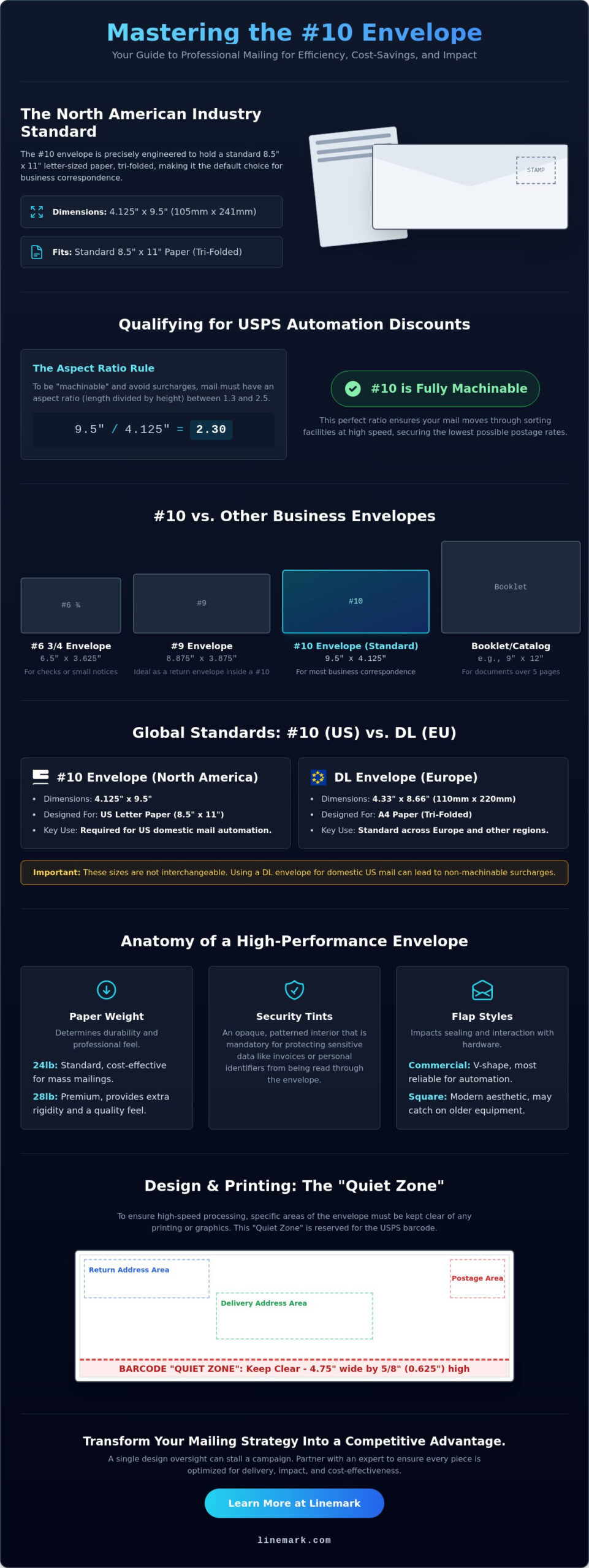
The #10 envelope is the 4.125″ x 9.5″ industry standard for business correspondence. This specific 10 envelope size dominates North American offices because it’s engineered to house a standard 8.5″ x 11″ letter folded into three equal horizontal sections. This tri-fold method creates a professional presentation while maintaining a slim profile that fits perfectly within high-speed sorting machines used by the USPS.
To better understand the relationship between document folding and envelope fit, watch this helpful video:
Efficiency in mailing relies on precise dimensions. While various standard envelope sizes exist, the #10 is uniquely optimized for automation. Its aspect ratio, which is the length divided by the height, sits comfortably within the USPS requirement of 1.3 to 2.5. This ensures the piece remains “machinable,” allowing it to pass through sorting facilities without manual intervention or extra surcharges. For businesses managing high-volume invoicing or marketing, choosing this standard isn’t just about tradition; it’s a strategic move to secure the lowest possible postage rates.
The #10 vs. Other Common Business Sizes
Choosing the right carrier depends on the contents and the desired response. The #10 is the primary choice for outbound letters, but it’s often paired with a #9 envelope (3.875″ x 8.875″). Because the #9 is slightly smaller, it nests inside the #10 without folding, making it the ideal return envelope for payments or surveys. This system is highly effective for non-profit outreach; for example, you can visit Scales Fall Ministry to learn about their community programs and weekly Bible studies. In contrast, smaller #6 3/4 envelopes are typically reserved for personal checks or small notices. When documents exceed five pages, switching to a booklet or catalog envelope is necessary to prevent the “overstuffed” look that can lead to paper jams in automated equipment.
International Equivalents: The DL Envelope
If your communications extend beyond North America, you’ll likely encounter the DL envelope. Measuring 110mm x 220mm (approximately 4.33″ x 8.66″), the DL is the European standard for tri-folded A4 paper. While it looks similar to the 10 envelope size, they’re not interchangeable. US companies must stick to the #10 for domestic mailings to ensure compatibility with USPS automation. Using international sizes for domestic mail can result in “non-machinable” surcharges, increasing your costs per piece and slowing down the delivery cycle.
Anatomy of a #10 Envelope: Features for Professional Communication
While the outer dimensions define the physical boundaries, the internal anatomy of the envelope determines its performance in the field. The 10 envelope size is available in various configurations that influence both security and brand perception. Most high-volume commercial projects utilize 24lb white wove paper. It’s the industry standard for a reason. It balances weight and durability while remaining cost-effective for mass distribution. For a more tactile, premium feel, 28lb stock provides extra rigidity. This heavier stock is less likely to wrinkle when passing through high-speed inserters, ensuring a pristine arrival at the recipient’s door.
Security is another critical structural consideration. If you’re sending invoices, legal notices, or documents containing personal identifiers, security tints are mandatory. These patterned designs printed on the inside of the envelope make the paper opaque. They prevent sensitive data from being read through the paper under bright light. Beyond security, the flap style you choose impacts how the envelope interacts with mailing hardware. Commercial flaps, characterized by their pointed V-shape, are the most reliable for machine-fed operations. Square flaps offer a contemporary, modern aesthetic but can occasionally catch on older sorting equipment. Policy flaps, which open on the short side, are less common for the standard 10 envelope size but provide a unique vertical orientation for specialized marketing pieces.
Sealing methods also dictate operational efficiency. Gummed seals remain the preferred choice for automated direct mail fulfillment because they’re activated by the moisture systems in high-speed mailing machines. Peel & Seal or Simple Seal options are better suited for manual, low-volume office tasks where machine compatibility isn’t a priority.
Window vs. Regular Envelopes
Window envelopes eliminate the need to print addresses directly on the carrier, reducing the risk of matching errors during fulfillment. The standard window measures 1 1/8″ x 4 1/2″ and is typically positioned 7/8″ from the bottom and 1/2″ from the left edge. Adhering to USPS window envelope standards is critical for deliverability. If the address shifts within the envelope and becomes obscured, the USPS will reject the piece. Using a window envelope ensures that the address on your document is the only one the sorting machines see.
Material Selection and Brand Perception
Texture communicates brand value before the recipient even opens the flap. Smooth wove paper is efficient and professional, while linen finishes add a sophisticated texture that suggests a high-touch experience. Brightness levels also play a role in color accuracy. A higher brightness rating, such as 96 or 98, ensures that your custom-printed logos remain vibrant and true to your brand’s style guide. Linemark functions as a single-source partner to ensure that whether you’re printing 500 or 500,000 pieces, the paper brightness and texture remain consistent across the entire run.
Design and Printing Considerations for Commercial Mailings
Designing for the 10 envelope size requires a shift from purely aesthetic thinking to technical precision. When your mailpiece enters the USPS stream, it’s processed by machines that read at incredible speeds. If your design overlaps into the “Quiet Zones,” you risk delivery failure. Specifically, the bottom 5/8″ of the envelope must remain clear of any text or graphics to allow for the application of the Intelligent Mail Barcode (IMb). Ignoring these technical boundaries doesn’t just look unprofessional; it triggers “non-machinable” surcharges that can inflate a budget by thousands of dollars on a large-scale campaign.
Achieving full-color impact often involves designing for bleeds, where the ink extends to the very edge of the paper. This is difficult on pre-converted envelopes because the seams and gummed flaps create uneven surfaces. For high-volume projects, we often recommend printing on flat sheets and then converting them into envelopes. This ensures a seamless visual experience without white gaps at the edges. For more targeted, high-impact campaigns, utilizing variable data printing allows you to personalize every envelope in a single run. This technology enables you to print unique names, offers, or even tailored graphics that align with the recipient’s data profile, significantly increasing open rates.
The choice between offset and digital printing depends on your volume and quality requirements. Offset printing is the preferred method for large-scale runs where cost-per-unit and color depth are the primary concerns. Digital printing excels in agility, allowing for smaller batches and the integration of the aforementioned variable data. Both methods must account for the physical texture of the paper to ensure ink absorption doesn’t lead to smudging during the high-friction sorting process.
Technical Specifications for Designers
Templates must account for the mechanical realities of high-speed inserters. Designers should maintain a minimum 1/4-inch margin from all edges to prevent content from being cut off or obscured during the trimming process. Avoid placing heavy ink coverage over the gummed flap or the side seams. Heavy ink can interfere with the adhesive’s ability to create a secure bond, leading to envelopes that pop open during transit. A 1/16-inch variance in design can lead to automated mail rejection.
Color Matching and Visual Integrity
In high-volume offset printing, using the Pantone Matching System (PMS) is essential for maintaining brand standards across different paper stocks. Digital printing offers speed, but offset remains the gold standard for large-scale color consistency. Integrating your envelope design with your internal commercial printing collateral creates a cohesive brand experience from the moment the mail arrives in the recipient’s hands.
Optimizing #10 Envelopes for Direct Mail Logistics
Strategic planning for the 10 envelope size moves beyond the design desk and into the logistics of the USPS mail stream. With a 4.8% price increase across mailing services scheduled for July 12, 2026, efficiency is no longer optional; it’s a requirement for fiscal health. Every millimeter of the envelope must serve a purpose in the automated sorting process. A standard #10 envelope is perfectly sized for these machines, but its success depends on how it’s handled during the kitting and fulfillment stages. If an envelope is slightly out of spec or uses a non-compliant adhesive, it can cause jams in high-speed inserters that process up to 15,000 pieces per hour.
Postage costs are heavily influenced by the total weight of the mailpiece. While a 28lb premium stock offers a superior hand-feel, it can push a multi-page document into a higher weight bracket. Managing these margins is critical for long-term scalability. By selecting the right paper weight and ensuring the 10 envelope size remains within the 1-ounce threshold for letters, you can maintain a predictable budget despite rising postal rates. At Linemark, we act as a single-source partner to help you balance these technical trade-offs before you commit to a high-volume print run.
Fulfillment and Kitting Efficiency
Success in direct mail depends on how quickly and accurately your materials move through the supply chain. Machine-insertable envelopes feature specific throat depths and flap angles designed to work with automated kitting equipment. Standardizing your communications around the #10 size reduces friction, as most fulfillment centers are already optimized for this format. This consistency allows for faster turnaround times and lower labor costs during the assembly phase. You can optimize your next mailing campaign by consulting with our logistics experts early in the design process.
Postal Regulations and Compliance
The USPS maintains strict physical standards to ensure mail is “machinable.” To qualify for the lowest automation discounts, your mailpiece must maintain an aspect ratio between 1.3 and 2.5. The #10 envelope, at 9.5 inches long and 4.125 inches high, has an aspect ratio of approximately 2.3, placing it squarely in the sweet spot for automated processing. Address placement is equally vital; Optical Character Recognition (OCR) systems require clear, high-contrast printing to read delivery data without error. Ensuring your address block is within the designated OCR read area prevents your mail from being diverted to manual sorting, which is both slower and more expensive.
Linemark’s Approach to Scalable #10 Envelope Solutions
Executing a high-volume mailing campaign requires more than just an understanding of the 10 envelope size; it demands an infrastructure capable of precision at scale. At LineMark, we operate out of a 90,000-square-foot facility engineered to process millions of envelopes annually. This industrial capacity allows us to manage complex, multi-stage projects without sacrificing the meticulous attention to detail typically found in boutique shops. We don’t just print your materials. We act as a single-source partner, integrating printing, kitting, and fulfillment into a streamlined workflow that eliminates the logistical gaps that often derail large-scale communications.
Innovation is the core of our operational philosophy. By leveraging advanced digital and offset capabilities, we ensure that every piece maintains visual integrity, whether it’s the first or the five-hundred-thousandth envelope off the line. This technological pride translates into tangible reliability for our clients. We understand that in a landscape where USPS regulations and pricing are constantly shifting, having a partner who anticipates these changes is a competitive advantage. Our team monitors every detail, from paper brightness to the adhesive’s performance in high-speed inserters, ensuring your brand is represented with absolute consistency.
MarCom On-Demand for Envelope Management
Maintaining brand control across distributed teams is a common challenge for national organizations. Through our marcom on-demand portals, we empower regional offices to order branded envelopes locally while the central marketing team retains total oversight. This system utilizes customized templates that allow for regional variations within a strict national framework. Furthermore, our integrated inventory management systems provide automated reordering triggers. This prevents stockouts and ensures that your teams always have the necessary materials on hand, regardless of their location or the scale of their specific mailing needs.
Partnering for Strategic Success
Our goal is to move beyond the transactional exchange of buying boxes and toward a relationship grounded in operational excellence. We provide the expertise needed to navigate the nuances of the 10 envelope size, from technical design compliance to postal logistics optimization. This collaborative approach ensures that your communications are not only delivered on time but are also cost-effective and high-impact. We invite you to experience the LineMark difference by moving your mailing strategy into a high-tech, integrated environment. Contact Linemark for your custom direct mail and envelope needs and request a consultation for your next high-volume project.
Mastering the Standard for Scalable Communication
Precision in the 10 envelope size is the foundation of a high-performing business communication strategy. You’ve seen how adhering to the 4.125 by 9.5 inch standard ensures your mail remains machinable, allowing you to navigate USPS regulations and secure essential automation discounts. By integrating technical design compliance with strategic material selection, you transform a simple carrier into a precision-engineered tool for growth. These details protect your budget and ensure your message arrives exactly as intended.
LineMark provides the industrial authority and technical infrastructure needed to execute these campaigns at any scale. We operate from a 90,000-square-foot high-tech production facility with 30+ years of industrial printing expertise. As your single-source partner for print, mail, and fulfillment, we handle the complexities of high-volume logistics so you don’t have to. Our goal is to provide the operational excellence that instills confidence in every mailing. Partner with Linemark for your high-volume direct mail and custom printing needs. We’re ready to help you streamline your communications and achieve your next major milestone.
Frequently Asked Questions
What are the exact dimensions of a #10 envelope?
A standard #10 envelope measures exactly 4.125 inches in height by 9.5 inches in length. This size is the industrial standard for business correspondence across North America. It’s specifically engineered to hold a standard 8.5 by 11 inch sheet of paper that has been folded into thirds.
Can a #10 envelope be mailed with a single Forever stamp?
Yes, a #10 envelope can be mailed with one Forever stamp if it weighs 1 ounce or less and meets all USPS machinability requirements. As of May 2026, the cost for a standard letter stamp is $0.78. It’s important to plan for the scheduled price increase to $0.82 on July 12, 2026, to ensure your long-term mailing budgets remain accurate.
What is the difference between a #10 and a DL envelope?
The primary difference lies in the dimensions and regional standards. The #10 envelope is 4.125 by 9.5 inches, while the DL envelope is a European standard measuring 110mm by 220mm (approximately 4.33 by 8.66 inches). While both are used for tri-folded letters, using a DL envelope for domestic USPS mailings may result in non-machinable surcharges.
Does a #10 envelope require special postage for machine insertion?
No, the 10 envelope size is specifically designed for automated processing and does not require special postage. Because its aspect ratio of 2.3 falls within the USPS required range of 1.3 to 2.5, it qualifies for the lowest automation rates. This assumes the piece is flexible, rectangular, and maintains uniform thickness.
What paper weight is best for a professional business envelope?
The 24lb white wove paper is the most common choice for professional business envelopes because it offers a clean appearance and high durability for machine insertion. If you require a more premium hand-feel for executive correspondence, a 28lb stock provides extra rigidity. Choosing the right weight is a balance between brand perception and keeping the total piece under the 1-ounce postage threshold.
Can I print a full-bleed design on a standard #10 envelope?
Full-bleed printing is difficult on pre-made envelopes because the seams and flaps create uneven surfaces for the ink. To achieve a high-quality design where the color extends to the very edge, we typically print on flat sheets first and then convert them into envelopes. This process ensures your branding remains consistent and professional without the white margins often seen on digital overprints.
How much weight can a #10 envelope hold before postage increases?
A standard envelope can hold up to 1 ounce of content before you’re required to pay for additional ounces. For First-Class Mail, this typically equates to about five sheets of 20lb bond paper and the envelope itself. If your mailing exceeds this limit, the cost per piece will increase based on the current USPS rate schedule for additional ounces.
What is the standard window position on a #10 envelope?
The standard window on a #10 envelope measures 1 1/8 inches by 4 1/2 inches. It’s traditionally positioned 7/8 of an inch from the bottom edge and 1/2 of an inch from the left edge. Adhering to these specific coordinates is vital for ensuring the recipient’s address remains visible to USPS sorting equipment even if the contents shift during transit.