

 05/08/2026
  Steve Bearden
A generic print-on-demand paperback is a liability when your objective is to project decades of market authority. With the global commercial printing market projected to reach $517.4 billion in 2026, the distinction between a standard document and a high-prestige asset has never been more critical for your brand’s legacy. You’ve likely spent years building a reputation that deserves more than a flimsy binding or dull paper stock. Professional corporate history book printing requires a sophisticated approach to materials and logistics, especially as hardwood pulp prices approach $1,300 per ton this year.
It’s frustrating to face technical jargon like “smyth sewn” or “offset vs. digital” when you simply need a durable, impressive product for your stakeholders. We understand that managing global distribution is equally daunting, particularly with USPS Priority Mail rates increasing by 6.6% as of January 18, 2026. This guide simplifies the entire process. You’ll learn how to select premium specifications that reflect your company’s prestige, navigate shifting environmental regulations like the Extended Producer Responsibility (EPR) laws now active in seven states, and implement a scalable fulfillment strategy. We’ll transform your archival files into a streamlined, nationwide delivery that impresses every recipient.
Key Takeaways
- Establish your brand’s legacy as a permanent anchor by understanding the strategic role of corporate history book printing in long-term employee engagement and recruitment.
- Select high-prestige specifications like case binding and 100lb coated text stock to ensure your printed asset meets industrial quality standards and lasts for generations.
- Optimize production costs by leveraging offset printing for large-scale runs or high-end digital solutions for customized, short-run editions that require faster turnaround.
- Solve complex distribution challenges through integrated kitting and fulfillment services that reach global partners and remote offices with precision and care.
- Streamline future inventory needs by integrating your project into a MarCom On-Demand portal for efficient, single-source reordering and management.
The Strategic Value of Corporate History Book Printing
A corporate history book functions as a permanent anchor for your brand in an increasingly ephemeral digital environment. While web content is often scrolled and forgotten, a physical volume commands attention and signals stability. Professional corporate history book printing transforms your organizational narrative from a series of data points into a high-prestige asset that builds immediate trust with investors and partners. This physical presence creates a “Prestige Effect” that digital media simply cannot replicate. It offers tangible proof of longevity and success that resonates during critical boardroom discussions. By 2026, the global commercial printing market is projected to reach $517.4 billion, reflecting a renewed corporate focus on physical assets that survive the noise of social media.
To better understand how the industry has evolved to support these high-stakes publications, watch this helpful video:
The 2026 landscape of corporate storytelling emphasizes a blend of archival depth and modern production techniques. We see a significant shift toward using these books as strategic tools for employee engagement and recruitment. New hires are no longer just handed a digital handbook; instead, they receive a curated volume that connects them to the company’s foundational values. This connection is rooted in the long history of modern book printing, where the printed word has served as the ultimate record of industrial achievement. A physical book provides a sense of belonging that a PDF cannot match, making it a powerful asset for retaining top talent in a competitive market.
Why Print Trumps Digital for Corporate Legacies
Tangibility provides a sensory experience that digital files lack. The weight of 100lb coated text stock and the texture of a premium cover communicate quality before a single word is read. Longevity is the primary advantage here. Digital files are subject to format obsolescence and server failures, but a well-bound book remains accessible for decades. In high-stakes environments, the psychological weight of a physical book carries more authority than a link in an email. It’s a statement of permanence that says your brand isn’t going anywhere.
Identifying the Right Milestone for Your Publication
Timing is a critical factor in the success of your publication. Most organizations look toward centennial or decennial anniversaries as the primary catalyst for a project. However, major pivot points like mergers, acquisitions, or significant leadership transitions also serve as ideal legacy moments. A founder’s retirement is another key opportunity to capture institutional knowledge before it fades. These milestones aren’t just dates on a calendar; they are strategic windows to reinforce your market position. Leveraging corporate history book printing during these transitions ensures that your brand’s mission remains clear even as the leadership structure evolves.
Technical Specifications for High-Prestige Books
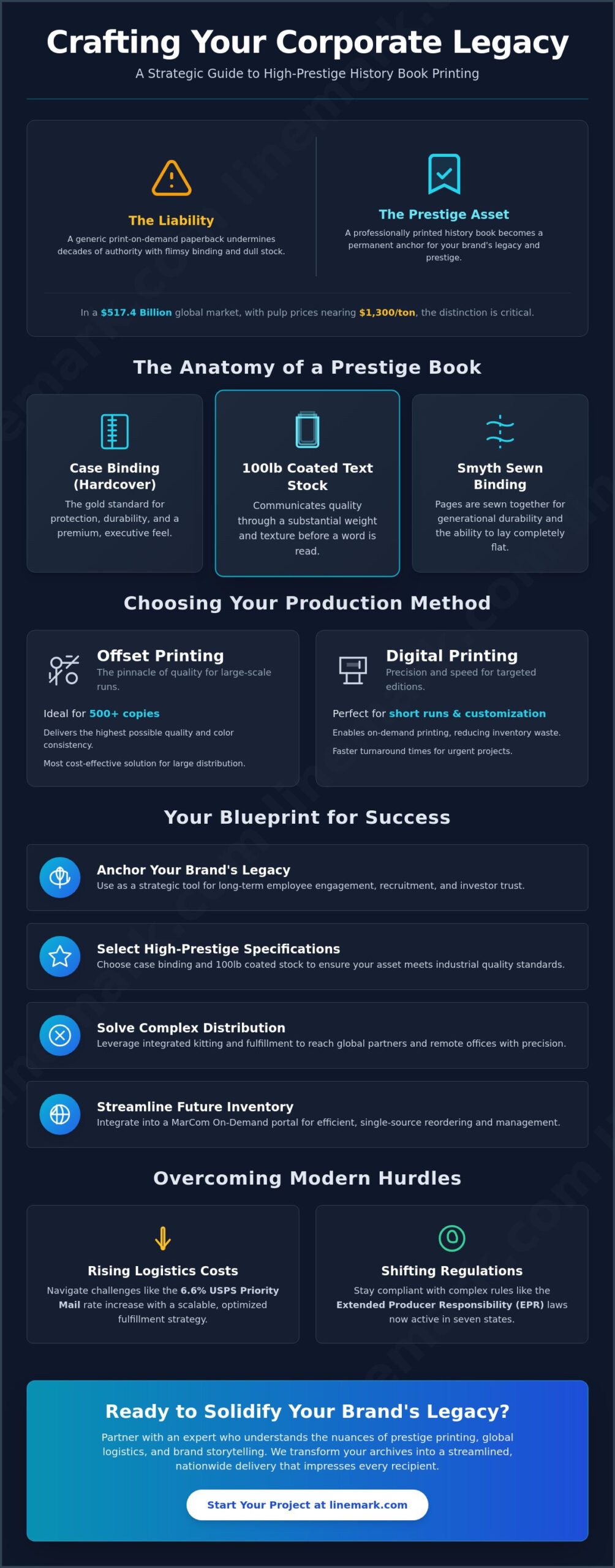
The technical architecture of a publication determines its perceived value long before a reader opens the first page. High-prestige corporate history book printing requires a deliberate selection of materials that signal durability and industrial authority. While standard digital prints suffice for internal memos, a legacy asset demands a hierarchy of specifications that mirror your brand’s market position. These books are often viewed as valuable assets that document a company’s evolution, making the choice of binding and paper stock a critical executive decision.
Smyth Sewn binding represents the gold standard for these projects. Unlike standard adhesive methods where pages are glued to the spine, Smyth Sewn books involve sewing folded groups of pages together. This traditional technique ensures the book can lay flat without the spine cracking; it also guarantees that pages won’t fall out even after decades of use. When combined with 100lb coated text stock, the result is a substantial, tactile experience. Coated paper is essential for corporate histories because it prevents ink absorption, allowing high-resolution archival photography to remain crisp and vibrant.
Hardcover vs. Softcover: Choosing Your Impact
Case binding, or hardcover, is the preferred choice for executive gifts, board members, and limited edition runs. It offers maximum protection and a commanding shelf presence that communicates permanent authority. However, perfect binding (softcover) has evolved significantly. By using high-quality 12pt or 14pt cover stocks with professional finishes, softcover editions provide a cost-effective way to distribute your story across a large employee base without sacrificing the premium feel. The choice often depends on your distribution scale and the specific “handshake” you want the book to deliver to its recipient.
Advanced Finishes and Cover Treatments
To truly separate your publication from standard commercial print, you must utilize advanced tactile finishes. These treatments turn a simple cover into a sensory experience that commands attention in a boardroom setting.
- Soft-Touch Lamination: This creates a velvet-like texture that resists fingerprints and adds a modern, sophisticated feel to the cover.
- Spot UV and Scodix: These techniques apply a glossy, raised layer to specific areas, such as a company logo or an anniversary seal, creating a 3D effect.
- Hot Foil Stamping: Using heat to press metallic foil into the cover material provides a level of brilliance that metallic inks cannot match, which is ideal for centennial dates.
- Embossing and Debossing: These processes physically alter the paper’s surface to create raised or recessed patterns, adding a classic, architectural depth to the design.
Selecting the right combination of these features can be complex, but it’s where the Linemark experience adds the most value. We help you balance aesthetic goals with production realities to ensure your final product is both stunning and durable. If you’re ready to define the specifications for your next project, our team can guide you through the custom book printing options that best fit your brand’s legacy.
Offset vs. Digital Printing for Corporate Editions
Selecting the right technology for your project depends on your distribution strategy and total volume. While some providers focus only on the writing process, we prioritize the technical execution that ensures your budget is used effectively. For corporate history book printing, the decision between offset and digital technologies determines both the unit cost and the speed of delivery. This choice is vital because the global commercial printing market is projected to reach $517.4 billion in 2026; businesses today demand both precision and scalability.
Offset Printing: The Standard for High Volume
Offset printing remains the industrial standard for high-volume runs, typically exceeding 1,000 copies. This method uses metal plates to transfer ink onto a rubber blanket and then onto the paper. It offers the lowest unit cost for large distributions, making it the logical choice for nationwide employee rollouts. Beyond cost, offset provides superior ink saturation and image depth on specialty uncoated papers. If your brand relies on specific Pantone colors to maintain a strict visual identity, offset’s specialized ink systems deliver unmatched consistency across every page.
Digital Printing and Variable Data Opportunities
Digital printing has seen a significant rise in 2026 due to its agility and high-end output. It’s the ideal solution for short-run editions, regional office distributions, or sudden events where speed-to-market is the priority. One of the most significant advantages of digital technology is the ability to integrate variable data printing. This allows you to personalize individual copies with custom cover letters, unique employee names, or location-specific inserts. This technology turns a standard history book into a personalized recognition tool that resonates deeply with its recipient.
Managing corporate history book printing projects at this scale requires sophisticated color management systems. Our 90,000-square-foot facility is equipped with 2026-grade technology that ensures a digital short-run looks identical to an offset master edition. This scalability allows us to function as your single-source partner, handling massive national orders while maintaining the meticulous attention to detail of a boutique shop. Whether you need 50 executive gift books or 50,000 copies for a global workforce, the LineMark experience provides a seamless transition from file submission to final delivery.
Logistics, Kitting, and Global Distribution
Precision in the pressroom is only half the journey. For a legacy project to succeed, the distribution strategy must be as sophisticated as the book’s design. Managing the “Last Mile” is a primary challenge for modern enterprises with remote workforces and global partners. Professional corporate history book printing requires an integrated logistics partner capable of handling complex shipping variables. As of January 18, 2026, USPS Priority Mail rates increased by approximately 6.6%, making efficient route planning and bulk shipping more critical than ever for maintaining project budgets.
Data-driven distribution allows for the automation of personalized delivery. By integrating your secure mailing lists directly into our fulfillment systems, we eliminate the manual errors that often plague large-scale rollouts. This approach also supports your organization’s ESG goals. As of February 2026, seven U.S. states have implemented Extended Producer Responsibility (EPR) laws for packaging. Our logistics team ensures your shipping materials comply with these evolving regulations while utilizing sustainable, recyclable components that align with your corporate values.
The Kitting and Fulfillment Process
Kitting adds a layer of prestige to your publication by bundling it with other high-value items. We frequently combine history books with anniversary coins, personalized certificates, or signed letters from leadership. To create truly unique physical components for these bundles, you might discover Protomolecule and their specialist rapid prototyping services. Our automated kitting workflows ensure every bundle is identical and arrives in pristine condition. Custom packaging design is a standard part of our process; we build protective containers that prevent corner damage during transit. Stakeholders can monitor every movement through real-time tracking portals, providing total transparency from the moment a book leaves our facility until it reaches an employee’s doorstep.
National and International Warehousing
Storing thousands of books in a corporate office is rarely practical. We solve this by managing your inventory in our centralized facility. This on-demand fulfillment model allows you to ship one book or five thousand at a moment’s notice. It removes the logistical burden from your internal HR and marketing departments, allowing them to focus on strategy rather than postage. Whether you are fulfilling a sudden request for a new board member or planning a massive regional event, our scalability ensures your assets are always ready for immediate dispatch.
Efficient distribution is the final step in securing your brand’s legacy. Our integrated systems turn a complex mailing project into a streamlined, hands-off experience for your team. If you need a partner to manage your project from the press to the porch, explore our kitting and fulfillment solutions today.
The Linemark Difference: Your Single-Source Partner
LineMark operates as a single-source partner, bridging the gap between archival history and future growth. We’ve refined our processes over 30 years, ensuring that every project benefits from a deep well of industrial knowledge. Our 90,000-square-foot facility provides the physical security and production capacity required for high-volume corporate history book printing. This isn’t just about floor space; it’s about a tech-savvy infrastructure that handles everything from offset masters to digital short-runs with identical precision. We treat each project as a collaborative journey, moving beyond simple transactions to provide strategic communication solutions that reflect your organization’s market authority. The LineMark difference lies in our ability to scale with your needs without losing the meticulous attention to detail found in a boutique shop.
Streamlining with MarCom On-Demand
Most legacy projects fail to account for the years following the primary anniversary event. New hires join and regional offices expand, yet the supply of history books often remains trapped in a central warehouse or disappears entirely. Integrating your book into our MarCom On-Demand portal addresses this challenge directly. This system centralizes your brand assets, allowing authorized regional managers to order copies as needed for local recruitment or partner meetings. Automated inventory alerts trigger when stock levels hit a specific threshold, preventing stockouts of your most important brand assets. You maintain total control through user-permission levels that manage both ordering frequency and departmental budget spend. This ensures your legacy remains active and accessible across your entire global footprint.
Starting Your Corporate History Project
Success begins with a consultation focused on your specific goals. Our experts help you navigate the complex custom book printing landscape, from selecting the right paper weights to choosing the most durable binding methods. We don’t expect you to make these decisions in a vacuum. We provide physical samples and high-fidelity press proofs to ensure every detail meets executive standards before the full production run commences. This meticulous approach ensures your final timeline aligns perfectly with your anniversary gala or leadership transition. We manage the technical complexity and the heavy lifting of logistics, so you can focus on the celebration. It’s a partnership built on precision, innovation, and the LineMark experience. By aligning our 2026 technology with your unique story, we transform your history into a high-prestige asset that continues to build value for decades.
Secure Your Brand Legacy for the Next Decade
LineMark provides a seamless path forward as your single-source partner for print, kitting, and fulfillment. We leverage over 30 years of commercial printing expertise to guide your project from initial proof to final delivery. Our 90,000-square-foot high-capacity facility ensures your production remains secure and scalable, regardless of the project’s complexity. We manage the technical details so your team can focus on the milestone celebration. Request a custom quote for your corporate history project at Linemark to start your journey. Your company’s story is an invaluable asset; let’s ensure it’s preserved with the professional excellence it deserves.
Frequently Asked Questions
What is the best binding for a corporate history book?
Smyth Sewn case binding is the industrial standard for books intended to last for decades. This method involves sewing sections together so the book stays flat when open. It prevents the spine from cracking and ensures pages remain secure through years of handling. For high-prestige projects, combining this with a hardcover case provides the ultimate shelf presence and durability for your brand’s legacy.
Can I print a small run of history books for executives only?
You can absolutely print short runs using our high-end digital technology. This is an efficient solution for creating exclusive, leather-bound, or specialized editions for your board of directors and executive leadership. Digital printing eliminates the need for physical plates; this makes it cost-effective for runs as small as 50 copies while maintaining the visual quality of a large-scale production.
How long does the corporate book printing process take?
A typical timeline for professional corporate history book printing ranges from 4 to 8 weeks depending on the complexity of your finishes. Custom hardcover projects with specialized treatments like foil stamping or embossing require more time for precision curing and assembly. Digital short-runs can often be completed in less than 14 business days. We provide a detailed production schedule during your initial consultation to ensure your books arrive before your milestone event.
What file formats do I need to provide for professional book printing?
We require high-resolution, press-ready PDF files, specifically in the PDF/X-4 format. Your files should be set to CMYK color mode with a minimum resolution of 300 DPI for all archival imagery to ensure crisp results. It’s vital to include a 0.125-inch bleed on all sides of your pages. Our technical team reviews every file submission to confirm that all specifications align with our industrial press requirements.
Can Linemark help with the distribution of books to our global offices?
LineMark acts as a single-source partner by managing the entire logistics chain from our 90,000-square-foot facility. We handle kitting, fulfillment, and global shipping to ensure your books reach remote employees and international partners without delay. Our systems integrate with your mailing lists to automate the process. This reduces the administrative burden on your internal marketing team while providing real-time tracking for every shipment.
What is the difference between offset and digital printing for milestone books?
Offset printing is the most cost-effective choice for volumes exceeding 1,000 copies because it offers the lowest per-unit price. It utilizes specialized ink systems for perfect Pantone color matching. Digital printing is better for short-run milestone books or projects requiring personalization. Both technologies in our facility are calibrated to the same high standards, ensuring consistent quality across different print methods and distribution phases.
How can we make our corporate history book look more ‘premium’?
Premium aesthetics are achieved through a combination of heavy 100lb paper stocks and tactile cover finishes. You can elevate your project with soft-touch lamination, which provides a velvet-like feel, or use hot foil stamping for brilliant metallic accents. Incorporating spot UV or Scodix adds a raised, glossy texture to your logo. These details transform a standard publication into a high-prestige asset that stakeholders will value.
Is it possible to include personalized letters in each book?
Personalized letters can be seamlessly integrated into your project using variable data printing technology. We can print unique messages, employee names, or location-specific content directly onto inserts or even the book covers themselves. This level of customization turns a general history book into a deeply personal recognition tool. It’s a highly effective way to increase engagement and show genuine appreciation to your long-term team members.