


 05/02/2026
  Steve Bearden
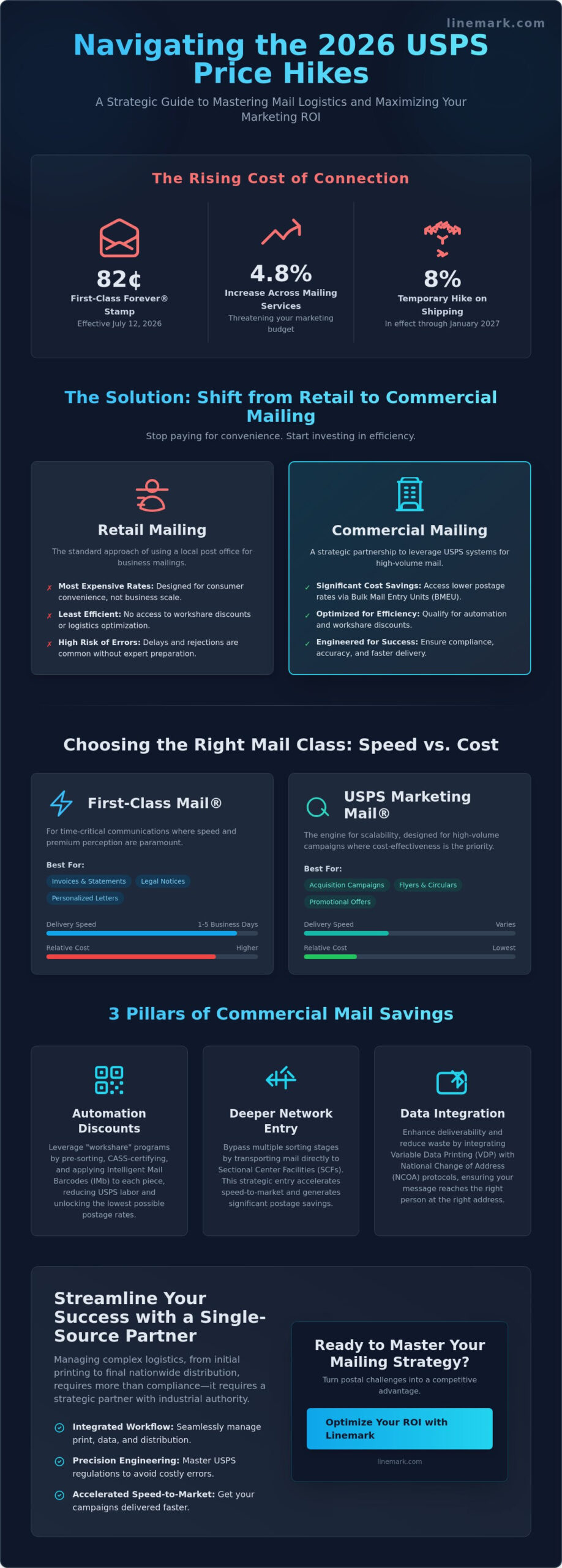
On July 12, 2026, the price of a First-Class Mail Forever stamp will climb to 82 cents, marking a 4.8 percent increase across mailing services that directly impacts your marketing budget. When you combine this with the temporary 8 percent price hike on domestic shipping services currently in effect through January 2027, the financial pressure on your logistics strategy is undeniable. It’s frustrating to watch rising costs and complex usps regulations threaten the ROI of your most reliable communication channel. At Linemark, we believe that managing this environment requires more than just compliance; it requires a strategic partnership built on technical precision and industrial authority.
You likely feel that managing high-volume mailings has become a constant struggle to avoid design errors and mitigate rising expenses. We agree that the current market demands a more sophisticated, integrated approach to fulfillment. This guide will show you how to master these complexities and leverage professional mailing services to maximize your marketing returns. We’ll examine how to capture automation discounts, utilize deeper network entry at Sectional Center Facilities, and integrate your printing and mailing into a single-source partner workflow for faster speed-to-market.
Key Takeaways
- Identify the strategic differences between Marketing Mail and First-Class options to optimize your delivery speed and postage budget.
- Master the latest usps technical requirements, including mandatory barcoding and design standards, to qualify for maximum automation discounts.
- Enhance campaign deliverability and engagement by integrating Variable Data Printing with National Change of Address (NCOA) protocols.
- Streamline your operations by leveraging a single-source partner to manage complex logistics, from initial printing to final nationwide distribution.
Understanding the USPS Ecosystem for Commercial Success
The United States Postal Service operates as the essential physical infrastructure for national commerce. It’s the only entity with the legal mandate and operational capacity to reach every residential and business address in the country. For business leaders, this “last-mile” access is a strategic asset that digital channels cannot replicate. While many logistics providers focus on hub-to-hub transport, the usps network ensures your message lands directly in the hands of your target audience. This reliability makes it the backbone of direct commerce, providing a tangible connection to customers that remains vital in a digital-first economy.
To better understand the fundamentals of this channel, watch this helpful video:
Success in 2026 requires moving beyond simple postage. The system is designed to reward efficiency through “workshare” programs. In these arrangements, professional printers handle the heavy lifting of pre-processing, such as sorting, barcoding, and transporting mail to specific entry points. This collaboration reduces the burden on the postal system and allows your organization to capture significant automation discounts. These savings are critical now, as they help offset the 4.8 percent price increase for mailing services scheduled for July 2026. By acting as a strategic ally in the logistics chain, a high-capacity printer like Linemark turns a standard mailing into a precision-engineered logistics project.
Retail vs. Commercial Mail: What Businesses Need to Know
Walking into a local post office is the most expensive and least efficient way to manage business communications. Retail rates are designed for convenience, not for the scalability required by modern marketing. In 2026, the gap between retail and commercial pricing has widened significantly. While a First-Class Forever stamp moves to 82 cents on July 12, 2026, commercial mailers using a Bulk Mail Entry Unit (BMEU) access much lower rates. These specialized facilities verify high-volume mailings for accuracy and compliance. This ensures your projects move through the system without the delays or rejections that often plague unoptimized mailings.
The Logistics of the Modern Mailstream
Decoding USPS Mail Classes: Marketing Mail vs. First-Class
Selecting the optimal mail class is a strategic pivot point for your marketing ROI. It’s not merely a matter of delivery speed; it’s about the technical alignment of your communication with usps logistics. First-Class Mail offers the fastest delivery within a one to five day window and includes premium features like automatic forwarding and return-to-sender services. In contrast, Marketing Mail serves as the engine for scalability. It offers significant cost savings for high-volume acquisition campaigns where immediate delivery is less critical than total reach. For those seeking a foundational overview of these categories, the Business Mail 101 portal offers a technical starting point for understanding these distinctions.
When to Choose First-Class Mail
Use First-Class for time-critical documents like invoices, legal notices, and highly personalized correspondence. This class carries a premium perception. Recipients often perceive it as more urgent than bulk mailings. It’s a professional choice. With the Forever stamp rising to 82 cents on July 12, 2026, the cost per piece is higher, but the built-in address correction services provide immense value for maintaining clean data. If a recipient has moved, the post office forwards the piece at no extra charge for up to 12 months. This ensures your financial or legal obligations are met without manual list cleaning or wasted postage on undeliverable addresses.
Maximizing ROI with USPS Marketing Mail
Marketing Mail is designed for efficiency at scale. It requires a minimum of 200 pieces or 50 pounds, making it the ideal choice for catalogs, newsletters, and brochures. Effective July 12, 2026, the maximum weight for Marketing Mail flats increases from 16 ounces to 20 ounces. This regulatory shift allows you to include more content or heavier, high-quality paper stock without jumping into a more expensive parcel category. While delivery takes longer, the 5 to 6 percent rate increase proposed for July 2026 still keeps this class the most affordable option for mass outreach. For eligible organizations, non-profit rates offer even deeper discounts, further stretching your marketing budget.
Balancing these options requires a partner who understands the operational nuances of the usps network. To see how these classes fit into your broader strategy, consider the Linemark experience for your next campaign. We help you navigate the 2026 rate trends by selecting the class that matches your speed-to-market requirements while protecting your bottom line. Choosing the right class isn’t just about the postage stamp; it’s about the intelligence behind the distribution.
USPS Regulations and Design Requirements for 2026
Many marketing teams hesitate to launch campaigns because they believe direct mail design is too restrictive. We see it differently. These regulations are the technical specifications for a high-speed logistics system. By adhering to USPS Physical Standards, you ensure your mail moves through automated sorters without manual intervention. Compliance isn’t a hurdle; it’s the gatekeeper to automation discounts. This precision is what allows your organization to offset the 4.8 percent price increase for mailing services scheduled for July 2026. The most critical element is the Intelligent Mail Barcode (IMb). This 65-bar code is mandatory for commercial discounts and acts as a digital fingerprint for every piece in the usps network.
The aspect ratio, found by dividing the length of your piece by its height, must fall between 1.3 and 2.5. If your design is too square or too long, it becomes non-machinable. This triggers significant surcharges that can devastate your campaign budget. Machines also require a clear Optical Character Reader (OCR) area to process addresses at high speeds. When you treat these requirements as a framework for success rather than a limitation, you transform your mail into a streamlined asset for the postal infrastructure.
The Technical Anatomy of a Mailable Piece
Precision begins with the layout. Your design must reserve the bottom 5/8 inch of the mail piece for the barcode clear zone. Additionally, paper thickness, or caliper, is a vital factor in high-speed sorting. For example, postcards must be at least 0.007 inches thick to survive the mechanical stress of the mailstream. Our automation-compatible design checklist includes:
- Maintaining an aspect ratio within the 1.3 to 2.5 range.
- Reserving a 2.75-inch by 4-inch space for the address block.
- Ensuring the IMb is placed within the specified clear zone.
- Using paper stock that meets minimum caliper requirements for the specific mail class.
Every Door Direct Mail (EDDM) vs. Targeted Lists
Choosing between saturation and precision depends on your campaign goals. Every Door Direct Mail (EDDM) allows you to reach every home on a specific carrier route without a mailing list. While Retail EDDM is limited to 5,000 pieces per day per ZIP code, Commercial EDDM offers unlimited scalability for larger brands. However, for campaigns requiring high levels of personalization, data-driven targeted lists often yield better results. To dive deeper into these strategies, explore our Direct Mail Marketing in 2026 guide. Effective July 12, 2026, the weight limit for Marketing Mail flats increases to 20 ounces, giving you more creative freedom in both EDDM and targeted formats within the usps system.
Strategic Integration: Print, Data, and USPS Logistics
The intersection of high-speed printing technology and usps logistics is where marketing efficiency is truly realized. Variable Data Printing (VDP) allows you to customize every piece of mail for the individual recipient without sacrificing production speed. This level of personalization creates a stronger connection with your audience. It ensures your message stands out in a crowded mailbox. By integrating digital printing capabilities with precise data management, we transform a static mailer into a dynamic communication tool that qualifies for the deepest automation discounts.
The Power of Data Hygiene
Data is the lifeblood of a successful campaign. Before ink hits paper, your mailing list must undergo rigorous processing to ensure accuracy. Coding Accuracy Support System (CASS) certification is the industry standard for address verification. It acts as the gatekeeper to bulk postage discounts. Without it, you pay the highest retail rates. National Change of Address (NCOA) processing further refines your list by identifying recipients who moved within the last 48 months. On February 23, 2026, the postal service updated its list of rural ZIP codes, making precise address data even more vital for budget control. Deduplication is another critical layer. It removes redundant entries to ensure you aren’t sending multiple pieces to the same household. Data hygiene is the foundation of any high-ROI mailing.
Informed Delivery: The Future of USPS Marketing
Informed Delivery serves as a powerful bridge between the physical mailbox and the digital inbox. This service provides millions of users with a digital preview of their incoming mail every morning. It’s an omnichannel opportunity. As your single-source partner, LineMark can enhance these notifications with a clickable ride-along image. This is a full-color advertisement that appears directly below the grayscale scan of your mail piece. It allows recipients to respond to your offer before they even touch the physical envelope. This dual exposure increases conversion rates and provides concrete digital tracking metrics for your physical mail campaigns.
Strategic logistics also play a role in speed-to-market. By drop-shipping your mail directly to local Sectional Center Facilities (SCFs), we bypass the standard postal long-haul network. This technique can shave two to four days off your delivery window. It also protects your pieces from the wear and tear of multiple sorting facilities. When you combine precise data hygiene with advanced logistics and digital integration, you create a campaign that is both resilient and highly effective.
To start optimizing your data and logistics strategy for 2026, connect with a LineMark consultant today. We provide the technical expertise needed to turn complex postal regulations into a competitive advantage for your business.
Scaling with a Single-Source USPS Partner
From Commercial Printing to Final Fulfillment
Efficiency is born from integration. Our 90,000-square-foot production facility houses every stage of the process under one roof. This proximity eliminates the delays and risks associated with transporting materials between separate print shops and mail houses. Our kitting and fulfillment services are specifically designed to handle complex, multi-part mailers that require precision assembly. Whether you’re coordinating a nationwide product launch or a localized outreach campaign, professional inventory management ensures your materials are ready for deployment the moment they’re needed. This streamlined workflow is essential for maintaining the speed-to-market required in a competitive 2026 landscape.
The Scalability of MarCom On-Demand
For organizations with distributed marketing teams, maintaining brand consistency while enabling local agility is a constant challenge. Our MarCom On-Demand portals solve this by providing a centralized command center for your usps compliant communications. Local agents or franchise owners can trigger personalized, pre-approved mailings directly from the portal. This ensures every piece of mail meets corporate standards and qualifies for automation discounts without requiring local expertise. You maintain total control over the budget and the brand while empowering your front-line teams to act. It’s a high-touch solution that scales with your business needs.
Your direct mail campaigns shouldn’t be a source of stress; they should be a reliable engine for growth. By consolidating your printing, data management, and logistics with a single-source partner, you gain the transparency and control needed to maximize ROI. Partner with Linemark for your 2026 USPS direct mail strategy to experience a seamless transition from complex challenge to scalable solution. Our commitment to innovation and precision ensures your projects are always in capable hands.
Turning Postal Complexity into a Competitive Advantage
Successfully navigating the July 2026 rate increases and technical shifts requires a move toward precision-driven logistics. You’ve seen how mastering mail classes and adhering to usps automation standards can protect your budget while expanding your reach. By integrating advanced data hygiene with omnichannel tools like Informed Delivery, your organization transforms a traditional mail piece into a high-performance digital bridge. The technical barriers that once felt restrictive are actually the keys to capturing deeper discounts and ensuring faster speed-to-market.
At LineMark, we provide the industrial authority and technical infrastructure needed to scale these efforts with ease. Our 90,000-square-foot production facility and 30+ years of logistics expertise ensure your high-volume projects are handled with meticulous detail. Whether you’re utilizing our MarCom On-Demand portals for distributed teams or seeking deep network entry discounts, we act as your dedicated single-source partner. The challenges of the modern mailstream don’t have to be a barrier to your growth. With the right strategic ally, they become the foundation for a resilient and profitable communication strategy.
Streamline Your USPS Mailings with Linemark and ensure your 2026 campaigns are built for maximum impact. It’s time to let our innovation drive your results.
Frequently Asked Questions
What is the current USPS commercial postage rate for 2026?
Effective July 12, 2026, the price for a First-Class Mail Forever stamp is $0.82. Commercial mailers are experiencing an average rate increase of 4.8 percent across mailing services product prices. For those utilizing Marketing Mail, rates for letters and flats are expected to rise by approximately 5 to 6 percent. Utilizing metered mail or automation-compatible designs remains the most effective strategy to mitigate these costs compared to retail pricing.
How many pieces are required for a USPS bulk mail discount?
To qualify for usps Marketing Mail discounts, your mailing must consist of at least 200 pieces or 50 pounds of mail. If you’re utilizing First-Class Mail for commercial purposes, the minimum volume requirement is 500 pieces. Meeting these thresholds allows you to access automation rates. These rates are significantly lower than standard retail prices and are essential for scaling high-volume corporate communications.
What is the difference between USPS Marketing Mail and Standard Mail?
There is no functional difference between these two terms because “Standard Mail” was officially rebranded as “USPS Marketing Mail” in January 2017. The transition was a strategic move by the postal service to better reflect the primary use of the mail class for promotional purposes. It remains the preferred choice for businesses sending high-volume catalogs, newsletters, and brochures that don’t require the expedited delivery of First-Class service.
How does the Intelligent Mail Barcode (IMb) benefit my business?
The Intelligent Mail Barcode is the technical foundation for accessing modern automation discounts. It provides your business with end-to-end tracking data as your mail moves through the usps infrastructure. This visibility allows you to synchronize your email and social media follow-ups with the exact day your physical mail arrives. It also improves deliverability by ensuring your address data is processed through the latest sorting technology.
Can Linemark help me obtain a USPS mail permit?
Yes, LineMark serves as a single-source partner that manages the complexities of mail permits on your behalf. We maintain our own commercial permits, which means you can leverage our established relationship with the postal service without the administrative burden of applying for your own. This integration ensures your campaigns are compliant with all 2026 regulations while accelerating your speed-to-market for every project.
What is the fastest way to send a large-volume commercial mailing?
The fastest method involves a combination of First-Class Mail and strategic drop-shipping to local Sectional Center Facilities (SCFs). By transporting your mail directly to these hubs, you bypass several layers of national sorting and long-haul transport. This logistical shortcut can reduce delivery times by two to four days. It’s a high-efficiency solution that ensures your time-sensitive marketing messages or legal notices reach their destination with industrial precision.
Does USPS provide free boxes for business direct mail?
The postal service provides free branded packaging exclusively for Priority Mail and Priority Mail Express shipping services. For traditional direct mail campaigns involving postcards, letters, or flats, businesses use their own custom-printed materials optimized for high-speed sorting. We provide the technical expertise to ensure your custom designs meet all 2026 physical standards. This prevents the surcharges often associated with non-compliant or retail-grade packaging.
How does Informed Delivery tracking work for marketers?
Informed Delivery provides a digital grayscale preview of incoming mail to over 50 million users, allowing marketers to add a clickable “ride-along” image to the notification. You receive specific metrics on open rates and click-through rates for these digital previews. This creates a powerful omnichannel experience. It allows you to track the performance of your physical mail with the same precision you expect from your digital marketing channels.