

 04/20/2026
  Steve Bearden
What if the most expensive choice in your production cycle is actually the one that causes a 12% spike in your 2026 shipping costs? A single cracked spine on a 10,000-unit print run can diminish perceived brand authority by 40% before a reader even opens the cover. You’ve likely felt the pressure of choosing between technical methods while worrying if your pages will stay intact during high-volume distribution. Mastering the nuances of professional book binding is no longer just about aesthetics; it’s a strategic logistics decision that impacts your bottom line.
You deserve a finished product that reflects your status as a market leader without inflating your overhead. This guide provides a clear decision-making framework to help you select the right finishing for your upcoming campaigns. You’ll learn how to achieve the perfect balance of durability and cost-efficiency while ensuring your projects survive the rigors of the global mail stream. We’ll examine the LineMark experience in precision finishing, from automated PUR applications to scalable solutions that integrate with your fulfillment strategy to provide the operational excellence your brand requires.
Key Takeaways
- Analyze the strategic impact of tactile finishing on brand authority and how professional physical presentation directly influences reader engagement.
- Compare the technical mechanics of Perfect, PUR, and Saddle Stitching to determine the optimal book binding method for your project’s scale and durability.
- Optimize the trade-off between production speed and unit cost by selecting finishing solutions that align with your project’s intended archival lifespan.
- Master critical pre-press essentials, including paper grain direction and spine width formulas, to ensure flawless cover alignment and prevent structural defects.
- Discover how leveraging a single-source partner with advanced industrial capabilities can streamline your transition from complex print production to high-volume finishing.
The Strategic Role of Professional Book Binding in 2026
Professional book binding represents the industrial precision required to secure printed signatures within a protective, branded housing. It’s more than a final step; it’s a strategic decision that dictates how a reader interacts with your content. In 2026, the tactile experience of a physical book serves as a primary driver for brand authority. When a client feels the weight and tension of a well-bound spine, they subconsciously assign a higher level of trust to the information inside. This physical connection is a key factor in increasing reader retention rates, which can be up to 40% higher for physical media compared to digital counterparts according to recent engagement metrics.
To better understand the craftsmanship and technical detail involved in this process, watch this helpful video:
The technology behind these finishes has transitioned from labor-intensive traditional techniques to high-speed, automated systems. While historical Bookbinding methods like Smyth sewing remain the benchmark for archival durability, advanced Polyurethane Reactive (PUR) adhesives now offer 50% more flexibility and page-pull strength than standard EVA glues. This evolution directly impacts the entire lifecycle of custom book printing, allowing for faster turnaround times without compromising the structural integrity of the final product. Choosing the right book binding method ensures your document stands up to the rigors of its intended environment.
Beyond Aesthetics: The Functional Purpose of Binding
Binding serves as the structural skeleton of your project. It protects content from environmental wear and the friction of high-frequency use. For technical manuals, lay-flat capabilities are essential for hands-free operation; for luxury coffee table books, a rigid spine provides the necessary support for high-gsm coated papers. Logistics also play a role. The choice of binding material can alter a book’s spine width by 10% or more, which significantly influences national distribution costs and storage efficiency in fulfillment centers.
The Business Case for High-Quality Finishing
In a saturated market, premium tactile finishes differentiate your product from standard commodities. High-quality finishing ensures that corporate reports and marketing assets survive the rigors of shipping and repeated handling. Industrial finishing is the bridge between raw print and a market-ready product. At LineMark, we act as a single-source partner to ensure that every binding choice aligns with your long-term scalability and brand goals. This approach turns a simple print job into a sophisticated communication tool that reflects the LineMark difference.
Primary Industrial Binding Methods: A Technical Breakdown
Selecting the correct book binding method is a strategic decision that dictates both the longevity of your collateral and the user’s physical interaction with your brand. High-volume production requires a balance of aesthetic appeal and structural integrity. At LineMark, we approach these technical specifications as a core component of our integrated service model, ensuring every project meets rigorous industrial standards.
Perfect Binding and PUR: The Professional Softcover Standard
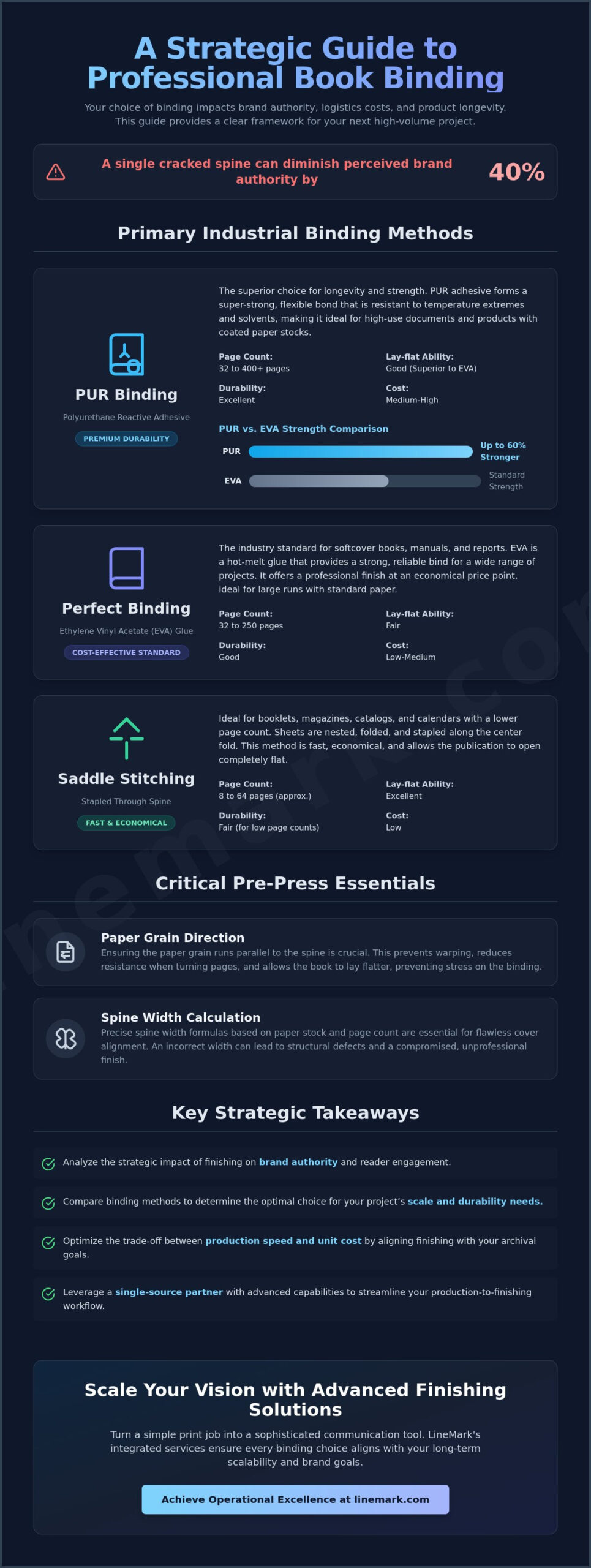
Adhesive-based binding relies on sophisticated chemistry to secure page blocks to a wrap-around cover. Traditional Perfect Binding uses Ethylene Vinyl Acetate (EVA) glue, which is efficient for standard paper stocks. However, Polyurethane Reactive (PUR) adhesive represents a significant technological advancement. PUR is 40% to 60% stronger than EVA and offers superior resistance to temperature extremes, preventing the spine from cracking in cold mail trucks or melting in high-heat storage. This makes it the ideal choice for softcover book printing in demanding corporate environments. To ensure a secure bond, we typically require a minimum spine thickness of 0.125 inches, which usually equates to about 40 to 50 pages depending on paper weight.
Saddle Stitching: Efficiency for High-Volume Collateral
Saddle stitching remains the industry benchmark for speed and cost-effectiveness. The process involves nesting folded signatures inside one another and securing them through the fold line with wire staples. It’s the primary method utilized in catalog printing because it allows for high-speed automated production. Our technical teams pay close attention to “creep,” where the inner pages of a thick book protrude further than the outer pages. For documents exceeding 32 pages, we adjust the inner margins by as much as 1/32 of an inch per signature to maintain visual alignment across the spread. This precision ensures your layout remains centered regardless of the page count.
Mechanical Binding: Wire-O and Spiral Coil
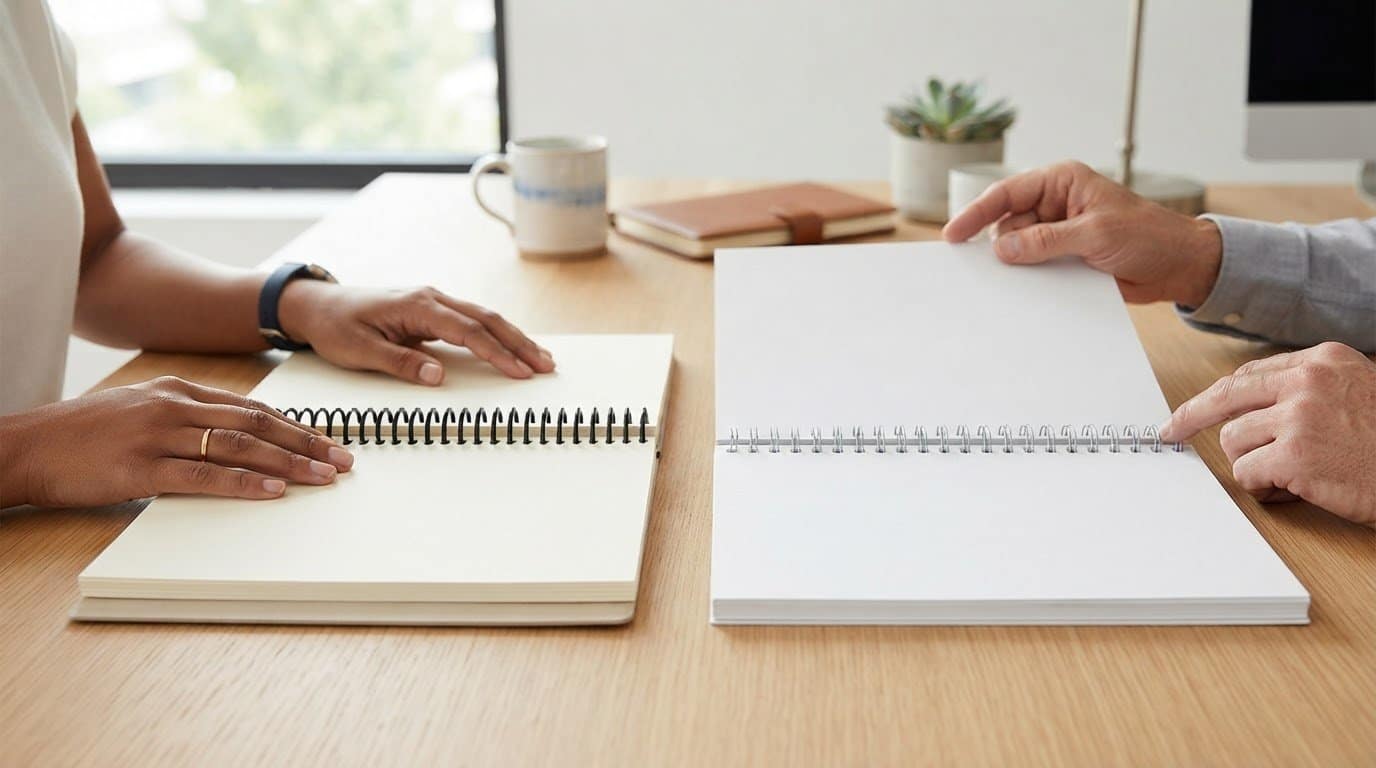
When functionality is the priority, mechanical book binding offers unmatched utility. Both Wire-O and plastic coil methods allow for 360-degree rotation, letting the book lay completely flat on a desk or workbench. This is essential for training manuals, cookbooks, and technical reference guides. While plastic coils offer extreme durability for heavy-duty field use, metal Wire-O provides a more sophisticated, semi-concealed aesthetic for executive presentations. We often recommend metal for high-end reports where the professional finish must match the quality of the data inside.
For projects requiring the ultimate level of durability, case binding serves as the gold standard. This method uses a rigid board cover and sewn signatures to create a premium hard-cover presentation that lasts for decades. As your single-source partner, we help you navigate these technical choices to find the scalable solution that fits your specific distribution and logistics needs.
Selecting the Optimal Binding for Your Project Goals
Choosing the right book binding requires a strategic analysis of how the end-user will interact with the document. A 200-page catalog requires different structural integrity than a 16-page promotional insert. Production speed often conflicts with durability. While saddle stitching allows for rapid turnaround in high-volume mailings, it lacks the longevity required for archival reference materials. Page count serves as the primary technical constraint. Once a document exceeds 0.25 inches in thickness, traditional stitching methods often fail, leading to page creep where inner sheets extend beyond the cover. This physical limitation dictates whether you move toward adhesive or mechanical finishes.
The LineMark approach focuses on balancing these trade-offs to protect your brand’s reputation. If your project needs to lay flat on a desk, a mechanical bind is essential. If you need shelf visibility, a printable spine is a requirement that only perfect or case binding can satisfy. We don’t just look at the immediate cost; we look at the intended lifespan of the piece. A document meant for a single trade show has different engineering needs than a reference manual used daily for three years.
Binding Choice by Document Type
For annual report printing, the goal is to project stability and prestige while managing tight distribution windows. Perfect binding is a standard choice here because it provides a printable spine that looks professional on a shelf. In contrast, training manuals used in active environments demand functionality. Wire-O binding is superior for these applications because it allows the book to lay completely flat on a desk. This hands-free efficiency is critical for roughly 85% of workplace learners who need to reference materials while performing hands-on tasks.
The Cost-to-Value Ratio of Different Methods
The financial side of book binding hinges on scalability. Digital on-demand finishing is ideal for short runs of 50 to 500 units, but unit costs drop significantly when moving to high-capacity offset-run binding for 10,000 units or more. Investing in PUR (Polyurethane Reactive) binding often yields a higher long-term ROI for thick books. PUR adhesive is 40% to 60% stronger than standard EVA glue. This strength drastically reduces the risk of pages falling out when books are exposed to extreme temperatures during shipping. As your single-source partner, we help you weigh these technical variables to ensure your project scales without compromising quality.
Pre-Press Essentials: Preparing Your Manuscript for Professional Binding
Professional book binding begins long before the first sheet hits the press. Achieving a flawless finish requires meticulous technical preparation to ensure structural integrity and visual alignment. One of the most critical factors is paper grain direction. The grain must run parallel to the spine. If the grain runs perpendicular, the paper fibers resist the fold, resulting in unsightly spine wrinkling or “cockling” that compromises the book’s durability. This structural failure is common in amateur layouts but is entirely avoidable with proper pre-press planning.
Designers must also calculate spine width with industrial precision to avoid cover misalignment. You can determine the exact width using the formula: (Total Page Count / 2) x Paper Caliper. For instance, a 256-page manuscript printed on 60lb offset stock with a .0045 caliper requires a spine width of 0.576 inches. This calculation ensures the wrap-around cover, which includes the front, back, and spine in a single flat file, fits perfectly without shifting the design elements or bleeding onto the wrong panel.
Proper margin and gutter setup prevents the “loss of text” in the binding fold. For perfect bound projects, we recommend a minimum gutter margin of 0.75 inches. This accounts for the 0.125-inch grind-off during the milling process. It’s a technical necessity that ensures your content remains legible and doesn’t disappear into the spine’s adhesive layer. Precision at this stage defines the difference between a project that feels crowded and one that offers a premium reading experience.
Understanding Signatures and Imposition
Professional high-volume printing relies on signatures, which are large sheets folded into 8, 16, or 32-page sections. Your total page count must be divisible by these increments to avoid unnecessary blank pages or costly manual inserts. Imposition is the strategic arrangement of pages for optimal binding, ensuring that once the signatures are folded and trimmed, every page appears in the correct sequence and orientation.
Paper Stock Selection and Binding Compatibility
The interaction between paper chemistry and adhesives is a critical variable in 2026 production standards. PUR (Polyurethane Reactive) binding is the preferred choice for coated stocks because traditional EVA glues don’t always penetrate the ink and coating barrier effectively. Recent 2024 industry benchmarks show PUR binding offers 50% more flexibility and higher resistance to temperature extremes than standard adhesives. Heavy interior stocks exceeding 100lb require specialized scoring to prevent the book from springing open or cracking under its own weight.
Scaling Your Vision with Linemark’s Advanced Finishing Solutions
The Linemark Difference is built on a foundation of 30 years of industrial expertise. We don’t just attach covers; we integrate sophisticated engineering into every spine to ensure durability and aesthetic excellence. Operating from a 90,000-square-foot facility, our team manages the entire lifecycle of your project under one roof. This massive footprint allows for a seamless transition from the initial press run to the final book binding stage, ensuring your vision remains intact from start to finish.
Our infrastructure is designed to support national distribution at a scale that smaller shops can’t match. By utilizing data-driven production methods, we deliver personalized, on-demand book products that meet the specific needs of 2026’s fast-moving market. Whether you’re producing 500 bespoke units or 50,000 retail-ready volumes, our facility scales to your requirements without compromising on precision.
Single-Source Efficiency: From Press to Fulfillment
Efficiency thrives when you eliminate the middleman. By removing the need for third-party bindery houses, we drastically reduce turnaround times, often shaving days or weeks off traditional production schedules. Our integrated digital and offset finishing lines allow for real-time quality control. This means every page is verified before it’s bound. Beyond the bindery, our team handles complex kitting and nationwide distribution. We ensure your materials arrive at their destination in pristine condition, regardless of the geographic spread. Our book binding services are a core component of this streamlined logistics chain, providing a single-source solution for modern publishers.
Collaborating for Success
We view every project as a strategic partnership. Our consultative approach helps you select the specific finishing techniques that align with your unique ROI goals. We don’t believe in one-size-fits-all solutions. Instead, we leverage advanced technology, including precision automated binding, to guarantee consistent quality at any volume. This technological pride ensures that the first book off the line is identical to the ten-thousandth. When you’re ready to elevate your brand’s physical presence, we’re here to provide the industrial authority and technical skill your project deserves. Request a comprehensive book printing services quote for your next project and experience the Linemark standard as your single-source partner.
Elevate Your Print Strategy with Precision Finishing
The landscape of 2026 demands more than just a printed page; it requires a tactile experience that reinforces brand authority. Choosing the right book binding method serves as the final, critical step in transforming a manuscript into a professional asset. Whether you’re navigating the technical nuances of adhesive selection or aligning pre-press specifications with high-speed machinery, the details define your success.
Linemark operates a 90,000-square-foot high-capacity production facility designed to handle these complexities with ease. Our team brings over 30 years of industrial printing and finishing expertise to every project, ensuring your vision scales without friction. We don’t just finish your books; we offer seamless integration with national direct mail and fulfillment services to streamline your entire supply chain. This comprehensive approach turns a logistical challenge into a competitive advantage. You’ll find that having a single-source partner simplifies the transition from the press to the customer’s doorstep. It’s about a strategic alliance that prioritizes your growth.
Partner with Linemark for high-volume, professional book binding solutions today.
Your next project deserves the highest standard of excellence, and we’re ready to help you achieve it.
Frequently Asked Questions
What is the most durable type of book binding for high-use manuals?
Polyurethane Reactive (PUR) binding is the most durable solution for high-use manuals. It uses a specialized adhesive that forms a strong chemical bond with paper fibers, offering 50% more pull strength than standard EVA glue. This ensures pages remain intact even when exposed to extreme temperatures ranging from -40°F to 200°F. For manuals used in industrial environments, PUR binding provides the structural integrity required for heavy daily handling.
How many pages do I need for a book to be perfect bound?
You typically need a minimum of 40 to 60 pages to achieve the necessary spine thickness for perfect binding. A spine must be at least 0.125 inches wide to allow the adhesive to grip the page edges effectively. If your document is thinner than this threshold, the glue surface area is insufficient, which leads to structural failure. For projects under this page count, saddle stitching serves as a more reliable alternative.
What is the difference between Perfect binding and PUR binding?
The primary difference between these two methods lies in the chemical composition of the adhesive used. Perfect binding utilizes Ethylene Vinyl Acetate (EVA), which is a hot-melt glue that sets quickly but can become brittle over time. PUR binding uses a moisture-curing polyurethane adhesive that retains 100% of its flexibility after drying. This flexibility allows the book to lay flatter without the spine cracking, making it the superior choice for coated stocks.
Can I print on the spine of a saddle-stitched booklet?
You can’t print on the spine of a saddle-stitched booklet because this method uses staples driven through a folded edge. Unlike a flat spine, a saddle-stitched fold lacks the surface area required for legible text or graphics. If your branding requirements necessitate a printed spine, you must transition to a square-back or perfect bound format. These options provide a distinct flat edge that accommodates titles and logos for easy shelf identification.
Why is grain direction important for professional book binding?
Grain direction is vital because it determines how the paper fibers react to moisture and mechanical folding. For a professional book binding result, the grain must run parallel to the spine. When the grain is perpendicular, the pages will resist the fold, causing unsightly buckling along the spine. Industry standards dictate that correct grain alignment reduces mechanical stress on the adhesive by 30%, ensuring the book opens smoothly and stays flat.
How does binding type affect the cost of a custom book project?
Binding type influences costs through varying labor requirements and machine setup times. Simple saddle stitching is often the most economical choice for high-volume runs because the process is fully automated at speeds up to 12,000 units per hour. As your single-source partner, we analyze these variables to ensure scalability. Complex workflows like Smyth sewing increase production time, which directly impacts the final project budget for specialized custom orders.
Is Wire-O binding the same as spiral binding?
Wire-O binding isn’t the same as spiral binding. Wire-O uses a series of double-looped metal wires that are squeezed shut into a C-shape, providing a sophisticated look for corporate presentations. Spiral binding uses a single continuous plastic filament threaded through holes. While both allow a book to lay 180 degrees flat, Wire-O offers a more professional finish that aligns pages perfectly when the book is open, making it ideal for high-end reports.
What is Smyth sewing, and when is it necessary for commercial projects?
Smyth sewing is a premium book binding technique where thread is sewn through the center fold of paper signatures. It’s necessary for commercial projects that require a 100% lay-flat capability and archival durability. This method ensures that even if the adhesive fails, the physical thread keeps the pages secured. It’s the gold standard for high-end coffee table books and medical textbooks that must withstand decades of frequent reference in professional settings.