

 06/03/2026
  Steve Bearden
What if the true cost of your training program isn’t the development of the content, but the friction of getting it into the hands of your team? You likely understand the frustration of seeing expensive binders fall apart in rugged industrial environments or discovering that a remote crew is working from a version of a manual that was retired months ago. Managing high shipping costs for heavy materials and maintaining version control across a distributed workforce often feels like a constant battle against operational inefficiency.
This guide explores how to transform these materials into durable, high-impact assets through professional training manual printing services. You’ll discover how to leverage advanced kitting, inventory management, and nationwide fulfillment to streamline your operations and lower your total cost of ownership. We will also examine how centralized ordering portals and the latest 2026 global standards, such as the EU Packaging and Packaging Waste Regulation, are reshaping the way organizations approach industrial documentation and logistics. By the end of this article, you’ll have a roadmap for turning your training collateral into a scalable, strategic asset that reinforces your brand’s authority.
Key Takeaways
- Understand why physical manuals remain superior for knowledge retention and how to position them as high-impact assets in a digital-first world.
- Learn how to select paper stocks and synthetic finishes that ensure your materials survive rigorous use in industrial or outdoor environments.
- Identify the precise production volumes where offset printing becomes more cost-effective than digital for your training manual printing services.
- Discover how integrated kitting and fulfillment services transform standard documents into ready-to-use training kits for simultaneous nationwide distribution.
- Explore how MarCom On-Demand portals provide a centralized solution for version control while allowing decentralized teams to order materials as needed.
The Strategic Role of Professional Training Manual Printing Services in 2026
In 2026, training manual printing services represent far more than ink on paper. They function as a unified logistics and communication strategy that bridges the gap between complex operational knowledge and field execution. While the history of printing highlights a shift from mass production to precision, today’s focus is on the holistic journey of the document. This includes everything from digital file management and high-volume production to kitting and nationwide fulfillment. By integrating these steps, organizations ensure that their most critical intellectual property is delivered accurately, securely, and professionally to the people who need it most.
Physical manuals provide a tactile experience that digital screens often fail to replicate, particularly in high-stakes environments. Research suggests that the physical act of flipping pages and highlighting text improves spatial memory and knowledge retention. This isn’t just about learning; it’s about safety. Standardized, printed documentation ensures that every technician or operator is looking at the same verified safety protocols, which is vital for regulatory compliance. In industrial sectors, where a single error can lead to significant downtime or injury, the reliability of a printed guide is an essential layer of risk management.
To better understand whether to manage these assets internally or partner with a specialist, watch this helpful video:
The shift toward “just-in-time” printing has redefined how companies manage their inventory. Instead of warehousing thousands of potentially outdated binders, modern digital printing allows for smaller, high-frequency runs. This approach eliminates the waste associated with version control issues and reduces the total cost of ownership by cutting storage fees. When content changes, the next batch reflects those updates immediately. This ensures your team never relies on obsolete data, keeping your operations agile and compliant with the latest 2026 standards.
Types of Manuals That Drive Business Growth
Different operational needs require specific print formats to maximize impact. Technical and industrial guides must withstand harsh manufacturing environments, often requiring specialized binding and finishing. Employee handbooks and onboarding kits serve as the first touchpoint for company culture, requiring high-quality commercial printing to reflect brand authority. To further bolster this identity, many organizations include custom apparel or promotional products from Plain Insane Graphix in their onboarding packages. Additionally, professional software and user manuals help customer success teams by providing clear, accessible instructions that reduce support tickets and improve the overall user experience.
In addition to these manuals, organizations often need to explore VIPColor Label Printers to create the durable, high-resolution labels required for equipment identification and safety warnings in industrial environments.
The ROI of High-Quality Instructional Materials
The return on investment for professional training manual printing services is found in the reduction of “hidden costs,” such as employee errors, retraining time, and equipment damage caused by poor instructions. Brand-aligned materials also project a sense of stability and precision that builds confidence among both employees and clients. In the fast-paced 2026 market, the bridge between tactile learning and workforce productivity is built on the foundation of high-quality, physically accessible information that empowers employees to perform with certainty.
Selecting Specifications for Durability and Functionality
The physical environment where your team operates is the primary architect of your manual’s design. If your staff works in a climate-controlled corporate office, standard premium paper stocks offer a clean, professional feel. However, field operations and manufacturing floors demand industrial-grade solutions. These settings often mirror the complexity found in state-managed printing and distribution services, where durability is non-negotiable. For these high-impact zones, synthetic, water-resistant papers prevent the degradation caused by moisture, oil, or frequent handling, ensuring the document remains legible for years.
Functionality also extends to how easily a user can navigate the content. Tab dividers are a critical component for complex training manual printing services, allowing users to jump to specific technical sections without fumbling through hundreds of pages. When combined with custom covers, these manuals become more than just instructions; they serve as long-term brand reinforcements. A heavy-duty, professionally branded cover signals that the information inside is valuable and authoritative, encouraging employees to treat the material as a vital tool rather than a disposable handout.
Binding Options: Form Follows Function
Choosing the right binding is a decision that balances usage frequency with storage needs. Plastic Coil and Wire-O are the preferred choices for manuals that must lay flat on a workbench or desk. These options allow for 360-degree rotation, ensuring the user doesn’t lose their place while performing hands-on tasks. For documents that require frequent page updates as protocols evolve, GBC and Comb binding provide the necessary flexibility to swap out sections easily. Conversely, Perfect Binding offers a sleek, book-like spine that is ideal for high-page-count handbooks destined for a reference shelf. Many of the techniques used in custom book printing apply here, ensuring even the most technical sets maintain a premium look and feel.
Paper Weights and Protective Coatings
The weight of your paper, measured in GSM or point-weights, determines the “hand-feel” and opacity of the manual. We recommend a higher point-weight for covers to provide structural integrity, while interior pages can utilize a lighter stock to manage overall bulk and weight for shipping. Protective coatings like UV or lamination are not merely aesthetic choices; they’re investments in the manual’s lifespan. In 2026, sustainability is also a core requirement for global operations. The EU Packaging and Packaging Waste Regulation, which takes full effect in August 2026, reflects a broader shift toward recyclable materials. Modern recycled stocks now meet these rigorous demands without sacrificing the crispness of digital or offset printing. To see how these elements come together, you can explore our specialized binding & finishing solutions that are tailored for high-volume corporate needs.
Digital vs. Offset Printing: Maximizing Your Training Budget
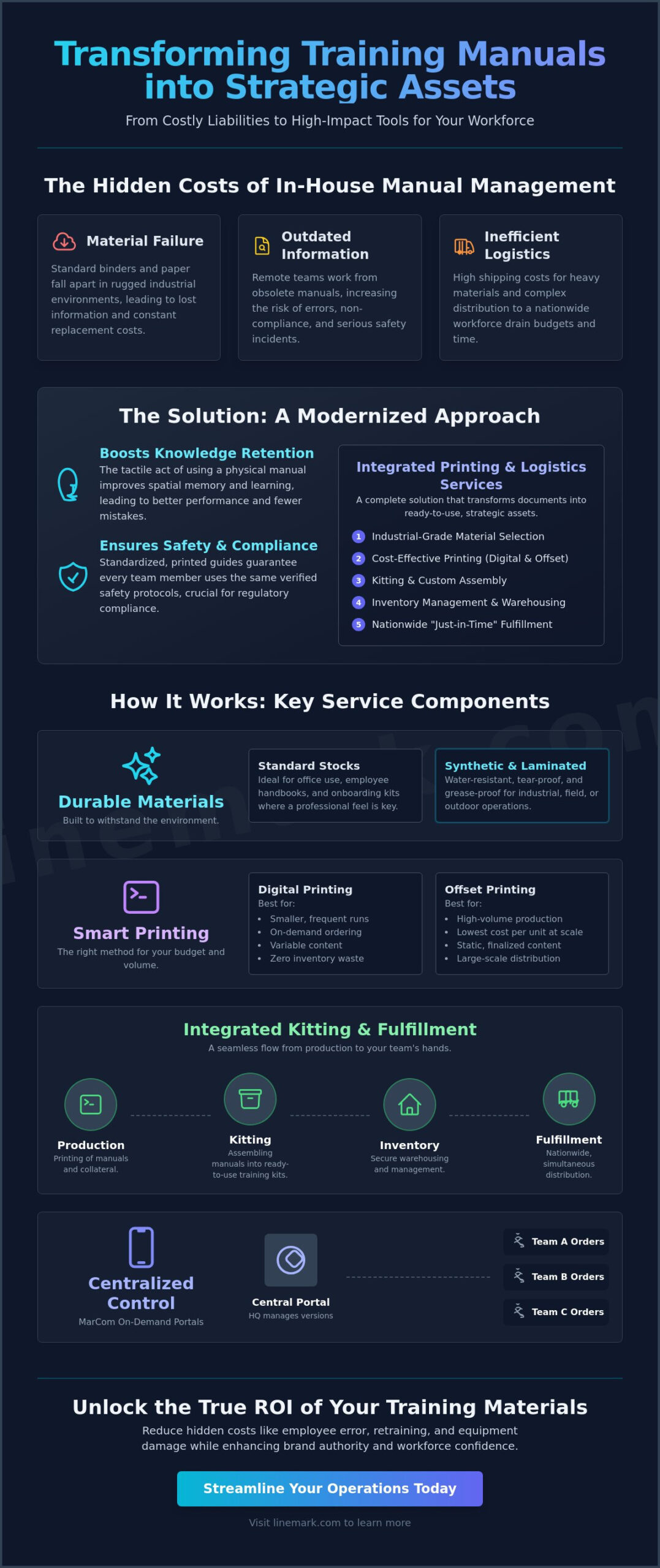
Selecting the right production method is a pivotal step in optimizing your budget for training manual printing services. It’s not just about the final look; it’s about the math behind the machine. Digital and offset printing each offer distinct advantages that depend heavily on your project’s scale, timeline, and level of customization. Understanding these technical differences allows you to make an informed decision that aligns with your organization’s financial and operational goals.
Digital printing has revolutionized the speed and flexibility of modern production. It operates without the need for physical plates, which eliminates the initial setup costs that typically inflate the price of short runs. This technology is the engine behind “just-in-time” delivery. If your training content changes frequently, digital allows you to print exactly what you need without the risk of creating obsolete inventory. It’s an agile solution for companies that prioritize speed and version control over sheer volume.
Offset printing remains the industry standard for high-volume efficiency. This process involves transferring ink from a plate to a rubber blanket before it hits the paper. While the setup requires more time and a higher initial investment, the cost per unit drops dramatically as the quantity increases. Typically, the transition point where offset becomes more economical than digital occurs when your run exceeds several hundred units. For national rollouts or evergreen manuals that remain unchanged for long periods, offset is the most cost-effective path to large-scale distribution.
Variable Data Printing (VDP) is a digital-only innovation that adds a layer of sophistication to your training materials. It allows you to inject unique data points into each manual during the print cycle. You can include a trainee’s name, their specific department’s QR code, or facility-specific instructions without stopping the press. This level of personalization transforms a generic document into a tailored learning tool, increasing engagement and accountability among your workforce.
When to Choose Digital Printing
Digital is the ideal choice for short-run requirements, such as specialized workshops or pilot programs where you only need a limited number of copies. It’s also the best solution for rapid turnaround needs. If an update is required for an “overnight” training session, digital can meet that deadline. The personalization options for individual trainees through data-driven workflows make it a powerful tool for modern, high-touch onboarding experiences.
The Case for Large-Scale Offset Production
Offset is the strategic choice for high-volume national rollouts where the unit cost is your primary KPI. It provides superior color accuracy, which is essential if your brand standards require exact Pantone matches for logos and corporate colors. For manuals that serve as “evergreen” resources, printing a large batch via offset and utilizing inventory management for long-term storage ensures you always have high-quality materials ready for recurring needs.
Beyond the Press: Kitting, Fulfillment, and Nationwide Distribution
Professional training manual printing services reach their full potential when combined with sophisticated kitting and fulfillment strategies. A manual sitting on a warehouse shelf has no value until it reaches the hands of a trainee at the exact moment it’s needed. By treating production as a logistics challenge rather than a simple print job, organizations can synchronize nationwide rollouts across multiple facilities simultaneously. This integrated approach ensures that every employee, regardless of location, receives identical, high-quality materials on day one. It removes the variability that often plagues decentralized training efforts.
Outsourcing these complex tasks to a strategic partner significantly reduces the operational burden on internal HR and marketing departments. Instead of diverting valuable staff time to manual assembly, packing, and shipping, your teams can focus on content development and high-level strategy. Secure, climate-controlled warehousing for bulk printed assets further protects your investment; it ensures that high-volume offset runs remain in pristine condition until they’re dispatched. This centralized control model provides a level of precision and reliability that in-house efforts simply can’t match.
The Art of the Training Kit
Kitting transforms a single document into a comprehensive “training in a box” experience. This involves integrating your printed manuals with supplemental items like branded pens, USB drives containing digital backups, or specialized brochures. Custom packaging and structural inserts protect these items during transit while creating a premium first impression for new hires. Our extensive direct mail logistics expertise allows us to navigate complex distribution networks with the same precision used for high-volume marketing campaigns. This ensures your training kits arrive intact and on schedule, every time.
Inventory Management and Just-In-Time Delivery
Effective distribution relies on real-time visibility into your stock levels. Modern inventory management systems provide automated tracking, allowing you to monitor usage patterns and prevent training delays before they occur. By setting automated reordering triggers based on historical data, you can maintain a lean supply chain that supports just-in-time delivery. This precision also helps reduce the carbon footprint of your distribution by optimizing shipping routes and reducing the need for emergency expedited freight. This alignment with 2026 sustainability goals, such as the EU Packaging and Packaging Waste Regulation standards for efficient material use, is a core component of our operational model. To see how we can streamline your distribution, explore our comprehensive kitting & fulfillment solutions today.
Streamlining Operations with MarCom On-Demand Training Portals
The final pillar of a scalable strategy for training manual printing services is the digital infrastructure that governs the entire process. Web-to-print portals have emerged as the definitive solution for version control in an era of rapidly evolving technical standards. These platforms act as a centralized command center where your most current training assets live in a print-ready state. By moving away from manual order forms and email chains, organizations eliminate the risk of printing obsolete content. When a manual is updated in the portal, the change is instantaneous across the entire network, ensuring that the next order placed by a regional facility contains the latest protocols and safety data.
This model balances decentralized ordering with strict centralized control. Regional managers can access the portal to request the specific materials they need for upcoming workshops, yet the brand’s integrity remains protected through pre-approved templates and standardized specifications. This approach stops “rogue” printing at local shops where quality and branding often deviate from corporate standards. The portal also provides a level of transparency that traditional procurement lacks. Stakeholders can access real-time reporting on spend management, usage patterns, and inventory levels, allowing for more accurate budget forecasting and a significant reduction in wasted materials.
The Power of MarCom On-Demand
Empowering regional leaders through a dedicated portal removes the administrative bottleneck from your central HR or marketing departments. Managers can order onboarding kits or technical guides as needed, with the system handling the technical details of production and fulfillment automatically. We customize these portals to reflect your corporate identity, creating a seamless user experience that feels like an internal tool rather than a third-party service. This integration ensures that the most current version of a manual is always the one being produced, which is critical for maintaining compliance with the evolving 2026 global standards mentioned earlier in this guide.
Quality Assurance in a High-Capacity Environment
Scalability doesn’t mean a move toward generic, low-touch production. Our approach combines the meticulous attention to detail of a boutique shop with the power of an industrial-scale operation. Every project undergoes a technical file review to verify that high-resolution results are achieved on every page, regardless of the run size. This commitment to precision is backed by a physical infrastructure designed for growth; our 90,000-square-foot facility provides the high-capacity environment necessary to scale your training manual printing services from a local pilot program to a nationwide rollout with absolute consistency. By combining this technical breadth with an agile problem-solving spirit, we serve as a strategic ally that ensures your training materials remain as professional and durable as the brand they represent.
Future-Proofing Your Training Infrastructure
Modern workforce development requires a shift from viewing documents as static objects to seeing them as dynamic, scalable assets. Throughout this guide, we’ve explored how the intersection of durable specifications, cost-effective production, and streamlined distribution creates a more resilient training ecosystem. Whether you’re navigating the complexities of 2026 global regulations or managing a nationwide rollout, your choice of training manual printing services is a critical component of operational success.
We provide a unified partnership backed by 30+ years of industrial printing expertise. Our advanced 90,000-square-foot production facility and proprietary MarCom On-Demand technology ensure your projects scale with precision and boutique-level attention to detail. We’re ready to help you transform your instructional materials into high-impact tools that drive brand authority and employee performance.
Request a Strategic Consultation for Your Training Manual Project today and let’s build a solution that grows alongside your organization.
Frequently Asked Questions
What is the best binding for a training manual that will be used daily?
Plastic coil or Wire-O binding are the most effective choices for manuals that require daily handling. These methods allow the document to lay completely flat on a desk or workbench, which is essential for hands-free operation. This durability prevents the spine from cracking over time and ensures that pages can be turned 360 degrees without damaging the paper or the binding structure.
How can I ensure my training manuals are up to date across all national locations?
Utilizing a centralized MarCom On-Demand portal is the most reliable way to maintain version control across a distributed workforce. This technology stores your master digital files in one secure location, ensuring that regional managers only order the most current, approved version. It removes the risk of teams relying on outdated safety protocols or obsolete technical instructions that could compromise operational safety.
Can I include supplemental materials like brochures or flyers in my manual kits?
Yes, our kitting and fulfillment services are designed to integrate manuals with brochures, flyers, newsletters, and other supplemental documents. We assemble these varied components into a unified training kit before they leave our facility. This “training in a box” strategy ensures your team receives every necessary resource in a single delivery, which simplifies logistics for your internal HR and marketing departments.
What is the typical turnaround time for a high-volume training manual order?
Turnaround times vary based on the specific printing technology used and the complexity of your finishing requirements. Digital printing offers rapid turnaround for short-run updates, while high-volume offset projects require more time for plate setup and large-scale production. We coordinate these schedules within our 90,000-square-foot facility to meet your specific rollout deadlines for training manual printing services without sacrificing quality.
Should I use digital or offset printing for my 500-page employee handbook?
The decision between digital and offset printing rests primarily on your total order volume. For runs under 250 units, digital printing is typically the most economical path because it avoids the initial setup costs of physical plates. However, for larger national rollouts, offset printing provides a significantly lower cost per unit. Both methods deliver the crisp text and professional color accuracy required for high-page-count corporate handbooks.
Do you offer custom tab dividers for better manual organization?
We provide fully customizable tab dividers as part of our specialized binding and finishing options. These dividers are vital for organizing complex technical guides, allowing users to navigate between sections quickly and accurately. You can specify custom titles, color-coding, and reinforced coatings to ensure the tabs remain legible and intact even after years of frequent use in rugged industrial environments.
How does a web-to-print portal help manage training manual costs?
A web-to-print portal lowers your total cost of ownership by eliminating the need for expensive, long-term warehousing of potentially obsolete materials. You can print on-demand as new hires join the company or as regional needs change. The portal also provides detailed reporting on spend management. This transparency allows your leadership to monitor usage patterns and control budgets for training manual printing services across the entire organization.
Can you handle the distribution of manuals to 50+ different office locations?
Our nationwide fulfillment infrastructure is built to manage simultaneous distribution to 50 or more unique locations with precision. We handle the entire logistics process, including secure inventory management, packing, and real-time shipment tracking. This centralized model ensures that every office receives its materials on a synchronized schedule. It also helps lower shipping costs by optimizing logistics routes and reducing the need for emergency, ad-hoc deliveries.