

 02/25/2026
  Steve Bearden
Budgeting for a major print project can feel like navigating a maze of technical specifications and variable pricing, especially when you need a clear answer to a critical question: what is the true cost to print 1000 softcover books? The fear of hidden fees, the confusion of comparing quotes, and the worry of sacrificing quality for budget are common challenges that can derail even the most well-planned project. This comprehensive 2026 pricing guide is engineered to eliminate that uncertainty and provide a clear path forward.
Budgeting for a major print project can feel like navigating a maze of technical specifications and variable pricing, especially when you need a clear answer to a critical question: what is the true cost to print 1000 softcover books? The fear of hidden fees, the confusion of comparing quotes, and the worry of sacrificing quality for budget are common challenges that can derail even the most well-planned project. This comprehensive 2026 pricing guide is engineered to eliminate that uncertainty and provide a clear path forward.
Here, we will deconstruct the key variables that determine your final investment-from paper weight and trim size to cover finishes and binding methods. Our goal is to equip you with the knowledge to prepare your project for an accurate, competitive quote. You will learn to make strategic choices with confidence, ensuring you achieve the best possible quality for your budget and find a reliable partner, such as a full-service commercial printer like Micro Printing, for this project and beyond.
Here, we will deconstruct the key variables that determine your final investment-from paper weight and trim size to cover finishes and binding methods. Our goal is to equip you with the knowledge to prepare your project for an accurate, competitive quote. You will learn to make strategic choices with confidence, ensuring you achieve the best possible quality for your budget and find a reliable single-source partner for this project and beyond.
Key Takeaways
- Master the five core specifications, from paper stock to cover finishes, that give you direct control over your per-book printing budget.
- Understand why the cost to print 1000 softcover books represents a strategic investment, leveraging the economic advantages of offset printing for superior value.
- Streamline the quoting process with our 3-step pre-quote checklist, designed to help you gather the essential details for a fast, accurate project estimate.
- Access a realistic 2026 budget range for a standard softcover book run and learn how your specific project choices will influence the final price.
The Bottom Line: Ballpark Costs for 1000 Softcover Books
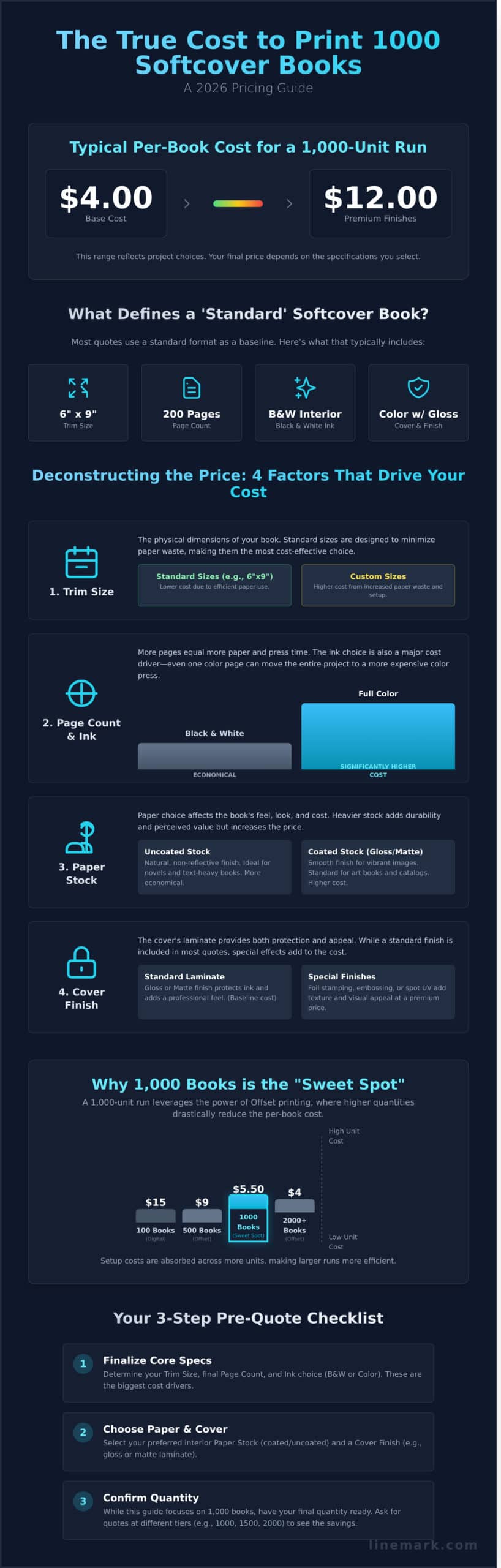
When planning your budget, understanding the foundational numbers is critical. Based on our extensive project data, the cost to print 1000 softcover books typically falls between $4.00 and $12.00 per book. This is a wide spectrum because the final investment is a direct reflection of your project’s unique specifications. Think of this range as a starting point for a strategic conversation, not a fixed price.
The per-book price, or ‘unit cost’, is heavily influenced by economies of scale. As the quantity increases, the unit cost decreases significantly, making a 1,000-book run a highly efficient choice for many projects. The ultimate price is determined by several key variables that we will explore in detail throughout this guide:
- Trim Size & Orientation
- Total Page Count
- Paper Stock & Weight
- Cover Finish & Special Effects
What Does a ‘Standard’ Softcover Book Include?
To establish a clear baseline, most initial estimates are based on a ‘standard’ book format. This industry benchmark typically includes a 6×9 inch trim size, a 200-page count with a black-and-white interior, and a full-color cover printed on sturdy stock with a gloss laminate finish. This configuration provides a reliable reference point, allowing you to see how your custom choices will impact the final project cost from a shared starting line.
Total Project Cost vs. Per-Book Cost
Your official quote from a printing partner like Linemark will present two key figures: the total project cost and the per-book (or unit) cost. While it’s tempting to focus solely on the unit cost, understanding the total investment is essential for budgeting. The total cost includes initial setup fees for plates and press calibration, which are absorbed more efficiently across larger quantities. This is a core principle of Offset printing, the technology that makes high-volume runs so cost-effective. By understanding both figures, you can accurately assess the overall cost to print 1000 softcover books while using the unit cost to compare the value of different quantities.
Deconstructing the Price: 4 Factors That Drive Your Per-Book Cost
To accurately project the cost to print 1000 softcover books, it’s essential to understand the anatomy of a printing quote. Each specification you choose directly impacts the final price. Mastering these four core areas gives you full control over your budget, allowing you to balance production quality with financial objectives. Think of these as the primary levers you can adjust to achieve the perfect outcome. A dedicated printing partner will guide you through these options, but a foundational knowledge ensures you can make strategic, cost-effective decisions from the start.
Factor 1: Trim Size
The physical dimensions of your book, or its trim size, play a significant role in material costs. Standard sizes like 5.5″ x 8.5″ and 6″ x 9″ are the most cost-effective because they are engineered to maximize the use of large parent sheets of paper, minimizing waste. Opting for a custom size can increase paper consumption and setup time, which in turn raises the per-unit cost. Even large-scale publishers like the U.S. Government Publishing Office rely on standardized formats to maintain efficiency. We advise choosing a size that not only fits your budget but also aligns with the conventions of your book’s genre, whether it’s a portable novel or an expansive workbook.
Factor 2: Page Count & Interior Ink
Your book’s total page count is one of the most direct drivers of cost-more pages mean more paper, ink, and press time. The type of ink used is equally critical. A black-and-white (B&W) interior is substantially more economical than a full-color one. It’s important to note that printing technology often requires that if even a single interior page features color, the entire book must run on a color press, which can significantly increase the overall project cost. Strategically planning your layout can yield major savings.
Factor 3: Paper Stock & Weight
The paper you choose for the interior pages affects both the tactile experience and the bottom line. The two main categories are:
- Uncoated Stock: A natural, non-reflective paper ideal for text-heavy books like novels and memoirs.
- Coated Stock (Gloss or Matte): A paper with a smooth finish that makes images and graphics appear sharp and vibrant. It’s the standard for photography books, catalogs, and manuals.
Paper weight (e.g., 50lb, 60lb, 70lb) also influences price and perception. Heavier paper increases cost but adds perceived value and durability, preventing ink from showing through on the other side.
Factor 4: Cover Finish
The cover is your book’s first impression, and its finish serves two purposes: protection and appeal. A laminate finish protects the ink from scuffs and moisture. The most common, cost-effective options are gloss lamination, which offers a shiny, vibrant look, and matte lamination, which provides a modern, non-reflective finish. While premium options like spot UV or foil stamping can create a stunning tactile effect, they are specialty processes that will add to your final cost to print 1000 softcover books.
Offset vs. Digital Printing: Why 1000 Books is the Sweet Spot
The decision between digital and offset printing is the single most significant factor impacting your project’s budget. It’s the classic warehouse store principle: buying a single box is convenient, but purchasing a full pallet yields a per-unit price that transforms the entire economic equation. When you’re assessing the cost to print 1000 softcover books, you’re standing at that exact threshold-the sweet spot where professional quality becomes exceptionally cost-effective.
When Digital Printing Makes Sense
Digital printing is engineered for agility and short runs, typically for quantities under 500 units. It operates much like a high-end office printer, transferring a digital file directly to paper without the need for plates. This method is ideal for proof copies, test marketing, or print-on-demand models where minimizing upfront investment is critical. Because there are no plates to create, turnaround times can be faster for very small quantities, though the per-book cost remains significantly higher.
The Power of Offset for 1000+ Copies
For runs of 1000 or more, offset printing is the undisputed professional standard. This process involves creating custom metal plates for your book, a significant initial setup. However, once the press is running, the cost per copy falls dramatically. This economy of scale is precisely what makes a 1000-unit run so much more efficient than printing smaller batches.
The benefits extend far beyond price. Offset delivers superior and consistent quality across every single book. The ink is absorbed into the paper rather than sitting on top of it, resulting in richer, deeper colors and crisper text-a standard of craftsmanship celebrated by institutions like the University of Iowa Center for the Book. This method also unlocks a world of customization:
- Specialty Inks: Access to the full Pantone Matching System (PMS) for perfect brand color replication.
- Wider Paper Selection: A vast array of paper weights, textures, and finishes to create a unique tactile experience.
- Unmatched Consistency: Every book in the run is a perfect replica of the first, ensuring brand integrity at scale.
Choosing offset for a 1000-book run is a strategic decision that prioritizes both long-term economic value and uncompromising professional quality.
Your Pre-Quote Checklist: How to Get an Accurate Price, Fast
Moving from a budget estimate to a firm production quote is a critical step. To receive the most accurate cost to print 1000 softcover books, a prepared client is a successful client. This three-step checklist is your action plan, designed to organize your project details so you can engage a printing partner with confidence and clarity, ensuring a seamless transition into production.
Step 1: Finalize Your Manuscript
The single most significant factor in your printing cost is the final page count. Before requesting a quote, your manuscript should be complete-professionally edited, proofread, and formatted. Any changes to the page count after a quote is issued will require a requote, potentially delaying your timeline. Having your final, press-ready PDF complete ensures the initial quote reflects the true project scope and provides a reliable number for your budget.
Step 2: Define Your Specifications
A printer needs precise details to build an accurate quote. The decisions you made in the previous section now become your project’s blueprint. Have your primary choices-and if possible, a backup for flexibility-ready for the following specifications:
- Trim Size: The final dimensions of your book (e.g., 6″ x 9″).
- Interior Paper Stock: The weight and finish for your inside pages (e.g., 60# uncoated white).
- Cover Stock & Finish: The weight of the cover paper and the desired laminate (e.g., 12pt C1S with a matte finish).
- Ink: Black and white or full color (CMYK) for the interior and cover.
- Binding Type: Perfect bound is the standard for most softcover books.
Step 3: Prepare Your Print-Ready Files
Technical file preparation is non-negotiable for a quality result. Your design files for both the interior pages and the cover must be high-resolution, with all images set to a minimum of 300 DPI (dots per inch). Furthermore, files must be correctly formatted with proper bleed (extending the artwork beyond the trim line) and safe margins to prevent critical content from being cut off during trimming. For a detailed walkthrough, review our comprehensive File Preparation Guide.
With a finalized manuscript, defined specifications, and properly prepared files, you are perfectly positioned to receive a fast, precise quote. This level of preparation demonstrates a commitment to quality and streamlines the entire production process. When you are ready to transform your project from a plan into a tangible product, our team is ready to assist. Request your customized quote from LineMark today.
Partner with Linemark for a Seamless Softcover Book Run
Understanding the variables that influence your printing budget is the first step. The next is choosing a partner who can navigate them with you to achieve a flawless final product. For over 30 years, Linemark has been the trusted, US-based partner for businesses, publishers, and creators seeking high-quality custom book printing. We move beyond simple transactions to build strategic partnerships, ensuring your project is executed with precision from start to finish.
The Linemark difference is our commitment to being a single-source solution. We combine decades of expertise with cutting-edge technology to manage every aspect of your book’s lifecycle under one roof.
Expert Guidance Through Every Choice
Our team doesn’t just take your order; we collaborate with you to optimize it. We’ll guide you through paper weights, binding options, and finishing touches to align the final product with your vision and budget. Whether your project is best suited for our advanced offset presses for large runs or our state-of-the-art digital presses for customized orders, we guarantee exceptional quality and consistency every time.
More Than a Printer: A Fulfillment Partner
Your book’s journey doesn’t end when the ink is dry. As a fully integrated printing and fulfillment partner, we offer a streamlined solution that saves you time, money, and logistical headaches. By printing, warehousing, and shipping your books directly from our facility, we create a more efficient supply chain.
- Reduce Costs: Eliminate the extra expense of shipping pallets of books from a printer to a separate fulfillment center.
- Save Time: Get your books into the hands of your readers faster with a coordinated print-and-ship process.
- Simplify Logistics: Manage your entire inventory and distribution with a single point of contact and a unified system.
Request Your Custom Quote Today
While this guide provides a solid overview, the only way to determine the exact cost to print 1000 softcover books is with a quote tailored to your project’s unique specifications. Our team is ready to provide a detailed, transparent estimate based on your specific needs.
Take the next step toward bringing your softcover book to life. Get a precise, no-obligation quote for your book printing project.
Your Partner in Print: Bringing Your Softcover Book to Life
As we’ve explored, the final cost to print 1000 softcover books is a dynamic figure shaped by key decisions in trim size, paper stock, and binding. This quantity represents a strategic sweet spot where the superior quality and per-unit efficiency of offset printing become truly accessible. Understanding these variables is the first step toward a successful and cost-effective print run.
The next step is partnering with an expert who can navigate these details with precision. With over 30 years of printing expertise, Linemark leverages advanced offset and digital technology to deliver exceptional results. As your single-source partner for printing, warehousing, and fulfillment, we transform complexity into a seamless process. Ready to see what the Linemark difference means for your project? Request a custom quote for your softcover book project.
Let’s work together to bring your vision from the screen to the printed page with confidence and clarity.
Frequently Asked Questions About Printing Softcover Books
What is the difference between a softcover and a paperback book?
The terms “softcover” and “paperback” are largely interchangeable in the publishing industry. Both refer to books with a flexible paperboard cover, as opposed to a rigid hardcover. At LineMark, we use “softcover” to describe the technical construction of the book, which typically involves perfect binding. This method provides a durable, high-quality finish for a wide range of projects, from trade paperbacks to corporate manuals, ensuring a professional appearance that aligns with your brand’s standards.
How long does it take to print 1000 softcover books?
Our standard production timeline for 1000 softcover books is typically 7-10 business days after final proof approval. This timeframe allows for meticulous printing, binding, and quality assurance. Timelines can be influenced by custom finishes or complex specifications. We provide a precise production schedule with every project quote, ensuring complete transparency and alignment with your launch or distribution deadlines. Our streamlined workflow is engineered for both speed and precision, delivering quality on schedule.
Can I get a printed sample or proof before the full run?
Absolutely. We consider proofing a critical step for quality assurance. We offer both digital proofs (PDFs) for content and layout review, and hard-copy printed proofs for a tangible assessment of color, paper stock, and finish. A printed proof allows you to approve the final product with complete confidence before we proceed with the full production run. This process is integral to the LineMark experience, guaranteeing the final output precisely matches your vision.
What is the minimum number of books I can order?
While we specialize in high-volume projects, our advanced digital printing technology allows for scalable solutions. We can accommodate short runs starting at 100 units. For larger quantities, where the cost to print 1000 softcover books becomes more efficient, we utilize offset printing for optimal value. Our team will advise on the most effective production method to meet your specific quantity requirements and budget, ensuring a customized and scalable solution.
Do you offer distribution and fulfillment services for self-publishers?
Yes, we provide comprehensive, integrated fulfillment and distribution services. Beyond printing, LineMark acts as your single-source partner for logistics. Our capabilities include secure warehousing, inventory management, pick-and-pack order fulfillment, and direct shipping to individual customers or retailers. This seamless integration streamlines your supply chain, reduces administrative burden, and allows you to focus on marketing and sales while we handle the operational complexities with precision and care.
What are the most common mistakes to avoid when preparing a book for print?
The most frequent issues we see involve file preparation. Key mistakes include submitting low-resolution images (below 300 DPI), which result in a pixelated final product, and failing to include proper bleed and safety margins in the design files. Another common oversight is providing files in RGB color mode instead of the industry-standard CMYK. Our pre-press team meticulously reviews every file to catch these issues, ensuring your project is perfectly optimized for professional printing.
How much does shipping typically cost for 1000 books?
Shipping expenses are a variable component of the total cost to print 1000 softcover books. The final price depends on the total weight of the shipment (determined by page count and paper stock), the destination, and the required delivery speed (e.g., ground vs. freight). As part of our comprehensive project management, we provide a detailed shipping quote based on your specific needs, leveraging our logistics network to secure competitive rates for you.
What is ‘perfect binding’ and is it right for my softcover book?
Perfect binding is the industry standard for softcover books. In this process, the pages and a wrap-around cover are securely bonded together at the spine with a strong yet flexible thermal glue. The other three sides are then trimmed to create a clean, “perfect” edge. This method is ideal for books with 40 pages or more, offering a professional, high-end appearance with a flat, printable spine. It provides the durability and polished look required for novels, manuals, and catalogs.