


 09/08/2026
  Steve Bearden
In July 2026, the average cost of mailing services climbed by 4.8 percent, pushing the price of a Forever stamp to 82 cents and tightening the margins for high-volume mailers across the nation. You likely feel the pressure of these rising usps marketing mail rates as you plan your upcoming fiscal quarters. It’s a common frustration to see complex automation requirements and design nuances threaten to derail a carefully constructed marketing budget. When postage accounts for a significant portion of your project spend, even a minor miscalculation in mail piece dimensions or barcoding can lead to costly budget overruns.
We believe that postage is a variable cost that can be engineered downward through strategic design and data precision. This guide will empower you to master the 2026 rate structure, transforming postage from an unpredictable expense into a precisely controlled asset for maximum ROI. We will break down the specific costs for letters and flats, explore the significant discounts available through deeper saturation, and provide a roadmap for seamless execution from the print floor to the final delivery unit. By the end of this article, you’ll have the technical insights needed to secure lower cost-per-piece rates and ensure your communications reach their destination with industrial-grade efficiency.
Key Takeaways
- Understand the core shifts in the 2026 USPS ‘Delivering for America’ initiative and how they redefine commercial mailing strategies for high-volume projects.
- Navigate the latest usps marketing mail rates by evaluating the cost-efficiency of standard letters versus flat-sized mail pieces for your specific campaign volume.
- Implement rigorous address standardization and NCOA protocols to qualify for the most aggressive automation discounts available in the current year.
- Master the balance between premium print quality and postage costs by optimizing paper weights and dimensions to prevent costly non-machinable surcharges.
- Leverage centralized production and digital portals to reduce logistical friction, ensuring a seamless journey from initial design to nationwide delivery.
What is USPS Marketing Mail? Understanding the 2026 Framework
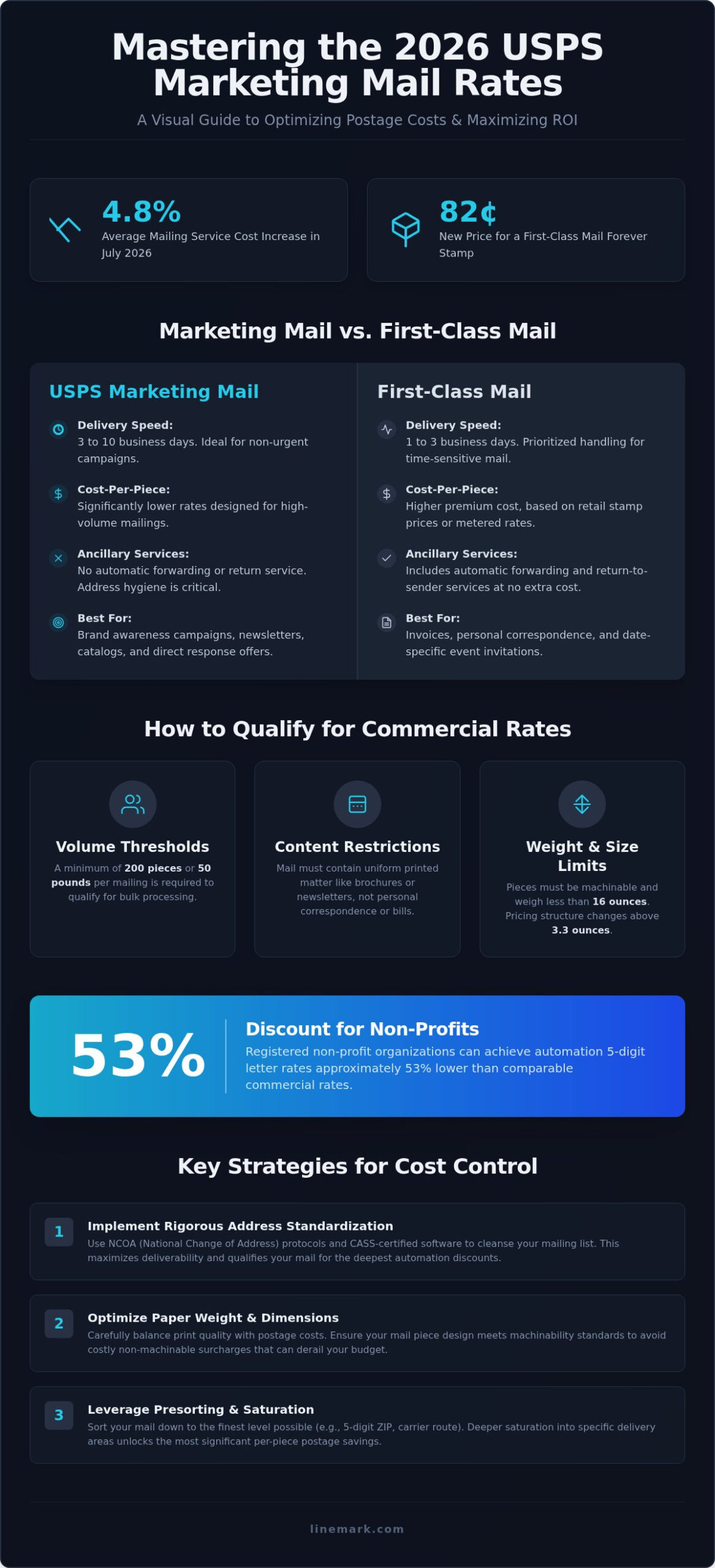
Marketing Mail represents a specialized postage class engineered for organizations that prioritize scale and cost-efficiency. It’s often referred to as “bulk mail” because it requires a minimum volume of 200 pieces or 50 pounds per mailing. As part of the 2026 “Delivering for America” initiative, the USPS has implemented more frequent rate adjustments to stabilize its infrastructure. This means that staying competitive requires a technical understanding of how What is USPS Marketing Mail? fits into a broader distribution strategy.
Retailers, non-profits, and corporate communication teams use this class to drive growth without the premium cost of individual stamps. The July 2026 rate adjustment saw an average increase of 4.8 percent across mailing services, making precision in mail preparation more critical than ever. Non-profit organizations benefit significantly here, as their automation 5-digit letter rates are approximately 53 percent lower than comparable commercial rates. By leveraging industrial-scale presorting and automation, you can mitigate these rising usps marketing mail rates and maintain a predictable budget.
To better understand how bulk mail operations function within a high-tech facility, watch this helpful video:
Marketing Mail vs. First-Class: A Strategic Comparison
The primary trade-off between these two classes involves speed and ancillary services. First-Class Mail is designed for time-sensitive documents like invoices or personal correspondence, offering delivery within one to three business days. In contrast, Marketing Mail typically arrives within three to ten business days. While First-Class includes automatic forwarding and return-to-sender services, Marketing Mail does not. This is why it’s essential to maintain a clean database to avoid wasting budget on undeliverable addresses.
For high-volume marketing campaigns where the focus is on a lower cost-per-piece, the savings offered by usps marketing mail rates usually outweigh the slower delivery window. If your campaign is tied to a specific date, such as a grand opening or a flash sale, you might choose First-Class to guarantee arrival. However, for most brand awareness and direct response efforts, the bulk structure provides the best ROI.
Eligibility Requirements for Commercial Rates
Qualifying for commercial pricing isn’t just about volume; it’s about preparation. To access the lowest rates, your mail pieces must meet strict machinability and sorting standards.
- Volume Thresholds: You must present at least 200 pieces or 50 pounds of mail at a single time. This allows the USPS to process the mail using automated equipment rather than manual sorting.
- Content Restrictions: The material must be uniform printed matter, such as brochures, newsletters, or catalogs. It cannot contain personal correspondence or bills, which are reserved for First-Class.
- Weight and Break Points: Pieces must weigh less than 16 ounces. Once a mail piece exceeds the 3.3-ounce “break point,” the pricing structure shifts from a flat per-piece rate to a combined per-piece and per-pound calculation.
Our role as a strategic ally is to help you navigate these technical thresholds before the first sheet is printed. We ensure your designs align with automation requirements, preventing the “non-machinable” surcharges that can erode your ROI. High-capacity operations require this level of precision to turn a logistical challenge into a scalable solution.
2026 USPS Marketing Mail Rate Structure: Letters vs. Flats
The July 12, 2026, rate adjustment introduced a 4.8 percent average increase across mailing services, fundamentally altering the economics of bulk distribution. For high-volume mailers, understanding the distinction between letter-size pieces and flats is the first step in protecting campaign margins. While both formats fall under the same postage class, their usps marketing mail rates diverge significantly based on how easily they move through automated sorting equipment. Precision in the design phase ensures that your project remains in the most cost-effective pricing tier.
Letter-Size Mail: The Sweet Spot for ROI
Letters remain the most efficient vehicle for direct mail due to their high compatibility with USPS automation. In 2026, the rate for a Commercial Automation 5-Digit presort letter starts at $0.395 per piece. To secure this rate, your mail piece must adhere to strict dimensional standards, typically ranging from 3.5 by 5 inches to 6.125 by 11.5 inches. It’s also vital to monitor the aspect ratio. If the length divided by the height doesn’t fall between 1.3 and 2.5, the piece is classified as non-machinable, triggering a surcharge that can erode your savings.
Standard letters can weigh up to 3.5 ounces without increasing the per-piece price, providing ample room for multi-page inserts or heavy cardstock. However, once you transition to “heavy letters” or non-automated pieces, the pricing structure shifts. We focus on engineering mail pieces that maximize weight allowances while maintaining the physical integrity required for high-speed processing. This technical balance is where industrial authority meets marketing strategy, allowing for complex direct mail campaigns that don’t sacrifice quality for cost.
Flats and Oversized Mailers
When your communication requires more visual real estate, such as a catalog or a large-format newsletter, you move into the “Flats” category. These pieces offer a larger canvas but come with higher usps marketing mail rates. For example, Automation 5-Digit flats in 2026 range from $0.742 to $0.783. Beyond the higher base cost, flats must meet specific “flexibility” tests. If a mail piece is too rigid or contains uneven contents, it may be reclassified as a parcel, significantly increasing the postage spend.
Budgeting for these larger formats requires a keen eye on the weight break point. For saturation flats, the per-piece rate typically covers items up to 3.3 ounces. Once a piece exceeds 4 ounces, the USPS applies a pound-rate calculation that adds a variable cost to each item. To mitigate these expenses, many organizations look for alternative entry strategies. You can learn How to Qualify for the Lowest Commercial Postage Rates by exploring programs like EDDM-Retail, which currently sits at $0.260 per piece for eligible flats. Our team acts as a strategic communications ally, helping you determine if the increased engagement of a larger format justifies the higher postage investment or if a streamlined letter-size design provides a better path to your end goals.
How to Qualify for the Lowest Commercial Postage Rates
Securing the most competitive usps marketing mail rates in 2026 requires more than just meeting volume thresholds. It demands a technical commitment to data hygiene and address precision. The USPS rewards mailers who reduce “undeliverable-as-addressed” (UAA) mail because it minimizes the strain on their sorting infrastructure. Coding Accuracy Support System (CASS) certification ensures your addresses are valid and complete, while National Change of Address (NCOA) processing is a mandatory step for 2026 commercial mailings. These updates ensure your list reflects the latest relocation data, keeping your postage costs in the lower automation tiers rather than the more expensive non-automation categories.
We leverage industrial technology like MarCom On-Demand to streamline the intersection of data and design. By presorting your mail at our facility, we offload the labor the USPS would otherwise perform. This collaborative approach allows you to capture deep discounts while ensuring your message remains highly personalized for every recipient. When your data is clean and your mail is presorted, you aren’t just sending a message; you’re operating a high-efficiency logistics engine that protects your campaign ROI.
Automation and Barcoding Requirements
The Intelligent Mail Barcode (IMb) is the backbone of modern postage discounts. In 2026, a valid IMb is non-negotiable for anyone seeking automation 5-digit or AADC rates. This barcode tracks each piece through the postal system, providing visibility that was once impossible. Address accuracy standards have tightened, requiring mailers to prove their lists are current within 95 days of the mailing date. Meeting these standards directly reduces your per-piece cost by allowing the mail to bypass manual sorting. It’s a precise, technology-driven process that ensures your project moves through the system with industrial speed.
Destination Entry Discounts (SCF and NDC)
Strategic mailers often bypass the initial postal processing centers entirely through “drop shipping.” This involves transporting your mail directly to a Sectional Center Facility (SCF) or Network Distribution Center (NDC) closer to the final delivery destination. By entering the mail deeper into the USPS network, you qualify for Destination Entry discounts that further lower your usps marketing mail rates. For example, entering letters at a DSCF can significantly reduce your base rate compared to a standard entry point. Managing these logistics across a national campaign requires a centralized partner capable of handling both high-volume production and complex distribution schedules without sacrificing precision.
Strategic Budgeting: Balancing Print Quality and Postage Costs
Effective budgeting for high-volume campaigns requires looking beyond the raw usps marketing mail rates to understand the total cost of ownership. While postage is a regulatory variable, your print specifications are where you can engineer significant savings. A premium brand experience doesn’t always require the heaviest paper stock; it requires a technical understanding of how physical attributes like weight and thickness interact with postal equipment. By optimizing these elements at our 90,000-square-foot facility, we help you maintain industrial-grade quality while staying within the most favorable postage tiers.
The true measure of success isn’t the lowest cost per piece, but the lowest total cost per response. This is where the synergy between Direct Mail and Variable Data Printing (VDP) becomes a catalyst for growth. Personalizing content for every recipient increases engagement and conversion rates, effectively lowering the relative impact of postage on your bottom line. When your message is relevant, the investment in postage yields a much higher return, transforming a logistical necessity into a high-performance marketing asset.
Paper Weight and Thickness Optimization
Selecting the right substrate is a critical decision in the design phase. For letters, the USPS allows pieces to weigh up to 3.5 ounces without a price increase, but the “caliper” or thickness must remain within specific limits to pass through automated sorters. A piece that’s too thin may lack the rigidity for high-speed processing, while a piece that’s too thick might be reclassified as a flat. Specialized finishes like UV or matte coatings add a tactile sense of luxury, but they must be applied with precision to ensure they don’t interfere with the Intelligent Mail barcode readability. We guide you through these technical nuances to ensure your mail feels premium without triggering non-machinable surcharges.
Format Innovation: Postcards vs. Envelopes
Postcards remain one of the most efficient ways to reach a national audience, offering a lower entry price and immediate visual impact. For organizations looking to break through the noise, leveraging large format graphics in a self-mailer configuration can drive massive open rates. However, these larger formats must adhere to the 2026 tabbing requirements to remain machinable. Using the correct number and placement of translucent tabs prevents the mail piece from opening during sorting, which is essential for maintaining your usps marketing mail rates. Choosing the right format is a strategic balance between the “real estate” needed for your message and the logistical constraints of the postal system.
If you’re ready to optimize your next high-volume project for maximum efficiency, consult with our direct mail strategists to review your piece design before you go to print.
Partnering with a Strategic Communications Ally for 2026
Managing high-volume campaigns against the backdrop of fluctuating usps marketing mail rates requires more than just a vendor; it requires a strategic communications ally. A centralized print-and-mail provider eliminates the logistical friction that often occurs when moving a project between a creative agency, a production facility, and a separate mail house. By unifying these stages, you ensure that technical requirements for automation are integrated into the design from the very first proof. This collaborative approach minimizes the risk of budget overruns and ensures your message reaches its destination with industrial precision.
Innovation is a core pillar of our operational model. Through MarCom On-Demand portals, distributed marketing teams can manage complex inventories and trigger targeted mailings with ease. This technology allows for rapid scaling of national efforts while maintaining the meticulous attention to detail typically found in boutique shops. It’s a data-driven approach that turns the complexity of bulk postage into a streamlined, predictable process, positioning your organization for sustainable growth in 2026.
Integrated Direct Mail Fulfillment
Our 90,000-square-foot production facility is engineered to handle diverse and complex projects, ranging from high-impact custom book printing to massive nationwide direct mail distributions. With over 30 years of industrial experience, we’ve refined a holistic journey that includes real-time tracking and reporting for every campaign. This level of transparency provides confidence that your project is moving through the USPS system as efficiently as possible. Whether you’re sending a few thousand specialized catalogs or millions of postcards, our high-capacity operations ensure your project stays on schedule and within budget.
Getting Started: The RFP and Planning Process
Transitioning from a transactional vendor relationship to a strategic partnership begins with a comprehensive planning process. When preparing your RFP, providing detailed specifications regarding paper weight, dimensions, and intended delivery dates allows us to generate an accurate direct mail quote. Our consultative planning focuses on designing for the lowest possible rate, identifying opportunities for drop shipping or automation that others might overlook. We don’t just print your materials; we engineer them for success within the current postal landscape. We invite you to Contact Linemark for a Strategic Direct Mail Consultation to begin optimizing your 2026 outreach strategies.
Optimizing Your Mail Strategy for a Competitive 2026
Mastering the complexities of usps marketing mail rates is no longer just an administrative task; it’s a strategic imperative for high-volume growth. By engineering your mail pieces for automation and maintaining rigorous data hygiene, you transform postage from a rising expense into a controlled investment. We’ve explored how technical precision in design and a commitment to address accuracy can secure the lowest possible cost-per-piece while maximizing engagement through variable data personalization. These steps ensure your marketing budget remains predictable and effective throughout the year.
Success in this evolving landscape requires a partner who combines industrial capacity with an agile approach to problem-solving. With 30+ years of direct mail expertise and a 90,000-square-foot integrated print and logistics facility, we’re ready to handle your most complex, high-volume projects with meticulous precision. Our variable data capabilities ensure every piece is a catalyst for your brand’s growth, backed by a well-oiled machine that manages the journey from print floor to final delivery. It’s time to move beyond transactional mailing and embrace a unified partnership that delivers results.
Scale Your Direct Mail Strategy with Linemark and ensure your 2026 campaigns reach their full potential with confidence.
Frequently Asked Questions
What is the difference between USPS Marketing Mail and Standard Mail?
USPS Marketing Mail is simply the modern name for what was formerly called Standard Mail. The postal service rebranded this class in 2017 to better describe its primary function as a vehicle for advertising and bulk communications. It remains the most cost-effective way to send newsletters, brochures, and catalogs. While the name has changed, the core mission of providing deep postage discounts for high-volume, non-personal mailings remains the same for commercial organizations.
How much did USPS Marketing Mail rates increase in 2026?
In July 2026, the USPS implemented an average price increase of 4.8 percent across its mailing services. This adjustment raised the cost of a Forever stamp to 82 cents and impacted all commercial bulk tiers. Staying informed about these usps marketing mail rates is essential for maintaining an accurate marketing budget. These periodic adjustments are part of a long-term plan to stabilize the postal infrastructure and ensure nationwide operational reliability for high-volume mailers.
What is the minimum number of pieces for USPS Marketing Mail?
To qualify for these discounted rates, you must mail at least 200 pieces or 50 pounds of mail at a single time. This threshold allows the postal system to process your items through high-speed automated equipment rather than manual sorting. For high-volume campaigns, this minimum is easily met, enabling organizations to leverage industrial-scale distribution. Meeting this requirement is the first step toward transforming a standard mailing into a scalable, data-driven marketing asset that protects your ROI.
Can I use USPS Marketing Mail for international addresses?
USPS Marketing Mail is strictly for domestic addresses within the United States and its territories. It cannot be used for international mailings. If your campaign requires global reach, you must utilize First-Class Mail International or other specialized shipping services. Our nationwide distribution capabilities focus on optimizing your domestic outreach, ensuring that your message reaches every corner of the country with the precision and reliability that high-capacity marketing demands.
How does ‘presorting’ actually lower my postage rates?
Presorting involves organizing your mail by ZIP code or delivery route before it arrives at the post office. By performing this labor ourselves at our 90,000-square-foot facility, we reduce the handling time required by the USPS. The postal service rewards this efficiency with lower usps marketing mail rates, as they can bypass their own sorting stages. It is a collaborative process where industrial technology and logistics expertise work together to drive down your total cost per piece.
What are the weight limits for a standard marketing mail letter?
A standard marketing mail letter can weigh up to 3.5 ounces while still qualifying for the base per-piece automation rate. This generous limit allows for multiple inserts or heavy cardstock without increasing your postage spend. Once a piece exceeds 16 ounces, it no longer qualifies as Marketing Mail and must be sent via a different class. Managing these weight thresholds is a technical skill that helps you balance premium print quality with logistical efficiency for national campaigns.
What is an Intelligent Mail Barcode and why do I need it?
The Intelligent Mail Barcode is a 65-bar code that provides the USPS with the destination, mailer ID, and service type for every piece. You need it because it is a mandatory prerequisite for accessing automation-tier discounts. Beyond the cost savings, the IMb allows for real-time tracking and reporting across high-volume campaigns. It represents the intersection of physical mail and digital data, providing the visibility required to manage complex marketing efforts with industrial authority and precision.
How long does it take for USPS Marketing Mail to be delivered in 2026?
Marketing Mail delivery typically takes between three and ten business days, depending on the distance and entry point. While this is slower than First-Class Mail, the significant cost savings make it the preferred choice for bulk communications that aren’t time-sensitive. By entering mail closer to its final destination through SCF facilities, we can often improve these transit times. This strategic approach ensures your message arrives within a predictable window without sacrificing your project’s bottom line.