

 10/14/2026
  Steve Bearden
A printed book doesn’t have to begin with a large inventory. With self-published book printing, print-on-demand (POD) can produce a single copy when a customer places an order, so books are printed as they’re needed. That makes print practical even if you’re not planning a large run.
Choosing print still involves decisions that shape how the finished book looks and functions. Paper affects the pages’ appearance and weight, while trim size and binding influence the reading experience and overall presentation.
This guide explains how POD works, when print may suit your project, and how to approach paper, format, and binding choices. You’ll also learn what to consider as you prepare a book for production, helping you move from finished manuscript to physical copy with a clearer plan.
Key Takeaways
- Match trim size, paper, cover stock, and binding to your book’s content and the experience you want readers to have.
- Print-on-demand produces copies as customers order them, while volume printing suits projects planned around a larger print quantity.
- Choose binding based on how the book will be used, its page count, and the finish you want for the finished copy.
- Prepare photographs and other bitmapped graphics as .TIF files set to 300 DPI resolution, or 2 x the output device’s line screen, according to US EPA.
Why is publishing a print book a good idea?
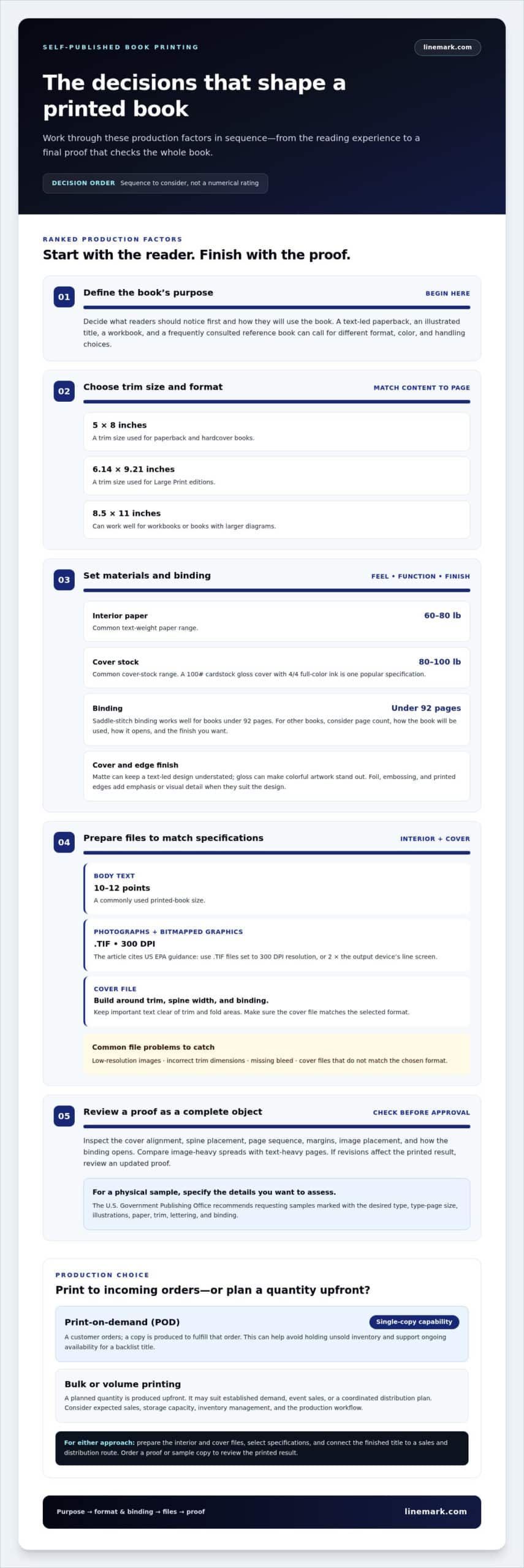
For self-published book printing, a physical edition gives readers a choice beyond digital formats. A 5 x 8 inch trim size suits paperback and hardcover books, while 6.14 x 9.21 inches is used for Large Print editions.
Common printing errors include low-resolution images, incorrect trim dimensions, missing bleed, and cover files that don’t match the chosen format. Before ordering, compare the interior and cover files with the printer’s specifications, then review a proof for text, image placement, and binding alignment.
Kristen Martin explains bookbinding types in this tutorial:
Choose materials to suit the subject and reading experience. Interiors commonly use 60 to 80 lb text-weight paper; covers often use 80 to 100 lb stock. A 100# cardstock gloss cover and 4/4 full-color ink are popular specifications. An 8.5 by 11 inch format can work well for workbooks or books with larger diagrams.
Paperback and hardcover formats create different handling and presentation. Saddle-stitch binding works well for books under 92 pages; other binding choices depend on the book’s format, page count, and intended use. Specialty cover treatments, such as foil or embossing, add texture or emphasis. Printed edges can add a visual detail when the book is closed.
Build the cover file around the chosen trim, spine width, and binding, and keep important text clear of trim and fold areas. Set body text between 10 and 12 points for a commonly used printed-book size. According to US EPA, photographs and other bitmapped graphics should use .TIF files set to 300 DPI resolution, or 2 x the output device’s line screen.
For a physical check, the U.S. Government Publishing Office recommends requesting samples marked with the desired type, type-page size, illustrations, paper, trim, lettering, and binding. Reviewing these details together helps you assess the complete finish, not just the cover.
What is print-on-demand (POD)?
Print-on-demand produces books as orders arrive, making it possible to print a single copy instead of stocking a large run. Choosing between POD and volume printing comes down to expected demand, inventory, and distribution.
Print-on-Demand and Bulk Printing
POD can print a single copy when a customer orders, helping self-publishing authors avoid holding unsold inventory. Bulk or volume printing produces a planned quantity upfront and may suit authors with established demand, event sales, or a coordinated distribution plan. Before choosing, compare how each approach fits your sales pattern, storage capacity, and preferred production workflow.
The right self-published book printing service in the United States depends on your needs. Look for a production approach, format options, and distribution workflow that fit your book. An author testing demand may value POD’s single-copy capability, while a planned release may call for a volume run.
Production and Ordering
With POD, a customer places an order and the book is produced to fulfill it. The author prepares the interior and cover files, selects the book’s specifications, and connects the finished title to a sales and distribution route. For example, authors planning to sell through Amazon should account for that channel in their ordering workflow.
This model ties production to incoming demand instead of requiring a large batch upfront. It can also support ongoing availability for a backlist title, while a premium edition or event quantity may need a separate production plan. Compare expected orders with the inventory and control needs of each approach.
Order Quantities and Print Proofs
What are the minimum order quantities for book printing? POD can produce a single copy when a customer places an order. Bulk printing is based on a planned quantity, so the right amount depends on expected sales, distribution, and how much inventory you want to manage.
To review a book before publishing, order a print proof or sample copy and inspect the cover, page sequence, image placement, and finishing. Make corrections to the files, then review an updated proof if revisions affect the printed result. Authors comparing production approaches can explore book printing options as part of planning their project.
Printing and binding customization
Customization works best when you match the book’s physical features to its purpose. A writing-focused paperback for bookstore shelves may prioritize easy handling and a clear, readable interior; an illustrated title may need color reproduction that gives artwork equal weight with text. Decide what readers should notice first, then align the cover, page design, and binding.
Think of the book as a production system, not a set of isolated options. Start with the content and intended use, choose a format and binding, then prepare the cover and interior files to match. This sequence helps prevent a cover layout from becoming unsuitable after the binding or page count changes.
Binding affects how copies open, feel, and hold together. Saddle-stitch binding works well for books under 92 pages. For a longer manuscript, compare other binding approaches against the book’s thickness, handling needs, and desired finish. A reference book that readers consult repeatedly has different practical demands from a short event program.
Cover treatments shape the first impression, while interior choices support reading. A restrained matte finish can keep a text-led design understated; gloss can make colorful artwork stand out. Consider whether a specialty treatment or printed edges strengthen the design, rather than adding detail without a clear purpose. For global audiences, prioritize legible type and visuals that remain clear in the book’s intended use.
Before approving production, review a proof as a complete object. Check the cover alignment, spine placement, page sequence, margins, and how the binding opens. Compare image-heavy spreads with text-heavy pages, since each can reveal different issues. If corrections affect the cover or interior, review the revised proof before releasing the final files.
Use this decision path: define the reading experience, select binding and finish, match files to the specifications, then inspect a proof. That practical sequence keeps each customization tied to reader value. Plan your book’s printing and binding around the format, finish, and production requirements that fit your project.
Linemark: Custom Book Printing
Linemark provides Custom Book Printing for authors turning a finished manuscript into a physical book. Bring your format, paper, cover, and binding choices together in one production plan, whether you’re preparing a single title or coordinating print materials for a broader communications project.
Turn to Linemark when you’re ready to move from files and specifications to printed copies. The team also provides Commercial Printing, Direct Mail, and Large Format Graphics for related communications needs.
Contact Linemark to discuss your book printing project.
Turn Your Manuscript Into a Production Plan
Your next step is to turn your creative vision into a clear production brief. Define how you want readers to experience the book, the role the printed edition will play in your publishing plan, and which decisions need to remain flexible as the project progresses. A focused brief helps keep design and production aligned.
Linemark offers Custom Book Printing, with Direct Mail and Large Format Graphics for authors planning related launch communications. These services can serve different roles, from putting a book in readers’ hands to giving an event or promotion a physical presence. Consider them when planning a coordinated publishing experience, not as automatic additions to every project.
For authors ready to move from planning to production, contact Linemark about your book. A conversation about your self-published book printing project can help turn your priorities into a practical next step. Your book is taking shape; keep the momentum going and bring your publishing vision closer to print.
Frequently Asked Questions
How fast can I get my books?
Production and delivery timing depend on the print method, book specifications, proof approval, and shipping. To plan for a launch or event, work backward from the date books need to arrive. Set milestones for completing files, reviewing a proof, approving production, and delivery. Leave room for corrections, especially if revised artwork or text changes the final files.
What about quality?
Quality depends on how well the finished copy matches the approved files and intended reading experience. Review a printed proof under good lighting, checking small type, image detail, color consistency, page order, and cover alignment with the spine. For example, inspect a full-color illustration beside a text-heavy page. Comparing them can reveal issues that are easy to miss onscreen.
What is an ISBN?
An ISBN is a 13-digit identifier used to identify a book. It helps distinguish a title in publishing and book-ordering records. Before preparing sales information, make sure the ISBN shown in your book’s metadata matches the one printed on its copyright page and barcode. Accurate, consistent details help bookstores and distribution systems identify the book you intend to sell.
With So Many Options, What’s Best for My Book?
Start with the reader and the book’s purpose, then prioritize the choices that support them. A poetry collection may call for a compact format that’s comfortable to carry, while a workbook needs space for notes and exercises. List your must-haves for readability, durability, and presentation, then use that shortlist to guide format, materials, and finishing decisions.