

 07/20/2026
  Steve Bearden
A professional book is only as strong as its spine, yet many high-volume projects fail because the binding was treated as an afterthought rather than a structural engineering requirement. You understand that a premium catalog or annual report needs to do more than just look good. It has to withstand heavy use without the pages falling out or the spine cracking under pressure. Utilizing professional perfect binding services is the definitive way to ensure your brand’s publications deliver both a sleek aesthetic and industrial-grade durability.
This guide explores how precision spine width calculations and advanced Polyurethane Reactive (PUR) adhesives create a superior bond that holds up in any environment. You’ll discover how to scale your production without sacrificing quality, ensuring your materials are ready for high-impact distribution and fulfillment. We will examine the technical nuances that turn a standard print job into a sophisticated marketing tool that reflects your organization’s commitment to excellence and operational precision.
Key Takeaways
- Understand the structural advantage of PUR adhesive over traditional EVA for creating crack-resistant, heavy-use publications.
- Learn how to calculate precise spine widths and gutter margins to prevent critical design elements from being lost in the binding process.
- Identify why industrial-grade perfect binding services are the strategic choice for high-end catalogs, journals, and professional annual reports.
- Discover how to scale production seamlessly from initial digital proofs to high-volume offset runs with integrated fulfillment.
Defining Professional Perfect Binding Services
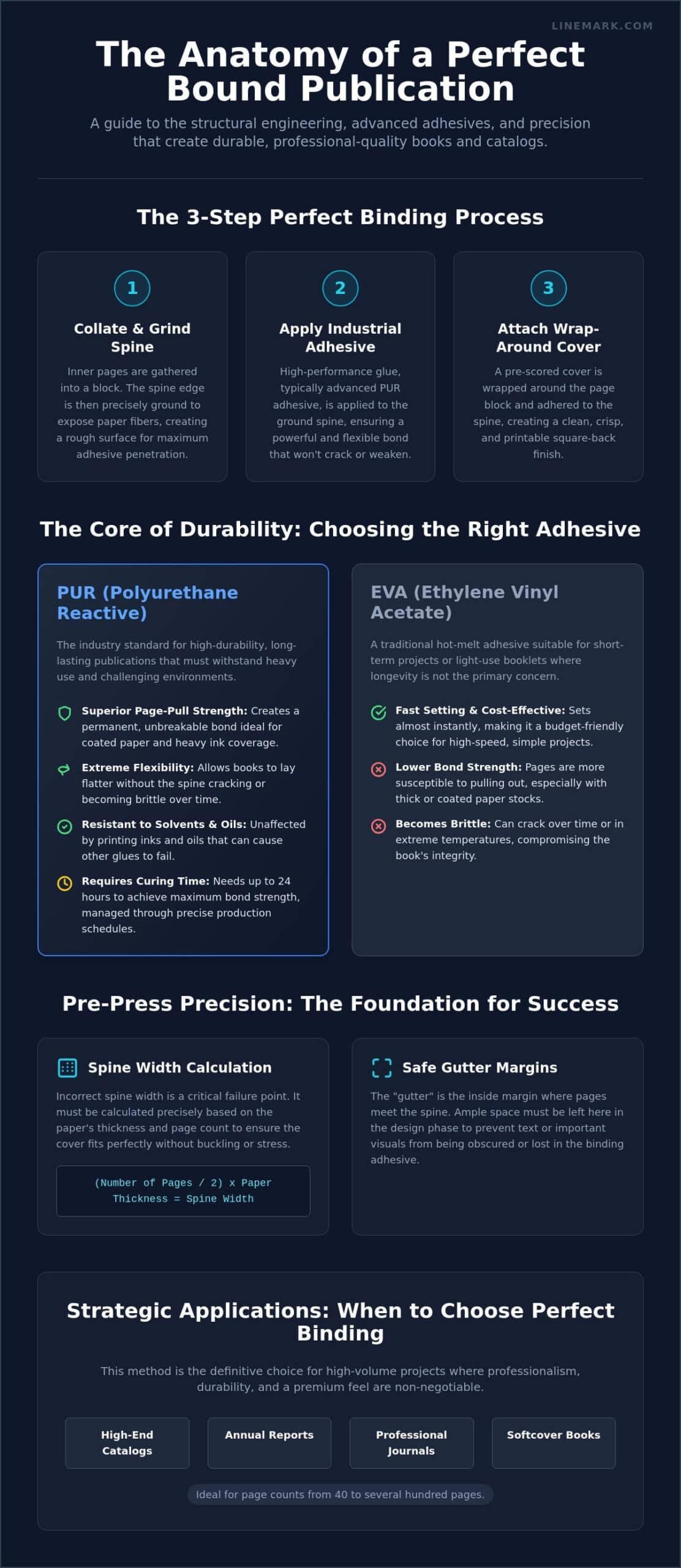
Professional perfect binding services provide the structural foundation for high-impact print communications. This method involves gathering the inner pages of a publication into a block, grinding the spine edge to expose paper fibers, and then adhering them to a wrap-around cover using industrial-strength glue. It’s the gold standard for softcover books, high-end catalogs, and corporate annual reports that require a polished, bookstore-quality finish. Unlike saddle stitching, which uses staples and is limited by page count, perfect binding comfortably supports documents ranging from 40 pages to several hundred. It’s the definitive choice for projects that demand a flat, printable spine and a premium feel.
The history and technical evolution of Bookbinding have led to this modern solution, which offers a clean, professional profile that stands out on any shelf or desk. To better understand the industrial application of this process, watch this helpful video:
The Anatomy of a Perfect Bound Book
The integrity of the finished product relies on the preparation of the spine. During production, the spine of the page block is precisely grinded or notched. This creates a rough surface that allows the adhesive to penetrate deep into the paper fibers, ensuring pages don’t pull out during frequent use. The spine grinding process is a precision operation where industrial machinery removes a thin layer of the folded page edges to create a uniform, porous surface. The wrap-around cover then envelops the block, providing a continuous canvas for branding across the front, spine, and back. While some binding styles offer rounded edges, industrial perfect binding typically produces a crisp, square-back spine that allows for clear title printing and a professional profile.
Why Professional Finishing Matters for Brand Perception
In a competitive market, the physical quality of your collateral is a direct reflection of your brand’s standards. A crisp, flat spine communicates a sense of authority and longevity that flimsy alternatives cannot match. This finishing technique is a vital component of premium custom book printing; it provides the heft and structural integrity expected by executives and high-value clients. A professional finish does more than just hold pages together. It acts as a catalyst for growth by positioning your business as a leader in its field. When you distribute high-volume catalogs, you aren’t just sending information; you’re sending a physical representation of your operational excellence. Choosing the right perfect binding services ensures your project transitions from a simple document to a durable brand asset.
The Mechanics of Durability: Adhesives and Structural Integrity
The structural success of any book depends on the chemical bond at its core. While the external aesthetics draw the reader in, the choice of adhesive determines if the publication survives the rigors of distribution and frequent reference. High-performance perfect binding services rely on advanced polymers to ensure the spine remains intact under stress. The objective is to create a bond that is both permanent and flexible, allowing the book to be handled repeatedly without losing its shape.
Polyurethane Reactive (PUR) adhesive has revolutionized the industry. It’s now the standard for high-durability projects. PUR offers significantly higher page-pull strength than traditional options, specifically when dealing with coated stocks or heavy ink coverage that can repel standard glues. Its unique chemical structure allows it to remain flexible once cured, preventing the brittle snap often associated with older binding technologies. This flexibility is what allows a thick catalog to be opened wide without the spine cracking.
PUR vs. EVA: Choosing the Right Bond
Ethylene Vinyl Acetate (EVA) is a traditional hot-melt glue that sets almost instantly. It’s cost-effective for short-term projects like event programs or light-use booklets. However, PUR is superior for longevity. It resists the solvents and oils found in digital inks that can cause EVA to fail over time. PUR requires a 24-hour curing period to reach maximum strength; a timeline that industrial partners manage through precise production scheduling to maintain efficiency without compromising the bond.
Structural Testing for High-Volume Runs
Precision in high-volume production requires more than just high-end machinery. It demands rigorous testing protocols. Industrial printers perform page pull-tests to measure the exact force needed to remove a sheet from the spine. This ensures every unit in a 10,000-copy run meets the same rigorous quality standard. Consistency is the hallmark of a well-oiled production facility, where technology and human expertise converge.
Paper grain direction is another critical factor in structural integrity. The grain must run parallel to the spine to allow the adhesive to flow into the fibers correctly. If the grain is perpendicular, the book will resist opening and the spine may warp. Our team integrates these technical checks into every binding and finishing project to guarantee excellence from the first copy to the last. This meticulous attention to detail ensures your materials are ready for the demands of real-world use.
Professional binding must also survive environmental extremes. It has to endure fluctuating temperatures during shipping and long-term storage in warehouses. PUR remains stable in extreme temperatures, ensuring your catalogs look as pristine in a summer delivery truck as they did on the production floor. This level of resilience is essential for brands that value their physical presence in the marketplace.
Strategic Applications: When to Choose Perfect Binding
Selecting a finishing method is a commercial decision that directly impacts how your brand is perceived by its audience. While saddle stitching serves thin brochures well, industrial perfect binding services are the strategic choice for projects requiring permanence, professional weight, and a high-impact presence. This method is particularly effective for publications that exceed the 40-page threshold, where the structural limits of staples are reached and the need for a printable spine becomes a marketing necessity.
Maximizing ROI with High-Volume Catalogs
For businesses distributing extensive product lines, the catalog is a vital sales tool that must survive months of frequent reference. Perfect binding provides a flat, square spine that acts as prime real estate for branding. This allows your publication to be easily identified when stored on a shelf, a benefit that spiral or wire binding cannot offer. Beyond aesthetics, this method facilitates efficient direct mail processing. Because perfect bound books have a uniform thickness and no protruding coils, they move through automated sorting equipment with a significantly lower risk of snagging or damage. Our team helps you balance paper weights and page counts to ensure your catalog meets the minimum 0.1875-inch thickness required for spine text while optimizing for postal weight tiers.
Corporate and Association Publications
Member journals, annual reports, and association directories benefit from the sophisticated “bookstore quality” that perfect binding provides. In the corporate world, the physical heft of a publication often correlates with the perceived value of the information inside. A non-profit report bound with a crisp, professional spine commands more attention from donors and stakeholders than a stapled packet. This sense of authority is why many organizations integrate these services into their MarCom On-Demand portals. It allows distributed teams to order high-quality, retail-ready materials that maintain brand consistency across different regions.
Pre-Press Precision: Preparing Your Files for Perfect Bound Success
The Spine Width Formula
PPI (Pages Per Inch) is the technical measurement of paper bulk that determines the final spine width based on the total number of pages in the document. You shouldn’t finalize your cover layout until the interior paper stock is selected and a physical dummy or digital calculation is confirmed. A 100-page book printed on 80lb gloss text will have a significantly thinner spine than the same page count on 80lb matte text because gloss coatings compress the fibers. We provide a final template before you start your cover design to ensure your spine graphics are centered and legible on the shelf.
Bleeds and Safety Zones for Finishing
Standard industry requirements dictate a 1/8-inch bleed on all sides of your wrap-around cover file. This extra margin allows for clean trimming without leaving white edges. Gutter safety is equally critical. The “grind” process removes a small portion of the inner margin to allow adhesive penetration. Keep all essential text and graphics at least 0.5 inches away from the spine to ensure they don’t disappear into the binding. Managing “crossovers”—images that span across two pages—requires careful alignment to account for the slight loss of image area in the gutter.
Professional binding uses hinge scores, which are vertical creases placed approximately 1/4 inch from the spine. These scores allow the cover to open without pulling on the first and last pages of the interior block, preserving the book’s structural integrity and aesthetic flow. Your design must also account for a “glue-free zone” or knockout area on the inside of the cover where the adhesive will be applied. Ink, varnish, or aqueous coatings in this specific area can weaken the bond and lead to cover detachment. To ensure your project is technically sound from the start, consult our experts on binding and finishing requirements before you begin your final layout.
High-Volume Execution: Why Linemark is Your Strategic Partner
High-volume execution isn’t just about speed; it’s about maintaining boutique precision at an industrial scale. Linemark operates from a 90,000-square-foot facility designed to move projects seamlessly through the entire production lifecycle. We understand that a project’s success depends on the transition from the press to the final bind. Whether you start with short-run digital proofs for stakeholder approval or move directly into massive offset production runs, our infrastructure is built to handle the complexity. Our perfect binding services provide the scalability required to grow alongside your brand’s ambitions.
From Press to Mailbox: Integrated Fulfillment
Logistical friction is often the hidden cost of high-volume print projects. By combining our binding capabilities with in-house kitting and nationwide distribution, we eliminate the need for multiple vendors. Your publications move directly from the binder into our fulfillment center, significantly reducing lead times and handling costs. We utilize data-driven distribution systems to manage personalized, high-volume book mailings with surgical accuracy. This unified partnership ensures that your catalogs or manuals reach their destination in pristine condition, ready for immediate use. A centralized production hub means fewer touchpoints and a more reliable journey for your brand’s assets.
Technology-Driven Quality Control
Precision is maintained through advanced automation and human expertise. We utilize automated sensor systems that monitor the production line in real-time, detecting missing or duplicated signatures before the adhesive is applied. This prevents the structural errors that can derail a high-volume run. Our facility also prioritizes color consistency, ensuring that the visual impact of your final offset run matches the approved digital proofs. This level of technical oversight is essential for maintaining brand integrity across thousands of units.
Repeat orders and inventory management are streamlined through our MarCom On-Demand technology. This system allows you to manage recurring binding projects with ease, providing a centralized platform for distributed teams to order materials as needed. It transforms a complex manufacturing process into a predictable, scalable solution for your marketing and logistics needs. With over 30 years of industrial experience, we act as a strategic communications ally that understands the nuances of modern production. Contact Linemark today for a custom book printing quote and discover how our integrated approach can stabilize your supply chain and elevate your brand’s physical presence.
Scale Your Brand with Precision Binding and Finishing
Achieving a professional look for high-volume catalogs and reports requires more than just high-quality printing. It demands a structural bond that withstands the rigors of distribution and frequent reference. By prioritizing advanced PUR adhesives and meticulous pre-press preparation, you ensure your publications maintain their integrity and sophisticated aesthetic. Utilizing industrial perfect binding services allows your brand to project authority while benefiting from the durability required for heavy-use corporate collateral. A well-executed spine isn’t just a finishing touch; it’s a statement of quality.
At Linemark, we combine 30+ years of industrial printing experience with a high-capacity, 90,000-square-foot facility to handle your most complex projects. Our integrated nationwide fulfillment capabilities mean your books move seamlessly from the binder to your audience’s hands without unnecessary delays. Our centralized hub is designed for operational excellence, ensuring that every project meets the highest standards of precision and scalability. We’re here to act as your strategic communications ally, providing the technical expertise needed to turn your vision into a retail-ready reality. We look forward to helping you build a more impactful physical presence.
Request a Quote for Your Professional Binding Project
Frequently Asked Questions
What is the minimum page count required for perfect binding services?
Professional perfect binding typically requires a minimum of 40 pages to create a spine thick enough for a secure adhesive bond. While it’s possible to bind publications with as few as 28 to 32 pages, the structural integrity and the ability to print legible text on the spine improve significantly at the 40-page mark. If your project falls below this threshold, saddle stitching is often the more effective finishing solution for your brand.
Can a perfect bound book lay completely flat?
Standard perfect bound books don’t lay completely flat because the adhesive bond creates a rigid spine that holds the page block together. Forcing the book to lay flat can lead to spine cracking or page detachment, especially if traditional glues are used. For applications like workbooks or technical manuals where hands-free use is required, you might consider coil or wire-o binding as alternatives to traditional perfect binding services.
What is the difference between PUR and EVA glue in book binding?
PUR (Polyurethane Reactive) adhesive is the modern industrial standard, offering superior flexibility and a much stronger bond than traditional EVA glue. PUR is resistant to temperature extremes and the solvents found in digital inks, which prevents pages from falling out over time. EVA (Ethylene Vinyl Acetate) is a cost-effective hot-melt glue that sets quickly, making it suitable for short-term projects that don’t require long-term durability or heavy handling.
How do I calculate the spine width for my book cover design?
You calculate the spine width by dividing the total number of interior pages by the Pages Per Inch (PPI) value of your chosen paper stock. Because paper bulk varies significantly between gloss, matte, and uncoated finishes, you should never guess these dimensions. We recommend waiting for a finalized technical template from our pre-press team to ensure your spine graphics and text are perfectly centered and professional.
Is perfect binding more expensive than saddle stitching for high volumes?
Perfect binding generally involves a higher per-unit cost than saddle stitching due to the specialized adhesive application and the three-knife trimming process. However, the investment is justified by the increased perceived value and the ability to accommodate much higher page counts. In high-volume industrial environments, the efficiency of automated binding lines helps mitigate these costs, providing a premium finish that reflects your organization’s commitment to quality.
How does paper weight affect the durability of a perfect bound spine?
Heavier paper weights increase the physical stress on the spine, which requires a more aggressive adhesive like PUR to maintain structural integrity. While thick stocks provide a premium feel, they also require precise spine grinding to ensure the glue can penetrate the paper fibers deeply. Our technical team evaluates your paper selection during the planning phase to ensure the bond is strong enough to survive nationwide distribution and frequent use.
Can you print on the spine of a perfect bound book?
You can print on the spine as long as the book reaches a minimum thickness of approximately 0.1875 inches. This flat surface is a primary advantage of the binding style, providing valuable branding real estate that makes your publication easy to identify on a shelf. If your book is thinner than this threshold, the spine won’t be wide enough to accommodate legible text, and a different finishing method might be more appropriate.
What is the typical turnaround time for high-volume binding projects?
Turnaround times for high-volume projects depend on the total quantity and the specific adhesive used, as PUR requires a 24-hour curing period to reach its maximum strength. Industrial-scale production lines can process thousands of units per hour, but the schedule must account for this essential curing time. We streamline the process by moving projects directly from our 90,000-square-foot production hub into our integrated fulfillment system to minimize overall lead times.