

 09/03/2026
  Steve Bearden
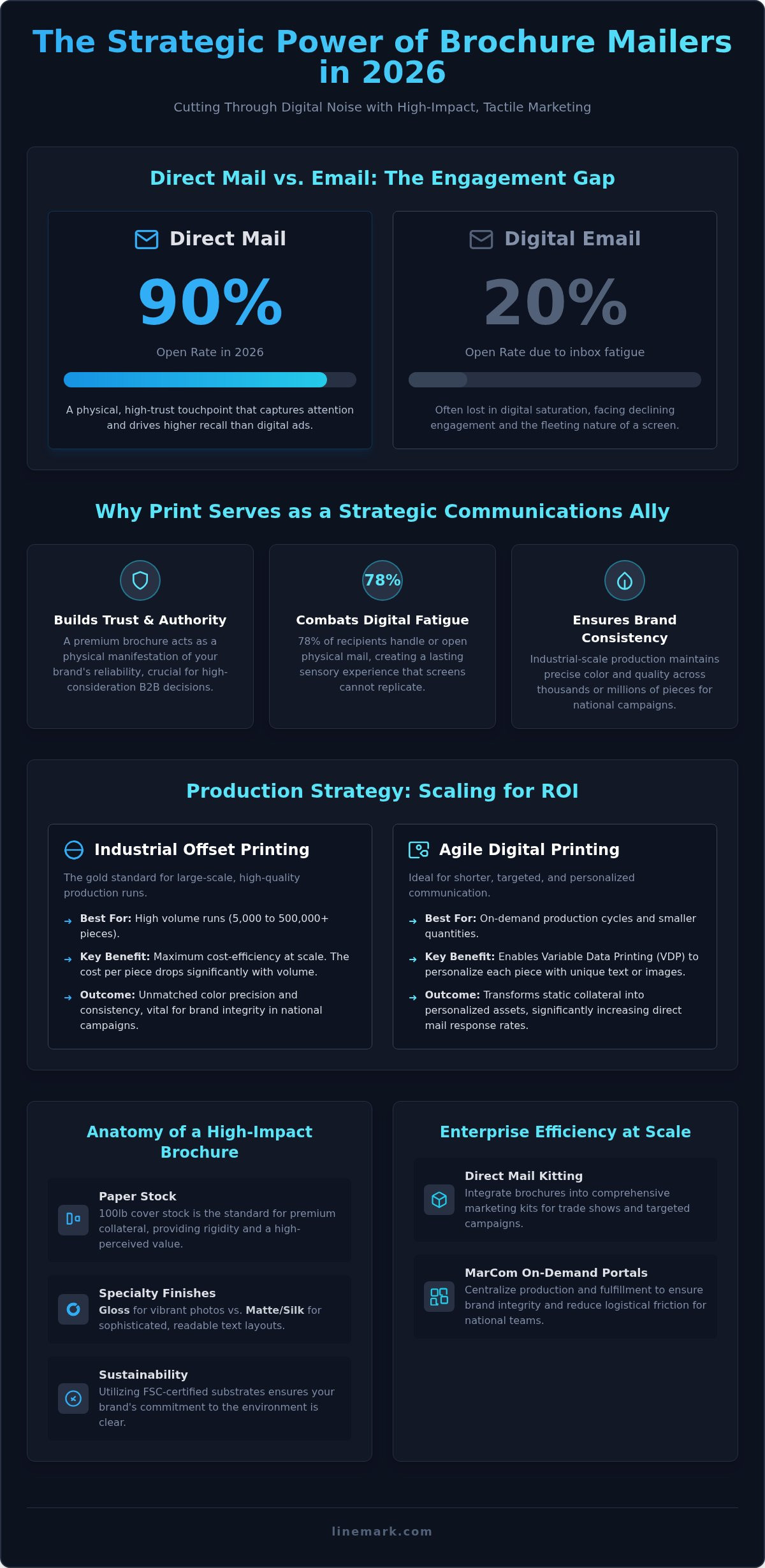
Did you know that in 2026, direct mail open rates have climbed as high as 90%, while digital inbox fatigue has pushed email open rates down to a mere 20%? This shift makes professional brochure mailer services a critical component for any brand looking to cut through the noise. For marketing executives, the challenge isn’t just getting noticed; it’s the logistical friction of maintaining consistent color quality across thousands of pieces and navigating the hidden costs of national distribution. Managing inventory for multi-location teams shouldn’t feel like an industrial hurdle, and we understand that your brand’s physical presence must be as precise as your digital strategy.
This strategic guide provides a roadmap to mastering high-volume printing and mailing, ensuring your tactile marketing materials drive measurable ROI through technical precision and streamlined workflows. You’ll learn how to bridge the gap between industrial offset production and data-driven personalization. We’ll examine the essential shifts in USPS regulations, such as the July 2026 rate updates, and show you how to integrate physical mail into your existing fulfillment ecosystem. From design to nationwide distribution, we’re here to help you transform your collateral into a high-performing growth catalyst that captures attention and builds lasting trust.
Key Takeaways
- Learn how high-quality print cuts through digital fatigue to serve as a high-trust touchpoint for complex B2B and consumer decisions.
- Discover how to optimize brochure mailer services by selecting the ideal paper weights and folding techniques to balance premium aesthetics with 2026 postal regulations.
- Understand when to utilize industrial offset printing for maximum cost-efficiency at scale versus digital printing for agile, on-demand production cycles.
- Leverage Variable Data Printing to transform static collateral into personalized assets that significantly increase direct mail response rates.
- Explore how MarCom On-Demand portals centralize production and fulfillment to ensure brand integrity across national teams while reducing logistical friction.
The Strategic Evolution of Brochure Printing in a Digital-First Era
The traditional view of a brochure as a simple handout has become obsolete. In 2026, high-volume brochure printing serves as a sophisticated anchor for unified communications strategies. While digital channels offer speed, they often lack the permanence required for high-consideration B2B purchases. A well-executed brochure acts as a premium brand ambassador; it’s a physical manifestation of your organization’s reliability and attention to detail.
Industrial-scale production ensures that your brand’s visual identity remains consistent across every market. When you utilize professional brochure mailer services, you aren’t just buying ink on paper. You’re investing in a logistics-heavy operation that maintains color precision and structural integrity, whether you’re distributing 5,000 pieces or 500,000. This level of consistency is non-negotiable for national campaigns where brand equity is at stake.
Combating Digital Fatigue with Tactile Marketing
Digital saturation has made the physical touchpoint more valuable than ever. Research indicates that physical mail pieces have significantly higher recall than digital ads. This is particularly true in professional and association sectors where building trust is paramount. While the history of direct mail shows a long-standing reliance on paper, modern brochures use specialty finishes and advanced folds to create a sensory experience that digital screens cannot replicate.
Strategic placement extends beyond the mailbox. Integrating brochures into trade show kits or direct mail kitting workflows ensures your message arrives in a context that demands attention. It’s about creating a tangible connection that lasts long after a browser tab is closed. We’ve seen that 78% of recipients handle or open physical mail, a stark contrast to the fleeting nature of a social media scroll.
The Strategic Communications Ally Model
The most successful marketing teams have moved away from transactional vendor relationships. They now seek a strategic communications ally. This collaborative production model uses first-party data to inform print runs, ensuring that every piece of collateral is relevant and timely. We don’t just print; we solve the logistical puzzles of nationwide distribution.
Operating from a 90,000-square-foot production facility allows for the kind of centralized quality control that decentralized print-on-demand often lacks. We focus on the technical nuances of industrial production so you can focus on growth. By leveraging tech-savvy brochure mailer services, organizations can bridge the gap between high-level strategy and concrete, scalable execution. This approach transforms a standard marketing expense into a high-performance asset that supports the entire sales funnel.
Technical Specs: Navigating Paper Stocks, Folds, and Specialty Finishes
Achieving a premium feel for your marketing collateral requires more than just a strong design. It demands a deep understanding of industrial substrates and how they perform under the pressure of high-volume production. In 2026, sustainability has moved from a preference to a requirement. We utilize FSC-certified substrates to ensure your brand’s commitment to the environment is as clear as your messaging. Choosing the right brochure mailer services means selecting a partner who understands how these technical choices impact both your brand perception and your bottom line.
Substrate Selection for Professional Impact
The tactile quality of your brochure begins with the paper weight. While text stock is suitable for lighter inserts, 100lb cover stock remains the industry standard for high-end corporate collateral because it provides the rigidity and durability needed for national distribution. Caliper refers to the specific thickness of the paper measured in thousandths of an inch, directly influencing the brochure’s perceived value and weight in a recipient’s hand. Gloss finishes offer vibrant color reproduction that makes photography pop, while matte and silk options provide a sophisticated, glare-free surface that improves readability for text-heavy layouts.
A robust Direct mail marketing strategy often hinges on these small details. They are the difference between a piece that is discarded and one that is kept. When your collateral feels substantial, it communicates a level of authority that digital ads simply cannot match. We help you navigate these choices to ensure your physical assets reflect the excellence of your services.
Precision Folding and Finishing Options
Folding is where engineering meets marketing strategy. Standard tri-folds are functional for simple handouts, but gate folds and accordion folds allow for more complex, multi-panel storytelling. The mechanics of a Z-fold provide a logical flow for informational content, whereas a roll fold creates a sense of discovery as the recipient unwraps your message panel by panel. Custom die-cuts add a unique architectural element that captures attention instantly, making your piece stand out in a crowded mailbox.
To prevent ink cracking on heavy stocks during the folding process, we employ precision scoring. This technique creates a clean, professional edge that maintains the integrity of your design. Specialty finishes like UV coating or soft-touch lamination add a final layer of protection and luxury. Soft-touch lamination provides a velvet-like texture that invites engagement, while aqueous coatings offer a cost-effective way to protect against scuffing during high-volume distribution. If you’re ready to elevate your outreach, exploring our direct mail strategic guide can help you identify the perfect technical specifications for your next campaign.
For more extensive content, integrating professional binding and finishing-such as saddle stitching or perfect binding-transforms a simple brochure into a comprehensive guide. These technical nuances are what turn standard brochure mailer services into a strategic communications alliance. We focus on the precision of the production line so you can focus on the growth of your business.
Offset vs. Digital Production: Scaling Your Print Strategy for ROI
Strategic scaling of your print collateral requires a clear understanding of production technology. While the design captures the audience, the production method determines your ROI. Choosing between digital and offset isn’t just about speed; it’s about matching your operational needs to the right industrial capability. Professional brochure mailer services provide the flexibility to pivot between these methods as your campaign grows. It’s about finding the balance between the agility of digital and the heavy-duty reliability of offset.
When to Choose Digital Printing
Digital printing has evolved significantly by 2026, closing the gap with traditional offset quality. It’s the ideal solution for short runs and time-sensitive marketing shifts. By producing materials on-demand, you drastically reduce inventory waste and eliminate the costs associated with storing obsolete brochures. This agility allows marketing teams to test messaging in specific markets before committing to a massive national rollout. Digital production excels when you need to update content frequently or when you’re targeting a niche audience with specialized messaging.
The Industrial Power of Offset Production
When your requirements scale into the tens or hundreds of thousands, offset printing becomes the essential choice. The unit-cost curve favors this technology for high-volume commercial orders, providing a level of cost-efficiency that digital cannot match. In our 90,000-square-foot production facility, we utilize advanced offset presses to ensure absolute consistency across millions of pieces. This is where industrial authority meets meticulous detail. We don’t just print; we engineer a process that guarantees every piece meets your exact specifications.
Key advantages of offset production include:
- Superior CMYK Color Matching: Essential for brand-critical assets that require exact replication across different print runs.
- Maximum Durability: Heavier ink coverage and specialized coatings provide better resistance in high-volume mailing environments.
- Precision Ink Control: Automated systems ensure the first brochure matches the last, even in runs exceeding one million units.
- Cost-Effective Scaling: The more you print, the lower your per-piece cost becomes, maximizing your marketing budget.
- High-Speed Production: Industrial presses maintain quality while meeting the tight deadlines of national campaigns.
Modern marketing often requires a hybrid approach. You might use offset for the high-volume base components of a campaign while leveraging digital’s variable data capabilities for personalized inserts. This integrated workflow ensures that your brochure mailer services are both cost-effective and highly targeted. By aligning production technology with your strategic goals, you turn every print run into a measurable growth catalyst. Our role as a strategic communications ally is to help you navigate these technical decisions to ensure your project stays on schedule and within budget.
Transforming Brochures into High-Performance Direct Mail Assets
The real value of a brochure isn’t realized until it reaches the hands of a prospect. Integrating your collateral into a broader direct mail strategy transforms a static piece of paper into a dynamic outreach tool. Unlike basic print shops that deliver a box of brochures to your office, professional brochure mailer services manage the entire lifecycle from the press to the mailbox. This ensures your high-consideration B2B assets are delivered with the same precision used in their production.
Variable Data: Hyper-Personalization at Scale
Static brochures often fail because they try to speak to everyone at once. Variable Data Printing (VDP) solves this by allowing you to swap images, contact information, and specific offers for every individual recipient within a single print run. This level of hyper-personalization is no longer a luxury; it’s a performance requirement in 2026. Variable data software communicates directly with digital presses to update text and imagery in real-time during the production cycle. By leveraging your CRM data, you can ensure that a prospect in the healthcare sector sees different visuals than one in manufacturing, significantly increasing engagement and response rates.
Fulfillment and Nationwide Distribution
Logistics is the most common point of failure for national campaigns. Managing the supply chain requires a centralized kitting and fulfillment operation that can handle complex marketing kits. This might include pairing your brochure with personalized letters, catalogs, or promotional items. Our 90,000-square-foot facility serves as a hub for this activity, ensuring that every kit is assembled accurately and distributed efficiently across the country. We don’t just provide brochure mailer services; we act as a strategic logistics ally that understands the nuances of modern marketing.
Postal optimization is another critical layer of the process. With the USPS rate updates effective July 12, 2026, navigating the new 3-digit rate categories is essential for maintaining ROI. We design and process your mailers to meet strict automation standards, which includes the strategic placement of wafer seals and address blocks. By managing the data processing and sorting in-house, we reduce your postage costs and ensure your brochures move through the postal system at maximum speed. If you’re ready to scale your outreach, our direct mail fulfillment solutions provide the industrial capacity you need to succeed.
Enterprise Efficiency: Streamlining Collateral with MarCom On-Demand Portals
Managing a national brand requires a delicate balance between corporate control and local flexibility. When marketing teams rely on decentralized brochure mailer services, they often face inconsistent quality and ballooning logistics costs. A centralized MarCom On-Demand portal eliminates these friction points by providing a unified destination for all collateral needs. This technology allows local agents to access approved materials while ensuring that every piece of print follows the rigorous brand standards established at the corporate level.
Automated ordering workflows reduce the administrative overhead that typically plagues multi-location teams. Instead of managing hundreds of individual requests, corporate marketers can lock templates and set approval hierarchies. This ensures that the first brochure printed in one region matches the last one printed in another, maintaining the industrial precision that defines your brand’s authority. By integrating these portals with your existing fulfillment workflows, you move from a transactional exchange to a strategic communications alliance.
MarCom On-Demand: The Strategic Advantage
The core of an efficient MarCom On-Demand strategy is the web-to-print portal. These platforms empower local agents or multi-location teams to order customized brochures through locked templates. Corporate headquarters maintains control over logos, colors, and legal disclaimers, while local users can update specific contact information or regional offers. This transition from a traditional storage and waste model to a print on-demand system significantly reduces the financial drain of obsolete inventory.
Centralizing your digital asset library ensures that every team member uses the most current version of your marketing materials. You don’t have to worry about outdated brochures being distributed in the field. By moving to a holistic journey from design to distribution, organizations can scale their outreach without increasing their administrative burden. It’s a proactive spirit that values efficiency and high-touch service at every level of the organization.
Operational Excellence in Logistics
Effective brochure mailer services must extend into the technical language of logistics and inventory management. Our 90,000-square-foot facility acts as your centralized warehouse, providing real-time tracking of printed collateral. Automated kitting services allow for the seamless assembly of marketing materials for new product launches or national association events. You gain full visibility into usage patterns through detailed tracking and reporting, allowing you to make data-driven decisions about future print runs.
This steady pace of operational excellence builds a sense of security for marketing executives. You can monitor inventory levels, track shipments, and analyze which regions are most active in their outreach. This level of transparency transforms a simple transaction into a unified partnership focused on your growth. Discover how a MarCom On-Demand portal can transform your operations and provide the industrial precision your brand deserves.
Elevating Your Brand with Industrial Precision and Strategic Scale
Success in 2026 requires more than just high-quality print; it demands a strategic communications ally capable of bridging the gap between design and nationwide distribution. We’ve explored how technical specifications, such as 100lb cover stock and precision scoring, protect your brand’s integrity during high-volume runs. By leveraging advanced variable data printing and the cost-efficiency of offset production, your organization can deliver personalized, tactile experiences that cut through digital fatigue and drive measurable ROI.
Operating from our 90,000-square-foot high-tech production facility, we provide the industrial capacity and FSC-certified sustainable printing options necessary for modern enterprise growth. Our integrated nationwide fulfillment and distribution workflows ensure your collateral reaches its destination with meticulous accuracy. Whether you’re streamlining distributed marketing through a MarCom portal or launching a massive direct mail campaign, we have the seasoned expertise to handle your most complex brochure mailer services. It’s time to transform your marketing collateral into a high-performance growth catalyst.
Ready to scale your next campaign? Request a custom brochure printing quote from Linemark today and experience the precision of a unified production partnership. Your vision deserves the steady hands of an industry leader.
Frequently Asked Questions
What is the difference between digital and offset brochure printing?
Offset printing is the most cost-effective solution for high-volume commercial orders, while digital printing is ideal for short, on-demand runs. Digital production allows for fast turnarounds without the need for physical plates. Offset remains the preferred choice for brand-critical CMYK matching across millions of pieces. Both methods are housed in our 90,000-square-foot facility to ensure your project scales efficiently from the initial test to a full national rollout.
How does variable data printing work for brochures?
Variable data printing uses specialized software to integrate customer data directly with digital presses, allowing for unique text and imagery on every piece. This technology transforms standard brochure mailer services into hyper-personalized assets. By swapping offers or visuals based on recipient demographics, organizations can significantly increase engagement. It’s a data-driven approach that ensures your collateral speaks directly to the individual needs of your prospects rather than delivering a generic message.
What are the most common brochure folding options for businesses?
Businesses typically choose from tri-folds, Z-folds, gate folds, or accordion folds depending on the content’s narrative flow. A Z-fold is excellent for multi-panel storytelling, while gate folds create a high-impact reveal for premium products. We also offer custom die-cuts and roll folds for more architectural designs. Every piece undergoes precision scoring to prevent ink cracking on heavy stocks, ensuring that your brochures maintain a professional appearance throughout the entire distribution process.
How can I ensure my brand colors are consistent across different print runs?
We ensure color consistency by utilizing advanced offset technology and centralized quality control within our production facility. This industrial approach prevents the variations often seen in decentralized brochure mailer services. By managing every print run from a single location, we guarantee that your brand-critical colors remain identical across different batches. This level of precision is essential for national organizations that require absolute visual uniformity to maintain brand authority and trust.
What is a MarCom On-Demand portal and do I need one?
A MarCom On-Demand portal is a centralized web-to-print platform where multi-location teams can order brand-approved materials. If your organization manages distributed marketing across the country, a portal is essential for maintaining brand integrity. It uses locked templates to empower local agents while preventing unauthorized changes to logos or legal copy. This system streamlines the ordering process, reduces administrative overhead, and eliminates the financial waste associated with storing obsolete printed inventory.
Can brochures be kitted with other items for direct mail fulfillment?
Brochures are often kitted with other marketing materials, such as catalogs, postcards, or personalized letters, to create comprehensive direct mail packages. Our facility provides integrated kitting and fulfillment services to manage these complex workflows. This centralized approach ensures that every recipient receives a complete, accurate kit. By handling the logistics from production to nationwide distribution, we simplify your supply chain and ensure your multi-component campaigns arrive on schedule and within budget.
What paper stock is best for a high-end corporate brochure?
For a high-end corporate feel, we recommend a 100lb cover stock. This substrate provides the necessary caliper and rigidity to communicate authority. You can pair this stock with a silk or matte finish for sophisticated readability, or a gloss finish for vibrant color reproduction. Adding a specialty finish, such as soft-touch lamination or a UV coating, further enhances the tactile experience and protects the piece during high-volume national distribution.
How do I optimize my brochure design for lower postage rates?
To optimize for lower postage, your brochure must meet specific USPS automation standards regarding size, weight, and sealing. Following the July 2026 postal updates, we utilize advanced data processing to access 3-digit rate categories. This includes the strategic placement of address blocks and the use of required wafer seals. By managing these technical nuances during the design and production phases, we help your organization maximize its marketing ROI through reduced postage costs.