


 05/23/2026
  Steve Bearden
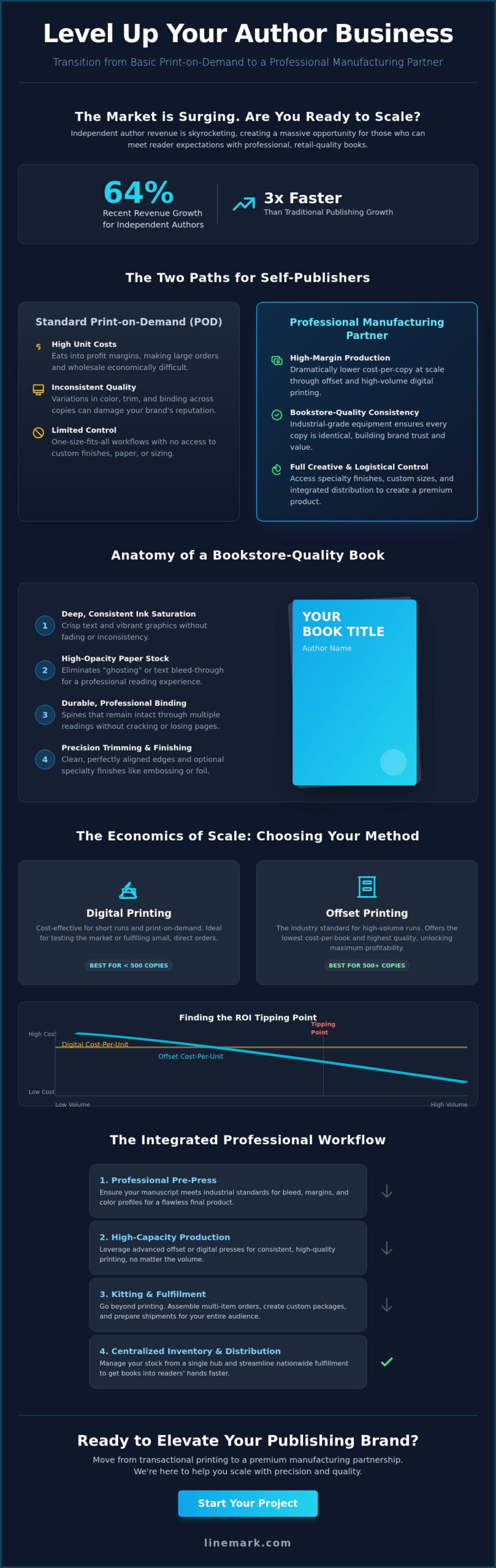
Revenue for independent authors grew by 64% recently, outstripping traditional publishing growth by nearly three to one. This surge highlights a clear reality: self-publishing is a serious business that requires professional book printing and distribution services to thrive at scale. You’ve likely felt the limitations of entry-level platforms where high unit costs and inconsistent quality eat into your margins and brand reputation. It’s frustrating to lack control over your shipping logistics when your audience expects a retail-quality experience. You deserve a manufacturing ally that treats your work with the precision it requires.
This guide explains how to transition from basic automated vendors to a high-capacity manufacturing partnership that prioritizes precision and scale. We’ll look at optimizing your cost-per-copy through advanced offset and digital printing while establishing a seamless kitting and fulfillment system that puts you back in the driver’s seat. Learn how to achieve bookstore-quality finishing and reliable inventory management to finally elevate your publishing brand and optimize your bottom line. We’re here to help you move from a transactional exchange to a premium, holistic manufacturing journey.
Key Takeaways
- Identify the technical benchmarks that separate standard self-published copies from retail-ready books produced on industrial-grade equipment.
- Select the optimal combination of binding and specialty finishes to enhance both reader experience and long-term shelf appeal.
- Calculate the ROI tipping point to determine when to transition from print-on-demand to high-margin offset or digital production.
- Master a professional pre-press checklist to ensure your manuscript meets industrial standards for bleed, margins, and gutter safety.
- Leverage integrated book printing and distribution services to centralize your inventory management and streamline nationwide fulfillment.
Defining Professional Standards in Modern Book Manufacturing
Transitioning from a hobbyist approach to a professional publishing model requires a fundamental shift in how you view manufacturing. Standard print-on-demand often relies on automated, one-size-fits-all workflows that prioritize speed over precision. When you scale, you need book printing and distribution services that utilize industrial-grade technology to ensure every copy looks identical to the first. This level of consistency isn’t just about aesthetics; it’s a strategic investment in your brand equity. High-capacity manufacturing ensures your project maintains its integrity even as volume increases.
Industrial equipment allows for tighter tolerances in registration and ink density. Large-scale offset and digital presses handle high-capacity production without the quality degradation common in consumer-grade setups. This reliability ensures you can meet unexpected market demand without compromising the physical integrity of your product. You’re no longer just buying a printed product; you’re securing a production standard that reflects your professional standing in the market.
To better understand the options available for your project, watch this helpful video:
The Anatomy of a Bookstore-Quality Book
Retail-ready books rely on specific technical benchmarks that consumers recognize instantly. Paper weight and opacity are primary factors. Readers notice when text bleeds through from the reverse side, a common issue in budget printing. Professional ink systems provide a depth of color and photographic clarity that standard toner-based systems can’t match. Utilizing professional bookbinding techniques ensures that the spine remains intact through multiple readings without cracking or losing pages. Consider these essential technical standards:
- Ink Saturation: Deep, consistent blacks and vibrant color gamuts for graphics.
- Paper Density: High-opacity stocks that eliminate “ghosting” from the other side of the page.
- Precision Trimming: Clean edges with no jagged cuts or misaligned margins.
- Color Management: Integrated systems that ensure cover art matches perfectly across multiple print runs.
Why Good Enough is a Risk to Your Brand
Choosing “good enough” is a gamble with your reputation. Readers often associate physical quality with the value of the content itself. A flimsy cover or poor ink coverage can lead to negative reviews and lost trust. Professional manufacturing supports higher retail price points by providing a premium tactile experience that justifies the cost. It’s the difference between a transactional printing job and a strategic production partnership. A high-capacity partner doesn’t just print pages. They act as a communications ally that understands how logistics and quality impact your growth. By leveraging professional book printing and distribution services, you ensure that your work is presented with the authority it deserves, turning every copy into a powerful marketing tool for your publishing business.
Technical Excellence: Binding, Stocks, and Finish Options
Professional Binding Methods Explained
Binding is the foundation of book construction. Perfect binding remains the industry standard for trade paperbacks, utilizing high-strength adhesives to secure the page block to a wraparound cover. It’s efficient for high-volume runs and provides a clean, professional spine that’s easy to stack and ship. For authors targeting the premium or gift market, case binding offers the structural rigidity of a hardcover. Integrating advanced binding and finishing techniques ensures your book can withstand repeated handling without losing its form. This durability is essential for maintaining brand reputation and minimizing returns due to damage.
Elevating the Aesthetic with Specialty Finishes
Finishes serve as both a protective barrier and a visual hook. Gloss lamination provides vibrant color pop and high durability, making it ideal for textbooks or children’s books that face frequent use. Matte lamination offers a sophisticated, velvety texture that reduces glare, which is often preferred for literary fiction and memoirs. Adding a UV coating provides an extra layer of defense against shelf wear and sunlight, preserving the cover’s integrity during long-term storage or transit. By utilizing professional book printing and distribution services, you gain access to these specialized material substrates that heighten the reader’s visual and tactile experience.
The choice of paper stock is equally critical to the final product’s success. Selecting the right stock involves a balance of opacity, weight, and texture. A 50lb offset might work for a dense novel, but a 70lb matte coated stock is often necessary for books with heavy ink coverage to prevent page warping. When evaluating the economics of academic publishing and commercial distribution, the tactile quality of the paper stock plays a significant role in perceived value. If you’re ready to move toward a more scalable production model, consider how our professional printing solutions can bring these technical details together for your next project.
The Economics of Scale: Digital vs. Offset for Authors
Print-on-Demand (POD) is a valuable tool for a manuscript’s debut, but it isn’t a sustainable manufacturing strategy for a growing brand. The unit cost of a POD book stays the same whether you sell ten or ten thousand copies. This static pricing eventually caps your profit potential and limits your ability to reinvest in marketing or future titles. To scale effectively, you need to transition to comprehensive book printing and distribution services that offer better economic leverage. Moving toward short-run digital or high-volume offset printing allows you to capture the margins necessary for a professional publishing business.
Digital Printing for Agile Publishing
Digital printing bridges the gap between single-copy production and massive industrial runs. It’s the ideal choice for short runs of 100 to 500 copies, providing a way to test new markets or produce limited editions without a massive upfront investment. This method maintains a high level of quality that meets the rigorous standards of the Book Manufacturers’ Institute. Our digital capabilities also include variable data printing. This technology lets you personalize special editions for your most loyal readers, adding unique value that standard POD cannot replicate. You reduce your upfront capital requirements while keeping your inventory agile and responsive to reader demand.
Harnessing the Power of Offset Printing
Offset printing remains the gold standard for high-volume book manufacturing. In fact, offset printing held the largest market share among printing types in 2025, at 52.3%. While the initial setup for offset is more involved, the per-unit price drops significantly as the quantity increases. This is the “tipping point” where your ROI shifts from linear to exponential. By leveraging custom book printing, you maximize long-term margins and gain the capacity to fulfill large orders from national retailers. High-volume production doesn’t just reduce your unit cost; it establishes a reliable pipeline for your business growth.
Inventory strategies are vital for authors with consistent national sales cycles. Integrated book printing and distribution services allow you to centralize your manufacturing and warehousing. This approach eliminates the delays inherent in one-off POD systems. You can move from a reactive model to a proactive one, ensuring your titles are always in stock when demand spikes. Transitioning to these professional manufacturing models is a clear signal that you’ve moved beyond the hobbyist stage and are operating a strategic publishing enterprise.
Preparing for Production: A Professional Pre-Press Checklist
Scaling your publishing business requires a shift from automated file checkers to a meticulous pre-press workflow. While entry-level platforms use basic algorithms to flag errors, professional book printing and distribution services rely on technical precision to ensure industrial-grade results. High-volume runs leave no room for the subtle layout shifts or color discrepancies that automated systems often overlook. Establishing a rigorous pre-press routine protects your investment and guarantees that your brand’s physical presence matches your creative vision. It’s the technical bridge between a digital file and a retail-ready asset.
Technical File Specifications
Industrial production begins with high-resolution, print-ready PDFs. Every image must meet a minimum of 300 DPI to avoid pixelation on the press. Perhaps the most critical technical adjustment is color space management. You must convert all files from RGB to CMYK. Standard digital screens display colors that physical ink cannot always replicate; a professional conversion ensures your cover art remains vibrant and accurate. Additionally, your layout must account for bleed, margins, and gutter safety. Gutter safety is particularly vital for thicker volumes to prevent text from disappearing into the binding. Common pre-press errors, such as incorrect spine width calculations for specific paper stocks discussed in earlier sections, can derail production schedules and increase costs.
The Approval Workflow
A professional partnership includes a structured approval process that goes beyond a digital thumbnail. Digital proofs are excellent for verifying text placement and general layout, but they cannot simulate the tactile reality of the finished product. For high-volume projects, a physical press proof is often essential. This allows you to verify color accuracy and binding integrity before the full run commences. Working with a dedicated project manager provides an extra layer of security, as they can identify potential issues that software might miss. This collaborative approach ensures that every detail, from the crispness of the typography to the saturation of the cover, meets your exact specifications.
Precision at the pre-press stage is the hallmark of a serious publisher. If you’re ready to ensure your files are optimized for industrial manufacturing, explore our custom book printing solutions to get started with a professional team today. Our experts will guide you through the technical nuances of your project to ensure a flawless production run.
Beyond the Press: Fulfillment and Inventory Management
Manufacturing excellence is only half of the equation for a successful publisher. The true test of a scalable business lies in how efficiently the finished product moves from the warehouse to the reader’s hands. Integrated logistics transform your production partner into a vital strategic ally. By leveraging professional book printing and distribution services, you gain access to centralized warehousing that facilitates rapid nationwide fulfillment. This infrastructure is essential for avoiding the stockouts that often occur during peak sales cycles, ensuring your titles remain available exactly when market demand peaks. You move from a reactive posture to a proactive strategy that protects your brand’s reputation for reliability.
Strategic Kitting and Fulfillment
Strategic kitting and fulfillment offer a competitive edge in a crowded marketplace. You can add significant value through custom kitting for pre-order campaigns or influencer outreach programs, creating a premium unboxing experience that resonates with your audience. Our marcom on-demand portals provide an intuitive interface for tracking these complex projects, giving you real-time data on inventory movement and stock health. Professional logistics management also helps in reducing shipping overhead, as a high-capacity partner can optimize transit routes and leverage industrial scale. This level of operational breadth allows you to scale your direct-to-consumer sales without the administrative burden of manual fulfillment.
Building a Scalable Publishing Ecosystem
Building a scalable publishing ecosystem requires moving beyond the limitations of small-scale, decentralized operations. Transitioning to a professional supply chain means your brand is backed by the same industrial rigor found in traditional publishing houses. Data-driven inventory management is the key to this transition, as it allows you to minimize waste and optimize your print runs based on actual sales velocity. You can further establish your market presence by integrating direct mail into your promotional strategy, reaching readers with physical touchpoints that complement your digital efforts. It’s a way to maintain a high-touch feel even as your volume increases.
When you align your book printing and distribution services with a long-term logistics strategy, you aren’t just selling books; you’re building a sustainable brand. This holistic journey ensures that every aspect of your production, from the first page to the final delivery, is handled with meticulous precision. By centralizing your inventory and automating your fulfillment, you free up the mental and financial capital needed to focus on your next manuscript. Your publishing business becomes a well-oiled machine, ready to meet the needs of a global audience with confidence and speed.
Commit to Industrial-Grade Scale
Scaling a publishing business is a deliberate move from transactional printing to a strategic manufacturing partnership. You’ve seen how moving beyond the limitations of basic print-on-demand unlocks higher margins and retail-quality finishes that define market leaders. Your growth depends on a reliable infrastructure that handles everything from pre-press precision to nationwide logistics. Professional book printing and distribution services provide the technical foundation needed to transform your manuscript into a scalable commercial asset. It’s about securing your brand’s future through consistent, high-capacity production.
Linemark brings over 30 years of industrial printing expertise to every project. Operating out of a 90,000-square-foot high-capacity production facility, we provide the scale and meticulous attention to detail your brand requires. We offer comprehensive kitting and fulfillment solutions to ensure your supply chain is as polished as your prose. Scale your publishing business with Linemark’s professional book printing services. Your vision deserves a production partner that matches your ambition. Let’s build your publishing legacy together.
Frequently Asked Questions
What is the minimum order quantity for professional book printing?
Minimum order quantities depend on the specific production method chosen for your project. Digital printing typically accommodates short runs starting at 100 units, while offset printing is most economical for quantities exceeding 500 to 1,000 copies. We recommend discussing your volume goals with a project manager to determine the most cost-effective entry point for your brand based on your current sales velocity.
Is offset printing better than digital printing for self-publishers?
The choice between offset and digital printing depends on your total volume and desired profit margins. Offset remains the gold standard for high-volume manufacturing due to its superior unit cost at scale. Digital printing offers exceptional quality for shorter runs and allows for variable data personalization. Both methods achieve professional results, but your specific sales projections will dictate which provides the best ROI for your publishing business.
How do I calculate the spine width for my book cover?
Spine width is calculated by multiplying the number of pages by the specific caliper, or thickness, of your chosen paper stock. Since different weights and finishes have varying PPI (pages per inch) ratings, a precise calculation is impossible until the paper is selected. Our technical team provides exact templates based on your final page count and stock choice to ensure your cover layout is perfectly aligned for the binding process.
Can I get a physical proof before my full print run?
A physical press proof is a standard component of our professional approval process for high-volume runs. While digital proofs are useful for layout verification, a physical sample allows you to confirm color accuracy and binding integrity on the actual paper stock. This step is critical for ensuring the final product meets your brand’s quality benchmarks before the full production run begins.
What is the difference between POD and short-run digital printing?
Print-on-demand (POD) typically refers to one-off, automated production, whereas short-run digital printing involves manufacturing a specific batch, such as 100 to 500 copies. Short-run digital provides better color consistency and lower unit costs compared to POD. It’s the preferred method for authors who need professional book printing and distribution services while maintaining agile inventory levels without the overhead of massive offset runs.
How long does the professional book printing process take?
Production timelines vary based on the complexity of your project and the chosen printing method. Digital projects often move from file approval to completion in a matter of business days. Offset runs require additional time for plate setup and drying. We provide a detailed schedule at the start of our partnership to ensure your launch dates are met with precision and reliability.
Do you offer warehousing and fulfillment for self-published authors?
We offer comprehensive kitting and fulfillment along with sophisticated inventory management solutions for our partners. This allows you to centralize your manufacturing and distribution within a single high-capacity facility. By utilizing our integrated book printing and distribution services, you can automate direct-to-consumer sales and ensure your titles are professionally packed and shipped to retailers nationwide without managing a personal warehouse.
What file formats are required for high-quality book manufacturing?
High-quality book manufacturing requires print-ready, high-resolution PDF files. All images should be set to a minimum of 300 DPI, and the color space must be converted to CMYK to ensure accurate reproduction on industrial presses. We also require files to include proper bleed and margin settings. Our pre-press team reviews these technical specifications during the initial stages of your project to prevent production delays and ensure a flawless finish.