


 08/24/2026
  Steve Bearden
What if you could hand the keys of your brand to hundreds of local agents without worrying that they might drive your corporate identity off a cliff? It’s a tension every marketing leader feels as we head into 2026. You want your field teams to have the agility to launch campaigns at a moment’s notice, yet you can’t afford the brand dilution that comes from unauthorized local marketing. Between the logistical headaches of shipping to countless locations and the mounting costs of obsolete inventory, an unmanaged distributed marketing platform often feels like a liability rather than an asset.
We understand that true efficiency requires a balance of control and empowerment. By utilizing a sophisticated MarCom On-Demand solution, you can centralize your brand assets while giving local teams the tools they need to succeed. This article will show you how an integrated system backed by industrial-scale production transforms your workflow. You’ll discover how to eliminate waste, reduce storage costs, and ensure that every piece of collateral meets your exact standards for precision and quality. We’ll explore the path to a more agile, high-capacity marketing future that bridges the gap between digital assets and physical fulfillment.
Key Takeaways
- Learn how to maintain absolute brand control while giving local teams the autonomy they’ll need to execute high-impact campaigns.
- Understand how a modern distributed marketing platform serves as the essential bridge between your digital assets and physical production.
- Discover the importance of industrial-scale infrastructure, including a 90,000-square-foot facility, in ensuring reliable nationwide fulfillment.
- Identify strategies to eliminate obsolete inventory and reduce the total cost of ownership across your entire marketing supply chain.
- Follow a clear 2026 roadmap for auditing collateral and establishing the brand guardrails necessary for a successful portal launch.
The Evolution of Distributed Marketing: Why On-Demand Portals Matter in 2026
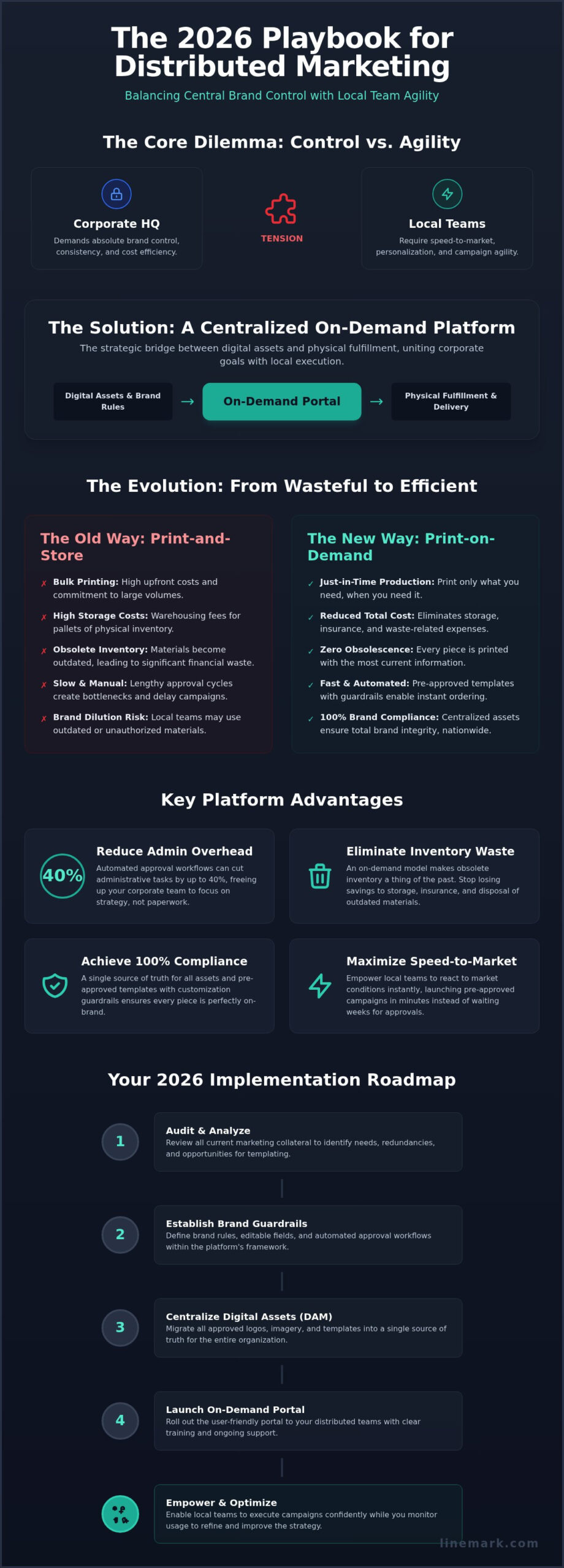
A distributed marketing platform serves as the strategic bridge between a corporation’s digital asset library and its physical delivery network. In an era where brand consistency is non-negotiable, this technology allows headquarters to maintain absolute control while giving local representatives the freedom to execute. This evolution reflects a broader industrial shift. We’ve moved past the days of “Print-and-Store” toward a more efficient “Print-on-Demand” model that prioritizes agility over sheer volume. By integrating your digital portal directly with a high-capacity production facility, you eliminate the friction that usually exists between a creative idea and a physical product.
As we move through 2026, speed-to-market has emerged as the primary competitive advantage for distributed organizations. The goal is simple: empower field teams to react to local market conditions instantly without risking brand dilution. When a local agent can access a centralized portal and order customized, pre-approved materials in minutes, the entire organization becomes more responsive. This centralized approach ensures that 100% of your marketing materials remain on-brand and compliant, regardless of how many locations you manage.
To better understand this concept, watch this helpful video:
Overcoming the Bottleneck of Manual Approvals
Manual workflows are often the single greatest barrier to campaign ROI. When local agents rely on corporate teams for every minor adjustment, the administrative burden becomes unsustainable. Every day spent waiting for an email reply is a day your campaign isn’t in the field. Automated approval hierarchies solve this by pre-approving specific dynamic fields within your distributed marketing platform. This structure allows local teams to personalize materials within set guardrails without needing a human reviewer for every order. It’s a shift that moves your marketing department from being a gatekeeper to being an enabler. Industry reports indicate that transitioning to these automated workflows can reduce administrative overhead by up to 40% by eliminating redundant back-and-forth communication.
Eliminating Inventory Waste and Obsolescence
The traditional bulk printing model carries significant hidden costs, including storage, insurance, and the inevitable disposal of outdated collateral. If you’re still printing thousands of brochures to get a lower unit price, you’re likely losing those savings to waste. On-demand production mitigates these risks by ensuring that every piece of marketing material is current at the time of order. Transitioning to a “Just-in-Time” model for corporate communications allows businesses to react to regulatory changes or product updates in real time. This approach effectively eliminates the financial burden of obsolete inventory while maintaining a lean, responsive marketing supply chain. You no longer have to worry about local teams using last year’s pricing or outdated logos just because they have a box of old flyers in the back room.
Essential Features of an Enterprise-Grade Distributed Marketing Platform
An enterprise-grade distributed marketing platform is more than a simple file repository. It’s a precision instrument designed for brand governance and operational scale. In 2026, the most effective systems combine a Centralized Digital Asset Management (DAM) system with high-capacity production capabilities. This ensures that field teams have one-click access to approved files, eliminating the risk of outdated materials being circulated. By hosting all assets in a single location, you create a single source of truth for the entire organization.
Beyond asset storage, integrated inventory management is vital. A robust platform tracks both on-demand production and pre-printed items stored in a warehouse. This visibility allows marketing leaders to monitor stock levels in real time, preventing shortages during critical campaign windows. For organizations looking to optimize their supply chain, a centralized MarCom portal offers the clarity needed to manage high-volume logistics with boutique-level attention to detail.
Dynamic Templates and Variable Data Integration
One of the most transformative features is the ability to use dynamic templates. These tools enable non-designers to customize brochures or postcards while keeping core brand elements locked. Logos, corporate colors, and legal disclaimers remain unchangeable, ensuring total compliance. This functionality is particularly powerful when paired with variable data printing, which allows local offices to execute personalized outreach that resonates with their specific demographics. It’s about providing the flexibility of local marketing without sacrificing the integrity of the national brand.
Real-Time Reporting and Budget Tracking
Decision-making in 2026 must be data-driven. Robust usage analytics allow you to see exactly which materials your field teams are using and which are gathering digital dust. This insight is critical for gaining visibility into marketing spend across the entire national organization. You can automatically allocate costs to specific cost centers or departments, simplifying the reconciliation process for accounting teams. By analyzing these engagement patterns, you can prune underperforming assets from the portal. This ensures your budget is always focused on the materials that drive the highest ROI and field engagement.
The Integrated Edge: Connecting Digital Portals to Physical Fulfillment
A software interface is only half of the equation. A distributed marketing platform that lacks a direct, real-time connection to a high-capacity production line is little more than a digital file cabinet. In 2026, the true competitive edge lies in the seamless transition from a user clicking “order” to a physical package leaving the loading dock. By leveraging a 90,000-square-foot production facility, we ensure that your marketing assets aren’t just stored; they’re manufactured and fulfilled with industrial precision. This infrastructure allows us to act as a strategic communications ally, managing the logistical “last mile” so your internal teams can focus on high-level brand strategy.
The synergy between a Web-to-Print portal and a national fulfillment network eliminates the friction points that typically slow down local execution. When the digital portal and the physical floor operate as a single unit, you gain total visibility into the production lifecycle. This integrated approach provides the reassurance that every project, regardless of scale, is handled by a well-oiled machine designed for accuracy. It’s a holistic journey that moves your organization away from transactional vendor relationships toward a unified partnership model.
Kitting and Fulfillment: Beyond the Print Run
Modern marketing campaigns often require more than just paper. They involve complex kits that combine on-demand brochures with signage, personalized direct mail, and promotional items from Logotrade. Managing these multi-component orders requires a sophisticated “pick and pack” process that maintains absolute accuracy at scale. Our nationwide fulfillment network is specifically designed to handle these logistical complexities. We streamline the distribution of high-volume, multi-component orders to hundreds of locations simultaneously. This level of kitting and fulfillment ensures that your field teams receive a complete, ready-to-use campaign package rather than a disorganized collection of separate shipments.
Having both offset and digital printing capabilities under one unified roof provides the flexibility needed for diverse marketing needs. Whether you require 50 personalized catalogs or 5,000 high-volume newsletters, our production model scales to meet the demand. Our facility supports an extensive range of services, including large-format graphics, wall murals, and custom book printing with professional binding and finishing. This breadth of service ensures consistent quality across every product line, from the smallest business card to the largest banner. When your distributed marketing platform is backed by over 30 years of industrial experience, you gain the confidence that your brand is in capable, steady hands.
Implementing a Distributed Marketing Strategy: A 2026 Roadmap
Transitioning to a distributed marketing platform requires a roadmap that balances technical integration with operational readiness. The journey begins with a comprehensive audit of your current marketing collateral. You need to identify high-frequency, low-variance items that are currently clogging your warehouse or nearing obsolescence. By moving these specific assets to an on-demand model, you immediately reduce waste and logistical overhead. Before the portal goes live, establishing rigid brand guardrails and automated approval workflows is essential. These rules ensure that your corporate identity remains intact while your field teams gain the agility they need to respond to local market shifts.
Success depends on field adoption. Training your teams across the country ensures they understand how to leverage the platform’s full potential without feeling overwhelmed by the technology. Once the system is operational, the work doesn’t stop. You must review and optimize the asset library every quarter based on real-world usage analytics. If an asset isn’t being used, it shouldn’t be taking up space in your portal. This proactive management keeps the system lean and effective. To see how this looks in practice, you can explore our integrated fulfillment solutions and start your transition today.
Building a Strategic Asset Library
A high-performance library isn’t just a folder of PDFs. It’s a structured environment where assets are categorized by their level of flexibility: static, versioned, or fully variable. Static assets like standard brand brochures require no changes, while versioned assets allow for local contact information or office addresses. Fully variable assets enable deep personalization, which is particularly effective when integrating MarCom On-Demand with your existing direct mail workflows. Setting expiration dates for seasonal or time-sensitive national promotions is another critical step. This prevents field teams from accidentally ordering materials for a campaign that ended months ago, protecting your brand’s relevance.
User Management and Access Control
Security and cost control are the cornerstones of enterprise-level systems in 2026. You must define clear roles, such as Admins who oversee the entire system, Managers who approve local orders, and Field Users who place them. Implementing Single Sign-On (SSO) ensures secure and easy enterprise access while maintaining strict data governance. Beyond security, you need to manage the financial aspect of distributed ordering. Setting strict budget limits or credit-based systems for field users prevents overspending. This level of control allows you to scale your operations across hundreds of locations without losing sight of the bottom line.
Driving ROI: The Strategic Impact of Centralized Communications
Centralizing your marketing supply chain is a strategic pivot that moves the department from a cost center to a significant driver of ROI. By evaluating the Total Cost of Ownership (TCO), organizations often discover that the price of an individual printed piece is secondary to the costs of storage, distribution, and obsolescence. A high-capacity distributed marketing platform addresses these inefficiencies head-on. When production is integrated with digital management, you gain the ability to launch national campaigns with immediate local relevance. This speed-to-market is a critical competitive advantage in 2026, allowing your brand to remain agile in a rapidly shifting environment.
Quantifying Savings from Reduced Waste
Transitioning to an on-demand model provides immediate financial relief by tackling the “hidden” costs of traditional print. Industry data indicates that on-demand models typically reduce print waste by 25-30% by eliminating the production of materials that never reach the end user. This reduction directly impacts the bottom line by lowering warehousing requirements and associated insurance costs. In 2026, this shift also serves your sustainability goals. Sustainable, on-demand production ensures that your organization only uses the resources necessary for actual engagement, aligning your operational excellence with environmental responsibility. You’ll spend less on storage and more on the strategies that actually move the needle.
Strengthening the Strategic Communications Alliance
The most significant benefit of a centralized hub is the evolution of your vendor relationship. You’re no longer just buying print; you’re entering a strategic communications alliance that understands the nuances of your business. This collaborative partnership model moves away from transactional exchanges toward a unified journey where advanced technology supports your long-term scale. As your business objectives evolve, your infrastructure must be ready to meet new challenges with the same meticulous attention to detail. This synergy allows you to scale up without sacrificing the quality that defines your brand. To see how this technology can transform your specific workflow, you can contact Linemark for a custom portal demo. This is the first step toward a more efficient, brand-compliant, and scalable marketing future.
Scaling Your National Brand with Operational Precision
The shift toward 2026 requires a marketing infrastructure that is as agile as it is disciplined. By adopting a high-capacity distributed marketing platform, you bridge the gap between corporate vision and local execution. This centralized approach doesn’t just protect your brand equity; it optimizes your entire supply chain by eliminating inventory waste and reducing administrative bottlenecks. When your digital portal is backed by over three decades of industrial precision and a 90,000-square-foot state-of-the-art facility, you gain a strategic communications ally capable of handling the most complex logistics with boutique-level attention to detail.
It’s time to move beyond transactional print and embrace a unified partnership model that drives measurable business growth. You can ensure your field teams have the tools they need while maintaining total brand integrity through integrated, data-driven fulfillment strategies. This transformation secures your place in a competitive landscape, turning your marketing logistics into a catalyst for transformative growth. Your journey toward a more efficient and scalable future starts with a system built for the demands of modern commerce.
Explore MarCom On-Demand Solutions with Linemark
Frequently Asked Questions
What exactly is a distributed marketing platform?
A distributed marketing platform is a centralized digital hub that bridges your corporate brand assets with a high-capacity physical production and fulfillment network. It allows local teams to access, customize, and order approved marketing materials through a secure web portal. This technology eliminates the gap between asset management and delivery, ensuring that every piece of collateral leaving the facility meets industrial standards for precision and brand consistency across your entire organization.
How does a MarCom On-Demand portal maintain brand compliance?
Compliance is maintained through the use of dynamic templates with locked brand elements. You specify which parts of a brochure or postcard can be edited, such as local contact information or office locations, while keeping logos, colors, and legal disclaimers unchangeable. This structure empowers field teams to execute personalized campaigns without risking brand dilution. Automated approval hierarchies provide an additional layer of security, ensuring no unauthorized materials ever reach the production floor.
Can I integrate my existing CRM with a distributed marketing platform?
Yes, integrating your existing CRM is a standard part of a modern distributed marketing strategy. This connection allows for seamless variable data printing, where local customer information is pulled directly into your marketing templates for personalized outreach. By syncing these systems, you can automate direct mail triggers based on customer behavior or sales milestones. This integration ensures that your marketing efforts are data-driven and highly relevant to specific local demographics in 2026.
Is MarCom On-Demand cost-effective for national associations?
MarCom On-Demand is exceptionally cost-effective for national associations because it eliminates the financial burden of obsolete inventory and bulk storage. Instead of printing thousands of items that might become outdated, you produce materials only when they’re needed. This “Just-in-Time” model reduces the total cost of ownership by lowering warehousing fees and insurance premiums. It’s a scalable solution that allows associations to manage high-volume needs while maintaining boutique-level attention to detail.
What types of products can be produced on-demand?
Our facility supports a wide range of industrial-grade products for on-demand production. This includes standard collateral like brochures, catalogs, and newsletters, as well as complex items like custom books and annual reports. We also handle large-format graphics, such as banners, floor graphics, and wall murals. Every product benefits from over 30 years of industrial printing experience, ensuring that even the most diverse product lines maintain a consistent, high-quality professional finish.
How does Linemark handle nationwide fulfillment and shipping?
We manage nationwide fulfillment through our 90,000-square-foot state-of-the-art facility. This infrastructure allows us to handle complex kitting projects where on-demand print is combined with promotional items for rapid distribution. Our integrated logistics system provides real-time tracking for every shipment, ensuring accuracy across hundreds of locations. This high-capacity operation acts as your strategic communications ally, managing the logistical “last mile” with precision and reliability to meet your 2026 growth objectives.
What is the typical setup time for a custom marketing portal?
Setup time varies depending on the complexity of your asset library and the number of dynamic templates required. A standard implementation involves auditing your existing collateral, establishing brand guardrails, and configuring user permissions. We focus on a structured, collaborative onboarding process to ensure your team is trained and ready for full adoption. Our goal is to move you from a fragmented traditional model to a unified, high-tech solution as efficiently as possible without sacrificing quality.
How do I track the ROI of my on-demand marketing materials?
ROI is tracked through robust usage analytics and real-time reporting built directly into the portal. You can monitor which materials are ordered most frequently, identify underperforming assets, and allocate costs to specific departments or cost centers automatically. By analyzing these engagement patterns, you can prune your library to focus on high-impact collateral. This data-driven approach provides total visibility into your marketing spend, allowing you to justify every dollar invested in your distributed marketing platform.