


 09/24/2026
  Steve Bearden
A flawless digital layout can lose its authority the second ink meets the wrong sheet of paper. Deciding between coated vs uncoated paper stock isn’t just an aesthetic preference; it dictates how ink absorbs, how contrast renders, and how recipients perceive your brand’s credibility. If you’ve ever opened a production run only to find muddy imagery, blinding light reflection, or colors that drift far from your approved proofs, you know how costly substrate miscalculations can be.
You shouldn’t have to guess whether an uncoated stock will feel too raw or if a heavy gloss will compromise legibility. This guide breaks down the technical, visual, and tactile mechanics between coated and uncoated paper so you can specify substrates with complete confidence. We’ll examine ink holdout, direct mail distribution durability, and press interactions across digital and offset workflows to ensure your next commercial print run delivers flawless color reproduction and lasting tactile impact.
Key Takeaways
- Understand how surface sealants drive ink holdout, helping you evaluate coated vs uncoated paper stock to prevent dot gain, color shifts, and unexpected ink absorption.
- Distinguish between gloss, satin, matte, and dull finishes to achieve the right balance between vivid photographic contrast and glare-free typography.
- Identify when the tactile, organic texture of uncoated stock elevates brand prestige, readability, and writeability for custom books and corporate communications.
- Assess post-press durability requirements to protect direct mail, catalogs, and brochures from scuffing, smearing, and postal handling wear.
- Learn how aligning your substrate choices with advanced digital and offset press capabilities eliminates costly reprints and ensures color consistency.
What Is the Difference Between Coated and Uncoated Paper Stock?
Every commercial print project begins with a fundamental decision: how ink should interact with paper fiber. The physical disparity between coated and uncoated paper stock rests on surface chemistry and structural porosity. Rather than just determining surface sheen, this choice dictates light scatter, mechanical ink holdout, and the final sensory impact of your printed collateral.
To see how these substrate variations directly influence printed colors and density, watch this helpful overview:
The Science of Paper Coating and Porosity
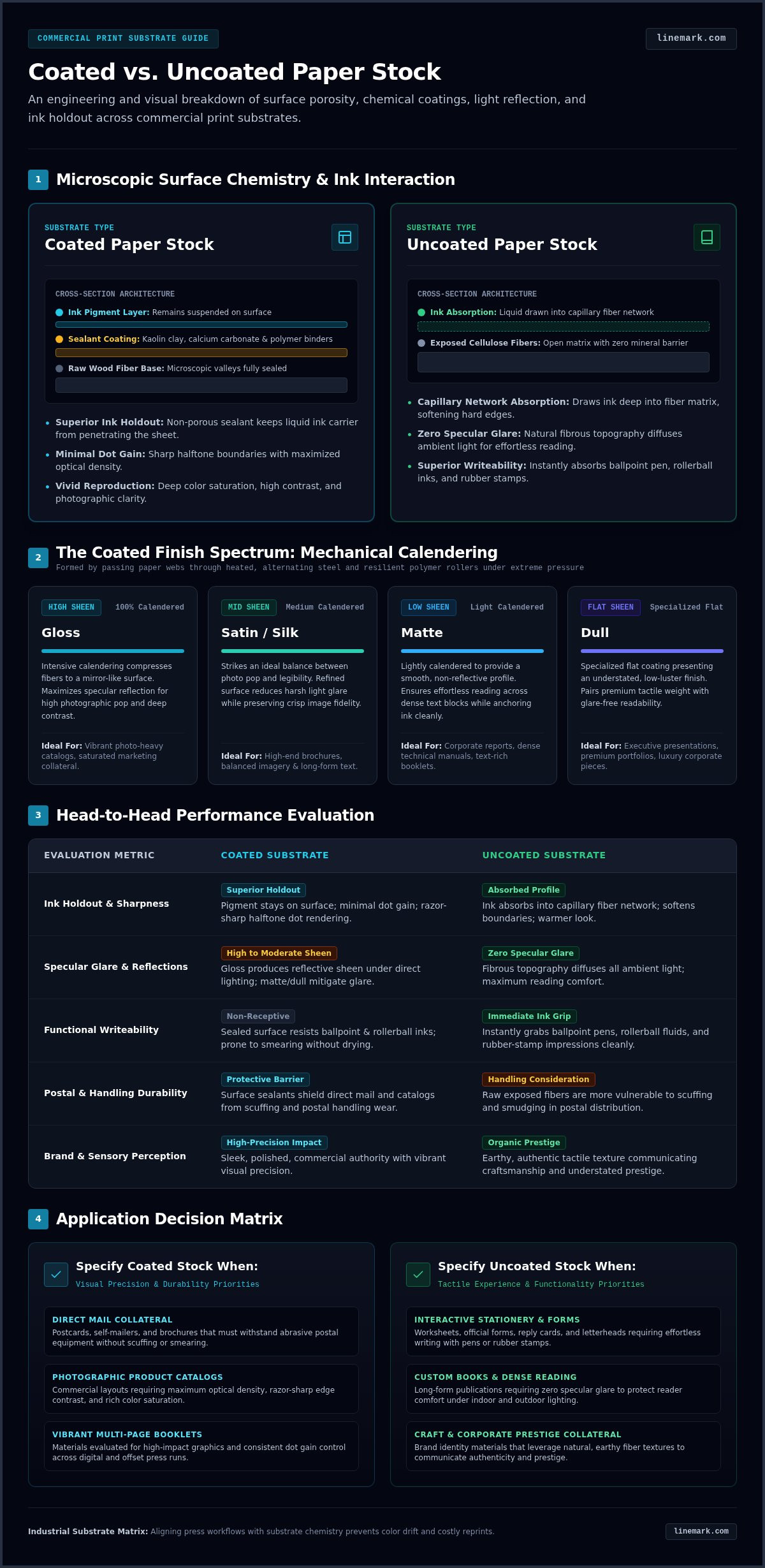
Industrial mills manufacture coated paper by applying a surface compound, typically consisting of calcium carbonate, kaolin clay, and synthetic polymer binders, directly over raw base sheets. This chemical layer seals microscopic valleys between wood fibers. Because the coating limits substrate porosity, liquid ink carriers cannot penetrate deeply into the sheet. Pigments remain suspended on the surface, yielding superior ink holdout. The practical result is minimal dot gain, sharper halftone boundaries, and maximized optical density for high-resolution graphics.
The Raw Tactile Nature of Uncoated Paper Stock
Uncoated paper leaves cellulose fibers completely exposed. Without a mineral barrier, the porous sheet draws ink carriers deep into its internal capillary network. This absorption softens edges and creates a warmer, more muted aesthetic. The open fiber matrix offers tangible benefits for specific commercial applications:
- Zero Specular Glare: Natural fibrous topography diffuses ambient light, eliminating harsh reflections under bright indoor lighting and direct sun.
- Superior Writeability: The receptive surface instantly grabs ballpoint inks, rollerball fluids, and rubber-stamp impressions without smearing.
- Organic Brand Feel: Readers register a distinct, earthy texture that communicates craft, authenticity, and understated corporate prestige.
Balancing coated vs uncoated paper stock requires evaluating how your audience engages with the finished product. When your artwork demands razor-sharp photographic clarity, coatings deliver necessary control. When human touch, sustained reading comfort, and functional writeability take priority, an uncoated substrate provides an inviting physical foundation.
Coated Paper Finishes: Gloss, Satin, Matte, and Dull Explained
Industrial papermaking doesn’t treat coatings as a one-size-fits-all solution. Mills calibrate surface textures through mechanical calendering, passing coated paper webs through heated, alternating steel and resilient polymer rollers under extreme pressure. This compression dictates whether a sheet reflects light like glass or diffuses it into a soft, velvety sheen.
Gloss vs. Matte vs. Satin Surface Characteristics
Calendering intensity dictates how your audience experiences color and reads typography across distinct coated finishes:
- Gloss: Intensive calendering creates a tightly compressed, mirror-like surface. It maximizes specular light reflection, giving photography rich color saturation, deep contrast, and vibrant detail.
- Satin and Silk: These mid-sheen coatings strike an ideal compromise between photographic pop and legibility. They offer a refined surface that reduces harsh light reflection while retaining crisp image fidelity.
- Dull: A specialized flat coating favored for executive presentations, dull coated stock presents an understated, low-luster finish that pairs premium tactile weight with high readability.
Optical Density, Dot Gain, and Color Saturation
Evaluating coated vs uncoated paper stock fundamentally comes down to how each substrate manages halftone reproduction. Dot gain occurs when wet ink expands laterally beyond its intended press diameter as the paper absorbs liquid carrier agents. On open, porous stocks, capillary action causes halftone dots to swell, which can muddy shadow details and mute fine photographic gradations.
Ink holdout on coated stocks prevents dot gain distortion by keeping ink droplets suspended on the surface barrier rather than letting them spread horizontally across permeable fibers.
By restricting absorption, coated substrates preserve dot geometry, producing higher maximum optical density and deeper, richer blacks. For teams weighing coated vs uncoated paper stock across complex multi-page assets, collaborating with commercial printing specialists at Linemark ensures you choose the exact coating formulation needed to protect your dynamic color gamut without compromising layout readability.
Coated vs Uncoated Paper Stock: Side-by-Side Performance Comparison
Specifying print substrates requires balancing aesthetic goals against mechanical realities. Evaluating coated vs uncoated paper stock means looking beyond simple visual appeal to analyze how sheets perform under constant reading, physical distribution, and automated sorting equipment.
Readability, Glare, and Writable Surfaces
How an audience consumes information directly influences substrate viability. Specular glare from high-gloss paper triggers ocular fatigue during sustained reading, making it poorly suited for annual reports, dense manuals, or corporate newsletters. Uncoated sheets scatter ambient light evenly, ensuring effortless reading across long passages of text.
Functional utility also sets these sheets apart:
- Writing Compatibility: Uncoated papers readily absorb ballpoint, fountain, and rollerball inks without smudging.
- Interactive Applications: Workbooks, reply cards, envelopes, and appointment reminders perform reliably on uncoated stock.
- Coating Resistances: Coated stocks cause water-based inks to pool, smear, and transfer onto adjacent sheets or hands.
Durability, Smudge Resistance, and Mailing Rigor
Direct mail pieces face aggressive friction. High-speed optical sorters and automated distribution belts run pieces through rapid directional shifts, generating intense surface abrasion. Coated stocks provide substantial structural defense against edge chipping, scuffing, and transit fingerprints.
Budget, Paper Weight, and Caliper Misconceptions
Commercial paper is sold by weight, but sheet weight doesn’t correlate directly to physical thickness. The mineral compounds applied to coated sheets increase overall density without adding volume. Consequently, an uncoated sheet features significantly higher bulk per caliper than a coated sheet of the identical basis weight. A 100lb text uncoated sheet feels noticeably thicker and more rigid to the touch than a 100lb text gloss sheet.
This caliper dynamic carries serious operational implications. Choosing a heavier coated stock to achieve a desired thickness can unintentionally push total piece weights past automated postal brackets. When assessing coated vs uncoated paper stock, analyzing overall project lifecycle efficiency prevents freight overages and costly mailing surcharges down the line.
Choosing the Right Paper Substrate by Commercial Print Application
Every commercial asset serves a distinct operational purpose. Specifying the wrong sheet compromises both marketing efficacy and functional performance. Aligning coated vs uncoated paper stock with the end-user journey ensures your collateral looks sharp, feels appropriate, and survives the distribution process intact.
Catalogs, Lookbooks, and Custom Book Printing
Product photography and art-heavy layouts require coated gloss or satin stocks to preserve color depth and highlight detail. Conversely, text-heavy publications, academic volumes, and literary works demand natural, glare-free uncoated text weights. For hybrid projects, our insights on custom book printing demonstrate how pairing coated visual inserts with readable uncoated editorial pages creates a dynamic, multi-sensory reading experience.
Direct Mail Postcards, Self-Mailers, and Inserts
Postal automation subjects mail pieces to intense mechanical friction. Postcards require dense coated cover stocks paired with protective coatings to prevent scratching and transit smudging. If your campaign relies on recipient responses, surveys, or appointment cards, select coated-one-side (C1S) cardstock. This hybrid sheet provides a vivid, high-gloss visual front with an uncoated, fully writable back. Review our comprehensive framework for direct mail to balance physical sheet weight against postal sorting requirements.
Corporate Stationery, Annual Reports, and Collateral
Executive collateral relies on tactile nuance to convey corporate prestige:
- Identity Systems: Corporate letterhead, official envelopes, and legal contracts demand premium uncoated stationery to support desktop printing and hand signatures.
- Annual Reports: Creative directors often combine heavy, textured uncoated covers with satin-coated interior sheets to present financial tables and executive photography cleanly.
- Brand Collateral: Embossed folders and blind-debossed business suites leverage the fibrous strength of uncoated stocks for memorable executive handoffs.
Navigating the nuances of coated vs uncoated paper stock requires an integrated manufacturing workflow. You can partner with the Linemark team to engineer your next commercial print campaign with exact substrate matching across digital and offset press runs.
Optimizing Substrate Selection with an Industrial Commercial Print Partner
Specifying a paper substrate is an engineering decision, not a theoretical design choice. Achieving flawless results across large commercial runs requires precise chemistry between inks, toners, and paper coatings. Evaluating coated vs uncoated paper stock in an industrial production setting means calibrating press mechanics to the microscopic realities of the sheet, ensuring every finished unit reflects your brand standards without registration drift or drying delays.
Digital vs. Offset Press Calibration for Stock Types
Production machinery responds to paper porosity in distinct mechanical ways. High-speed offset lithography requires press operators to fine-tune ink tack and dampening water balance specifically for uncoated stocks, which absorb fountain solution faster than sealed sheets. On coated jobs, operators adjust infrared drying units and deploy anti-offset powder spray to prevent heavy ink films from setting off onto adjacent sheets in the delivery stack.
Digital presses introduce another layer of calibration. Liquid electroinks and dry toner formulations behave differently across substrates. Variable data printing requires dimensionally stable sheets that endure electrostatic transfer and high-temperature heat fusing without curling or blistering the surface coating.
Streamlining Corporate Consistency via Nationwide Fulfillment
Multi-location enterprises face a unique operational hurdle: maintaining uniform brand presentation across distributed field teams and regional branches. A sales sheet printed on raw uncoated bond in one market can’t match the authority of a satin-coated brochure in another.
Deploying MarCom On-Demand portals centralizes your collateral rules, ensuring remote teams order materials adhering to exact substrate standards. Operating from an advanced 90,000-square-foot production and fulfillment facility, Linemark leverages over 30 years of commercial printing experience to safeguard physical quality. Strict environmental controls maintain raw paper moisture equilibrium, protecting both coated and uncoated sheets from atmospheric humidity before they ever enter a feed tray. From short-run digital prototypes to high-volume offset distributions across the country, unified workflows guarantee that your selection of coated vs uncoated paper stock translates into dependable brand equity.
Master Substrate Selection for High-Impact Commercial Print
Specifying between coated vs uncoated paper stock is never just an aesthetic preference. It’s an engineering decision that controls dot gain, dictates tactile engagement, and ensures your collateral survives high-speed mailing automation. Coated stocks provide the crisp ink holdout and scuff protection demanded by high-resolution imagery, while uncoated sheets deliver the warm texture, zero-glare readability, and writeability required for personal interaction.
You don’t have to navigate ink absorption curves or press chemistry alone. Backed by over 30 years of industrial commercial printing leadership, Linemark integrates advanced offset, digital, and direct mail capabilities under one roof. Operating from our 90,000-square-foot production and distribution facility, we maintain strict quality controls so every sheet performs reliably from press run to final delivery.
Ready to eliminate substrate guesswork and execute your print communications with complete confidence? Partner with Linemark for expert commercial print solutions and bring high-volume precision to your next project.
Frequently Asked Questions
Can you write on coated paper with a regular pen?
Standard ballpoint pens can write on matte or dull coated sheets, but liquid gel, rollerball, and fountain inks will smear across gloss surfaces. The polymer seal on high-gloss paper prevents aqueous inks from soaking into the fibers, leaving pigment wet on the exterior. If an interactive piece requires customer handwriting, signatures, or rubber date stamps, specifying an uncoated sheet or an uncoated back eliminates smudging and drying delays entirely.
Is coated paper stock always more expensive than uncoated paper?
No, coated paper stock isn’t inherently more expensive than uncoated paper. Production volume, mill availability, basis weight, and raw pulp markets dictate baseline costs across the board. In fact, premium textured, cotton, or specialty linen uncoated stocks often command higher manufacturing costs than commodity gloss text stocks. When evaluating coated vs uncoated paper stock, looking at yield, postal weight thresholds, and print run size gives a clearer picture of overall production efficiency.
What happens if you print vibrant, dark photography on uncoated paper stock?
Dark photography printed on uncoated stock will appear softer, less saturated, and noticeably more muted due to dot gain and ink absorption. Because open cellulose fibers draw liquid ink deep into the sheet rather than keeping it on the surface, dynamic contrast compresses and deep black levels shift toward dark charcoal. While this creates a moody, tactile aesthetic for lifestyle editorials, it won’t deliver the razor-sharp clarity or punch of a coated sheet.
How do you know whether to choose 80lb text or 100lb cover paper stock?
Choose 80lb text for interior publication pages, lightweight brochures, and multipage mailers, while reserving 100lb cover for booklet covers, postcards, presentation folders, and heavy cards. Text weights are flexible sheets designed for folding and gathering inside multi-page documents. Cover weights are rigid cardstocks engineered to protect interiors, withstand postal sorter friction, and stand upright on display counters without sagging or tearing under regular handling.
Is uncoated paper more environmentally friendly than coated paper stock?
Both substrates offer sustainable options, so uncoated paper isn’t automatically greener than coated stock. The environmental profile depends on post-consumer recycled content, certified sustainable forestry, and mill processing standards. While raw uncoated fibers break down easily during repulping, modern coated sheets use biodegradable mineral formulations like calcium carbonate and kaolin clay that separate cleanly in industrial recycling systems without generating toxic chemical sludge or preventing recovery.
What is C1S paper stock and when should you use it?
C1S stands for “Coated One Side,” a cardstock featuring a high-sheen coating on the front and raw, unfinished fibers on the back. It represents the perfect hybrid solution for direct mail postcards, retail packaging, and greeting cards. The sealed front side displays high-resolution marketing graphics with maximum color saturation, while the absorbent, uncoated reverse side readily accepts variable addressing, postal barcodes, desktop pen signatures, or personalized notes.
Can coated and uncoated paper stocks be combined within the same printed book?
Yes, commercial binderies frequently combine coated and uncoated sheets within a single publication. Known as mixed-stock manufacturing, this approach allows publishers to feature rich, color-critical photo inserts on gloss or satin stocks while running narrative chapters and financial charts on glare-free uncoated text pages. Production partners carefully match sheet calipers and binding adhesive chemistry during finishing so the spine holds both stock profiles securely across years of active page turning.