

 09/23/2026
  Steve Bearden
The most expensive failure in commercial print rarely happens on the press; it happens when structural binding mechanics clash with distribution logistics. You’ve likely experienced the frustration of unpacking a high-volume shipment only to discover misaligned edge bleeds, spine creep, or flimsy cover stock that degrades your brand’s market authority. Procuring enterprise-level custom booklet printing services shouldn’t force your team into a stressful gamble between tactile quality, press accuracy, and shipping durability.
You shouldn’t have to second-guess whether your digital files will perform reliably on the manufacturing floor. This guide gives you the definitive framework to master paper weights, binding selections, and commercial production specs so you can order flawless custom booklets at scale. We’ll evaluate how to choose between saddle-stitch, wire-o, and perfect binding for your specific page count, prep press-ready digital files that eliminate costly prepress delays, and integrate seamless direct mail fulfillment to streamline your entire project lifecycle.
Key Takeaways
- Learn how to choose between high-capacity digital and offset production within commercial custom booklet printing services to balance volume, speed, and unit efficiency.
- Identify the right binding architecture, from saddle stitching for lightweight pieces to durable perfect binding or lay-flat spiral options.
- Select complementary text and cover stocks with protective coatings that elevate tactile brand authority without inflating mailing weights.
- Master single-page PDF prepress specifications, creep compensation, and bleed safety margins to eliminate costly file rejections before files reach the press floor.
- Streamline complex national campaigns by integrating variable data personalization with centralized kitting and direct mail distribution.
What Defines Commercial Custom Booklet Printing Services?
Commercial booklet printing converts complex multi-page collateral into durable saddle-stitched, spiral, or perfect-bound publications. Whether you’re producing technical training workbooks, dense product catalogs, or corporate annual summaries, industrial manufacturing safeguards both your visual layout and structural integrity under repeated handling. High-capacity digital and sheetfed offset presses achieve precise ink density, exact sheet-to-sheet registration, and clean mechanical folds that standard office copiers simply can’t match.
The finished piece relies on centuries of industrial refinement rooted in modern bookbinding, combining engineered fold signatures with automated inline trimming. When managing enterprise campaigns, investing in commercial custom booklet printing services bridges the critical gap between digital graphic concepts and reliable physical execution.
To better understand how commercial production handles volume and structural assembly, watch this helpful overview:
Core Differences Between Quick Copies and Commercial Booklets
Retail copy shops rely on light-duty multi-function devices and generic copy papers that fluctuate widely in sheet caliper. Commercial print operations run heavy-duty digital presses and wide-format sheetfed offset presses built for exacting standards:
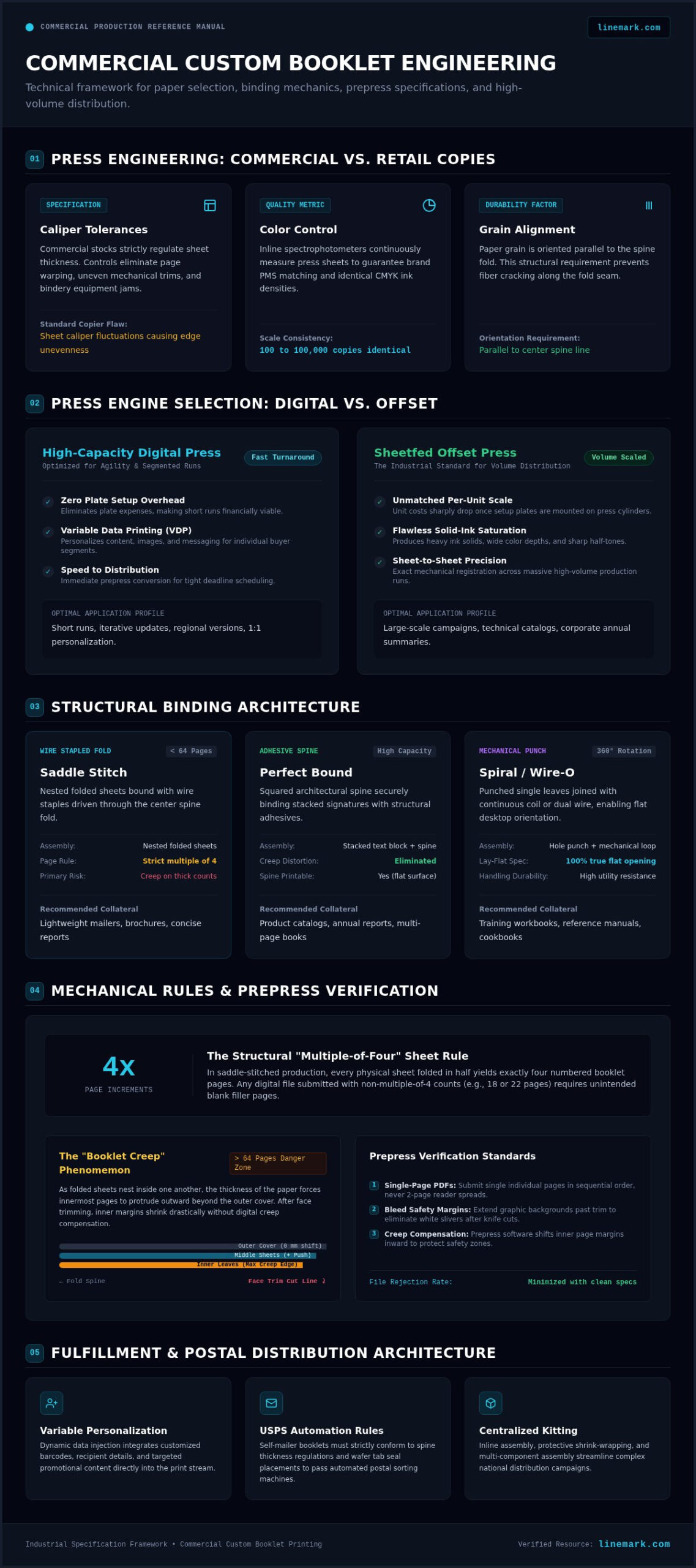
- Caliper Tolerances: Commercial text and cover papers adhere to strict thickness controls, preventing page warp, uneven edges, and mechanical bindery jams.
- Color Control: Spectrophotometers continuously measure press sheets to guarantee brand PMS matching and consistent CMYK densities across runs of 100 or 100,000.
- Grain Alignment: Production experts run paper with the grain parallel to the spine fold, eliminating the unsightly fiber cracking common in retail copy collations.
Selecting the Right Production Method: Digital vs. Offset
Choosing between digital and offset production comes down to order volume, scheduling deadlines, and customization needs. High-end digital presses eliminate plate setup costs, making them the preferred engine for rapid turnarounds, short runs, and variable data printing that personalizes content for specific buyer segments.
Offset printing remains the gold standard for high-volume booklet distribution. Once plates are set, offset presses deliver unmatched per-unit economies of scale alongside flawless solid-ink saturation. Aligning your schedule and run size with these production realities, as detailed in our guide to custom book printing, guarantees premium visual results while optimizing your overall commercial marketing investment.
Evaluating Booklet Binding Methods: Saddle Stitch, Perfect Bound, and Spiral
Binding determines reader comfort, page capacity, and brand authority. Beyond aesthetics, the physical volume of your page count dictates the structural mechanics needed to prevent tearing, warping, or spine failure. Top-tier custom booklet printing services evaluate paper bulk alongside sheet count before recommending an assembly technique.
Saddle Stitching: Mechanics and Page Count Rules
Saddle stitching nests folded sheets bound by wire staples driven through the center fold. Because every physical sheet yields four numbered booklet pages, your total page count must always be a multiple of four. This approach works best for collateral under 64 pages. Beyond that threshold, page bulk causes booklet creep, where inner leaves push outward past outer sheets, causing edge distortion. If you intend to distribute un-enveloped self-mailers, aligning your physical layout with official USPS booklet design standards ensures your spine thickness and wafer seals pass automated postal sorters cleanly.
Perfect Binding: Architectural Spines for Higher Page Counts
For publications exceeding 40 to 60 pages, perfect binding provides a squared, professional spine. Collated signatures are milled along the fold and secured to a wraparound cover using durable Polyurethane Reactive (PUR) adhesive. PUR glue retains flexible tensile strength in extreme temperatures, preventing brittle spine cracking when readers flex dense, coated papers. Designers must provide adequate gutter margins, keeping interior body copy at least 0.5 inches away from the bind edge so content doesn’t disappear into the spine curve.
Spiral and Wire-O: Hands-Free Functionality for Manuals
Technical handbooks, training workbooks, and recipe guides benefit from mechanical binding that rotates 360 degrees and lies completely flat on a desk. Plastic coil binding offers rugged durability that bounces back from heavy crushing in backpacks or job sites. Conversely, twin-loop wire-o creates a clean, executive look suited for corporate presentations. Remember to adjust your inner margins by at least 0.375 inches; mechanical punch dies will slice directly through vital graphics if your art runs too close to the edge.
Partnering with an industrial manufacturing team offering turnkey custom booklet printing services gives you direct access to bindery specialists who calculate paper bulk caliper and spine geometry before production begins.
Choosing Paper Stocks, Coatings, and Custom Protective Finishes
Substrate weight and texture immediately signal brand quality before a recipient reads a single headline. In high-volume commercial production, paper selection isn’t just a tactile choice; it directly affects press performance, binding durability, and mailing weight. Evaluating basis weights and tactile coatings ensures your custom booklet printing services deliver materials that withstand logistics handling while preserving visual clarity.
Coated vs. Uncoated Text Weight Paper Stocks
Text sheets form the bulk of your publication, typically ranging from 70lb uncoated sheets to 100lb coated stocks. Gloss-coated text offers a smooth reflective surface that enhances color saturation, making it the preferred substrate for product catalogs and vibrant imagery. Matte or dull-coated stocks diffuse ambient reflections, reducing eye strain across dense, copy-heavy annual reports. When producing technical workbooks or training materials requiring manual notes, premium uncoated stocks provide the necessary surface absorbency for ballpoint pens and pencils without smearing.
Self-Cover Formats vs. Heavyweight Cover Enclosures
Deciding between a self-cover format and a separate cover sheet dictates how your booklet holds its shape:
- Self-Cover Formats: The cover uses the exact same paper stock and weight as the interior pages. This approach drastically minimizes total manufacturing weight, making it highly effective for lowering postal delivery costs on high-volume direct mail drops.
- Heavyweight Plus-Covers: Wrapping your interior text with an 80lb or 100lb cover stock adds rigid structural protection. Commercial facilities score these heavier sheets along the spine prior to folding, preventing unsightly fiber cracking across ink-heavy cover designs.
Protective Coatings and Visual Embellishments
Unprotected ink can scuff during high-speed bindery collation and automated postal distribution. Professional production workflows apply inline aqueous coating during printing, sealing the sheet with a fast-drying protective layer that resists smudging and fingerprint transfer. For precise color consistency and standardized coating application across commercial press runs, facilities follow industry frameworks like the Idealliance Guide to Print Production.
When tactile impact is paramount, decorative embellishments transform standard collateral into premium touchpoints. Soft-touch laminates impart an ultra-smooth, velvet feel that elevates corporate marketing collateral. Pairing these matte film barriers with raised spot UV gloss creates striking textural contrast, highlighting cover logos, technical diagrams, or headline typography without sacrificing durability.
Prepress File Preparation: How to Prevent Booklet Print Flaws
Flawless booklet manufacturing starts long before paper feeds through a press. Submitting flawed artwork leads to costly production pauses, misaligned spreads, and discarded press sheets. Commercial imposition software requires single-page PDF files delivered in chronological reading order, rather than pre-imposed reader spreads. Always build your files with a standard 0.125-inch bleed extending beyond every outer trim edge, giving finishing blades adequate tolerance to slice cleanly through full-bleed imagery.
Understanding and Correcting Booklet Paper Creep
Creep occurs naturally during saddle-stitch binding when nested folded sheets gradually push interior pages outward past the cover. If unaddressed, the final edge trim clips off page numbers, margins, and exterior artwork on center leaves. Industrial prepress software compensates by incrementally nudging inner page layouts inward toward the spine. You can safeguard your design by maintaining a generous safe margin, keeping all live text, icons, and folios at least 0.25 to 0.375 inches away from final trim edges.
Resolution, Color Modes, and Typography Guidelines
Industrial presses resolve minute details, meaning shortcuts will stand out immediately. Adhere to these essential asset rules:
- Image Resolution: Ensure all raster photos and graphics maintain a crisp 300 DPI at 100% output scale to avoid blurry or pixelated reproductions.
- CMYK Color Conversion: Convert all RGB camera assets and brand colors into CMYK profiles before export, eliminating unexpected color shifts on press.
- Font Management: Embed all font libraries directly into your high-resolution PDF or convert complex display typography to outlines to prevent automated system font substitutions.
The Essential Preflight Checklist Before File Submission
Before handing your project over to professional custom booklet printing services, perform a thorough digital preflight review. Check that your saddle-stitched page count divides evenly by four. Review transparency settings and overprint attributes to ensure drop shadows don’t create opaque white bounding boxes. For expansive black backgrounds, don’t rely solely on 100% black ink; build a balanced rich black mix (such as 60 Cyan, 40 Magenta, 40 Yellow, and 100 Black) to achieve deep, saturated tones without causing sheet wetness issues.
Ready to move your publication into manufacturing without scheduling delays? Submit your booklet files for prepress inspection so our technical team can verify your geometry, bleeds, and color profiles before production begins.
Scaling Booklet Campaigns: Turnkey Fulfillment and Direct Mail Integration
High-volume booklet printing shouldn’t end with pallets sitting on your loading dock. The real value of commercial custom booklet printing services materializes when manufacturing connects directly with automated mailing lines and nationwide distribution networks. Integrating production with turnkey fulfillment eliminates logistical friction, cuts carrier transit times, and protects your bottom line.
Variable Data Printing for Hyper-Targeted Publications
Mass-produced generic collateral rarely drives the engagement modern enterprise campaigns demand. Digital variable data printing (VDP) allows marketing teams to alter booklet covers, localized dealer imagery, individualized promotional codes, and custom copy within a single automated print run. Tying recipient databases directly to digital press engines turns product catalogs and benefit summaries into targeted sales drivers. For deeper tactical execution on data-driven customer acquisition, explore our verified direct mail marketing strategies.
Centralizing Print Ordering with MarCom On-Demand
Managing multi-branch operations or distributed sales teams often risks brand dilution. Field reps seeking quick collateral frequently resort to local copy shops, leading to inconsistent color reproduction and unapproved messaging. Web-to-print portals solve this headache. By deploying centralized MarCom On-Demand solutions, corporate administrators maintain rigid design lockouts while empowering regional teams to customize approved booklet layouts, generate instant soft proofs, and initiate production runs on demand.
Turnkey Kitting, Warehousing, and Nationwide Distribution
Strategic enterprise programs frequently require more than a standalone booklet. Professional kitting combines custom bound collateral with promotional products, personalized letters, and branded presentation boxes for onboarding, membership rollouts, or corporate gifting:
- Climate-Controlled Warehousing: Storing high-volume press runs within an expansive 90,000-square-foot facility captures long-run production economies while releasing inventory in scheduled batches.
- Automated Postal Logistics: Direct mail workflows run addresses through CASS certification, NCOA updates, and presorting to secure the lowest possible commercial postal rates.
- Scalable National Reach: Drawing on over 30 years of industrial print manufacturing experience, a unified partner coordinates multi-location drop shipments and direct-to-consumer mail across the country without handoff delays.
Transform Your Multi-Page Collateral into Strategic Market Assets
Executing high-impact multi-page publications requires aligning structural bindery mechanics, substrate durability, and distribution logistics. Selecting the proper binding for your page bulk, configuring accurate prepress files with creep compensation, and pairing rich inks with protective coatings ensures your publications command immediate authority. Choosing the right custom booklet printing services means partnering with a team that views your print collateral as an engine for business growth, not an automated web transaction.
Operating an advanced 90,000-square-foot manufacturing and distribution facility, Linemark delivers end-to-end capabilities spanning high-capacity digital and offset printing, specialized binding, and automated direct mail fulfillment. Backed by over 30 years of industrial print manufacturing experience, our team eliminates production friction and safeguards your schedule from file preflight to doorstep delivery. Partner with Linemark for precision commercial booklet manufacturing and launch your next high-volume booklet campaign with absolute confidence.
Frequently Asked Questions
What is the minimum page count required for custom booklet printing?
Saddle-stitched booklets require a minimum of 8 pages, which equals two folded parent sheets, while perfect-bound publications typically require at least 40 to 48 pages to create an adequate spine width for adhesive bonding. For saddle stitching, page counts must always divide evenly by four. If your multi-page document contains fewer than 8 pages, it functions mechanically as a folded brochure rather than a bound booklet.
How does paper creep affect my saddle-stitched booklet design?
Paper creep occurs when nested folded sheets push innermost page leaves outward past the cover edge. When finishing knives trim the booklet flush, outer margins on interior pages become visibly narrower. Professional custom booklet printing services employ automated prepress compensation to incrementally shift interior layouts inward toward the spine, but maintaining safe margins of at least 0.25 to 0.375 inches prevents live text from clipping.
What is the difference between self-cover and plus-cover booklets?
A self-cover booklet uses the exact same paper stock for both the outer cover and interior text pages. In contrast, a plus-cover booklet pairs lightweight interior pages with a separate, heavier cover stock, such as an 80lb text interior wrapped in a 100lb cover. Self-cover formats minimize total manufacturing weight to reduce direct mail postage costs, whereas plus-covers deliver superior rigidity and tactile brand durability.
Should I export my booklet PDF files as reader spreads or single pages?
Always export your press-ready files as single-page PDF documents arranged in consecutive chronological reading order. Commercial prepress systems rely on automated digital imposition software to organize individual pages into press signatures based on sheet size, paper grain, and binding mechanics. Submitting pre-imposed reader spreads forces prepress technicians to manually deconstruct your file, creating unneeded scheduling delays and increasing the risk of spine alignment errors.
Which booklet binding method is best for employee training workbooks?
Spiral and double-loop wire-o bindings are the ideal choices for employee training workbooks and technical manuals. Mechanical binding methods allow the publication to rotate a full 360 degrees and lie flat on a desk, making hands-free reading and note-taking effortless. Plastic spiral coil offers rugged durability that resists crushing during active daily use, while twin-loop wire provides a clean, executive presentation for corporate seminars.
Can custom booklets be mailed directly to a targeted customer list?
Yes, partnering with commercial custom booklet printing services that offer turnkey direct mail fulfillment allows you to print, bind, address, and distribute publications in a single continuous workflow. Advanced commercial facilities scrub mailing databases through CASS certification and NCOA verification, applying variable data addressing and wafer seals inline. This unified manufacturing process eliminates secondary freight handoffs, accelerates delivery schedules, and secures the lowest possible commercial postal rates.