


 05/30/2026
  Steve Bearden
A single misplaced bleed line or a misunderstood color profile can transform a high-stakes brand investment into a pallet of unusable waste. When it comes to avoiding common book printing errors, the difference between a retail-ready masterpiece and a costly reprint often lies in the smallest technical details. You’ve likely felt that familiar anxiety over whether your CMYK values will shift on coated stock or if your spine width calculations are precise enough for a heavy page count. It’s a high-pressure environment where precision is the only currency that matters.
Mastering these nuances is the only way to ensure a flawless result that protects your budget and your timeline. This guide provides the strategic roadmap you need to move from complex file preparation to seamless kitting and fulfillment. We’ll explore the essential prepress checkpoints, the impact of 2026 design trends like the warm Cloud Dancer palette, and the logistical precision required to get your books into the hands of your audience with absolute confidence. Your vision deserves a production partner that values accuracy as much as you do.
Key Takeaways
- Master the technical specifications for bleed, trim, and safety zones to ensure your layouts translate perfectly from screen to press.
- Align your material selection with functional goals by matching specific paper weights and binding methods to your book’s intended use.
- Implement a rigorous proofing phase that prioritizes physical samples for avoiding common book printing errors like color shifts and layout drifts.
- Protect your investment after the press run by integrating strategic inventory management and specialized kitting to prevent transit damage.
- Leverage automated MarCom On-Demand portals and Variable Data Printing to enforce brand standards and eliminate manual production risks.
Mastering the Technical Foundation: File Preparation and Formatting
Achieving a retail-ready finish begins long before the press starts. Precision in file preparation is the cornerstone of avoiding common book printing errors that often derail high-volume projects. Whether you’re utilizing offset printing for a large run or digital printing for on-demand needs, technical discipline ensures your brand’s integrity remains intact from the first page to the last.
To visualize how these technical decisions impact your final product, watch this breakdown of common prepress pitfalls:
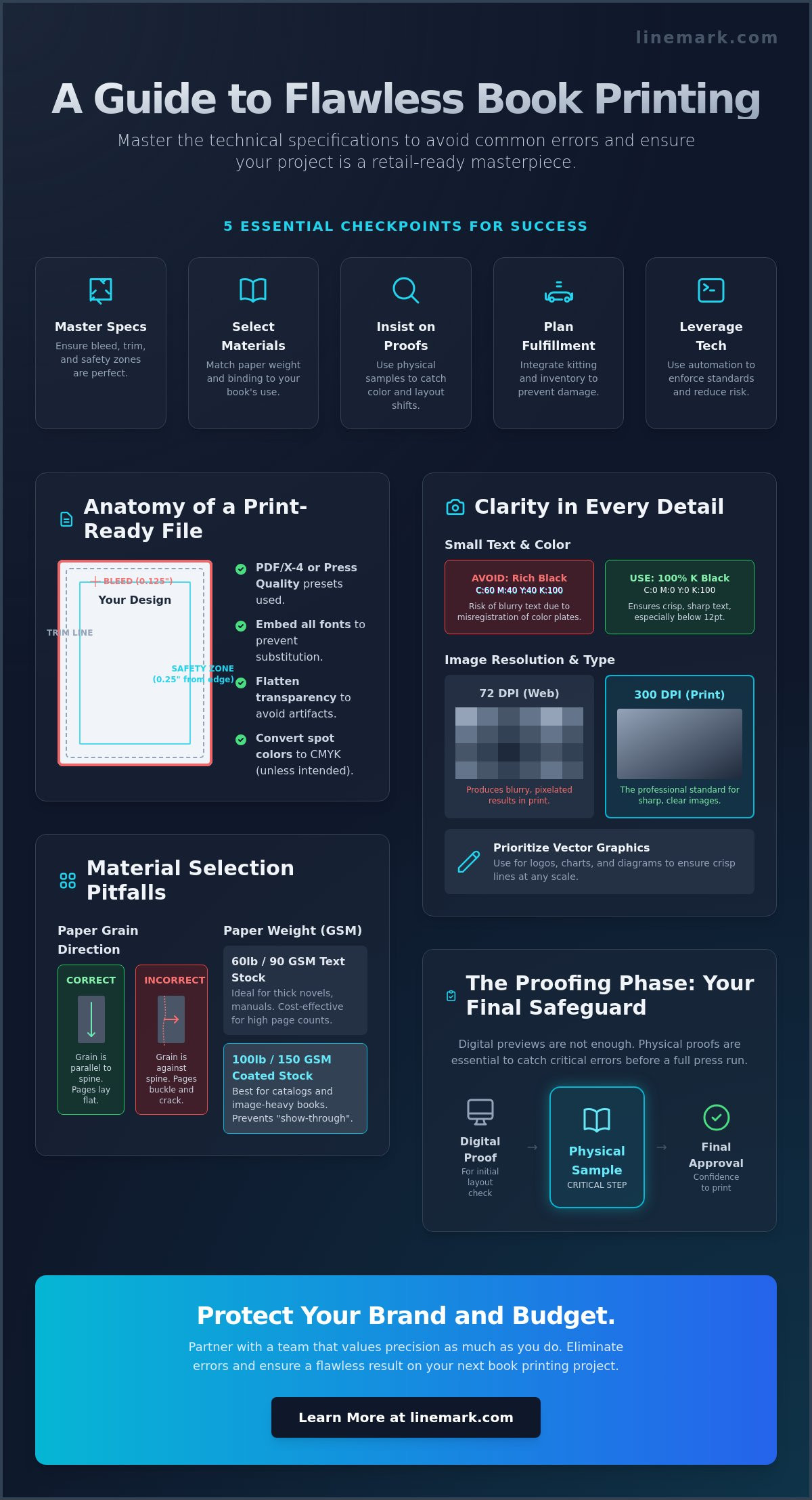
Small body text requires specific treatment to maintain legibility. Using “Rich Black” (a mix of Cyan, Magenta, Yellow, and Black) for fine typography often leads to registration issues, resulting in blurry or shadowed letters if the plates shift even a fraction of a millimeter. Stick to 100% Black (K) for text below 12 points. Similarly, failing to embed fonts can cause automated systems to substitute your carefully chosen typeface with generic alternatives. This breaks your layout and undermines your professional aesthetic.
The Anatomy of a Print-Ready PDF
High-quality output starts with the right export settings. Using “Press Quality” or “PDF/X-4” presets ensures that transparency layers are handled correctly and color profiles remain consistent. For perfect-bound books, you must account for the gutter. This inner margin prevents text from “disappearing” into the spine, a crucial step in understanding the bookbinding process and its physical limitations.
A common failure point is the lack of proper bleed. If your background colors or images don’t extend at least 0.125 inches beyond the trim line, you risk thin white slivers appearing at the edges after the book is cut. Use this verification checklist before submission:
- Confirm bleed extends 0.125″ beyond the final trim size.
- Ensure safety zones keep vital text 0.25″ away from all edges.
- Flatten transparency effects to prevent “box” artifacts around images.
- Verify that all spot colors have been converted to CMYK unless a fifth plate is intended.
Resolution and Image Integrity
Resolution isn’t just a technical spec; it’s the limit of your book’s visual clarity. While 72 DPI works for web graphics, commercial printing demands a minimum of 300 DPI at the final printed size. Scaling a small image up within your layout software doesn’t add detail; it only reveals pixels. This creates a “soft” or blurry look that signals a lack of professional oversight. It’s a primary factor in avoiding common book printing errors during the production of image-heavy catalogs or annual reports.
Material Selection Pitfalls: Paper, Binding, and Color Management
Selecting the right materials is a strategic decision. It dictates the lifespan and perceived value of your project. While digital and offset printing offer distinct advantages in speed and volume, the physical substrates must be chosen with operational intent. A common oversight involves ignoring grain direction. Paper fibers naturally align in one direction during manufacturing. If you fold against the grain, the pages will buckle and crack. Aligning the grain parallel to the spine is a fundamental rule in avoiding common book printing errors that preserves the structural integrity of your work.
Matching paper weight (measured in GSM) to functionality is equally critical. A lightweight 60lb text stock might suit a thick novel, but a high-end catalog requires a 100lb coated stock to prevent “show-through” where images on the reverse side are visible. This level of technical oversight prevents the common book printing file problems that often occur when designers fail to account for physical thickness during the layout phase.
The Strategic Choice of Binding
Binding selection depends on page count and intended use. Saddle stitching is efficient for thin brochures, but it cannot accommodate the spine of a 200-page annual report. For those larger projects, perfect binding provides a clean, professional edge. You must accurately calculate the spine width based on the exact paper PPI (pages per inch) to ensure your cover art aligns perfectly. For heavy-duty educational materials, Wire-O or coil binding allows the book to lay flat, an essential feature for user experience. If your project requires maximum durability, case binding offers the rigid protection necessary for luxury editions or archival records.
Color Consistency Across Print Runs
Color management is where many projects face unexpected hurdles. Monitors display color in RGB (light), while presses use CMYK (ink). This transition naturally reduces the vibrancy of bright neons and deep blues. To maintain corporate brand integrity, utilizing Pantone matching for critical logos is non-negotiable. The paper finish also plays a role; ink sits on top of coated paper for crisp, vibrant results, but it sinks into uncoated paper, creating a softer, more muted appearance. Understanding these shifts helps you set realistic expectations for your final product. For those seeking precision across complex, high-volume runs, our team at Linemark provides the industrial expertise to navigate these material nuances seamlessly.
The Proofing Phase: Why Digital Previews Are Not Enough
Relying solely on a monitor for final approval is a high-risk strategy that often leads to avoidable complications. Digital screens use transmissive light in an RGB color space, while physical printing relies on reflective light and CMYK inks. This fundamental difference means that the vibrant teal or deep mahogany you see on a backlit display will inevitably shift when applied to a physical substrate. Physical proofs serve as the final safety net for avoiding common book printing errors. They provide a tangible baseline to evaluate how your design interacts with the selected paper texture and weight.
The “Cold Eye” rule is a standard in professional production for a reason. After spending weeks or months on a project, your brain begins to see what it expects to see rather than what is actually on the page. This cognitive bias makes authors and primary designers the least effective people to conduct a final review. A fresh set of eyes is essential to identify technical artifacts like “ghosting” or ink set-off. These issues occur when high-ink-coverage designs don’t dry properly before the next sheet is stacked, leading to faint, unintended transfers of imagery. A physical sample reveals these mechanical flaws before you commit to a full production run.
Technical vs. Editorial Proofreading
A successful proofing phase requires two distinct lenses. Editorial proofing ensures that the Table of Contents remains synchronized with final page numbers and that no character substitutions occurred during the font embedding process. Technical proofing, however, focuses on the structural integrity of the file. You must check for moiré patterns, which are distracting wavy effects caused by improper image screening. It’s also the time to verify that barcodes and QR codes maintain enough contrast to be scannable. If a code fails on the proof, it will fail at the point of sale.
The Value of a Press Proof
For high-volume orders, a hard-copy press proof is a strategic investment that provides total peace of mind. It allows you to verify spine alignment and cover wrap-around in three dimensions. If the spine text is off by even a single millimeter, the book’s shelf presence is compromised. By integrating custom book printing standards into your review cycle, you establish a clear quality benchmark with your production partner. This collaborative step ensures that the final product mirrors your original vision with industrial precision. Use the proof as a communication tool to request final adjustments to saturation or trim margins, ensuring a seamless transition to the distribution phase.
Post-Production Pitfalls: Fulfillment, Scaling, and Distribution
The final bindery cut is only one milestone in a complex production journey. Precision must extend beyond the press and into the warehouse to ensure your investment reaches its destination in pristine condition. Many organizations focus so intensely on ink and paper that they overlook the operational risks inherent in the distribution cycle. Maintaining a high standard of quality control during the logistical phase is fundamental to avoiding common book printing errors that occur after the books leave the shop floor.
For projects utilizing Variable Data Printing, the stakes are even higher. Mailing list errors can lead to thousands of misdirected units, wasting both production spend and postage. Kitting adds another layer of complexity. Ensuring that every insert or marketing material is placed correctly requires a centralized, tech-driven approach to eliminate human error. If you’re looking to streamline your entire production and distribution workflow, you can find a comprehensive suite of solutions at linemark.com.
Streamlining Distribution and Logistics
Avoiding the hidden costs of decentralized shipping requires a unified approach to logistics. When projects are handled by multiple vendors, the risk of communication breakdown increases. Implementing data-driven direct mail strategies prevents waste by ensuring your materials reach the most relevant audience with postal precision. Centralized shipping also allows for better tracking and more consistent delivery timelines, which are essential for time-sensitive marketing campaigns.
Scalability and On-Demand Production
Transitioning from a short-run digital project to high-volume offset printing requires a partner that can maintain consistency across multiple batches. Digital printing is excellent for testing the market or handling MarCom on-demand needs, but scaling to thousands of units demands a shift in production strategy. The role of kitting & fulfillment becomes more pronounced as volume grows. Professional delivery isn’t just about speed; it’s about the meticulous assembly of every component to ensure your brand’s story is told exactly as intended, regardless of the scale.
Leveraging Technology to Eliminate Human Error
Technology represents the final, most robust line of defense in modern production. While manual checklists are valuable, they’re subject to human fatigue. Automated pre-flight software serves as a digital gatekeeper, scanning every file for the technical discrepancies discussed in previous sections, such as low-resolution imagery or missing bleed, before the press even starts. This systematic approach is the most effective method for avoiding common book printing errors at scale. By removing the guesswork from the prepress phase, you ensure that every project meets industrial standards with mathematical certainty.
Variable Data Printing (VDP) further enhances this precision. It allows for deep personalization across thousands of units without the manual error risk associated with traditional plate changes. Whether you’re producing customized annual reports or tailored newsletters, VDP ensures that unique data points are integrated seamlessly. This technological infrastructure transforms printing from a transactional task into a high-tech, reliable process that supports complex marketing objectives and drives client growth.
Centralizing Your Print Assets
Centralizing your materials within a digital asset library eliminates the danger of version control errors. When distributed teams work from a single source of truth, the risk of printing outdated branding or incorrect legal disclosures vanishes. Implementing marcom on-demand portals allows your partners to order retail-ready materials that are pre-approved and brand-compliant. This system also provides real-time inventory tracking, ensuring you never face a stock-out during a critical campaign. It’s a proactive model that prioritizes operational breadth and protects your brand’s visual identity across all channels.
Choosing a Strategic Communications Ally
The transition from a transactional vendor to a strategic communications ally is a catalyst for long-term growth. You need a partner that offers more than just ink on paper; you need a centralized destination for diverse needs. Evaluating a printer’s technological capacity is essential to ensure they can handle your scale. At Linemark, our 90,000 square foot facility is a hub of precision and logistics, designed to handle high-volume projects with the meticulous attention of a boutique shop. We don’t just provide a service. We offer a unified partnership that manages the entire holistic journey from initial file prep to final kitting and fulfillment. Choosing an ally with this level of industrial authority ensures your vision is executed with absolute reliability and a modern, proactive spirit.
Securing Your Brand’s Legacy Through Technical Precision
Professional book production is a sophisticated journey where technical accuracy meets logistical excellence. By mastering the nuances of file preparation and selecting materials that align with your book’s functional goals, you transition from a simple print project to a strategic communications asset. Precision is your greatest asset. The proofing phase and post-production logistics are equally vital. They ensure your vision is realized without the common pitfalls of color shifts or transit damage. Successfully avoiding common book printing errors requires a blend of meticulous design and industrial-grade execution.
At Linemark, we bring over 30 years of industrial printing experience to every partnership. Our 90,000-square-foot high-tech production facility is equipped to handle high-volume demands with meticulous attention to detail. We provide integrated, data-driven fulfillment and distribution to ensure your projects move seamlessly from the press to your audience. Partner with Linemark for Flawless Book Production and Fulfillment and move forward with the confidence that your project is in expert hands.
Frequently Asked Questions
What is the most common technical error in book printing?
The most frequent technical failure is a lack of adequate bleed and safety margins in the print-ready file. Without these extensions, the trimming process can leave unsightly white slivers at the edge of the page or cut off vital text. This is a primary factor in avoiding common book printing errors during the prepress phase. Maintaining a 0.25 inch safety zone for all critical content ensures a clean, professional finish.
How much bleed do I need for a professional book layout?
Professional book layouts require a standard bleed of 0.125 inches on all four sides of the page. This extra space allows the background color or imagery to extend beyond the final trim size; it compensates for slight mechanical shifts during the cutting process. Providing this margin is essential for achieving a full-bleed look that meets industrial quality standards across high-volume production runs and complex catalogs.
Can I print a book using RGB images?
You should never print a book using RGB images because commercial presses operate in the CMYK color space. RGB is designed for light-emitting screens, while CMYK is for light-reflecting ink. If you submit RGB files, the automated conversion process often results in muted colors and lost detail. Converting your assets to CMYK before submission allows you to control the output and maintain your brand’s visual integrity.
What is the difference between digital and offset printing for books?
Digital printing is ideal for short-run projects and Variable Data Printing (VDP) due to its quick setup and flexibility. Offset printing is the preferred choice for high-volume runs; it offers lower per-unit costs and superior color depth through the use of physical plates and liquid ink. Selecting between these methods depends on your total page count, volume requirements, and the need for specific tactile finishes or specialty coatings.
Why do my printed colors look different than they did on my screen?
Colors appear different on a screen because monitors use a backlit RGB display, which can produce a wider range of vibrant hues than physical ink. Paper stock also influences the result; uncoated paper absorbs ink for a softer look, while coated paper keeps ink on the surface for higher contrast. This discrepancy is a frequent hurdle in avoiding common book printing errors, making physical proofing a strategic necessity for any professional project.
How do I choose the right binding for my book project?
Choose your binding based on the book’s page count and intended durability. Saddle stitching is cost-effective for thin booklets, while perfect binding is the industrial standard for professional paperbacks with a spine. For projects requiring the pages to lay flat, such as manuals or educational materials, Wire-O or coil binding is the most functional choice. High-end annual reports often utilize case binding for maximum longevity and prestige.
Is physical proofing really necessary if I have a digital proof?
Physical proofing is essential because a digital proof cannot accurately represent how ink interacts with your chosen paper substrate. A hard-copy proof allows you to verify spine width, check for technical artifacts like moiré patterns, and confirm that the tactile feel of the paper meets your expectations. It serves as the final checkpoint to ensure your retail-ready book is free from mechanical or color-related flaws before the full run begins.
What are the risks of self-managing book fulfillment and shipping?
Self-managing fulfillment carries significant risks, including inventory mismanagement and damage during transit due to improper packaging. Without professional kitting & fulfillment, you may face higher shipping rates and slower delivery times. Utilizing a centralized partner with climate-controlled warehousing protects your paper integrity and ensures your books reach their destination in pristine condition. This integrated approach reduces the operational burden on your team while maintaining high standards of distribution excellence.