

 11/11/2026
 Steve Bearden
A trade show handout should make one point clearly, not try to deliver your entire sales presentation. When printing trade show handouts and flyers, start with a concise flyer featuring a key product, company details, or an event offer; add a product sheet or brochure when attendees need more depth. Plan essential print materials 2-3 weeks before the show.
It’s tempting to fit every feature, benefit, and detail onto one page. But a focused handout is easier to scan at a busy booth and gives attendees a clear next step.
This guide explains which flyers and leaflets suit different goals, how much information to include, how to estimate quantities, and what to prepare before sending files to print. You’ll also learn when a QR code or a longer brochure can support a handout without crowding its message.
Key Takeaways
- Match each handout to its job: use a concise flyer for a quick message and a more detailed piece when prospects need product information to share.
- Choose the format and information level around what attendees need to understand next, rather than squeezing every detail onto one page.
- Set quantities based on expected conversations and event length, then build in a buffer to help avoid running short.
- Prepare artwork and coordinate print materials ahead of the show so there’s time to review the design, QR code, and final production details.
1. Leaflets and flyers for sharing brand details and offers
Use a flyer to communicate one clear message: introduce your company, spotlight a product, or promote an event offer. A one-page comparison sheet can help visitors assess products without carrying a lengthy presentation. For example, highlight three key differences, a concise benefit, and a next step. Keep the copy brief enough to scan while people move between booths.
Choose a format that suits the information. A small leaflet can share basic company details, while a brochure gives a product or service more room. A business card can carry contact details, a website, or a QR code, but it shouldn’t carry the whole pitch. Link the QR code to a relevant landing page, product details, or an offer. Give it one clear purpose.
For legal considerations, make the terms of any advertised promotion clear. If a prize-entry card is connected to follow-up communications, explain clearly what entrants can expect. Collect only details you’ll use, such as a name, company, email, and interest selection. These steps help visitors understand the offer and what happens after they respond.
Keep colours, fonts, and visual style consistent across flyers, brochures, business cards, and booth graphics. When a visitor sees the same brand colours on a banner and leaflet, they can connect the materials at a glance. Use consistent logo placement and type styles, then tailor the copy to each format. This makes separate pieces feel like one coordinated set.
Choose branded promotional items for usefulness, not novelty alone. A notebook and pen can support note-taking during sessions, while a tote can hold brochures and other event materials. Add a logo and concise message, and keep the design aligned with the printed handouts. A memorable item should reinforce the same product, offer, or brand detail featured at the booth.
Before production, review every piece as a set. Confirm that the offer, contact details, QR destination, and visual identity match across the flyer, brochure, business card, and merchandise.
2. Choosing handouts by information level
Choose a format based on how much a visitor needs to know before acting. A rack card suits one product, service, or offer and leaves room for a short explanation. A product sheet can present benefits, features, specifications, relevant package options, proof points, and contact information. For example, show how two product options differ, then give visitors a clear next step. A focused layout makes printing trade show handouts and flyers more useful to people making a decision.
Use a brochure when a prospect needs polished information to share with a decision-making team. It can bring product details and supporting information together, while a booklet can serve as a fuller reference. Include specifications, pricing, or testimonials only when they help readers evaluate the offer. Divide longer content into labeled sections so attendees can find a specific detail without reading every page.
Flyers are quick to scan and suit a concise message, but their limited space makes them less effective for complex product details. Brochures offer more room for explanation, though visitors may not want a longer read at a busy booth. Postcards are compact and direct, making them useful for an event offer or follow-up message, but leave little room for context. Each format serves a different point in the conversation.
Common promotional postcard sizes are 4″ × 6″ and 5″ × 7″. Use the front for one offer or product image, then reserve the reverse for a brief explanation and response details. A QR code can connect that printed message to a landing page with deeper specifications or a special offer. Test the destination and keep the code easy to scan. This is one practical way printing trade show handouts and flyers can bridge booth conversations with digital information.
Business cards serve another purpose: they make a personal contact easy to retain. Include a name, role, and essential contact details; add a QR code only when it leads to a useful next step. A coordinated mix of concise and detailed materials can give each handout a clear role. Brochures and postcards can support distinct needs within a trade show handout set.
3. Pre-event print ordering timeline
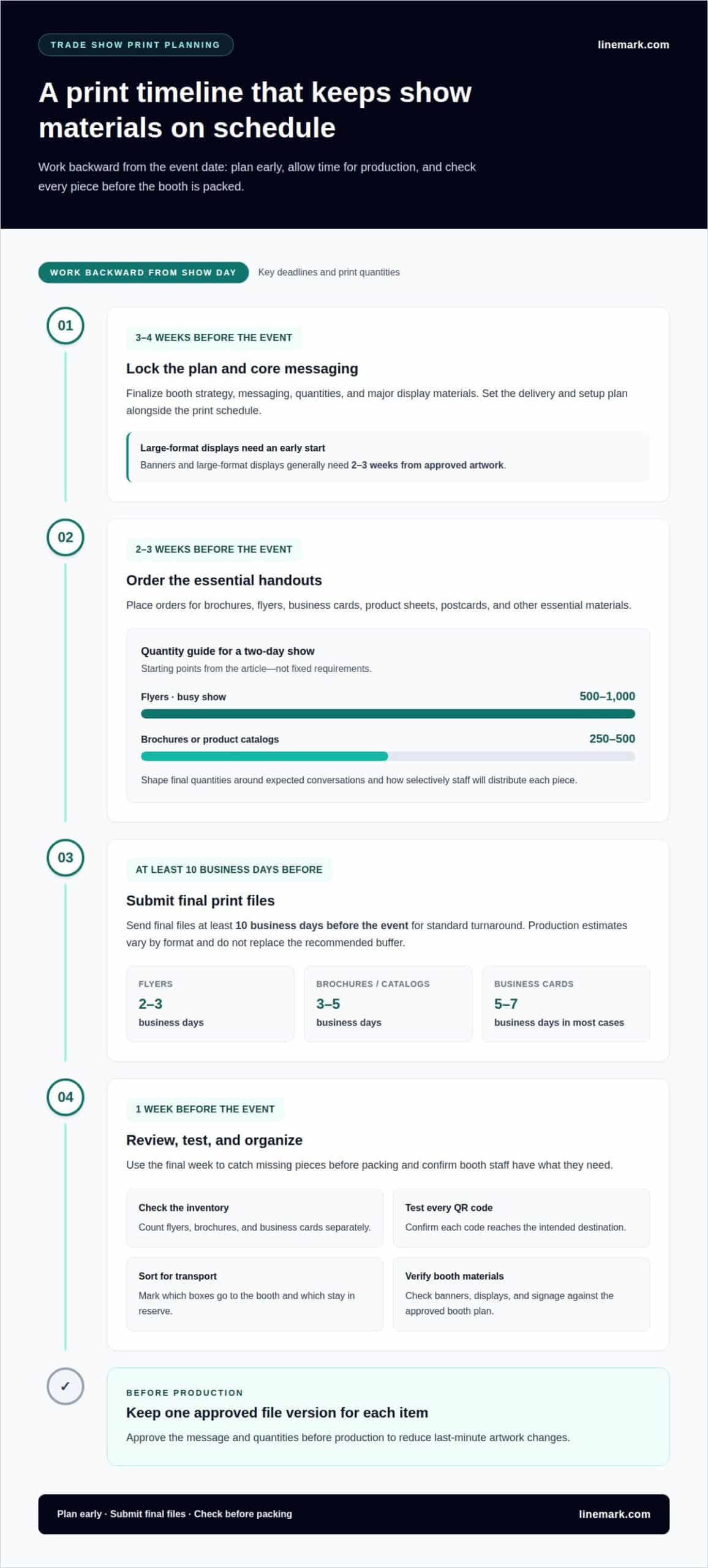
Work backward from the show date, separating artwork approval from production time. Finalize booth strategy, messaging, quantities, and major display materials at least 3-4 weeks before the event. Banners and large-format displays generally need 2-3 weeks from approved artwork, so they deserve an early place in the schedule. Set the delivery and setup plan alongside the print schedule.
Order brochures, flyers, business cards, product sheets, postcards, and other essential materials 2-3 weeks before the show. Typical production time varies by format: flyers may take 2-3 business days, while brochures or product catalogs may take 3-5 business days. These production estimates don’t replace the recommended buffer. Submit final print files at least 10 business days before the event for standard turnaround.
Build quantities around booth traffic and the role of each piece. For a busy two-day show, 500-1,000 flyers can provide a reasonable starting point. A two-day event may call for 250-500 brochures or product catalogs, with the final quantity shaped by expected conversations and how selectively staff will distribute them. Business cards generally need 5-7 business days in most cases, so include them in the same ordering plan.
One week before the show, review print inventory, organize materials, test QR codes, and confirm booth staff have what they need. Count flyers, brochures, and business cards separately, then note which boxes go to the booth and which stay in reserve. Check banners, displays, and signage against the approved booth plan. This review gives the team time to catch missing pieces before packing.
A coordinated schedule also reduces last-minute artwork changes. Approve the message and quantities before production, then keep one approved file version for each item. If a QR code links to event information, test it before printing and again on a printed proof. The final scan checks the code at its actual size and placement, not just on a screen.
4. Flyers for trade show handouts
A strong trade show flyer makes one message visible in seconds. Use a headline, one key benefit, a clear visual, and one call to action. Common flyer sizes are 8.5″ × 11″ and 5.5″ × 8.5″. Keep essential details away from trim edges, and prepare print files at 300 DPI with 0.125″ bleed on every side.
For brochures or product catalogs, 100 lb. gloss text stock is a recommended option. On flyers, choose a stock and finish that support the content: readable text should stay clear, while gloss can emphasize product imagery. Keep decorative effects secondary to legibility. A booklet can carry deeper product information, while the flyer directs visitors toward one next step.
For a busy two-day show, 500-1,000 flyers can be a reasonable starting quantity. Distribute them after a relevant conversation instead of placing a stack in every visitor’s path. This helps match the handout to genuine interest and limits leftovers. If giveaways accompany the flyer, connect each item to the same offer or product, creating a consistent impression rather than unrelated booth clutter.
Same-day printing shouldn’t be the schedule’s foundation. Production timing can vary, so approve files and place the order early. Before production, test each QR code; scan it again from a printed proof. Give the code enough contrast and clear space, then make sure its destination supports the flyer’s call to action.
For an efficient distribution plan, brief booth staff on which flyer fits each visitor need. Keep product comparisons ready for people weighing options, and reserve offer sheets for conversations about that promotion. Count remaining handouts during the event, then adjust how staff distribute them. Use a coordinated trade show print plan to align flyers, displays, and other booth materials before production.
Linemark
Linemark helps organizations coordinate trade show print materials around a clear message and event plan. Commercial Printing supports flyers and other printed marketing materials, while Large Format Graphics can carry the same visual identity across booth displays. Custom Book Printing suits projects that need a more substantial product publication, and Direct Mail can extend event communication beyond the show.
Turn to Linemark when you’re planning several connected pieces and want them aligned with your audience, quantities, and timeline. Share the formats you need, the approved artwork, and the event schedule to shape a coordinated production plan.
Contact Linemark to discuss your trade show print materials.
Make Your Next Trade Show Touchpoint Count
A printed handout can keep a useful booth conversation going after visitors leave. Treat it as part of the experience, not a standalone piece: its message should connect naturally to what your team says, what the display communicates, and what attendees can do next. That alignment gives your materials a clear role beyond the event.
A thoughtful approach to printing trade show handouts and flyers starts with the audience’s next decision. Consider whether someone needs to revisit a product detail, share information with colleagues, or respond to an offer. That goal can guide the next campaign, too, including follow-up through Direct Mail or a more detailed publication through Custom Book Printing.
With a clear objective and coordinated production plan, your next event materials can support the conversation from booth to follow-up. Contact Linemark to plan your print order, and move forward with a focused plan for your next trade show.
Frequently Asked Questions
What should I print for a trade show?
Choose print materials that support the conversations your booth team expects to have. A compact product sheet can help visitors compare options, while business cards make it easy to follow up with a specific representative. If your booth features a product that needs more explanation, offer a detailed booklet to qualified prospects. Match each piece to a clear audience need instead of handing every visitor the same packet.
What types of handouts and flyers work best at trade shows?
The best format depends on the depth of information and when you’ll share it. A flyer suits a single offer or announcement; a product sheet supports closer evaluation; and a booklet gives prospects a reference for later team discussions. For example, give a short overview to casual visitors and reserve detailed materials for attendees who ask about implementation or specifications.
How to design effective trade show flyers and handouts?
Build each piece around one audience and one action. Use a headline that names the benefit, then organize supporting details in a clear reading order. For example, a flyer promoting a product demonstration could pair a concise value statement with the demonstration details and a QR code for registration. Keep contact information easy to find, and review the printed proof for legibility and accurate links.
What are the turnaround times for trade show flyer printing?
Flyer production typically takes 2-3 business days, but production time isn’t the same as a safe order deadline. For standard turnaround, submit final files at least 10 business days before the show. That buffer leaves room for file preparation, approval, and delivery planning. Build your schedule from the event date, and account for other materials that may require longer production timelines.