

 11/02/2026
 Steve Bearden
Personalization has a clear boundary: bulk mail addressing requirements allow personal information in USPS Marketing Mail only when the piece contains an explicit advertisement or donation solicitation and the information directly supports it. USPS Marketing Mail Rule 243.2.2 sets that condition, while Rule 243.3.2.10 requires each piece’s printed matter to match at least one other piece, apart from the addressee’s name and address. A bulk mailing must contain at least 200 identical pieces to qualify by piece count.
It’s reasonable to want each mailpiece to feel relevant to its recipient, but personalization still needs to follow the mail class and preparation rules. Understanding those requirements helps you plan the message, address data, and production details together.
This guide explains what personal information may appear, how mail is sorted and bundled, and the minimum size and eligibility requirements to account for. You’ll also see how address formatting and postal preparation fit into a mailing that’s ready to enter the mail stream.
Key Takeaways
- Compare the minimum mailing thresholds for the mail class you plan to use before setting your quantity; some eligibility rules consider piece count, while others also consider total weight.
- Organize pieces by mail type and 3-digit or 5-digit ZIP Code groupings to support presorting and bundling.
- Plan personalization around the message: recipient-specific details have limits, while address formatting and barcodes help prepare pieces for postal processing.
- Review the mailpiece’s dimensions, weight, layout, and permit requirements together, since eligibility depends on more than the mailing’s total size.
Minimum mailing size
The minimum depends on the mail class and how the mailing qualifies. For Standard Mail, the stated threshold is 200 pieces or 50 pounds. A bulk mailing can also meet the stated minimum with 50 pounds of mail. These figures describe different ways to qualify, so determine the applicable class and preparation method before setting the final quantity.
Piece count matters, too. A mailing must contain at least 200 identical pieces to qualify by piece count. First-Class Mail has a separate threshold: bulk-rate eligibility requires at least 500 pieces, while a single First-Class indicia mailing must contain at least 200 pieces identical in size and weight. These distinctions affect list size, print quantities, and postage planning.
Mailpiece dimensions also set a practical minimum. A regular postcard must measure at least 3.5 inches high and 5 inches long, with a thickness of at least .007 inches. Letter-size mail must be at least 5 inches wide, 3-1/2 inches high, and .007 inches thick. Postcards and letters must meet a length-to-height aspect ratio between 1 to 1.3 and 1 to 2.5 to qualify for letter rates.
Build your mailing list and print quantity together. Removing duplicate records can prevent unnecessary copies, while confirming the final quantity helps you plan for minimum eligibility requirements. Bulk mail is prepared for reduced postage rates, but postage and preparation depend on the mail class and presort. Mailers submit a mailing statement and pay postage, often through a permit or prepaid account.
Folded pieces need physical preparation, too. Bulk mailers must have at least two tabs, placed within an inch of the corner. For example, a folded self-mailer’s fold should sit below the address area, with its open end above the postage-indicia area. These bulk mail addressing requirements bring quantity, format, and mailing readiness together.
Sorting and bundling by ZIP code or delivery route
Accurate addresses support presorting, which groups mail for more efficient postal handling. Sorting also helps organize printed campaign pieces and prepare the mailing documentation.
Address Standardization and ZIP Code Accuracy
Address standardization formats recipient details consistently, while ZIP Code accuracy helps route each piece to its destination. Every address in a bulk mailing must include a ZIP Code, and standardized addresses should include the nine-digit ZIP Code. USPS requires recipient addresses to be processed through CASS, the Coding Accuracy Support System. This helps identify address issues before pieces are printed and bundled.
Keep the recipient name, delivery address, city, state, and ZIP Code together in a consistent address block. Place the return address in the upper-left corner of the address side. Ancillary service endorsements should be legible and positioned so they don’t interfere with the recipient address or barcode. Clear placement reduces confusion during handling and keeps the mailpiece layout readable.
Presorting by ZIP Code, Size, and Mail Type
Presorting groups pieces by ZIP Code level and mail type before mailing. USPS bulk mail is presorted by 3-digit and 5-digit ZIP Code levels, as well as by mail type. Sort compatible pieces into those groups, then bundle each group separately. Size matters because different mailpiece formats may require separate preparation.
For example, a campaign with 200 pieces can be organized into the ZIP Code groups represented in its address list. Accurate grouping helps mailers prepare the mailing statement and calculate postage for the prepared mailing. Submit presorted bulk mail to the Post Office that issued the permit, or deliver it to a designated bulk mail facility or Business Mail Entry Unit.
Address errors, missing ZIP Codes, and barcodes that cannot be read can disrupt processing. Artwork in the barcode area can also obstruct postal equipment; gloss-finish pieces without printed barcodes need a clear strip 5/8 inch high across the bottom edge. For campaigns pairing mail with on-site displays, large format graphics can extend the campaign beyond the mailbox and support its broader marketing goals.
What personalized info can I include in USPS bulk mail I am sending?
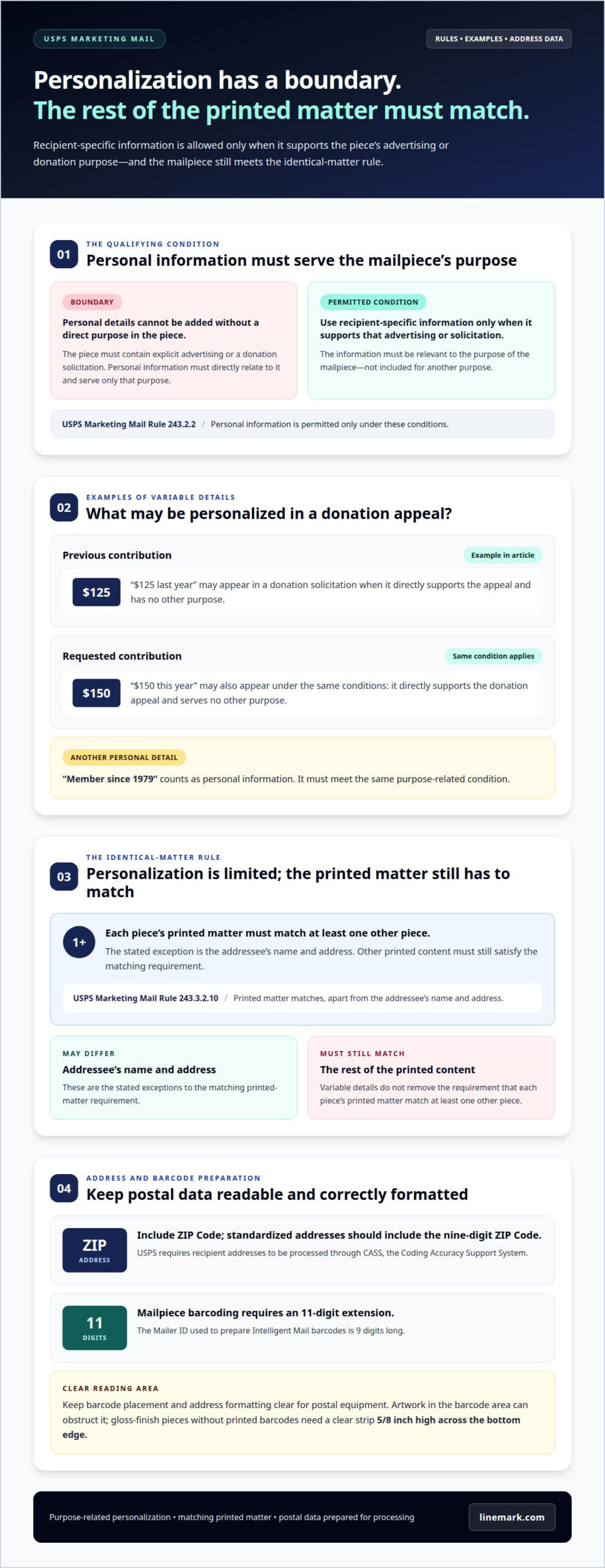
Personalization in USPS Marketing Mail must support the piece’s advertising or donation purpose. Rule 243.2.2 permits personal information only when the mailpiece contains explicit advertising or a donation solicitation, and the information directly relates to it and serves only that purpose. Rule 243.3.2.10 requires each piece’s printed matter to match at least one other piece, while allowing the addressee’s name and address.
That distinction guides variable content. A membership duration, such as “member since 1979,” counts as personal information. In a donation solicitation, the addressee’s previous contribution amount, such as “$125 last year,” may appear when it directly supports the appeal and has no other purpose. A requested amount, such as “$150 this year,” may also appear under the same conditions. The rest of each piece’s printed content must still meet the identical-matter rule.
Addresses and barcodes have separate preparation needs. Every address must include a ZIP Code; standardized mailing addresses should include the nine-digit ZIP Code. Mailpiece barcoding requires an 11-digit extension. CASS address verification includes barcodes that can help automate postal sorting, while address formatting and barcode placement should leave postal equipment a clear reading area.
What presort and barcode requirements apply to bulk mail? Sort pieces by mail type and 3-digit or 5-digit ZIP Code groups, then prepare them for the mailing. Automation-compatible barcodes support processing, and the Mailer ID used to prepare Intelligent Mail barcodes is 9 digits long.
For gloss-finish mailpieces without printed barcodes, the U.S. Postal Service requires a clear strip 5/8 inch high across the entire bottom edge for barcoding machines. Keep the address and barcode area free of artwork. Mail trays, sacks, and their labels should preserve the prepared groupings so each container corresponds to its sorted pieces. A permit imprint or other postage marking handles payment identification; it doesn’t replace the address or barcode.
Bulk-mail eligibility requirements
Eligibility depends on mail class, quantity, sender classification, content, and preparation. USPS bulk-rate eligibility requires at least 200 pieces of Standard Mail. Bulk mail of other types usually requires at least 300 pieces, while Parcel Post requires a minimum of 50 pieces. A single piece cannot weigh more than 15.99 ounces. These thresholds aren’t interchangeable: match the mailing quantity and format to the class you intend to use.
Mail class determines what a mailing can contain. Bulk mail may travel as First-Class Mail, Marketing Mail, or Nonprofit Mail, depending on the sender’s classification and goals. Marketing Mail has content restrictions, so check that the piece’s contents are eligible before sending. Hand-addressed mail should be sent as First-Class Mail and doesn’t qualify for discounted nonprofit rates. Choose the class based on the mail’s purpose and content, not just its volume.
Each bulk mailing also needs a permit number assigned to the mailer. A commercial mail permit is required to qualify for bulk postage discounts, and most bulk mailings need a permit and an account with USPS or a third-party mail service provider. Addresses should be prepared carefully, and pieces should meet applicable mailing guidelines for size, weight, and layout.
Preparation involves more than sorting the printed pieces. Mailers submit a mailing statement and pay postage, often through a permit or prepaid account. A permit imprint can replace stamps. Postage is calculated and deducted from the mailer’s account when the mailing is submitted at a Business Mail Entry Unit. Presorted bulk mail should go to the Post Office that issued the permit, or to a designated bulk mail facility or Business Mail Entry Unit.
Before committing quantities, align the class, sender eligibility, address file, permit, and physical format. A nonprofit classification affects access to nonprofit postage, while the mailing’s contents determine whether Marketing Mail fits. For coordinated print and postal preparation, plan your Direct Mail mailing as one production workflow.
Linemark: Custom Book Printing
Linemark’s Direct Mail and Commercial Printing services can take a prepared mailing from print planning through production. For campaigns with recipient-specific versions, Variable Data Printing supports tailored content across mailpieces. Large Format Graphics can extend campaign messaging into physical spaces.
Turn to Linemark when mailing requirements need to align with print specifications, personalization, and production planning. Linemark also offers Custom Book Printing for projects where a printed book is part of a broader communications program. Coordinating these needs in one workflow helps keep campaign materials aligned from file preparation to finished pieces.
Contact Linemark to discuss your mailing and print requirements.
Move your next mailing toward production
Shape the campaign before finalizing artwork and mailing files. Treat bulk mail addressing requirements as an early production input, not a last-minute correction. This gives your team time to align the audience, message, format, and postal preparation before committing to finished pieces. It also creates a clearer handoff between marketing decisions and the technical details needed to prepare the mailing.
Linemark supports this work through Direct Mail, with Custom Book Printing and Large Format Graphics available when your communications program calls for coordinated printed materials. Bring the campaign’s purpose and intended audience into planning, then consider how each printed piece contributes to the broader communication. Giving every format a defined role helps keep the campaign focused as it moves toward production.
Contact Linemark about your bulk mail project to discuss the next step and move your campaign toward a clear, coordinated production plan.
Frequently Asked Questions
What does USPS consider to be personal information for USPS Marketing Mail?
USPS treats details such as an addressee’s membership duration as personal information. For example, “member since 1979” is personalized content. A donation appeal may also include a recipient’s previous contribution amount or a requested amount when that detail directly supports the solicitation and serves no other purpose. Keep other printed matter consistent across pieces, with the addressee’s name and address as allowed differences.
Where Can I Find USPS Bulk Mail Forms?
For a bulk-mail permit application, start with a local Post Office. Submit the mailing statement with the prepared mailing, and pay postage through a permit or prepaid account. The paperwork process depends on the permit and mail class being used. Organize the final piece count, postage details, and presorted groups before submitting the statement.
What are USPS addressing requirements for bulk mail?
Each piece needs a readable recipient address that includes a ZIP Code, plus a return address in the upper-left corner of the address side. Keep the address block horizontal along the mailpiece’s longer side, and leave clear space for postal markings. For example, use separate lines for the recipient, street address, and city, state, and ZIP Code to make the address easier to process.
What are the minimum quantity requirements for USPS Marketing Mail?
The stated piece-count minimum for USPS Marketing Mail bulk-rate eligibility is 200 pieces. Plan the final quantity around one eligible mailing rather than combining unrelated pieces; the mailpieces must satisfy the applicable class and preparation rules. Marketing Mail is distinct from First-Class Mail, which has separate bulk-rate thresholds. The sender’s classification and the mailing’s contents also affect whether Marketing Mail is appropriate.
How should addresses be formatted for bulk mail, including ZIP+4 and delivery point codes?
Use a standardized address with the nine-digit ZIP Code, and include the 11-digit extension required for mailpiece barcoding. Process recipient addresses through CASS, which supports address verification and barcode preparation. Keep the printed address and barcode unobstructed, especially on glossy pieces where postal equipment needs a clear reading area. Check that the address data matches the intended recipient before printing labels.
What is NCOA processing and is it required before sending bulk mail?
NCOA processing checks mailing-list addresses against change-of-address information to identify records that may need updating. Address verification against the USPS move update list is a recommended preparation step, but it is separate from piece-count eligibility. For example, review the list before printing so returned or outdated addresses can be addressed before labels and mailing documentation are finalized.