

 10/20/2026
 Steve Bearden
The binding that looks more polished isn’t always the one that works best. When comparing spiral binding vs wire-o binding, product descriptions can make the two formats seem nearly interchangeable, even though their page movement, alignment, and appearance differ. Choose the wrong format for the document’s use, and a manual may be less comfortable to handle or a presentation may not have the look you want.
Both options can open flat and fold back, so it’s easy to see why the choice can feel unclear. The key is to match the binding to how people will use the document and the impression it needs to make. Spiral binding uses a continuous coil and can suit documents that get frequent handling. Wire-O uses paired metal loops and creates a structured spine, with pages that can sit neatly when open.
This guide compares how spiral and Wire-O bindings look and handle, and where each may fit. You’ll learn how to weigh everyday use, page layout, and presentation, then turn those priorities into a clear project specification. Connecting the binding decision to the document’s purpose helps you plan a finished piece that works for its audience and fits into your print production workflow.
Key Takeaways
- Start with the document’s primary purpose, then consider how often readers will handle, write in, or display it.
- Compare spiral binding vs wire-o binding by page movement, alignment, handling, and the presentation you want.
- Use the document’s layout and everyday use to decide which binding better supports its audience.
- Build a production-ready specification by recording the audience, intended use, page behavior, and presentation priorities.
- Plan binding as part of the complete custom book printing and finishing workflow, not as a last-minute detail.
Spiral Binding vs. Wire-O Binding: Why the Difference Matters
How will readers use and handle the finished document? Start with that practical question, rather than choosing a binding based on appearance alone. A workbook used at a desk, a reference guide carried between locations, and a report presented in a meeting may call for different page movement and visual treatment. In the spiral binding vs wire-o binding decision, the right fit depends on how the format supports the document’s purpose.
Neither method is universally better. Both hold punched pages along an edge, but their construction affects how the document opens, how pages turn, and the impression it makes. Understanding the difference gives you a clearer starting point for planning the finished piece.
What spiral binding and Wire-O binding mean
Spiral binding uses one continuous coil threaded through a row of punched holes along the page edge. The coil winds through the pages rather than joining separate loops. This method is also called coil binding; the Coil Binding (Spiral Binding) reference outlines the format and its common terminology.
Wire-O holds pages with paired wire loops that pass through punched holes and meet to form a double-loop spine. Both formats use punched holes, but their binding elements are constructed differently.
That difference also separates them from comb binding, which uses a spine with individual teeth that pass through the punched edge. These are distinct binding structures, not interchangeable names for the same finish. Naming the intended method clearly in a project brief keeps the production conversation focused on the format you want.
What to consider before comparing them
Begin with how the document will behave in use, then weigh its appearance. Will readers need to turn pages frequently, write on them, consult specific spreads, or present the document as a polished handout? These requirements can matter more than which binding looks most familiar in a product description.
- Page movement: Consider how readers will turn pages and whether the document needs to stay open for reference.
- Document use: Identify whether it will be read once, marked up, carried, or used as a working tool.
- Visual finish: Decide whether the binding should feel practical, understated, or presentation-focused.
- Handling: Think about where the document will be used and how often people will pick it up or pass it along.
For example, a staff workbook used regularly may need to stay open while someone writes, while a client-facing report may put more emphasis on presentation. Neither example determines the binding choice by itself. Page layout, cover design, audience, and intended use all matter.
Set those priorities before comparing formats. Binding is one part of the document’s production plan, alongside its content and intended audience. A clear purpose helps you weigh the practical trade-offs without assuming that one construction is automatically the best choice for every project.
How Spiral and Wire-O Bindings Hold Pages and Turn
The binding structure determines how pages travel around the spine, not just how they’re held together. To compare spiral binding vs wire-o binding in practical terms, follow the path from punched sheets to a turned page. Both formats secure pages at the edge and allow a document to open flat, but their different binding elements create distinct page movement.
How a continuous spiral coil works
In spiral binding, holes are punched along the document’s binding edge. A continuous coil is then threaded through the holes from one end of the book to the other. Pages turn around the coil as readers move through the document, and the covers can fold back for a more compact working position. The feel of the finished document depends on the project and its materials.
How Wire-O loops work
Wire-O also starts with punched pages, but paired wire loops pass through the aligned holes and join along the spine. Each page turns around these loops while remaining attached to the document. Because the binding uses separate paired loops rather than one continuous coil, the visible spine and the way pages sit when open differ from spiral binding.
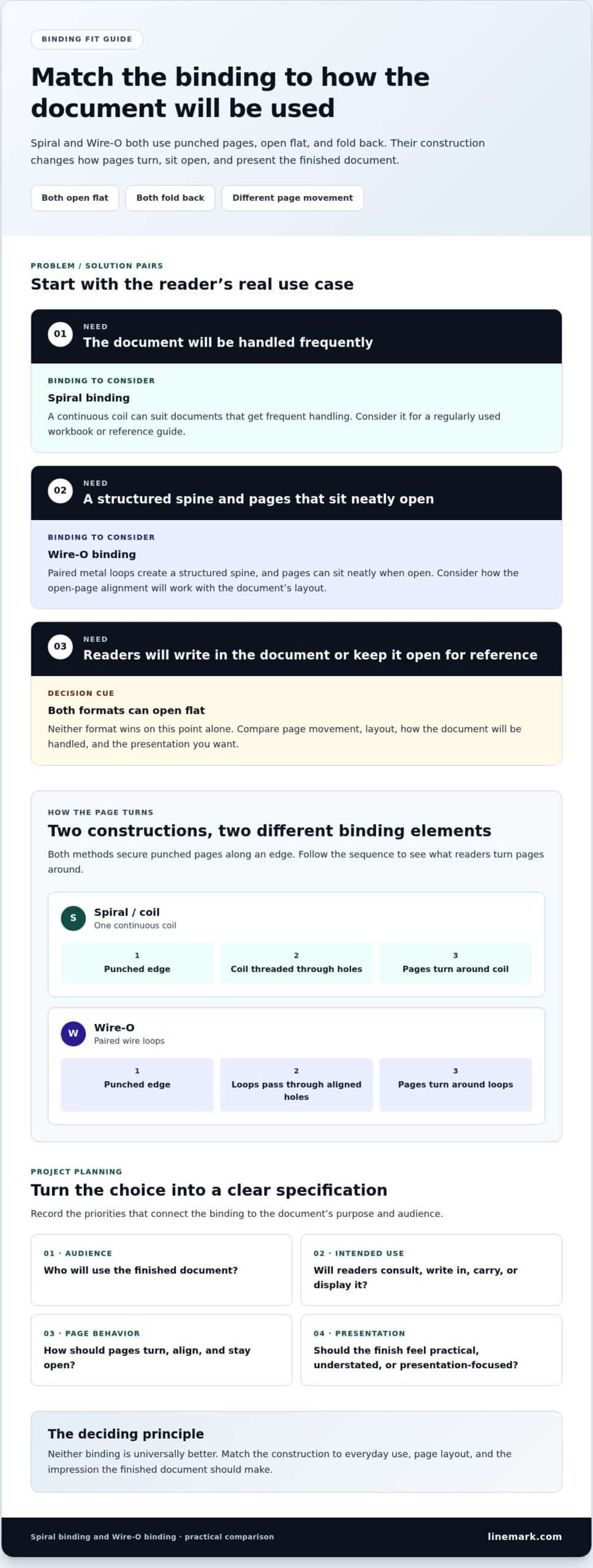
Follow the page: These simple sequences show how each construction supports page turning.
- Spiral: punched edge → continuous coil threaded through holes → pages turn around the coil.
- Wire-O: punched edge → paired loops pass through aligned holes → pages turn around the loops.
Both can open flat, which can help when a reader needs to write on a page or keep a reference nearby while working. A workbook used at a desk, for example, can stay open beside a task. A guide consulted repeatedly may be easier to use if readers can turn to a section and leave it visible. Consider the layout, too: when content spans facing pages, how those pages align when open may affect the reading experience.
Page movement also affects display and storage. A document intended to be shown open, such as a reference chart, has different needs from one that will be closed and shelved between uses. Think through where it will sit, how readers will hold it, and whether they’ll need to fold the covers back. These everyday actions help turn a construction difference into a useful production requirement.
For wider book-production context, the Book Manufacturers’ Institute offers an industry perspective through its Book Manufacturing Industry Standards resource. Once page behavior is clear, consider it alongside the full print and finishing plan. Linemark provides custom book printing as part of an integrated print workflow.
Spiral Binding vs. Wire-O Binding: A Side-by-Side Comparison
A useful comparison starts with the reader’s task, not a ranking of finishes. Spiral binding’s continuous coil allows pages to move around the spine, while Wire-O’s paired wire loops create a clearly defined edge. Both can suit professional print projects. The better choice depends on how the document will be read, marked up, presented, and stored.
| Factor | Spiral binding | Wire-O binding |
|---|---|---|
| Structure | One continuous coil passes through punched holes. | Paired wire loops pass through holes and meet along the spine. |
| Page handling | Pages move around the coil, making it a practical option when flexible page movement matters. | Pages turn around paired loops; the format can keep facing pages more closely aligned when open. |
| Visual finish | The continuous coil is visible along the edge and gives the document a functional, distinctive look. | The paired loops are visible at the edge, creating a different, orderly spine detail. |
| Possible project fit | Consider for manuals, workbooks, and reference documents that readers handle often. | Consider for reports, presentations, and planners where page access and the visible binding are part of the design decision. |
| Handling considerations | Materials and production choices affect how the finished coil responds to regular use. | Wire construction and handling affect how the finished binding holds up. |
Compare page handling and presentation
Both formats can open flat and fold back, but the pages may sit differently across a spread. Wire-O can keep facing pages more closely aligned when open, which may help with a chart or image designed to span both pages. With spiral binding, pages may sit slightly offset. For writing or consulting a single page, that difference may matter less than how comfortably the document opens on a desk.
The binding is only one part of the finished look. Cover stock, color, layout, and the amount of binding visible at the edge all contribute to the overall impression. Choose a format that supports the design rather than assuming one is automatically more professional.
Compare common project applications
A frequently used training manual or workbook may benefit from a format that lets readers turn pages readily during a task. A client presentation or report may put more emphasis on how the binding frames the document and how a two-page spread reads when open. A planner’s needs depend on its page design and how its audience uses it.
These are starting points, not fixed rules. Suitability and durability depend on the binding materials, production choices, and intended handling. To make the spiral binding vs wire-o binding decision concrete, identify the reader’s main task, then consider page access, spread alignment, and presentation together.
How to Choose Between Spiral and Wire-O for Your Project
Make the decision by tracing the document from its purpose to the way readers will use it. A binding that suits a frequently marked-up workbook may not serve a report intended for presentation. This step-by-step process turns the audience’s habits and the document’s design into a practical format choice, rather than relying on appearance alone.
Match binding to how readers use the document
Focus first on what readers need to do with the pages. Will they write notes, return to certain sections, or keep the document open beside a task? Consider the work surface, whether pages need to stay visible, and how readers will hold or carry the piece. These details clarify what page access means for the project.
- Define the document’s primary purpose. Is it a working manual, workbook, planner, report, or presentation piece? Name the main job before settling on a binding.
- Map the reader’s actions. Decide whether readers will write on pages, consult the document repeatedly, or display it for others. A workbook used during training has different demands from a report read in a meeting.
- Consider how it needs to open. If readers must keep the document open while following instructions or taking notes, make that behavior a priority. If they’ll mainly turn pages and read, other design factors may carry more weight.
- Think through handling and storage. Will the document stay on a desk, travel between locations, or be stored on a shelf between uses? Picture how the audience will pick it up, close it, and access it again.
- Match appearance to purpose. Decide whether the visible continuous coil or paired wire loops better supports the intended look. Consider how the binding edge will sit beside the cover and page design.
Match binding to the finished presentation
Review the cover, page layout, and binding edge together. A cover can make the binding a prominent design detail or draw attention toward the content instead. If the document includes charts or images across facing pages, consider how the spread reads when open. For a piece intended to be displayed, think about how it looks both open and closed.
Don’t choose based only on assumed price, durability, or prestige. Those judgments depend on project details, including materials, production choices, and expected handling. Instead, capture the audience, use, page behavior, and visual priorities in the project brief so the binding decision supports the complete print plan.
Rule of thumb: Prioritize spiral when flexible page movement is central to the task. Consider Wire-O when its paired-loop appearance and page presentation align with the design. Treat that as a starting point, not a universal rule. Linemark provides custom book printing to support a coordinated print plan.
Plan a Print Project Around the Binding Choice
A binding decision is most useful when it’s documented alongside the rest of the project. A clear brief connects the reader’s needs to the page layout, cover, and production plan, helping the team consider the finished document as a whole. For spiral binding vs wire-o binding, specify what readers need to do with the pages, not only which format you prefer.
Prepare a clear binding and print brief
Start with the document’s purpose and audience, then describe how readers will use and handle it. Note whether they’ll write on pages, return to sections, keep the document open during a task, or display it. Add the preferred binding and visual direction, including how the cover and binding edge should work together.
- Purpose and audience: State what the document is for and who will use it.
- Format and content: Identify the document format and organize the final content and layout requirements.
- Page behavior: Describe how readers should open, turn, write on, and refer to the pages.
- Presentation: Record cover preferences and whether the visible binding should stand out or complement the design.
- Handling and distribution: Note where the document will be used, stored, and delivered.
These notes help distinguish essential requirements from preferences. For example, a workbook may need to stay open while someone writes, while a presentation piece may give more weight to how the cover and binding look together. If a document includes content across facing pages, include that layout consideration in the brief as well.
Connect binding with the full production workflow
Binding and finishing are part of custom book printing, not isolated decisions made after the pages are designed. The selected format needs to work with the document’s content, cover, and intended handling. Bringing these requirements together early supports a coordinated production discussion and keeps the finished piece aligned with its purpose.
Linemark provides custom book printing, binding, and finishing within its commercial print capabilities. Its integrated workflow can also span printing, storage, fulfillment, and nationwide distribution, connecting production planning to how finished materials are managed and delivered. For organizations with ongoing inventory or fulfillment needs, include those requirements in the project conversation alongside the binding choice.
Use your brief to guide the next planning step. Linemark’s custom book printing guide can help you organize the document, binding, and production requirements into a more complete project plan.
Turn Your Binding Choice Into a Confident Project Plan
Turn your decision into a brief your production team can act on. Record the document’s purpose, audience, page-use needs, and presentation priorities, then keep those requirements visible as the project moves from planning to print. A clear specification helps align the finished piece with the way readers will actually use it.
Choosing between spiral binding vs wire-o binding is one part of that plan. Custom book printing has been part of Linemark’s work since 1999, supported by more than 30 years of industry experience. That experience informs a considered approach to matching print and finishing decisions with a document’s intended role.
Ready to develop your project brief into a production plan? Discuss your custom book printing project with Linemark and take the next step toward a document designed for its audience and purpose.
Frequently Asked Questions
What is the main difference between spiral binding and Wire-O binding?
The main difference is how each format holds the pages: spiral binding uses one continuous coil, while Wire-O uses paired wire loops. This construction affects the spine’s appearance and how pages move as readers use the document. In a print brief, name the format explicitly and describe the intended use, such as a reference book readers keep open beside a workstation. That gives the production discussion practical context.
Does spiral binding or Wire-O binding lay flatter?
Both formats can open flat, but the experience depends on the binding construction and the finished document. If readers will write notes in a workbook, consider whether the open pages provide a comfortable surface. For a book used beside equipment or instructions, think about whether it needs to remain open while the reader works. Match that task to the layout instead of relying on “lays flat” as the only requirement.
Can spiral-bound and Wire-O documents rotate pages all the way around?
Both formats can allow the covers to fold back on themselves, supporting compact handling. That can be useful when a reader has limited desk space or needs to hold a document in one hand. Page alignment and the feel of turning pages aren’t identical across the two constructions. If folding the document back is essential, include that use case in the print brief alongside the page design.
Is Wire-O binding the same as spiral binding?
No. They’re different binding methods, even though both use punched pages and an exposed binding edge. Spiral binding winds one continuous coil through the holes; Wire-O uses paired loops. The distinction matters when translating a design reference into a production instruction. If a mockup or sample is part of the project, identify the binding by name and note what you want the finished piece to achieve, rather than relying on a general term like “coil.”
Which binding is better for a workbook or manual?
Either may work, depending on the tasks the workbook or manual needs to support. For a workbook with spaces for notes, consider how readers will write while it’s open. For a procedure manual, prioritize quick page access and whether users need to keep instructions visible while completing a task. A sample layout showing notes, diagrams, or facing-page content can help clarify the use case before the binding is specified.
What information should I provide when planning a bound print project?
Share the document’s purpose, audience, content format, and expected handling. Include whether readers will write in it, revisit sections, or display it, along with cover preferences and layout details that affect how pages are used. For example, flag a spread that must be read across facing pages. Organizing these details in one brief gives the production team a clear basis for aligning binding, printing, and finishing.