

 10/12/2026
  Steve Bearden
The best retractable banner isn’t necessarily the widest or most elaborate option. A useful retractable banner printing guide starts with where the display will stand, who needs to read it, and how often you’ll use it.
Choosing a format can feel straightforward until you’re balancing venue constraints, viewing distance, brand consistency, and artwork that must work in a narrow vertical space. Small text and crowded layouts can weaken an otherwise polished display, while unclear file specifications can lead to avoidable revisions. Start by defining the banner’s setting, message, and reuse plan, then use those decisions to guide the design and production.
This guide will help you compare display formats, organize a clear visual hierarchy, and prepare artwork and production details with greater confidence. You’ll also learn how material, hardware, and print decisions affect the finished display, and how large-format production can support a coordinated program across events or locations. With more than 30 years of print experience, Linemark brings production and fulfillment capabilities together to help manage print projects from concept through completion.
Key Takeaways
- Choose a retractable banner or larger display based on the venue, viewing distance, portability, and how often the display will be reused.
- Build artwork around one primary message, a clear reading order, strong contrast, and concise copy so viewers can scan it quickly.
- Use this retractable banner printing guide to plan production in sequence, from defining project needs and preparing files to review, approval, and delivery coordination.
- Align the production approach with the project’s quantity, specifications, and schedule to support a smoother print process.
- For coordinated display programs, plan how printing, kitting, inventory management, and nationwide distribution work together.
Start with the Setting: When Does a Retractable Banner Make Sense?
Before comparing formats, decide where the display will be used and what it needs to communicate. A retractable banner is a vertical graphic that pulls up from a base for display and rolls back into it for transport or storage. It can provide a compact branded backdrop for a presentation, welcome visitors in a reception area, highlight an offer at a promotional event, or help identify an organization at a conference. This retractable banner printing guide starts with practical fit: the display should support the message without taking up more space or attention than the setting allows.
Portability and repeat use are central to the decision. A banner can suit a team that transports its display between events or needs a consistent visual presence in different locations. It’s less suited to a project that calls for a broad, immersive backdrop or a coordinated display across a large area. Measure the available floor space, consider how the display will be transported, and decide whether its message will remain relevant from one occasion to the next.
Match the banner to the audience and venue
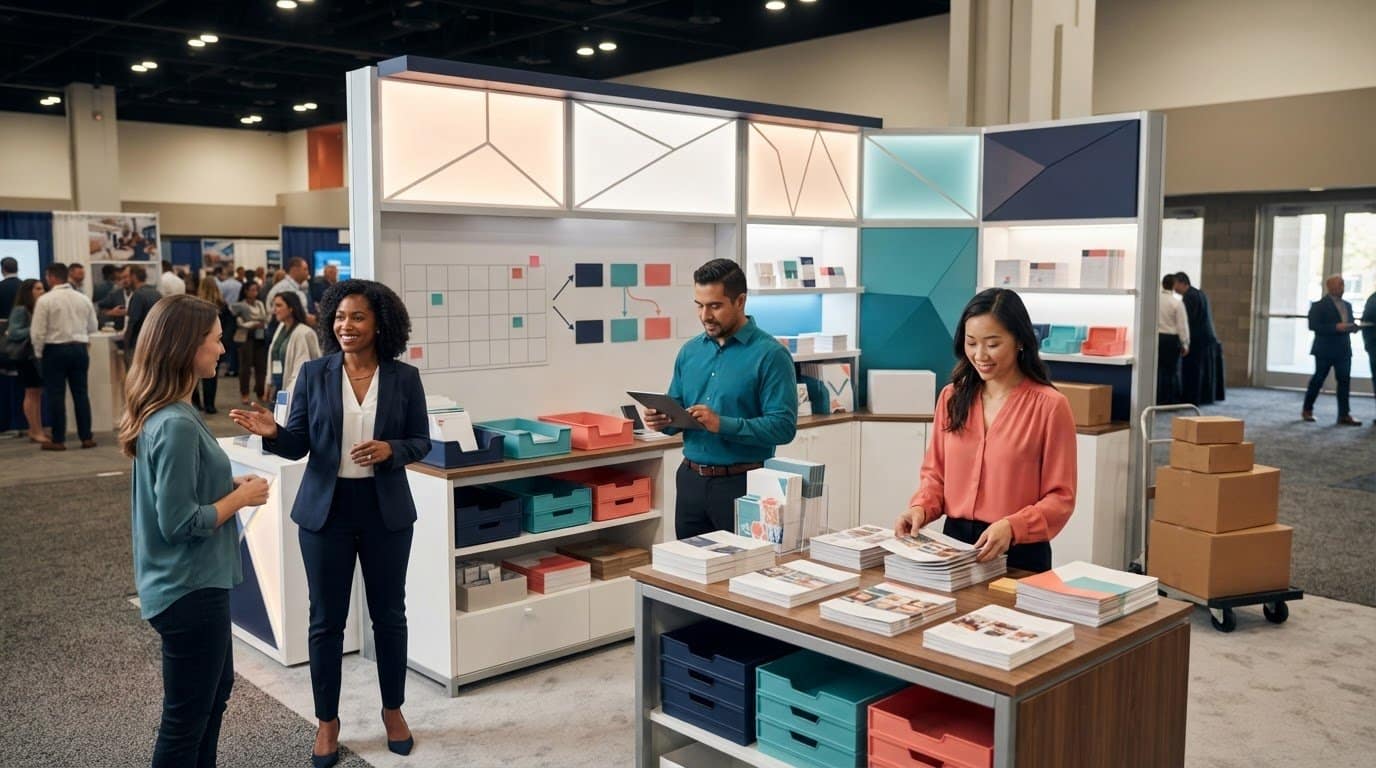
A reception banner is usually read at close range, where a concise welcome or service message can do the work. On an event floor, people may see the display while moving past it, so the main message needs to register quickly from farther away. Conferences are a natural context for trade show displays, where visual communication can help organizations introduce themselves and support conversations.
Assess viewing distance, foot traffic, lighting, and available floor space before settling on the layout. Glare or dim lighting can make content harder to see, while busy foot traffic makes a simple visual hierarchy especially useful. Give the display one primary message. If several claims compete for attention, visitors may struggle to decide what to read first or what action to take.
Set the job before comparing print options
Define the banner’s role in plain terms. It might inform visitors, direct them toward a location, promote an offer, or reinforce brand recognition. The purpose shapes the content: a directional message needs to be immediately clear, while a promotional display may need a concise benefit and a visible next step. Also decide whether the graphic is for one event or repeated use. A message tied to a single occasion needs different planning from one intended to represent the organization over time.
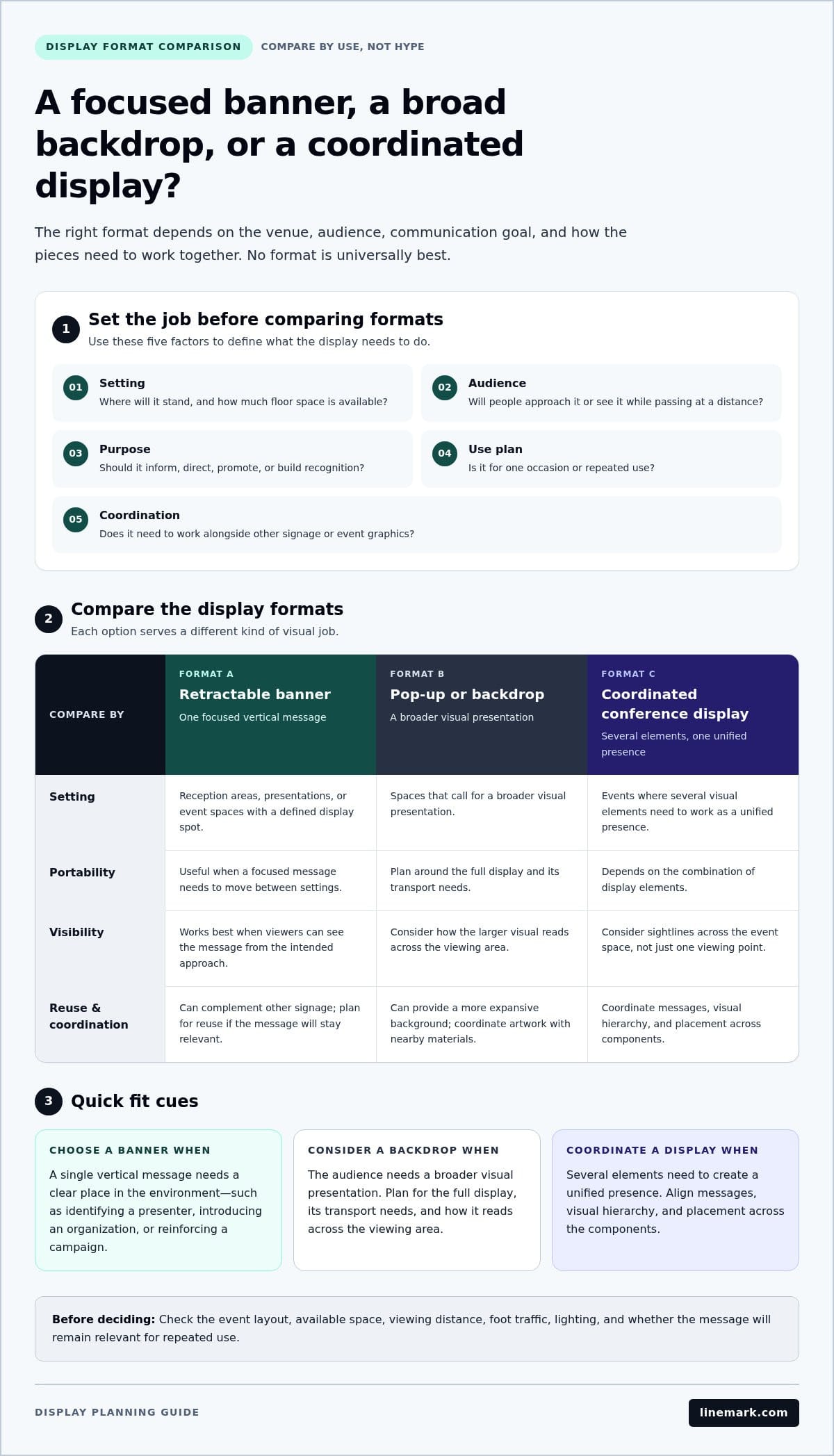
Use these criteria to compare formats:
- Setting: Where will the display stand, and how much space is available?
- Audience: Will people approach it or view it while passing at a distance?
- Purpose: Should it inform, direct, promote, or build recognition?
- Use plan: Is it for one occasion or repeated deployment?
- Coordination: Does it need to work alongside other signage or event graphics?
These decisions establish the job the display must do. From there, compare portability, visibility, reuse, and how well each format fits the event environment.
Retractable Banner vs. Other Displays: Compare by Use, Not Hype
A retractable banner printing guide should compare displays by the job they need to do, not by which format sounds most impressive. A retractable banner gives one focused message a defined vertical space. Pop-ups and backdrops can create a broader visual presentation, while coordinated conference displays can combine several elements to shape a larger environment. No format is universally best. Choose based on the venue, audience, communication goal, and how the pieces need to work together.
| Display format | Setting | Portability | Visibility needs | Reuse and coordination |
|---|---|---|---|---|
| Retractable banner | Reception areas, presentations, or event spaces with a defined display spot | Useful when a focused message needs to move between settings | Works best when viewers can see the message from the intended approach | Can complement other signage; plan for reuse if the message will stay relevant |
| Pop-up or backdrop | Spaces that call for a broader visual presentation | Plan around the full display and its transport needs | Consider how the larger visual reads across the viewing area | Can provide a more expansive background; coordinate artwork with nearby materials |
| Coordinated conference display | Events where several visual elements need to work as a unified presence | Depends on the combination of display elements | Consider sightlines across the event space, not just one viewing point | Coordinate messages, visual hierarchy, and placement across components |
When a retractable banner fits the brief
Choose a retractable banner when a single vertical message needs a clear place in the environment. It can identify a presenter, introduce an organization, or reinforce a campaign near a reception point or event space. It can also work alongside other signage, with the banner highlighting one message while other pieces handle wayfinding or additional information. Check the event layout, available space, and intended use before deciding.
When to consider a backdrop or coordinated display
If the audience needs a broader visual presentation, a pop-up or backdrop may suit the brief better than asking one banner to carry every message. For a conference presence with multiple communication needs, coordinated display elements can create a more unified experience. Visual cues influence how people interpret marketing materials; the University of Kansas paper on the impact of visual communication in marketing offers context for planning those choices.
Map the full display area before selecting individual pieces. Consider where visitors enter, what they see first, and how each element supports the next. Linemark produces large-format graphics, pop-ups, backdrops, and conference displays. For broader planning, explore this large format graphics guide or learn about large-format print production.
Plan Banner Artwork for Readability, Brand Consistency, and Impact
A strong banner design gives viewers a clear message to notice, understand, and act on. Keep the content focused: lead with one primary message, arrange supporting information in a deliberate reading order, and make the next step easy to spot. That might be a website, a direction, or a concise invitation, depending on the display’s purpose.
Readable banner design puts one message first, uses contrast to guide the eye, and leaves enough space for every element to be understood at a glance. Tiny text, low contrast, paragraphs of copy, and crowded logos all compete with that goal. If a detail matters but can only be read up close, keep it secondary rather than allowing it to overwhelm the main message.
Build a clear visual hierarchy
Plan the content sequence before refining colors or decorative elements. Give the central message the strongest position, then place supporting details and the next step where viewers can find them without searching. Use the organization’s established colors, typography, and logo treatment so the banner feels connected to its other materials. Secondary information can be smaller, but it should remain legible for people who choose to approach.
Contrast helps distinguish the headline from its background and separate key information from supporting copy. Leave breathing room around logos and text; several competing marks can make a layout feel crowded and blur the visual priority. Review the proof at its intended viewing size, then check whether the message is still apparent from the distance where people are likely to see it.
Prepare artwork with production in mind
Begin with the applicable banner template and PDF settings guidance so the document is organized for production. Before submitting, review image quality, fonts, alignment, spelling, and essential content. Check that important text and logos sit within the template’s designated area, and confirm that the approved file reflects the final message and brand assets. Linemark provides upload portals, PDF settings guides, and templates to support file preparation.
For teams coordinating branded materials across departments or locations, a consistent source of approved artwork helps keep the banner aligned with the wider campaign. Linemark’s MarCom On-Demand strategy guide provides context for organizing distributed marketing materials. The linked eCFR section concerns particular signage regulations and standards for outdoor advertising, not a universal design rule for indoor event banners, so use it only for the contexts it addresses.
For a final quality pass, view the artwork at realistic scale, check that the message reads in seconds, and remove any element that distracts from it. Linemark’s print production resources can support a well-prepared banner project.
From Approved Design to Print: Make Production Decisions Early
Production runs more smoothly when the display requirements are clear before files are submitted. Define the quantity, intended use, project specifications, and schedule first. These details inform the production approach and help align artwork, review, approval, and delivery coordination. In this retractable banner printing guide, treat each decision as part of one connected workflow, not a last-minute handoff.
- Define the need. Identify how many displays are required, where they’ll be used, and whether they’re part of a larger signage program.
- Prepare the artwork. Use the applicable template and PDF settings guidance, and check that the file reflects the agreed specifications.
- Submit the files. Organize artwork and project details together so the production team has the information needed to move the work forward.
- Review the materials. Have a designated reviewer verify the brand assets, copy, and final layout against the project requirements.
- Approve the final artwork. Keep one approved version as the production reference to reduce confusion if earlier drafts are still circulating.
- Coordinate delivery. Plan how the finished materials need to reach the event, team, or locations where they’ll be used.
Reduce file and approval friction
Linemark’s upload portal, PDF settings guide, and templates help organize file preparation and submission. Before approval, assign one person to check the essential details, including correct logos, current copy, alignment, and whether the file matches the intended display specifications. Clear ownership helps prevent conflicting edits and keeps review focused.
Once artwork is approved, keep the final file connected to its requirements, including quantity and distribution instructions. If a change is needed, update the production reference so teams aren’t working from different versions. A clean handoff supports consistent execution from file review through fulfillment.
Plan quantities and distribution together
Estimate demand before setting the order quantity. Count the locations, events, and teams that need a display, then account for whether materials will be shared or assigned to particular sites. This makes the quantity decision more useful than ordering based on a single event, especially when the banner is part of a wider program.
Production method depends on quantity, specifications, and schedule. Linemark’s digital printing is suited to short runs of 1-500 units, while offset printing is suited to runs of 500 or more. These ranges help frame production planning for a print project. Linemark’s in-house production, warehousing, fulfillment, and nationwide distribution can support coordinated projects across locations, with logistics planned around project needs.
Bring the artwork, quantity, and distribution plan together early for a more controlled production process. Explore how to plan a banner print project with Linemark.
Choose a Print Partner for a Complete Banner Program
A retractable banner is often one part of a larger communications plan. A print partner can help coordinate the display with related signage, event graphics, and campaign materials, then connect production with storage and distribution. This broader view matters when several teams, events, or locations need consistent materials managed through a coordinated process.
Use a practical framework to assess how a partner can support the full project:
- Production capabilities: Consider whether the partner can support banners and signage alongside large-format graphics, backdrops, or conference displays.
- Artwork support: Look for useful file-preparation resources, such as templates and PDF guidance, to help organize submissions.
- Quantity flexibility: Match production planning to the scale of the project, from a focused event need to a broader rollout.
- Fulfillment coordination: Account for how materials will be stored, assembled into kits, managed as inventory, and distributed to their destinations.
This retractable banner printing guide has focused on matching the display to its setting, clarifying the artwork, and planning production. The partner decision brings those pieces together. Consider how print production and related fulfillment can align with your organization’s workflow while keeping the message each display needs to deliver in view.
What an integrated print partner can coordinate
An integrated relationship can bring printing, warehousing, kitting, fulfillment, inventory management, and distribution into a connected project plan. That lets teams plan display production alongside how materials will be organized and sent where they’re needed. Linemark supports projects ranging from one copy to millions and offers nationwide distribution, with production and fulfillment planned around project requirements.
Coordination can extend beyond the banner itself. A conference display may need to work visually with related signage, a backdrop, or other campaign materials. Aligning these pieces in one program helps teams manage assets and project details together while keeping the visual system consistent across event touchpoints.
Take the next step with Linemark
Start with a clear outline of your audience, setting, artwork status, quantity needs, and distribution plan. Include whether the banner is a standalone piece or part of a wider display program. These details give the project team a useful foundation for planning production and fulfillment requirements. Linemark brings commercial printing, large-format production, and related fulfillment capabilities together to support projects from concept through completion.
Discuss your print and display project.
Turn Your Display Plan Into a Confident Next Step
A retractable banner can do more than fill an open space. With a clear role in your communications plan, it becomes one touchpoint in a consistent experience for customers, event visitors, and teams. Use this retractable banner printing guide as a starting point, then shape the project around the audience, setting, and message you want people to remember.
Linemark brings more than 30 years of industry experience to print projects, with large-format graphics and conference display capabilities supported by printing, inventory management, fulfillment, and nationwide distribution. That breadth can help connect an individual banner to a wider display program while keeping production and logistics aligned.
Bring your audience, setting, artwork status, and distribution needs into the conversation. Linemark can work with you to develop a project approach that fits the communication goal and materials involved. Discuss your print and display project and take the next step toward a display that’s ready to represent your organization with clarity.
Frequently Asked Questions
What is a retractable banner used for?
A retractable banner gives an organization a portable way to present a focused message in a specific location. Teams use one to identify a presentation area, welcome visitors, point attendees toward a destination, or feature a campaign at an event. For example, a product launch display might highlight the product name and direct visitors to a landing page. It works best as one clear communication touchpoint, rather than a substitute for every sign in a venue.
How do I choose between a retractable banner and a backdrop?
Choose a retractable banner when one concise message needs a distinct, portable display area; consider a backdrop when the setting calls for a wider visual background. Think about how much of the event space the graphic should occupy and whether people will see it behind a presenter, at an entrance, or beside a demonstration. A booth with several messages may call for coordinated elements instead of squeezing all the information onto one display.
What should I include on a retractable banner?
Include the organization or campaign name, one main benefit or message, and a clear next step that suits the audience. A website, event registration instruction, or QR code can direct interested viewers to more detail. Keep contact or offer information current, and avoid adding details that will quickly become outdated if the banner is intended for repeated use. Before finalizing, check that the call to action is easy to identify and follow.
How do I prepare a retractable banner file for printing?
Start with the current banner template and follow the provided PDF settings guidance. A retractable banner printing guide can help structure the process, but the project’s specific template should govern file setup. Review the exported PDF at full size, check that images and logos appear correctly, and confirm text, alignment, and spelling. Keep a clearly labeled approved file separate from working drafts so the submitted version matches the final sign-off.
Can retractable banners be used for multiple events?
Yes, a banner can serve across events if its message remains relevant and the graphic is kept in usable condition. An evergreen brand introduction or service overview is more adaptable than artwork tied to a single date, venue, or limited-time offer. Before each use, inspect the graphic for visible damage and confirm that any linked destination or contact information is still current. If the campaign changes, plan an updated graphic rather than relying on outdated content.
Is digital or offset printing better for a banner project?
The right production approach depends on quantity, specifications, and schedule, and the method should be considered for the whole project rather than assumed from the banner format alone. Linemark’s digital printing is suited to short runs of 1-500 units, while offset printing is suited to runs of 500 or more. These ranges can help frame planning, while the project’s requirements determine which approach fits the complete print run.
How can I keep banners consistent across multiple locations?
Maintain one approved master file and a shared set of brand assets, then document which version each location should use. Track quantities and destinations together so teams can coordinate inventory and fulfillment instead of managing disconnected requests. For a campaign that includes banners alongside other materials, align visual elements and key copy across the set. Linemark’s inventory management, kitting, fulfillment, and nationwide distribution can support coordinated programs across locations.