


 10/10/2026
  Steve Bearden
What if the printed collateral your teams need could move from production to the right destination without scattered storage, outdated files, and one-off shipping requests? Collateral fulfillment services coordinate print, inventory, kitting, and distribution so approved materials are easier to access and manage.
When materials are stored across offices or orders rely on disconnected processes, teams can lose time tracking stock, packing shipments, and correcting inconsistent collateral. Marketing leaders may also have trouble seeing what’s available and where materials are going. A connected workflow makes those steps easier to follow and reduces the manual work behind each order.
This article explains how to coordinate production, inventory management, kitting, and delivery around your organization’s needs. You’ll also learn how online ordering and a digital asset library can help distributed teams access approved materials. Linemark brings commercial printing and fulfillment capabilities together with MarCom On-Demand to support a workflow from production through distribution.
Key Takeaways
- Use collateral fulfillment services to coordinate printed materials, inventory, order handling, packing, and distribution in one connected workflow.
- Map each stage, from preparing and producing materials to storing, picking, packing, and distributing orders, to clarify handoffs and responsibilities.
- Compare in-house, multi-provider, and integrated fulfillment models by looking at workflow ownership, handoffs, and inventory visibility.
- Plan around the materials your teams use, who needs to order them, and how campaign schedules and updates affect replenishment.
- See how printing, inventory management, kitting, fulfillment, and online ordering can work together to support distributed teams.
What collateral fulfillment services do: why disconnected processes create friction
Collateral fulfillment services coordinate the storage, order handling, packing, and delivery of printed marketing materials. Printing creates the materials; fulfillment manages what happens next, from organizing stock to preparing orders for the teams and destinations that need them. That distinction matters when brochures, catalogs, annual reports, or campaign pieces must remain accessible after production.
Marketing collateral helps organizations communicate with customers, employees, and other audiences. As the marketing collateral overview explains, these materials can take many forms. The operational challenge is making the right version available when a team needs it, without scattered boxes, separate order requests, or staff tracking each shipment manually.
Disconnected processes create extra handoffs. One team may arrange printing, another may store materials, and local staff may pack and ship orders. Without a shared view of stock and orders, people may not know what is available, which version is current, or whether an item needs to be reordered. The result is more administrative work and less consistent access across teams.
Which printed materials can a collateral fulfillment workflow support?
A workflow can support recurring materials such as brochures, catalogs, annual reports, and newsletters, as well as campaign mailers prepared for a specific distribution. The right mix depends on what your organization produces, how often materials change, and where they need to go. For example, a team may need a small quantity of a current brochure while a campaign requires a coordinated set of printed pieces for a defined audience.
Stored collateral is produced in advance and held for later orders. Campaign-specific materials may be printed or personalized for a particular mailing or initiative, then prepared for distribution as part of that project. Keeping these needs distinct helps teams plan what to replenish and what belongs to a specific campaign, instead of treating every item as the same kind of stock.
When does fulfillment become more useful than handling orders internally?
There’s no universal order-volume threshold. Fulfillment becomes worth considering when the work grows complicated: shipments recur, several teams request materials, or staff must locate, pack, and send items alongside their other responsibilities. The number of handoffs and the effort required to keep information current can matter as much as order frequency.
- Repeated shipments: The same materials are requested regularly, but every order requires a new round of manual coordination.
- Distributed teams: Offices or departments keep separate supplies, making it harder to see what’s available across the organization.
- Changing collateral: Revised campaigns or updated materials create a risk that old and current versions will be stored or ordered at the same time.
These signals point to a workflow issue, not just a storage problem. When inventory is spread across locations and orders depend on individual staff members, visibility and consistency can suffer. A coordinated process gives teams a clearer way to manage access and distribution, shaped around their materials and needs.
How collateral fulfillment services connect production, inventory, and delivery
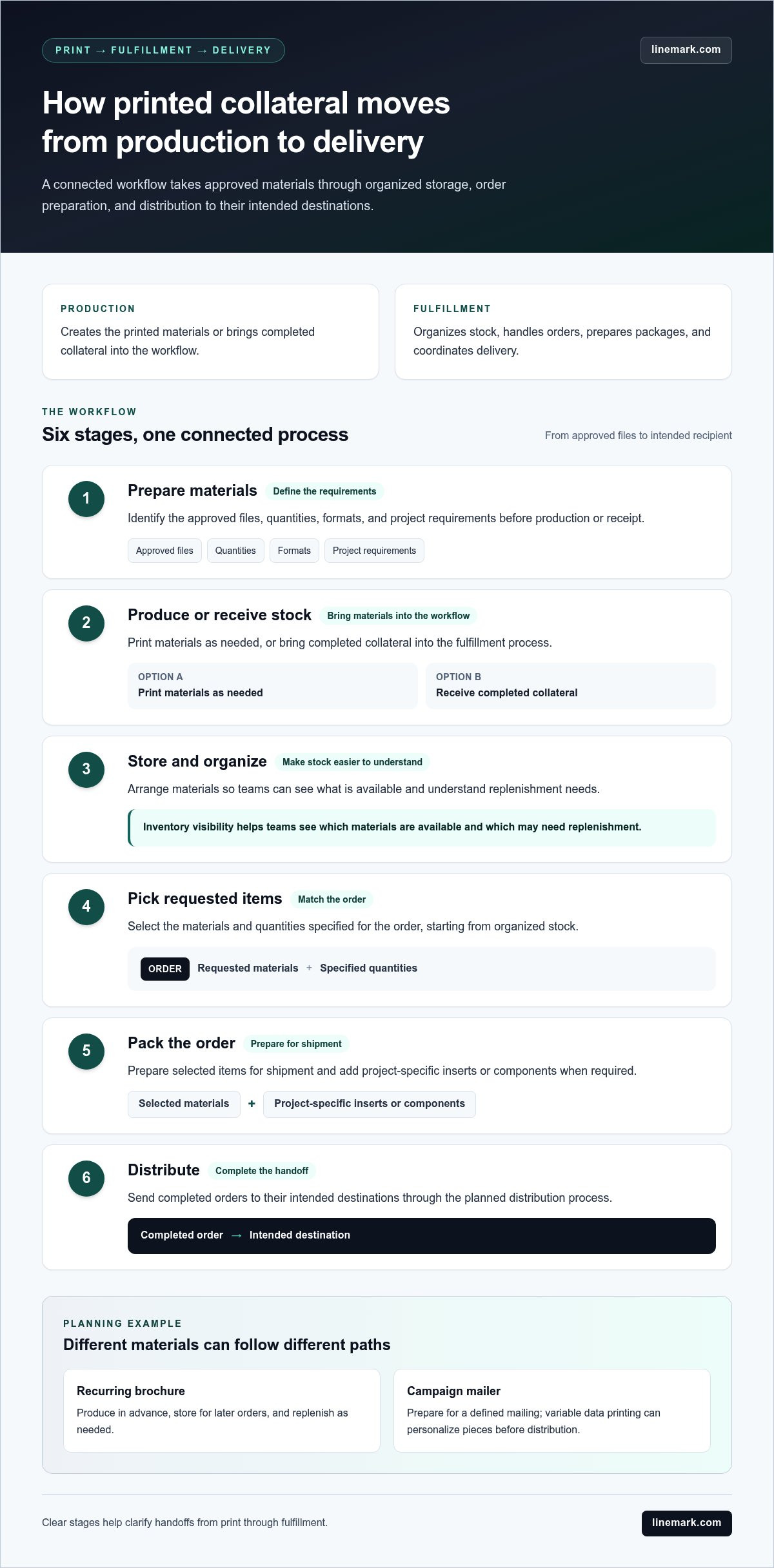
A coordinated fulfillment workflow moves approved materials from production or receipt through organized storage, order preparation, and delivery to the intended recipient. This sequence connects the work behind a printed piece with the practical steps that make it available to teams and audiences. Production method, personalization, packaging, and distribution can be tailored to the project.
A typical lifecycle follows these steps:
- Prepare materials. Identify approved files, quantities, formats, and project requirements before production or receipt.
- Produce or receive stock. Print materials as needed, or bring completed collateral into the fulfillment workflow.
- Store and organize. Arrange materials so teams can understand available stock and replenishment needs.
- Pick requested items. Select the materials and quantities specified for an order.
- Pack the order. Prepare selected items for shipment, adding project-specific inserts or components as required.
- Distribute. Send completed orders to their intended destinations through the planned distribution process.
Connecting these stages clarifies the handoff from print to fulfillment. For example, an organization might produce a brochure in advance for recurring requests, while a campaign mailer is prepared for one defined mailing. Variable data printing can personalize pieces for that campaign before distribution. The direct mail marketing guide offers related planning context for coordinating printed mail with campaign goals.
How storage and inventory management support reliable ordering
Inventory visibility helps teams see which materials are available and which may need replenishment. Organized stock gives recurring orders a consistent starting point, so departments can request approved pieces without locating boxes across offices or relying on informal counts. An inventory process can be tailored to the organization’s materials and ordering patterns. The American Marketing Association’s resource on Marketing Collateral Management reflects the value of managing collateral as an ongoing operational process, not just a print job.
How picking, kitting, and distribution work together
Picking means selecting the requested items; packing prepares them for shipment. Kitting assembles several materials into one project-specific package, such as printed pieces for a campaign or internal initiative. These steps connect with inventory and distribution, while the contents and handling depend on the order. Linemark’s kitting and fulfillment capabilities support workflows shaped around an organization’s materials and distribution needs.
For distributed organizations, a connected model can bring production, storage, and nationwide distribution into one coordinated process. Each stage has a defined role, giving teams a clearer way to move collateral from approved materials to shipment without treating every request as a separate print project.
In-house, fragmented, or integrated collateral fulfillment: how to compare models
Choosing a fulfillment model is about matching the workflow to the work. Some organizations can manage a compact set of materials internally. Others coordinate separate print, storage, and distribution providers, while an integrated model connects those activities through a unified process. Compare how each approach assigns responsibility, manages handoffs, and makes inventory information accessible.
- In-house: Offers direct control over ordering and day-to-day handling. Internal staff also manage storage, stock requests, packing, and distribution alongside their other responsibilities.
- Multi-provider: Assigns production or fulfillment activities to separate providers. Teams coordinate across handoffs, and inventory information may sit in separate processes.
- Integrated: Connects production, storage, and distribution within one service model. The workflow still needs to reflect the organization’s materials, users, and order requirements.
The comparison is about workflow fit, not a universal ranking. Choose the model that gives your organization the right balance of control, coordination, and visibility. Connecting production, storage, and distribution under one service model can reduce operational handoffs and give teams a clearer way to manage stock requests alongside campaign materials. The precise arrangement depends on project requirements.
What should marketing and operations teams evaluate?
Start with the scale and variety of the workflow, not a single order count. List the materials in use, the teams that request them, recurring campaigns, and destinations. Then map how artwork is approved, how staff request stock, and how replenishment needs are communicated. Include printing, storage, kitting, and distribution in the same review. This reveals where ownership is clear and where requests change hands.
For example, a team may have a reliable approval process but no shared way to see whether stock is available. Another may manage inventory centrally but handle packing and distribution separately for each campaign. These distinctions help marketing and operations identify the right process changes, whether they keep work in-house, coordinate existing providers, or bring connected activities together.
How can a centralized ordering portal fit the model?
A portal gives teams a common route to access approved materials and submit orders, rather than relying on separate requests to individual colleagues. Paired with a digital asset library, it can organize the materials available to users. Linemark’s MarCom On-Demand supports online ordering and digital asset library management, connecting access to approved assets with an ordering process. For more on distributed marketing workflows, see the MarCom On-Demand strategic guide.
As you assess collateral fulfillment services, consider whether the portal and fulfillment workflow match how your teams work. Linemark connects print production, inventory management, kitting, and distribution around an organization’s needs. Explore Linemark’s print and fulfillment capabilities as part of that evaluation.
How to plan a collateral fulfillment workflow your teams can use
A useful plan starts with what your organization produces, who needs it, and how materials move from approval to delivery. Map the workflow before setting stock expectations. This makes it easier to assign responsibilities, identify handoffs, and build a process that can adapt when campaigns or materials change.
- Inventory your materials. Record each item’s type, format, approved version, intended audience, and whether it is stored for repeat orders or produced for a particular campaign. Note known quantities and where stock is held to establish a clear picture of existing materials.
- Map the users. Identify the departments, offices, or teams that request collateral. Clarify who approves artwork, who can place orders, and who coordinates campaign updates or replenishment requests.
- Define order needs. Describe common order patterns, such as recurring brochure requests or planned sets of materials for a campaign. Note quantities, packaging or kitting needs, and the information required to prepare each order.
- Plan distribution. Identify intended audiences and destinations, along with how distribution relates to campaign schedules. Separate items intended for ongoing storage and ordering from materials prepared for a specific initiative.
What information helps define the workflow?
Bring together material types, formats, quantities, ordering patterns, and intended audiences. Then document the approval and order process: who signs off on content, who submits requests, and who communicates changes. If a project involves personal or otherwise sensitive information, treat its handling as project-specific and verify the relevant obligations with the appropriate internal stakeholders before defining the workflow.
How can teams keep collateral current and usable?
Set a clear artwork approval and version-control process before materials enter storage. Make approved files identifiable, assign responsibility for reviewing them, and define how outdated pieces are replaced or retired. This reduces the chance that a team orders an old version simply because it remains available. Link approved digital assets to ordering when it suits the organization’s process.
Inventory activity can guide replenishment planning, but it doesn’t mean setting one fixed stock level for every item. Review order patterns alongside campaign calendars, planned distribution, and upcoming material updates. A recurring brochure may need a different plan from a one-time campaign piece. Revisit assumptions as demand or content changes, and make clear who flags low stock and who approves replenishment.
For distributed teams, Linemark’s MarCom On-Demand supports online ordering and digital asset library management, connecting approved materials with a shared ordering route. A workflow can be tailored around your organization’s materials, users, and distribution needs. Explore Linemark’s fulfillment capabilities to consider how print, inventory management, and fulfillment can support your process.
How Linemark brings collateral fulfillment together from print to distribution
Linemark is a full-service commercial printing and communications company serving organizations nationally. Its capabilities connect digital and offset printing with inventory management, kitting, fulfillment, and distribution. For organizations coordinating collateral across teams or campaigns, these services provide a foundation for a workflow built around the materials, ordering patterns, and delivery needs involved.
How print production and fulfillment can work as a coordinated service
Connecting production planning with storage and distribution helps teams plan what happens after a job is printed. Materials for recurring orders can be managed alongside campaign-specific pieces, while kitting brings multiple items together for a planned initiative. Linemark’s commercial printing, direct mail, kitting, fulfillment, and inventory management capabilities support different print and campaign workflows, tailored to the organization’s needs.
This connected approach clarifies how a project moves from production into fulfillment. Teams can plan around the type of collateral, whether it is expected to be reordered, and how it will be distributed. A shared view supports coordination between print and fulfillment instead of treating each stage as an unrelated task. The workflow can reflect the organization’s materials and project requirements.
How MarCom On-Demand can support distributed teams
Distributed teams need a clear route to approved materials. MarCom On-Demand is Linemark’s online ordering platform with digital asset library management. It brings approved assets and ordering into a common process, helping teams access materials through an organized channel. This is useful when departments or offices need to request collateral while following shared brand and approval practices.
The platform complements physical production and fulfillment: digital asset management organizes what teams can access, while inventory and order workflows handle printed materials. Together, these capabilities support a consistent process from approved asset to printed piece and distribution. The setup can reflect how an organization assigns access, manages campaign updates, and handles recurring needs.
Linemark brings more than 30 years of experience to commercial printing and communications and operates a 90,000-square-foot facility. Its capabilities span production, storage, and nationwide distribution. Organizations can shape collateral fulfillment services around their mix of digital and offset print, stored materials, kitting, and delivery needs.
For a practical next step, discuss a collateral fulfillment workflow with Linemark and consider how production, inventory, and distribution can work together for your organization.
Make your next collateral workflow easier to manage
Start with one recurring collateral request and use it to set a practical baseline. Note who needs the material, how they request it, what approval it requires, and what happens when the current version changes. This review can reveal where ownership is unclear and which steps would benefit from a more coordinated process.
Then decide what your teams need most: clearer access to approved materials, a more consistent view of inventory, or fewer handoffs between production and distribution. Use those priorities to shape collateral fulfillment services around your actual workflow, rather than adding process for its own sake. The right approach should support how your organization works today and adapt as campaigns, materials, and team needs evolve.
Linemark brings printing, inventory management, kitting, and fulfillment together to support organizations’ collateral needs. Plan your collateral fulfillment approach with Linemark to build a workflow tailored to your teams and their materials.
Frequently Asked Questions
What does collateral fulfillment include?
Collateral fulfillment can include preparing approved printed materials for storage, orders, kits, or distribution, with activities shaped by the program. To scope it, identify where responsibility begins and ends: does the workflow start with finished print, or include production planning too? Also define how teams request exceptions, such as a new campaign insert or a special combination of materials.
How is collateral fulfillment different from direct mail fulfillment?
Collateral fulfillment can support materials for ongoing internal requests as well as campaign distribution. Direct mail fulfillment focuses on preparing pieces for mailing to intended recipients. A campaign can use both: a printed brochure may be held for team orders while a personalized version is prepared for a particular mailing. Defining the audience and delivery method helps determine which process applies to each piece.
Can collateral fulfillment support personalized print materials?
Yes. Variable data printing can customize content for recipients or audience segments before pieces are assembled and distributed. Align the data fields with the approved artwork and campaign audience, then establish how personalized output will be reviewed before mailing. This helps prevent a mismatch between the intended audience, the content on each piece, and the distribution plan.
How can a company manage collateral for teams in multiple locations?
Set shared rules for which materials teams can order, who approves changes, and how requests are submitted. For example, a central marketing team can maintain approved assets while departments use a common order route. A digital asset library and online ordering through MarCom On-Demand can support this structure. Clear ownership helps teams follow the same process even when their day-to-day needs differ.
What information is needed to plan collateral fulfillment?
Gather a working list of materials, formats, audiences, ordering teams, and campaign needs. Add examples of typical requests, packaging or kitting instructions, and destinations. Recent orders can help distinguish routine demand from one-off campaign activity. Also document who approves artwork and communicates updates, so the workflow accounts for changes rather than treating every printed item as permanent stock.
How can businesses reduce outdated printed collateral?
Give each material a clear approval status and review point, especially when its offer, contact details, or campaign message may change. Keep superseded files separate from assets available for routine orders, and identify who authorizes replacements or retirement. Before replenishing stock, compare upcoming campaign plans with current inventory. This creates a deliberate check between a content update and the next print decision.
Can collateral fulfillment work with an online ordering portal?
Yes. A portal gives users a consistent place to find approved materials and submit requests, while the fulfillment process determines how those orders are handled. Define who can order each item, what information an order requires, and how requests for new or revised materials are routed for approval. This keeps the portal connected to the organization’s content and inventory practices, rather than treating it as a standalone storefront.
When should a business consider outsourcing collateral fulfillment?
Consider outsourcing when internal staff regularly spend time locating stock, processing repeat requests, assembling campaign kits, or coordinating shipments. The key signal is workflow complexity, not a fixed order count. Compare current staff responsibilities and handoffs with the level of coordination you want. If several teams need materials and internal ownership is difficult to maintain, an external fulfillment workflow may be worth evaluating.