

 10/09/2026
  Steve Bearden
What if every new franchisee received a kit that was complete, current, and ready for launch? Onboarding new franchisees with print kits works best when the process prevents two common problems: materials arriving late or outdated, and corporate teams having to coordinate separate print orders and shipments. Franchisees need consistent brand essentials, while some materials also need accurate location-specific details.
A coordinated program pairs centrally approved materials with controlled local customization. This guide explains how to define a useful kit by role and launch stage, set a clear approval and fulfillment workflow, and manage inventory so the right materials reach each location when they’re needed.
Production, kitting, storage, and distribution can work together as one process rather than a series of disconnected tasks. With centralized ordering and approved assets, your team can support each new location, protect brand standards, and give franchisees a clearer path to opening day.
Key Takeaways
- Build the kit around a new franchisee’s first-month tasks so each item has a clear purpose.
- Separate standardized brand essentials from approved local additions to balance consistency with flexibility.
- Compare bulk, on-demand, and hybrid fulfillment based on item stability, storage needs, location growth, and customization.
- Make onboarding new franchisees with print kits repeatable by assigning clear ownership for content, approvals, location details, inventory, and distribution.
- Coordinate print production, kitting, fulfillment, and inventory management to support launches as the franchise network grows.
Why onboarding new franchisees with print kits takes more than a box of materials
A new location needs more than a welcome gesture. Owners and staff need approved information and practical tools to move from training to opening and early operations. That makes onboarding new franchisees with print kits a planning task: each item should support a real responsibility, reach the right person, and be current when it’s needed.
A franchise print kit is a curated set of printed tools that helps a new location complete launch tasks and begin operating in line with the franchisor’s standards. It differs from a merchandise swag kit, which focuses on branded giveaways or personal items. It also differs from a campaign kit, which supports a particular promotion, and from general marketing collateral, which may not be organized around a new franchisee’s onboarding needs.
The distinction matters because a kit should work as an operational resource, not simply introduce the franchisor. A business card may help an owner make local connections; an approved brochure may support early customer conversations; and a clearly organized manual may help staff follow procedures. Foundational information about Franchising describes the relationship between franchisors and franchisees, including the role of training and operating manuals. Printed guidance can make those standards accessible at the point of use.
What should a franchise onboarding print kit help a new owner do?
Start with the action, not the object. Map each item to a task, audience, or launch milestone. The owner may need operational documents during setup, while frontline staff may need concise guidance for customer interactions. Materials should answer practical questions, show approved language or procedures, and make the next step clear. A useful kit equips people to act; a welcome-only package mainly communicates that they’ve joined the network.
Which franchise materials belong in a print kit?
Choose contents based on the location’s early work, not a universal checklist. Training manuals and core operational documents may support setup and staff preparation. Business cards, brochures, and other launch materials may help with initial outreach. Keep items needed for immediate tasks distinct from optional pieces that become useful later, such as additional marketing materials for a planned local activity.
- Core guidance: training manuals, operational documents, or quick-reference materials tied to approved procedures.
- Launch tools: business cards, brochures, and other printed pieces selected for the location’s opening needs.
- Later-use options: supplementary materials reserved for a future milestone, audience, or local marketing activity.
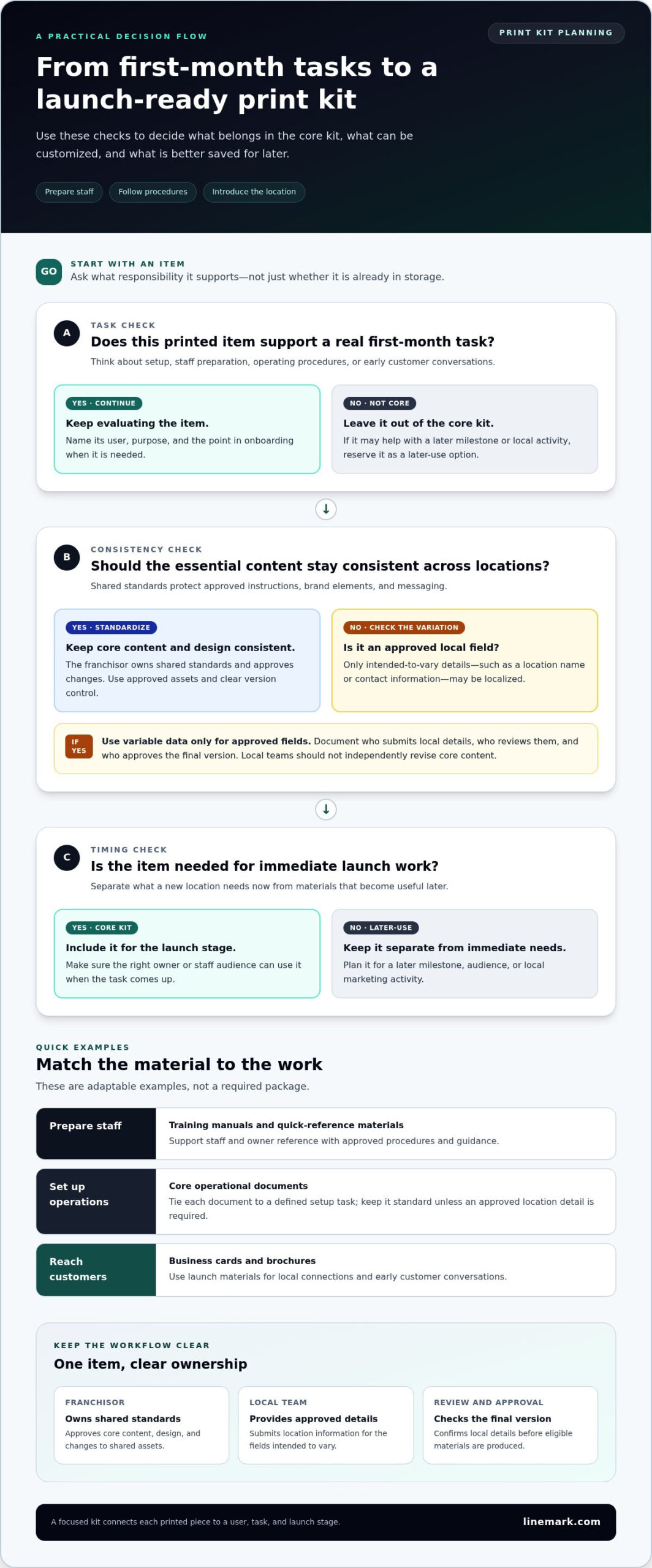
These are adaptable categories, not a required package. Review each proposed item by asking who will use it, what task it supports, and when it needs to be available. For example, if an item has no clear user or launch-stage purpose, leave it out of the core kit or plan it as a later-use option. This keeps the kit focused and aligned with the actual onboarding journey.
How to build a franchise print kit around standard and local needs
Build the kit from the work a franchisee must complete, not from a list of materials already in storage. Map first-month tasks such as preparing staff, following operating procedures, and introducing the location to customers. For each task, identify the audience, the printed tool that helps, when it’s needed, and who owns its content and approval. This keeps onboarding new franchisees with print kits focused on practical use and gives the franchisor a clear way to manage shared standards.
Then separate the contents into a fixed core and approved additions. The core should cover materials every new location needs; optional pieces can be selected for a particular launch stage or local requirement. The International Franchise Association’s professional development program highlights franchise management, operations, and training, areas that can help teams think carefully about the guidance new owners and staff need.
Which materials should remain consistent across franchise locations?
Keep corporate-approved manuals, operational documents, and brand-controlled marketing pieces consistent in their essential content and design. Shared artwork and clear version control reduce the chance that locations use outdated instructions, inconsistent logos, or different approved messaging. The franchisor should own the standards and approve changes to shared assets. Local teams can provide details, but shouldn’t revise core content independently.
Where can franchise print kits allow local customization?
Localize only the fields intended to vary, such as a location name, contact information, or other approved local details. Variable data printing can personalize eligible materials while preserving the core design. Before production, document who submits local information, who reviews it, and who approves the final version. A defined review helps catch errors without giving up control of shared brand elements.
A compact item matrix makes decisions visible to the people who prepare, approve, and replenish the kit. Use these examples as a starting framework, not a mandatory checklist:
- Training manual: staff and owner reference; standard content; franchisor approves; review or replenish when the approved version changes or stock needs replenishing.
- Operational document: supports a defined setup task; standard unless a location detail is required; operations owner approves; replenish when onboarding demand or a revised version calls for it.
- Business card: supports local introductions; shared design with approved location fields; brand and location details reviewed; replenish as staff or contact details change.
- Brochure: supports customer outreach; approved core messaging with eligible local details; marketing owner approves; replenish based on launch use and inventory needs.
Assign an owner, approval status, and replenishment trigger to every item, even if the trigger is a scheduled inventory review. Linemark’s MarCom On-Demand resources can support ordering workflows for approved materials.
Bulk, on-demand, or hybrid: compare franchise print-kit fulfillment models
Choosing a fulfillment model means balancing readiness with control over inventory and content. Bulk production keeps planned materials together in centralized stock, on-demand ordering responds to actual requests, and a hybrid approach uses both. The right fit depends on how often new franchisees join, how stable each item is, how quickly the network is growing, and how much local customization the materials require.
Standardization doesn’t mean every location needs identical quantities or local details. A franchise can protect approved artwork and messaging while adjusting kit quantities to a location’s needs and customizing eligible fields, such as contact information. Compare each model across four operational questions:
- Control: How will approved content and current versions be maintained?
- Storage: Which items need to be held as inventory, and who tracks them?
- Flexibility: Can the approach accommodate changing details or launch patterns?
- Replenishment: What signals that an item needs to be reordered or revised?
A hybrid model may balance launch readiness and inventory control by stocking stable essentials while producing variable materials as needs arise. It isn’t automatically right for every network. Choose the approach that matches how the franchise onboards locations and manages its materials.
When does bulk production suit franchise onboarding?
Bulk production can suit materials with stable content, predictable demand, and repeat use across locations, such as a current operations manual or a standard brochure. Centralized stock gives the franchisor a consistent supply to draw from, but it requires forecasts and version control. If demand shifts or shared content changes, remaining stock may become excess or outdated. Review inventory alongside asset revisions and onboarding plans.
When can on-demand or hybrid fulfillment make more sense?
On-demand production can fit materials whose details vary by location or whose order timing is difficult to predict. It lets a franchisee request eligible pieces as needed, while approved templates help preserve shared design. A hybrid model can hold stable essentials in inventory and produce variable materials when ordered. That approach requires clear rules for which items are stocked, which are produced to order, and who reviews local details.
Use onboarding new franchisees with print kits as a chance to match the fulfillment method to each item rather than forcing every piece into one production pattern. For example, the core manual may remain centrally stocked while location-specific business cards are produced when new contact details are ready. Review item stability, onboarding frequency, inventory oversight, and customization needs together. Coordinated kitting, fulfillment, and inventory management can support the chosen operating model, while a broader review of kit assembly and distribution can help teams assess the full process.
How to launch a repeatable franchisee print-kit workflow
A dependable workflow makes ownership visible at every handoff. Corporate operations defines onboarding needs, marketing controls shared content and brand approval, the franchisee provides location details, and the fulfillment team coordinates inventory, assembly, and distribution. The steps below give each group a clear role and build in checks before materials move to production or shipping.
- Define requirements. Operations maps launch milestones and first-month tasks to the materials needed. Record each item’s audience, purpose, quantity logic, and whether it’s a standard component or a location-specific addition.
- Prepare and control assets. Marketing owns approved artwork and content. Establish file ownership, consistent version naming, and a review path so teams can identify the current files and responsible approvers.
- Collect location details. The franchisee or assigned onboarding contact submits required fields, such as the location name and contact information. The designated reviewer checks entries for completeness and accuracy before they’re used.
- Approve the production proof. Marketing or the brand owner reviews the final proof for approved content and visual consistency. The location contact verifies local details. Production begins only after both checks are complete.
- Order and produce. The inventory owner confirms available stock and identifies items to replenish or produce. The production team uses the approved versions and quantities for the order, then records what was supplied.
- Pack and distribute. Fulfillment checks item counts against the approved location order, verifies version accuracy, and records shipment details. The onboarding owner can then track the kit as part of the location’s launch preparation.
How should teams prepare and approve kit materials?
Use an item specification to capture format, audience, quantity logic, approved artwork, content owner, and approval status. Keep a defined review path for shared and local information, then complete one final preproduction check covering content, location data, and brand consistency. This checkpoint helps catch an outdated file or incorrect detail before it’s reproduced and packed.
How can teams check and improve kit fulfillment?
Make the packing checklist match the approved location order, not a generic kit assumption. Record inventory movement, replenishment requests, shipment details, and recurring packing issues. After launch, gather franchisee feedback about missing, unused, or unclear materials. Review that input with onboarding teams and revise the contents or instructions when actual needs change.
For example, a workflow for a new location might begin with operations confirming its launch tasks, followed by marketing approving shared materials and the owner submitting contact details. After the proof is approved, inventory staff confirm available items, production prepares any remaining pieces, and fulfillment checks the packed order against the location record. The sequence stays consistent, while the contents and quantities reflect the specific location.
Linemark brings commercial printing, kitting and fulfillment, and inventory management together to support coordinated print programs. Explore Linemark’s print and fulfillment services to see how these capabilities can support a repeatable franchise-kit process.
How Linemark can support franchise onboarding print kits at scale
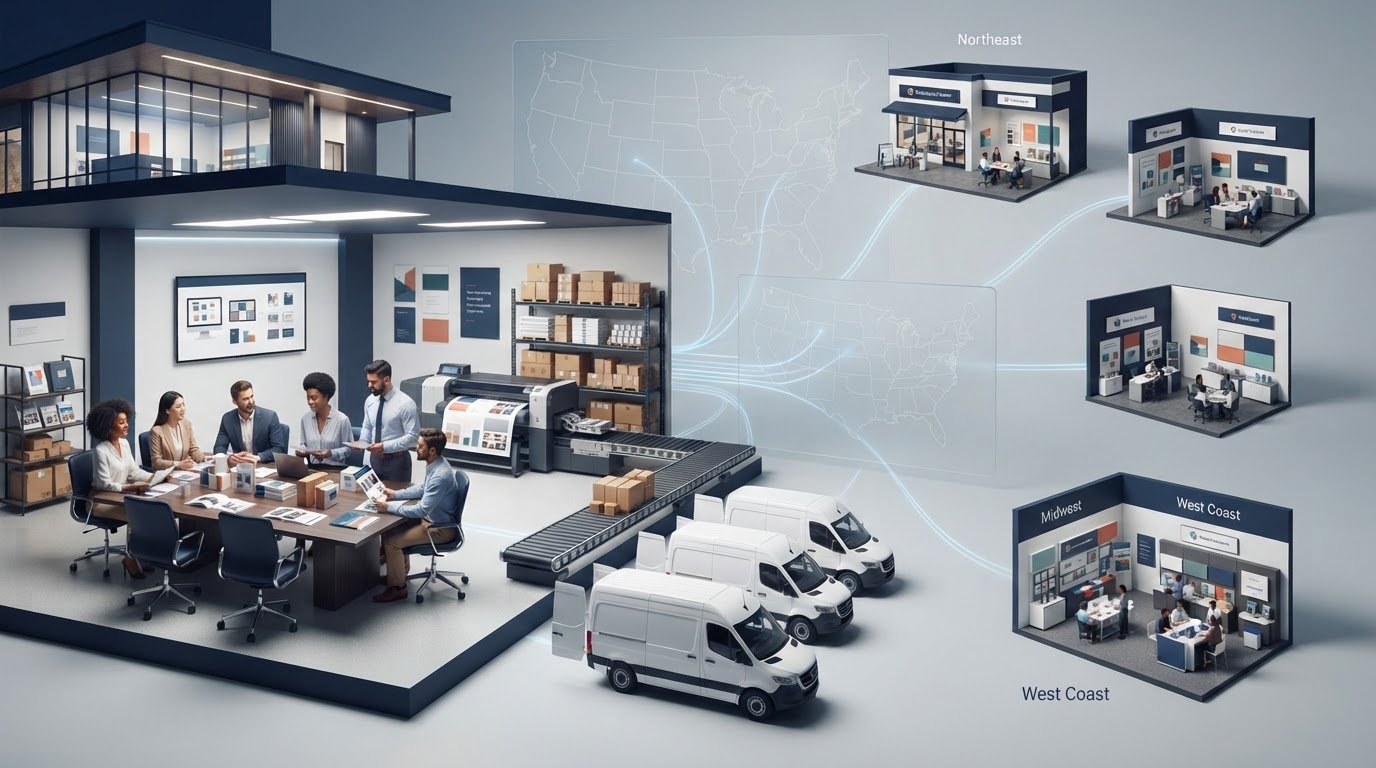
As a franchise network grows, print kits become a connected production and logistics program. Linemark brings commercial printing, kitting and fulfillment, and inventory management together to coordinate materials from production through storage and distribution. This gives corporate teams a partner for planning the pieces as one workflow rather than managing separate print and fulfillment handoffs in isolation.
The production method should fit the materials. Linemark offers digital and offset printing, and the appropriate approach depends on project specifications such as the item, quantity, and how often its content changes. There isn’t one universal method for every kit component. Stable, repeatable materials and pieces with location-specific details may call for different production considerations.
What does an integrated print-kit partner coordinate?
A coordinated program connects approved materials with production, inventory, kit assembly, and distribution. The team can plan how standard items are produced and stored, how location-specific pieces enter the process, and how the final kit is assembled against the approved order. Bringing those stages together can reduce separate handoffs for franchise staff and make responsibilities clearer across the program.
MarCom On-Demand supports the management of approved marketing assets and ordering workflows, helping franchise systems organize access to materials while maintaining brand control. Combined with inventory management and fulfillment, it provides a framework for handling core pieces and changing location needs. Linemark’s national distribution capability supports delivery across a franchise network, while project planning can be shaped around the program’s requirements.
How can a franchise program get started with Linemark?
Begin with the operating detail. Identify what franchisees need to do during onboarding, how locations are rolled out, and which print assets are already approved. Then group materials by stability, customization needs, and inventory role. This makes it easier to plan production, storage, kitting, and distribution together, without assuming every item should follow the same path.
Bring the content and operations owners into the planning conversation. Marketing can identify controlled assets and review requirements; operations can outline launch tasks and location patterns; and the team responsible for inventory can describe how replenishment should work. Linemark works collaboratively with franchise teams to connect these requirements to a coordinated print and fulfillment program.
Founded in 1985, Linemark operates a 90,000-square-foot production facility and supports projects spanning production, storage, kitting, fulfillment, and nationwide distribution. For organizations focused on onboarding new franchisees with print kits, the goal is a repeatable system that supports consistent materials while accounting for real differences between locations.
Start a conversation with Linemark about a franchise print-kit program tailored to your rollout, materials, and fulfillment needs.
Make each franchise launch a stronger starting point
A print-kit program can evolve as your franchise network and onboarding needs change. Treat each launch as an opportunity to learn: note which materials owners use first, where staff need clearer guidance, and which location details repeatedly require adjustment. Use those observations to refine the next kit, clarify ownership, and keep approved materials aligned with the way franchisees work.
This ongoing review turns onboarding new franchisees with print kits into a repeatable operating practice, not a one-time package. A well-managed program gives corporate teams a clearer view of what to maintain and helps new locations receive materials designed for their launch needs.
Linemark can work with your team to shape a franchise print-kit program around your rollout plans, approved assets, production needs, inventory, and distribution. Discuss a franchise print-kit program with Linemark and take the next step toward a more coordinated launch process. Your next franchise opening can be the start of a stronger system.
Frequently Asked Questions
What should be included in a new franchisee print kit?
Include printed materials that help the owner and staff complete launch tasks, then tailor the contents to the franchise model and each role. List the first activities a new location must handle, identify who needs printed guidance for each, and remove items that don’t support a clear task. For example, owners and frontline staff may need different reference materials, even at the same location.
How do you keep franchise print kits consistent across locations?
Use a controlled source for shared artwork and content, and make version status easy to verify before materials are packed. Identify the current approved version in the production record, then reconcile stored stock when a shared file changes. Retire superseded materials from active inventory so a correct packing count doesn’t accidentally include an outdated piece.
Can franchise print kits be customized for each location?
Yes. Location-level details, such as the business name or contact information, can be added to approved materials while the core design and messaging stay under corporate control. Variable data printing can support eligible personalized pieces. Define which fields may change and who verifies them, then review a proof with the location details in place. This keeps local information accurate without letting customization alter shared brand elements.
How do you choose between bulk and on-demand printing for franchise kits?
Choose based on how predictable the item’s content and demand are. Bulk production can suit stable materials used repeatedly, while on-demand ordering can better fit pieces that depend on current location information or less predictable requests. A hybrid plan can assign each item its own approach. Review the decision when franchise growth, content changes, or ordering patterns shift, rather than treating the original model as permanent.
How can franchise teams prevent outdated materials from being sent?
Connect version control to inventory handling. When an asset is revised, record which printed versions are still approved, identify stock that must be held or removed, and update the instructions used by the people assembling kits. Before dispatch, compare the order with the current item list and version record. This adds a practical control beyond checking that each package contains the expected number of pieces.
What is the difference between a franchise print kit and a swag kit?
A franchise print kit is organized around printed information and tools that help a location prepare for launch or carry out early operating tasks. A swag kit centers on branded merchandise, such as giveaway or personal-use items. The distinction is the job each package is meant to do: a print kit supports communication and practical reference, while merchandise primarily creates a branded gift or experience.
How can franchisees order approved marketing materials?
Franchisees can use a centralized ordering workflow, such as MarCom On-Demand, to access approved marketing assets and request the materials their location needs. Corporate teams can define which pieces are available, what details may be localized, and whether an approval step is needed before production. Clear ordering rules help franchisees use current materials and give the franchisor better visibility into requests and replenishment needs.