

 10/08/2026
  Steve Bearden
Effective commercial real estate signage works as a coordinated system. It helps prospects notice a listing, visitors find the right entrance, and tenants move through a property with confidence.
Choosing signs for listings, buildings, tenants, and wayfinding can feel complicated. Each format has a different job, and inconsistent design or hard-to-read messaging can weaken the experience across a property or portfolio. Plan the signs together around how people approach, enter, and use each space.
This guide explains how to select commercial real estate signage for different communication needs and build a clear, readable system. You’ll learn what to consider when specifying formats, materials, placement, and production, and how to coordinate those decisions through installation. Linemark produces large-format graphics, banners, and signage, and provides professional on-site installation to help connect the project stages in one coordinated workflow.
Key Takeaways
- Plan commercial real estate signage as a coordinated system for property identification, leasing, navigation, and daily operations.
- Match each sign format to its audience, task, and placement so prospects, tenants, visitors, and on-site teams can find the information they need.
- Compare materials and production requirements against the sign’s location, exposure, intended duration, and visual goals.
- Use one consolidated sign schedule to organize copy, dimensions, quantities, placements, ownership, proof reviews, and installation planning.
- Connect the project brief, artwork, production, and professional on-site installation to keep signage stages aligned.
What commercial real estate signage needs to accomplish
Commercial real estate signage is a connected set of signs that identifies properties, supports leasing and sales, guides people through a site, and communicates useful information. It should work as a system, not as unrelated messages competing for attention. A leasing banner may attract a prospect, while a directional sign helps that person reach the right entrance. Together, they create a clearer property experience.
Commercial properties serve different purposes and audiences. A basic overview of What is Commercial Property? helps frame that variety, from office and retail spaces to industrial buildings. Build the sign plan around who needs information and what they need to do:
- Prospects: Leasing and sale signs signal availability and prompt an inquiry or visit.
- Tenants: Building directories and tenant signs identify businesses and support daily movement.
- Visitors: Entrance and directional signs help people locate the correct destination.
- Vendors: Delivery and service directions clarify where to enter or report.
- On-site teams: Operational signs communicate locations, access points, or instructions needed to manage the property.
A sign is useful only if people can see it, read it, and understand how to act on it. Consistent visual identity connects signs across a building or portfolio, while thoughtful placement puts each message where its audience needs it.
Match signage goals to the property lifecycle
Active leasing and sale campaigns have a different job from signs in an occupied property. A campaign sign should make availability easy to recognize and give prospects a clear next step. Once spaces are occupied, the emphasis often shifts to identifying tenants, directing visitors, and supporting routine property use.
Tenant mixes can change, so plan for updates to names, suite information, or available-space messages. Separate stable property identification from content likely to change. For each sign, define an observable action: a prospect notices the available space, a visitor finds the entrance, or a vendor reaches the designated delivery point. This makes the sign’s purpose easier to assess and helps reveal whether its placement and message are doing their job.
Plan for different audiences and viewing conditions
Start with the approach. People on foot can read information at closer range; drivers need a message they can recognize quickly, without dense copy. Inside the property, signs can guide people through decisions such as which corridor, floor, or entrance to use. Map the approach and destination before choosing placement.
Check sightlines from the audience’s actual path. Trees, parked vehicles, architectural features, and other visual clutter can obscure a sign. Lighting also affects whether text and contrast remain easy to distinguish as conditions change. Keep copy concise, lead with the most important information, and use a clear hierarchy so the main message is noticed first.
Consistency matters across formats and locations. Repeating recognizable colors, typography, and layout conventions helps people connect a leasing sign outside with a directory or directional sign inside. The result is a coherent system in which each sign performs its specific communication task instead of asking one message to serve every audience.
Which commercial real estate sign formats fit each use?
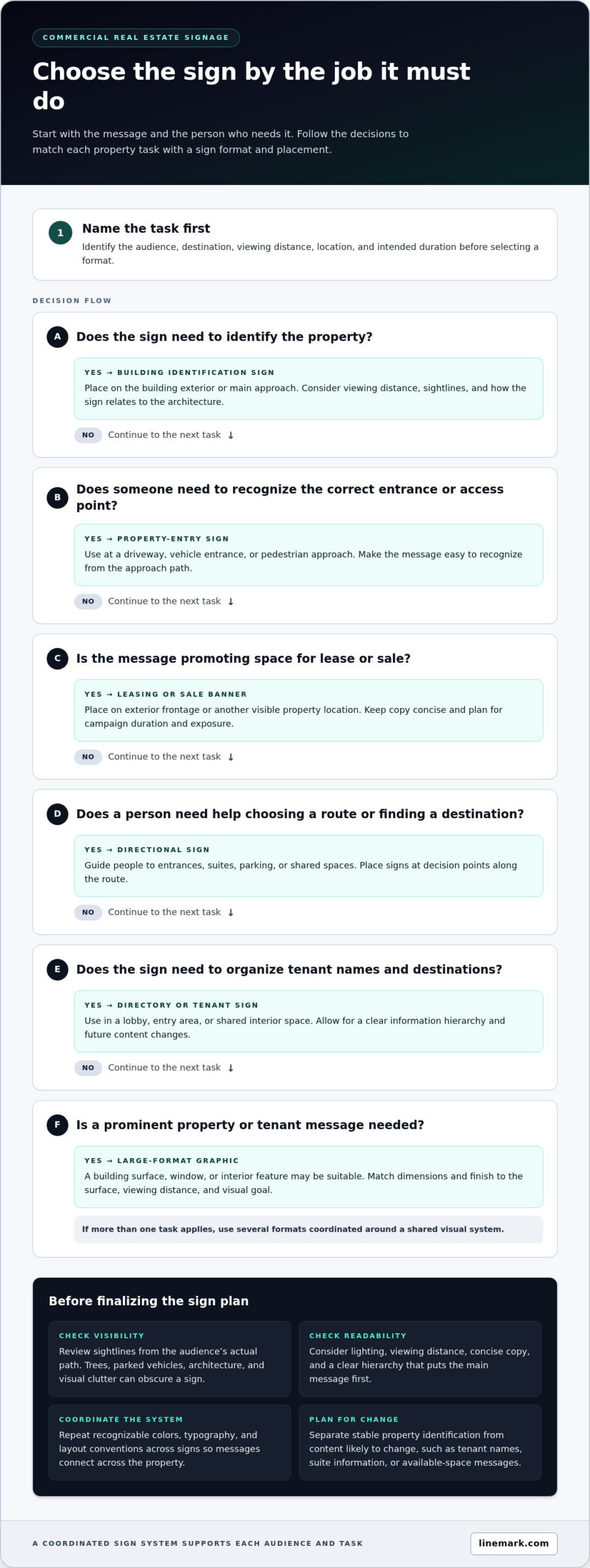
Choose a format by starting with the job, not the sign itself. A building identifier should help people recognize the property; a leasing message should make availability clear; directional signage should guide someone to a destination. Audience, location, viewing distance, and intended duration all shape the choice. A banner may suit a time-bound campaign, while a directory serves an ongoing navigation need.
Use this comparison to match common formats to property tasks. One property may need several formats, coordinated around a shared visual system.
| Format | Typical property task | Placement | Planning consideration |
|---|---|---|---|
| Building identification sign | Identify the property and reinforce its presence | Building exterior or main approach | Consider viewing distance, sightlines, and how the sign relates to the architecture. |
| Property-entry sign | Mark the correct entrance or access point | Driveway, vehicle entrance, or pedestrian approach | Make the message easy to recognize from the approach path. |
| Leasing or sale banner | Promote available space and direct prospects to the next step | Exterior frontage or another visible property location | Keep copy concise and plan for campaign duration and exposure. |
| Large-format graphic | Present a prominent property or tenant message | Building surface, window, or interior feature | Match dimensions and finish to the surface, viewing distance, and visual goal. |
| Directional sign | Guide people to entrances, suites, parking, or shared spaces | Decision points along a route | Place signs where a person needs to choose a direction. |
| Directory or tenant sign | Organize tenant names and destinations | Lobby, entry area, or shared interior space | Allow for clear information hierarchy and future content changes. |
Exterior signs for identification, leasing, and promotion
Exterior formats serve distinct purposes. Building identification establishes which property people have reached; an entry sign confirms where to enter; a leasing banner announces an opportunity. Outdoor exposure and viewing distance influence scale, substrate, and finish. A sign intended for a short campaign may have different production priorities from one planned for ongoing use. Durability depends on the selected materials, installation conditions, and exposure, so avoid treating any lifespan as universal.
Banners and large-format graphics can provide flexibility when a property needs a prominent campaign message or a visual treatment across a larger surface. The International Sign Association (ISA) offers industry information that can support broader sign planning.
Interior and directional signs for property navigation
Interior signs help people move from an entrance toward a suite, meeting area, or shared facility. Put directional signs at route decision points, not only at the destination. Directories and tenant signs organize names and locations so visitors can scan for the right business without working through a crowded wall of copy.
Plan for accessible, readable communication by considering legibility, contrast, placement, and the needs of people who use the space. For coordinated large-format graphics and signage, align the formats, locations, and content as part of one property plan.
How to compare signage materials, design, and production needs
Material and design choices should follow the sign’s location and job. An interior directory, an exterior property identifier, and a temporary leasing message face different conditions and need different levels of detail. Evaluate each sign against its own requirements while keeping typography, color, and logo treatment consistent across the property.
Choose materials around placement and intended use
Begin with the installation location: indoors or outdoors, exposed or sheltered, close to cleaning and handling, and intended for short-term or ongoing use. Metal, acrylic, wood, and printed flexible materials offer different visual qualities and production considerations, but none is automatically right for every sign. Compare options against the project specifications, the surface where the sign will sit, and how often its message may need to change.
Consider maintenance and replacement as part of the decision. A sign in a frequently cleaned interior may need a finish suited to that routine; an outdoor sign may face weather and direct exposure. Assess how the substrate, finish, and mounting method work together in that setting. Expected durability depends on the selected materials and the conditions they encounter.
Prepare artwork and specifications for production
A complete brief keeps design decisions connected to production. For each sign, record the final copy, dimensions, quantity, artwork, placement, and finish. Include the intended viewing distance and mounting context. These details help align the layout with the sign’s function and reduce late changes caused by missing information.
A production-ready sign brief identifies what each sign must say, where it will go, how it will be displayed, and which approved artwork and specifications should guide production.
Proof review is the opportunity to check names, suite numbers, directions, spelling, logo use, and layout before production. Review at the sign’s intended scale when possible. Copy that looks clear on a screen may feel crowded at its final size or be difficult to read from the expected approach. Check that the most important message stands out first and that related signs share recognizable visual cues.
For a multi-sign property, use approved design elements consistently and keep a record of each sign’s version. This helps building identification, tenant listings, and campaign graphics stay visually aligned, even when their formats differ. It also makes future updates easier to manage without treating every sign as a separate design project.
Accessibility and local sign rules are planning considerations, not assumptions to resolve with a generic template. Review the applicable ADA Standards for Accessible Design for the particular sign and setting, and assess current local requirements for the property. The International Zoning Code Sign Regulations provide a reference for sign-planning topics, but local adoption and project conditions matter. Coordinate artwork, dimensions, substrate, finish, and mounting details early so production and installation can follow a clear specification.
How to plan a commercial real estate signage project
A clear plan turns a collection of sign requests into a coordinated project. Start with an on-site audit, then connect each sign to a specific audience, location, and task. Keep decisions in one sign schedule so property teams, artwork reviewers, production, and installation stay aligned as the project moves forward.
Build a property signage inventory and schedule
Walk the property and record existing signs, missing information, and locations where people may need direction. Group entries by exterior identification, leasing, wayfinding, and interior communication. For each sign, note its purpose, location, audience, content owner, format, copy, dimensions, quantity, and replacement needs. This inventory makes conflicting messages easier to spot and can reveal gaps, such as a visitor route that stops before the intended destination.
Use the inventory to guide a practical workflow:
- 1. Audit needs: List existing signs, upcoming campaigns, and communication gaps across the property.
- 2. Define audiences: Identify who each sign serves and the action it should support.
- 3. Map placements: Mark sign locations along real arrival routes and key decision points.
- 4. Specify signs: Record format, final copy, dimensions, quantity, artwork, finish, placement, and the person responsible for content.
- 5. Review proofs: Check text, layout, visual consistency, and legibility before approving production.
- 6. Coordinate installation: Align approved signs, site locations, and installation planning so the handoff is clear.
For a property with multiple buildings or changing tenants, the schedule can also support a phased rollout. Prioritize signs needed for opening, leasing, or visitor access, then plan later updates around tenant changes or new communication needs. Keep stable property information distinct from content that changes often. Assigning a content owner to each sign helps prevent outdated names or directions from lingering after a change.
Coordinate proofing, production, and installation
Set review points before production begins. Confirm final copy first, then review artwork, dimensions, materials, finish, and placement details against the schedule. A final proof check can catch a misspelled tenant name, an incorrect suite location, or a layout that gives the main message too little emphasis. Resolve those details before approval so the production file and installation plan use the same information.
Production and professional on-site installation can be managed as connected project stages. When the schedule records what is being produced and where each sign belongs, fewer details need to pass between separate handoffs. This is especially useful when large-format graphics, banners, and other signs are part of one property program. Linemark brings production and on-site installation together for coordinated projects. Explore Linemark’s commercial signage services.
Bring commercial real estate signage from brief to installation with Linemark
A signage project moves more smoothly when the goals, artwork, production details, and installation plan stay connected. Linemark produces large-format graphics, banners, and signage, and provides professional on-site installation. Property teams can carry approved project details through the next stages rather than treating every sign as a separate request.
For commercial real estate signage, that connection matters across a property. Building identification, leasing messages, tenant information, and visitor-facing graphics may serve different purposes, but they can still follow a consistent visual direction. A shared brief gives the production team context for the full program, including which messages are permanent, which may change, and how the signs relate to one another.
What to include in a project brief for Linemark
Bring the core information into one working document. Describe the property goals and audiences, list sign locations, and provide approved copy and brand assets. Add quantities, dimensions, material preferences, installation context, and the names of people responsible for reviewing content and proofs. Photos or location notes can clarify where a sign belongs and what surrounds it.
Flag open decisions clearly, such as a tenant name awaiting approval or a placement that still needs a site review. Organize the brief so it distinguishes decisions ready for production from details that need resolution. This helps keep the schedule, artwork, and production specifications aligned.
- Property and purpose: Identify the site, audience, and communication goal for each sign.
- Artwork and content: Supply approved copy, logos, and other brand assets, with clear ownership for updates.
- Production and placement: Record quantities, dimensions, material preferences, finish, and intended location.
- Review and installation: Name proof reviewers and describe relevant site conditions or installation context.
Coordinate large-format production and on-site installation
Once the brief is organized, proof review becomes a practical checkpoint. Confirm the message, artwork, dimensions, and placement information before production. This helps catch mismatches early, such as copy that doesn’t fit the approved layout or a sign assigned to the wrong location. Clear approval records also help keep teams aligned on the version moving forward.
Production and installation planning should use the same project information. Linemark’s large-format production and professional on-site installation work as connected stages, supporting a unified approach across banners, graphics, and signage. The result is a clearer handoff from approved brief to finished signs in their intended locations.
Ready to organize the next steps for your property? Review Linemark’s signage capabilities.
Make your next property update easier to manage
A signage plan can keep working after the initial installation. Treat it as a living property resource: review it when tenants change, spaces are reconfigured, or visitor routes shift. Keeping sign locations, approved artwork, and content ownership organized gives your team a practical starting point for updates and helps preserve a coherent experience over time.
That forward planning makes commercial real estate signage an adaptable part of property operations, not a one-time project. Linemark can connect the project brief, production, and on-site installation around the needs of the property.
Start with a clear brief, then discuss your commercial real estate signage project with Linemark.
Frequently Asked Questions
What signs are commonly used for commercial real estate?
Commercial properties commonly use identification signs to mark a building, leasing or sale signs to promote available space, and directional signs to guide people around the site. Tenant directories organize business names and destinations, while interior and exterior signs communicate information such as entrances, shared facilities, or property messages. A campus with several buildings may need a different mix than a single storefront. Choose formats around property goals, audiences, placements, and viewing conditions.
How do I choose signage for a commercial property?
Start by defining what people need to notice or do, then identify the audiences and locations involved. Consider how far away each sign will be viewed, what materials suit its setting, and whether the artwork supports the message. Include installation planning before finalizing specifications. A property signage inventory helps reveal missing directions or outdated content and gives reviewers one reference for keeping messages and visual elements consistent across the site.
What materials are used for commercial real estate signs?
Material options vary by application, placement, exposure, appearance, and intended duration. A sign for a sheltered lobby has different considerations from one exposed outdoors or displayed as a temporary leasing message. Compare substrate choices alongside dimensions, finish, mounting method, and artwork, since those details affect the finished result and production plan. Material alone doesn’t determine lifespan or performance; those depend on the project specifications and conditions where the sign is used.
Do commercial real estate signs need to meet accessibility requirements?
Accessibility requirements depend on a sign’s purpose, placement, and the rules that apply to the property. The ADA Standards for Accessible Design are an important reference for evaluating signs in relevant settings, but requirements shouldn’t be assumed to apply identically to every sign. Identify the sign types and locations early, then make sure project specifications reflect current applicable requirements. This helps teams address accessibility during planning, rather than treating it as a last-minute production change.
How long does it take to produce and install commercial real estate signage?
Project timing depends on sign types, quantities, artwork readiness, approval stages, material decisions, and installation coordination. A project with approved artwork and clearly mapped locations may follow a different schedule from one still resolving tenant names or placements. Provide a consolidated brief that identifies open decisions, reviewers, and installation needs. The project schedule can then be established around its actual scope rather than relying on a generic turnaround estimate.
How much does commercial real estate signage cost?
There isn’t one standard rate for a signage project. The total depends on scope, dimensions, quantities, materials, finishes, artwork, and installation requirements. A single temporary message and a coordinated program across multiple buildings involve different production needs. Prepare a consolidated sign schedule that lists each format, location, specifications, and quantity. This gives the project a consistent basis for scoping and makes it easier to compare the needs of each sign within the overall program.
Can commercial real estate signage be updated when tenants or property information changes?
Yes, updates can be planned, though the approach depends on the sign format, construction, content, and project requirements. At the start, identify which information is likely to change, such as tenant names, suite assignments, or leasing details. Keep approved source artwork and a record of sign locations organized so future revisions can be matched to the correct sign. This preparation helps property teams manage updates without losing track of the overall visual system.