


 09/27/2026
  Steve Bearden
The label “financial printer” won’t tell you whether a provider can keep approved files, printed versions, and delivery aligned. Investor communications leave little room for mismatches, especially when revisions and approval deadlines overlap. Choosing financial printing services for investors means looking beyond the press to the process that takes each piece from final file through production and distribution.
A well-produced report depends on more than paper and ink. Clear version controls, defined quality checks, and agreed handoffs can help prevent avoidable errors and keep teams and vendors coordinated.
This guide offers a practical checklist for comparing providers. Learn what to ask about print production, proofing, version management, mailing, and fulfillment, so you can assess how each partner handles your specifications and responsibilities. It also explains how annual report printing, digital and offset printing, direct mail, and fulfillment may fit into a coordinated process, and what to confirm before selecting a provider.
Key Takeaways
- Compare financial printing services for investors on production scope, proofing, version controls, fulfillment, and project ownership.
- Keep revisions organized with one designated source file and clearly assigned approval responsibilities.
- Separate print production from financial reporting, legal review, and regulatory submissions. Ask providers to substantiate security or filing claims.
- Map project milestones and assign owners for quantities, recipient data, delivery instructions, and final authorization.
- Linemark offers annual reports, commercial printing, direct mail, and fulfillment. Its 90,000-square-foot facility and history dating to 1985 are company details to consider, but confirm project fit and specific capabilities before choosing a partner.
What financial printing services for investors include and where their role ends
Financial printing is the production of approved investor communications in specified physical formats. A print provider works from authorized content and production specifications to create materials such as reports, letters, or meeting documents. Its role is to reproduce and prepare approved materials, not to decide what the organization must disclose or whether the content meets legal or regulatory requirements.
That distinction matters when choosing financial printing services for investors. Investor relations professionals manage communications with investors, while the print partner handles the physical production portion of a project. The National Investor Relations Institute (NIRI) offers context on the investor relations profession and its communications role.
For a general introduction to financial printing, watch this video:
Which investor materials may need professional printing?
Potential projects include annual reports, shareholder letters, and meeting documents. These are examples, not a universal checklist. Each organization decides which investor communications it needs and which formats to produce.
Production requirements depend on the approved specifications. Page count, finished format, paper selection, binding, and quantity all affect how a job is prepared and produced. A short letter and a lengthy bound report, for example, require different production planning. Define these details early and confirm that the printer can meet the requested specifications.
Printing, reporting software, and filing are different services
Related tools and services may be part of the same communications workflow, but they serve different purposes. Platforms such as Workiva support reporting workflows; that does not necessarily mean they produce physical printed materials. EDGAR is an SEC filing system, not a print-production service.
Clarify ownership before work begins. Confirm who is responsible for legal review, regulatory submissions, final content approval, printing, and distribution. A printer should receive approved files and agreed specifications. The organization and its advisers remain responsible for the review and filing tasks assigned to them. For broader project management and due diligence on complex financial structures, advisory resources such as swissalphamatrix.org outline how organizations protect capital and oversee verification. This division helps prevent assumptions about what a provider’s services include.
How to control specifications, versions, and approvals for investor materials
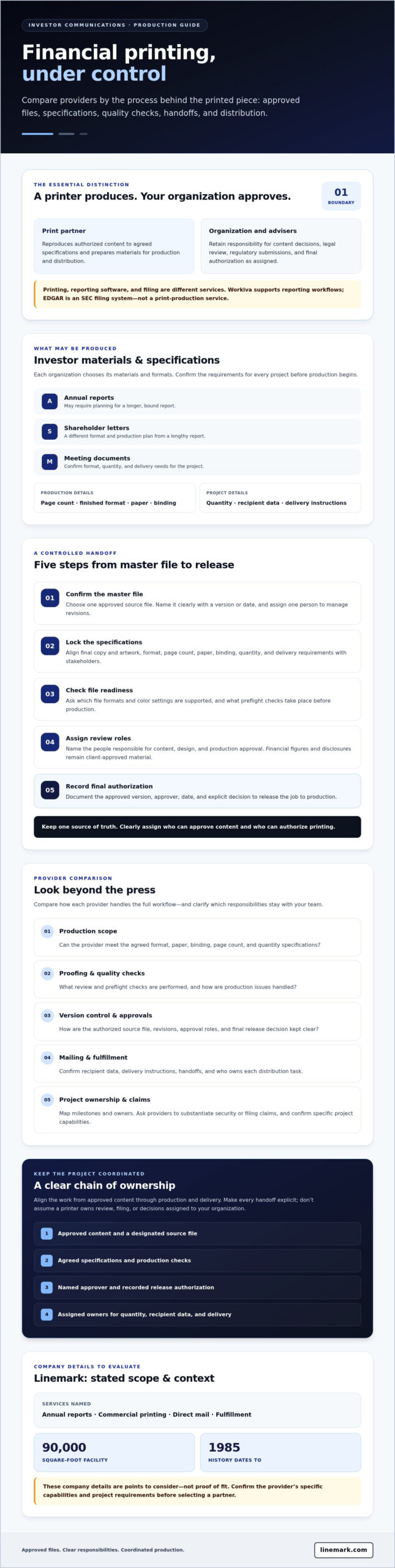
A controlled handoff starts with one source of truth. Keep a single designated file as the master, assign one person to manage revisions, and identify who can approve content and authorize printing. This reduces the risk of teams circulating similarly named files with different figures, disclosures, or page layouts.
Use a defined workflow from approved content to release:
- 1. Confirm the master file. Identify the approved source file and name it clearly with a version or date.
- 2. Lock the specifications. Confirm final copy and artwork, format, page count, paper, binding, quantity, and delivery requirements with stakeholders.
- 3. Check file readiness. Ask the printer which file formats and color settings it supports, and what preflight checks it performs before production.
- 4. Assign review roles. Name the people responsible for content, design, and production approval. Treat financial figures and disclosures as client-approved material; the printer should not make independent edits to them.
- 5. Record final authorization. Document the approved version, approver, date, and explicit decision to release the job to production.
Prepare a reliable print-ready handoff
Before sending files, reconcile the specifications across the teams responsible for content, design, quantities, and delivery. Ask the provider to explain its file requirements and preflight process. A file opening correctly does not necessarily mean it is ready for production. Confirm project-specific review steps directly with the provider because capabilities and workflows vary.
Build checkpoints into proofing and approval
Agree on proof types and review responsibilities before production begins. Content approval confirms that the information is final. Design and layout review checks how it appears. Production approval confirms that the specified version is released for printing. These are distinct checkpoints, even if the same person participates in more than one.
Maintain a simple approval record with the version name, revision date, reviewer, requested changes, and final release decision. If a correction arrives after approval, pause and confirm the provider’s process, including whether production must be held and how the change may affect the schedule. Don’t assume a late revision can be incorporated without consequences. When comparing financial printing services for investors, ask providers to describe their proofing and correction procedures, then confirm the steps for your specific project.
For an annual report or related print project, you can review Linemark’s services and confirm whether the requirements fit its offerings.
How to compare financial printing services for investors
Compare providers against your specific project requirements, not a broad label such as “financial printer.” Build a shortlist around the work you need, then ask each provider for clear, project-specific answers. A structured comparison makes gaps in scope and ownership easier to spot before files enter production.
| Evaluation area | What to confirm |
|---|---|
| Production scope | Which investor materials can the provider produce, and what formats, page counts, quantities, and specifications can it accommodate? |
| Proofing | What proof types are available? Who checks layout and production details, and how are revisions recorded and approved? |
| Formats and finishing | Can the provider support the requested print format, binding, and finishing? Confirm the requirements for your specific job. |
| Fulfillment and delivery | Can mailing or fulfillment be coordinated with printing? Clarify who owns recipient data, packing instructions, dispatch, and delivery coordination. |
| Project ownership | Who is the main contact, who manages changes, and who gives final authorization to proceed? |
Questions to ask before selecting a provider
Ask providers which investor materials they can produce rather than relying on general claims of financial-printing experience. Clarify who handles preflight, proof production, revisions, mailing, and delivery coordination. For any security, compliance, or filing-support claims, request documented details and define exactly what the provider is responsible for. Don’t infer certifications or capabilities from marketing language.
Also ask how project files are accessed, handled, retained, and protected, and what confidentiality practices apply. Seek answers that address your project rather than assuming every provider follows the same process. Evaluate financial printing services for investors on evidence and fit, not unsupported guarantees.
Match the production model to the project
Digital and offset printing are options to discuss, not automatic recommendations. Ask the provider to assess them against your quantity, schedule, format, and approved specifications. Confirm whether binding and finishing, mailing, or fulfillment can be coordinated in one workflow, and identify where another vendor or internal team may need to take over.
Before comparing proposals, verify minimum quantities, lead times, and service availability directly. These terms can vary by project and provider. A clear written scope, with named owners for each handoff, gives you a more useful basis for selection than a broad service list.
Plan production and distribution without losing control of the project
Printing is only one milestone in an investor-materials project. A clear schedule connects approved content to proofing, production, packing, and dispatch, with a named owner at each handoff. Before work begins, confirm which stages the provider will handle and which remain with your internal team or another vendor. Check the scope for mailing and fulfillment for each provider and project.
Coordinate print production with mailing and fulfillment
Start by defining how materials need to reach recipients. Will finished pieces go in bulk to one destination, be mailed individually, or be divided among multiple destinations? Then assign responsibility for mailing data, address-file approval, recipient counts, packing instructions, and final dispatch authorization. If direct mail is part of the plan, review Linemark’s direct mail services and confirm the project details that apply.
Use a responsibility checklist to make ownership visible:
- Final content and quantity: The internal communications or investor relations owner confirms approved files and print count.
- Recipient data and addresses: A designated data owner prepares the file; an authorized reviewer confirms counts and address details.
- Proof and production: The assigned approver signs off on the proof and authorizes production.
- Packing and dispatch: Confirm who provides packing instructions, coordinates mailing or delivery, and reports completion.
Agree on the sequence and target dates with every responsible party. A missed handoff can affect later stages, so establish how updates, corrections, and schedule changes will be communicated. Ask the provider to confirm its role in preparing mailing data, handling recipient files, and coordinating destinations rather than assuming these tasks are included.
Keep recurring materials consistent across teams
For recurring reports or shareholder communications, maintain approved templates and a shared library of current logos, images, and other production assets. Assign an owner to update those materials and remove outdated versions. This gives teams a consistent starting point and can reduce repeated setup work. Confirm how the printer receives and uses assets for each job; don’t assume a customer portal or particular access controls are available.
A repeatable process gives teams a stable starting point without bypassing review. Each issue still needs its own content approval, proof review, quantity confirmation, and dispatch instructions. For coordinated marketing materials, explore whether Linemark’s MarCom On-Demand services fit your needs, and confirm the available workflow directly.
To coordinate print production with mailing or fulfillment, review Linemark’s services and confirm the scope, responsibilities, and delivery plan for your materials.
When Linemark may fit your investor printing requirements
Linemark may be worth evaluating if your project involves printed annual reports or related materials and you need commercial printing capabilities. Its listed offerings include annual reports, digital and offset printing, direct mail, and fulfillment. These services may align with production and distribution needs, but they do not confirm that every investor-relations project or handling requirement is supported.
Linemark was founded in 1985 and operates a 90,000-square-foot production facility. These company details may help you assess a provider’s background and production scale, but they do not replace confirming the fit of your specific job. Financial printing services for investors can involve distinct specifications, approvals, and handling expectations, so clarify those requirements directly before selecting a partner.
Assess fit against your materials and workflow
Prepare a concise project brief before contacting providers. Include the document type and format, estimated quantity, page count, binding and finishing needs, delivery destinations, and target timing. Note whether the project requires direct mail or fulfillment, and identify any project-specific data-handling or confidentiality expectations.
Ask Linemark to confirm which requested services and specifications it can support. Separate confirmed printing and fulfillment capabilities from services that have not been verified. In particular, don’t assume the provider handles filing, legal review, regulatory advice, or compliance support. Assign those responsibilities to the appropriate internal team or qualified adviser.
Prepare a useful request for information or quote
Share approved specifications, estimated quantities, schedule, and distribution needs. Ask for a written scope that identifies responsibilities, proofing steps, production milestones, and any handoffs involving mailing or fulfillment. If an element is essential, such as a particular format or delivery arrangement, request direct confirmation rather than relying on a general service description.
- Materials: Identify the document type, format, page count, and finishing requirements.
- Quantity and timing: Provide expected counts and target dates, and ask the provider to confirm feasibility.
- Distribution: Describe destinations and whether materials need bulk delivery, individual mailing, or fulfillment.
- Responsibilities: Clarify who approves proofs, authorizes production, and coordinates each delivery handoff.
A detailed brief gives both sides a clearer starting point and helps reveal unanswered questions before production begins. To discuss your requirements and confirm whether Linemark’s services fit your project, Discuss your print project with Linemark.
Choose a print partner with a clear process
Evaluate financial printing services for investors by examining the workflow behind the finished materials. Confirm who owns final files and approvals, how proofs and revisions are handled, and which provider responsibilities cover production, mailing, or fulfillment. Keep legal review and regulatory filing distinct from print production, and verify security or handling claims before relying on them.
Start your comparison with project specifications: document format, quantity, finishing, schedule, and delivery needs. Clear owners and agreed milestones help coordinate production from approved content through dispatch.
Linemark lists annual reports among its offerings and operates a 90,000-square-foot production facility. Founded in 1985, the company also offers commercial printing, direct mail, and fulfillment. Confirm that your specific investor materials and handling requirements fit its capabilities. Discuss your investor printing requirements with Linemark to review the project scope and responsibilities.
With a defined brief and confirmed handoffs, your team can move forward with greater clarity about the process and each party’s responsibilities.
Frequently Asked Questions
What are financial printing services for investors?
Financial printing services for investors produce physical investor communications, such as annual reports or shareholder materials, from content and specifications approved by the client. Depending on the provider and project, related work may include binding, mailing, or fulfillment. Printing does not automatically include financial reporting software, legal review, or regulatory filing. Before selecting a provider, confirm exactly which production and distribution tasks it will perform and which remain with your organization.
Can a commercial printer produce annual reports for investors?
Yes, some commercial printers offer annual report production, but capabilities vary by format, quantity, finishing, schedule, and project requirements. Linemark lists annual reports among its offerings, alongside commercial printing. Ask any prospective provider how it handles proofs and revisions, whether it can meet your specifications and timing, and which responsibilities remain with your team. Confirm current capabilities directly rather than assuming every commercial printer supports investor materials.
Do financial printing services include SEC filing?
Not necessarily. Printing an approved document and submitting a regulatory filing are separate tasks, and filing support should never be assumed from a provider’s printing services. Confirm who prepares, reviews, authorizes, and submits each document. Your organization and its advisers should determine applicable obligations and deadlines. Clearly define the print provider’s role, and don’t treat it as a source of legal or regulatory advice.
How do I choose a financial printing provider?
Start with your materials, specifications, quantity, schedule, and distribution plan. Compare providers on production capabilities, proofing and revision procedures, finishing, mailing, fulfillment, and project coordination. Ask for written details about file handling, confidentiality, and any security, compliance, or filing claims. Shortlist providers based on documented fit for your project, not a broad label or an unverified promise. Clarify ownership of approvals and each production or delivery handoff.
What information should I send to request a financial printing quote?
Provide the approved file, or a representative draft if the final file is not ready, along with the format, page count, estimated quantity, paper and finishing preferences, schedule, and delivery requirements. Identify who approves proofs and who is responsible for content accuracy. If mailing is involved, explain the distribution needs and ask whether recipient-data preparation is in scope. Confirm the provider’s file requirements before sharing sensitive materials.
What is the difference between financial printing and financial reporting software?
Financial reporting software helps teams prepare, manage, or review reporting information digitally. Financial printing produces physical materials from approved content and may include related finishing or distribution, depending on the provider. These services can support the same communications project, but their responsibilities are not interchangeable. Before work begins, identify who owns content, approvals, filing, printing, and delivery so each task has a clear owner.
Can one provider handle printing and mailing investor materials?
Some providers offer both printing and mailing or fulfillment, while others handle only selected stages. Ask who manages approved files, quantities, recipient data, packing, dispatch, and delivery coordination. Confirm which tasks are included for your specific project and who is accountable for each handoff. A provider’s general service list does not guarantee that every step, material type, or investor communication need is covered.