


 09/28/2026
  Steve Bearden
What if the unboxing experience did more than surprise the recipient? Effective dimensional mail marketing gives every part of the package a purpose, from the outer format to the final call to action.
A distinctive mailer can earn a second look, but novelty alone isn’t a campaign strategy. Choose a format that suits the audience and response goal, and make sure the contents connect clearly to the message. The concept also needs to work in production, personalization, kitting, and fulfillment.
This guide explains how to choose a dimensional format that supports your objective and plan an unboxing sequence that leads to a clear next step. You’ll learn how to keep the package relevant rather than gimmicky, coordinate print and fulfillment requirements early, and identify mailing details to verify before production. Use these steps to shape a coherent recipient experience and a practical production plan.
Key Takeaways
- Match your dimensional mail marketing format to the audience, campaign objective, and response you want to encourage.
- Plan the unboxing sequence so each reveal supports the message and guides recipients toward one clear next step.
- Compare formats by recipient fit, message capacity, handling, and fulfillment needs before committing to a concept.
- Use a preflight process to review artwork, personalization data, components, assembly, addressing, and distribution planning.
- Coordinate printing, variable data, kitting, and fulfillment with a production partner. Confirm project capabilities and mailing requirements before launch.
What Is Dimensional Mail Marketing, and When Does It Make Sense?
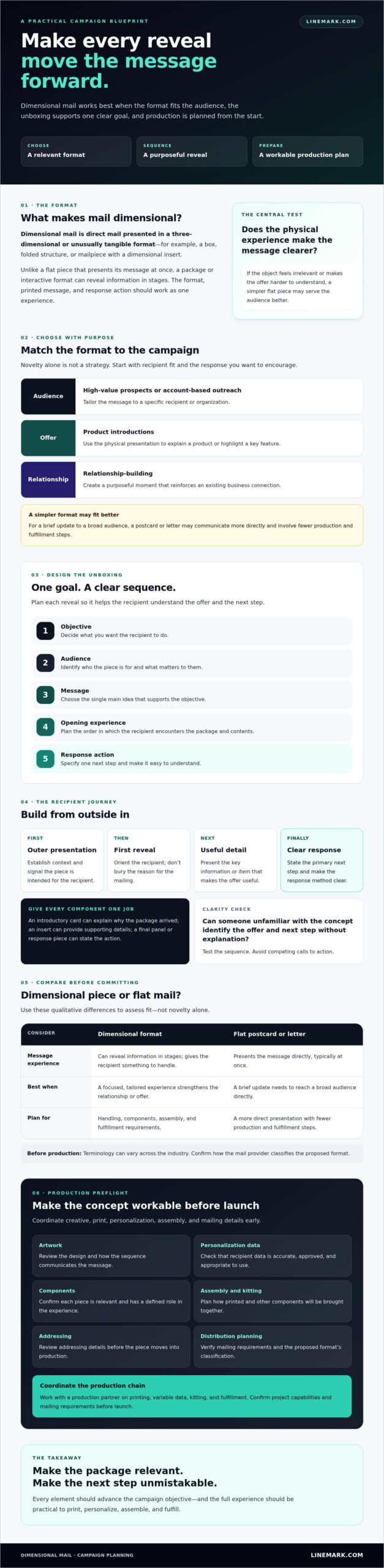
Dimensional mail marketing is direct mail presented in a three-dimensional or unusually tangible format, such as a box, folded structure, or mailpiece with a dimensional insert. Unlike a flat postcard or letter, it gives recipients something to handle and an opening experience to follow. Terminology can vary across the industry, so confirm how a mail provider classifies a proposed format before production. For background on direct mail as the broader category, see this overview of advertising mail.
The difference is more than shape. A flat piece typically presents its message at once; a package or interactive piece can reveal information in stages. That sequence lets you connect the format, printed message, and response action in one campaign experience. But a physical package doesn’t guarantee attention or action. If the object feels irrelevant or obscures the offer, the extra interaction can add complexity without making the message clearer.
How dimensional mail differs from flat direct mail
A postcard puts its message directly in view. A dimensional format may ask the recipient to open a package, unfold a structure, or explore an insert before reaching the main message. That interaction can make the communication feel more considered, provided the sequence is easy to follow and every element has a purpose.
Treat the format as part of the message, not as decoration. Make clear what recipients should notice first, what they’ll discover next, and what action to take. If they have to work to understand the offer, a simpler flat piece may serve them better.
Which campaigns are a strong fit?
Dimensional formats may suit campaigns where a focused, tailored experience supports the relationship or offer. Consider them for:
- High-value prospects or account-based outreach: Tailor the message to a specific recipient or organization.
- Product introductions: Use the physical presentation to explain a product or highlight a key feature.
- Relationship-building: Create a purposeful moment that reinforces an existing business connection.
In each case, match the package and contents to the audience, campaign message, and desired next step. Make a prompt to book a meeting, explore an offer, or contact a representative easy to find. If the goal is to share a brief update with a broad audience, a postcard or letter may communicate more directly and involve fewer production and fulfillment steps. Choose dimensional mail when the experience strengthens the message, not simply because the format is different.
Design the Unboxing Journey Around One Clear Campaign Goal
A memorable package isn’t a sequence of surprises for its own sake. In dimensional mail marketing, each reveal should move the recipient toward one campaign outcome, such as considering an offer, booking a conversation, or taking another defined action. Plan the experience in this order:
- 1. Objective: Decide what you want the recipient to do.
- 2. Audience: Identify who the piece is for and what matters to them.
- 3. Message: Choose the single main idea that supports the objective.
- 4. Opening experience: Plan the order in which the recipient encounters the package and its contents.
- 5. Response action: Specify the next step and make it easy to understand.
Every package element should earn its place by advancing the campaign objective. This keeps creative choices grounded in audience relevance and production requirements.
Build the sequence from first impression to call to action
Map the experience from the outside in. The outer presentation establishes context and signals that the piece is intended for the recipient. The first reveal should orient them, not bury the reason for the mailing. Next, present the key information or item that makes the offer useful. Put the primary message where it naturally follows from that discovery, then close with a clear response prompt.
Give each component one job. An introductory card can explain why the package arrived; an insert can provide supporting details; and a final panel or response piece can state the action. Avoid competing calls to action. If you want recipients to schedule a discussion, say so directly and make the response method clear. Test the sequence with someone unfamiliar with the concept. Can they identify the offer and next step without explanation?
Make the experience personal and useful
Use audience knowledge to shape the content, not just to insert a name. A message tailored to a recipient’s role, organization, or expressed interest can feel more relevant, provided the data is accurate, approved, and appropriate to use. Variable data printing can support different versions of printed content for different recipients. Read Linemark’s variable data printing guide for more on its role in direct mail.
Personalization calls for careful data checks. Confirm fields, spelling, and recipient records before production, and decide what to do if information is missing. An incorrect personalized detail can undermine trust more than a general message would.
Assess every added item: does it clarify the offer, support the experience, or help prompt a response? If not, it may distract recipients or add handling without adding value. Linemark provides direct mail and fulfillment services, including data processing and kitting. Explore Linemark’s direct mail and fulfillment services, and confirm the project’s specific format and requirements before production.
Compare Dimensional Mail Formats Before Committing to a Concept
The right format gives the message room to work without making production and delivery harder than the campaign requires. Use this comparison to shortlist ideas, then review a physical sample and confirm project requirements before approving a design.
| Format | Recipient fit | Message capacity | Handling | Fulfillment considerations |
|---|---|---|---|---|
| Dimensional package | May suit a selected prospect or recipient who will recognize why the package is relevant. | Can hold multiple coordinated items, so prioritize what the recipient should notice first. | Requires opening and handling a container; consider ease of access and protection of contents. | Plan component assembly, packaging, addressing, and distribution. Confirm dimensions and weight. |
| Mailer with inserts | Can serve audiences that need a focused message with supporting information. | Provides space for a primary piece and related inserts, but too many can dilute the main point. | Keep inserts organized and easy to remove, read, or store. | Check insert sizes, sequence, assembly, and how the completed mailpiece will be handled. |
| Interactive printed piece | May fit recipients who benefit from a guided reveal or simple interaction. | Uses folds or other structural features to present information in stages. | Make opening and use intuitive, legible, and accessible. | Review construction, finishing, assembly, and mailing specifications with production and mailing partners. |
Shortlist the format that makes the message easiest for the intended recipient to understand while keeping handling and fulfillment manageable. In dimensional mail marketing, a more elaborate structure is useful only if it improves the experience or helps communicate the offer.
Match the format to the recipient and message
Before settling on a concept, ask whether recipients can understand the package’s relevance from its presentation and contents. The core message needs enough space and visibility to stand out, not compete with the structure. Consider whether recipients can open the piece comfortably, handle its contents, and keep any materials they may want to reference later. If the format creates barriers or obscures the offer, simplify it.
Weigh creative impact against execution demands
A promising mockup still needs to work as a repeatable, deliverable piece. Review assembly steps, packaging protection, personalization, addressing, and distribution before final approval. Give production and mailing partners the dimensions, weight, and a representative sample early so they can assess the format and confirm applicable mailing requirements. Don’t assume mailing eligibility based on appearance alone. If added complexity doesn’t strengthen the message or response action, choose a simpler format.
Plan Production, Personalization, and Fulfillment Before Launch
A dimensional mail concept is ready for production only when its data, physical components, assembly process, and distribution plan work together. Bring production and mailing partners into the process early, while there’s still time to review formats and specifications. Use this preflight sequence to identify gaps before a full run:
- Confirm data: Approve recipient records, mailing data, personalization fields, and rules for missing or duplicate information.
- Finalize artwork and specifications: Review artwork files, finished dimensions, materials, component counts, and format requirements with the relevant partners.
- Prototype the experience: Assemble a representative sample and test how it opens, how the contents are revealed, and whether components stay protected and legible.
- Document assembly and addressing: Set the component order, packing instructions, addressing approach, and quality checks.
- Plan distribution and measurement: Assign release responsibilities and define how you’ll track delivery, response, or conversion.
Prepare artwork, data, and physical components
Use approved specifications to prepare artwork and confirm each component’s dimensions and quantity. Review a physical sample rather than relying on a screen mockup. Folds, inserts, and packaging can affect assembly order and the recipient’s experience. Document that order so everyone handling the job follows the same process.
For personalized versions, inspect variable-data proofs before production. Check names, addresses, personalized copy, and how each rule works across the intended records. Make sure the recipient file and final proof have been approved. Resolve incomplete or inconsistent fields before production instead of relying on manual corrections during assembly.
Coordinate kitting, fulfillment, and measurement
Decide who is responsible for printing, kitting, inventory, addressing, and release for distribution. Specify how completed pieces will be packed, labeled, and stored, and how the team should handle replacements, delayed sends, or returned mail. Confirm dimensions, weight, and applicable mailing specifications with production and mailing partners. Don’t assume eligibility based on a prototype’s appearance.
Set measurement criteria before launch. For example, decide how delivery will be monitored and how responses or conversions will be attributed to the campaign. These measures help teams assess the mailing afterward, but they don’t guarantee a particular result. Linemark offers direct mail, variable data printing, kitting and fulfillment, and inventory management. Discuss production and fulfillment planning with Linemark, and confirm that the proposed format and requirements fit the project.
How Linemark Can Support a Dimensional Mail Campaign
A dimensional mail campaign involves more than a printed piece. Print, personalization, components, inventory, and fulfillment need to align around the approved concept. Linemark offers direct mail, commercial printing, variable data printing, kitting and fulfillment, and inventory management. These services may support relevant campaign stages, subject to confirming the proposed format, specifications, and project requirements with Linemark.
Working with one production partner gives campaign teams a shared point of discussion for production sequencing, data needs, component handling, inventory, and distribution planning. That coordination doesn’t mean every format or requirement is automatically suitable. Confirm responsibilities and capabilities before finalizing the creative or committing to production. For broader campaign planning, explore the direct mail marketing strategy guide.
Coordinate print and fulfillment through one partner
Discuss how printing, variable data, kitting, and fulfillment could fit together for your project. Clarify when recipient data must be approved, how printed components will be grouped, and what information is needed to plan inventory and distribution. Early conversations can help identify dependencies and questions before the concept is locked in.
Linemark was founded in 1985 and operates from a 90,000-square-foot facility. These details provide company context, not a guarantee of campaign performance or confirmation that a particular dimensional format can be produced. Ask Linemark to assess the specific concept and verify applicable production and mailing requirements.
Prepare a useful project brief and take the next step
A concise brief makes that review more practical. Include the audience, campaign objective, planned quantities, components, personalization needs, timing, and distribution requirements. If you have a mockup or sample, share it along with known dimensions and weight. Note what is decided and what still needs validation.
Before completing the creative, ask Linemark to confirm suitable formats, specifications, and production capabilities for the project. This gives your team a chance to adapt the concept to operational requirements while preserving its purpose. To begin, discuss your direct mail project with Linemark.
Turn Your Campaign Plan Into a Coordinated Mailing
Effective dimensional mail marketing starts with a clear campaign objective, then carries it through the format, message, recipient experience, and response action. Choose a package that makes the message easier to understand, not simply more elaborate. Before committing, test the opening sequence and confirm production, personalization, fulfillment, and mailing requirements with the teams involved.
Linemark offers direct mail, variable data printing, kitting, and fulfillment to support relevant campaign stages, subject to confirming your project’s specific format and requirements. Founded in 1985, Linemark operates from a 90,000-square-foot facility. These details provide company context, not a promise of campaign outcomes or confirmation that a particular dimensional mail format is feasible.
Bring your audience, objective, components, quantities, personalization needs, timing, and distribution plan into an initial project discussion. Discuss your dimensional mail project with Linemark to review requirements and confirm what may be feasible. A focused brief and early coordination help you move forward with clarity and build an unboxing experience designed to support your campaign goal.
Frequently Asked Questions
What is dimensional mail marketing?
Dimensional mail marketing uses direct mail in a three-dimensional or unusually tangible format, such as a package, folded structure, or mailer with dimensional inserts. Unlike a flat postcard or letter, it may guide recipients through an opening sequence before they reach the main message. Choose the format when the physical experience helps explain an offer, reinforce a relationship, or prompt a specific response.
How does dimensional mail create a memorable unboxing experience?
It creates an intentional sequence of discoveries rather than presenting every detail at once. Start with an outer presentation that feels relevant, use the first reveal to orient the recipient, and place the key message where it’s easy to notice. Give each insert or component a clear role. End with one specific, visible next step, such as responding to an offer or contacting a representative.
Is dimensional mail more effective than a postcard?
Not automatically. Dimensional mail offers more opportunity for tactile interaction and staged messaging, while a postcard can communicate a concise offer directly. The better choice depends on the audience, campaign objective, message, and execution requirements. For a focused update to a broad audience, a postcard may be simpler and clearer. Consider a dimensional format when the physical experience adds useful context and supports the response you want.
What should a dimensional mail campaign include?
A strong campaign includes a clear objective, a defined audience, one primary message, a relevant format, and a specific response action. Plan the opening sequence so recipients know why they received the piece and what to notice next. Include only components that support the message or make the offer easier to understand. Also plan artwork, recipient data, assembly, addressing, distribution, and how you’ll measure responses.
How do you personalize dimensional direct mail?
Personalize the message using information that’s accurate, appropriate, and relevant, such as a recipient’s name, organization, or known interest. Variable data printing can produce different versions of printed content for different recipients. Before production, review proofs and verify names, addresses, personalization fields, and the rules that determine which version each person receives. If a field is incomplete or unreliable, use a suitable general version instead.
What should marketers confirm before producing dimensional mail?
Confirm the final format, dimensions, weight, materials, artwork, component quantities, assembly sequence, addressing, and distribution plan with production and mailing partners. Build and test a representative sample to check the opening experience and component fit. Approve recipient records and personalization proofs before production. Verify mailing specifications and eligibility for the completed piece rather than assuming they apply. Linemark offers direct mail, variable data printing, kitting, and fulfillment, with specific project capabilities to be confirmed.