

 09/26/2026
  Steve Bearden
What if the printer with the strongest quality claims isn’t the right fit for your greeting card project? A card’s paper, dimensions, fold, finish, and mailing plan all affect production, so comparing providers takes more than reviewing samples. Even when you’re familiar with catalog printing services, greeting cards bring their own specifications to confirm.
It’s reasonable to feel uncertain about which details to settle before requesting a quote, or how to compare print methods and vendor capabilities. The best starting point is a clear project brief, then a practical check that a print partner can support the format, quantity, schedule, and fulfillment workflow you need.
This guide will help you identify the specifications to prepare, compare providers against your actual requirements, and ask the right questions about production, mailing, and delivery. You’ll also learn why it’s important to verify that a provider accepts greeting card projects and can accommodate the stocks, folds, finishes, and quantities you have in mind before committing.
Key Takeaways
- Define the card’s format, quantity, artwork, and delivery needs before requesting quotes so providers can assess the same project requirements.
- Compare digital and offset printing against your run size and artwork needs, then confirm each provider’s available stocks and finishing options.
- Use a vendor scorecard to evaluate technical fit, proofing, communication, production capacity, and service scope, including providers of catalog printing services.
- Prepare production-ready artwork by checking bleed, trim, safe areas, image quality, and color expectations with the printer before approving a proof.
- Clarify what the proposal includes, from finishing and packing to delivery, and verify that the provider can support any mailing or fulfillment coordination your project requires.
What to expect from greeting card printing services
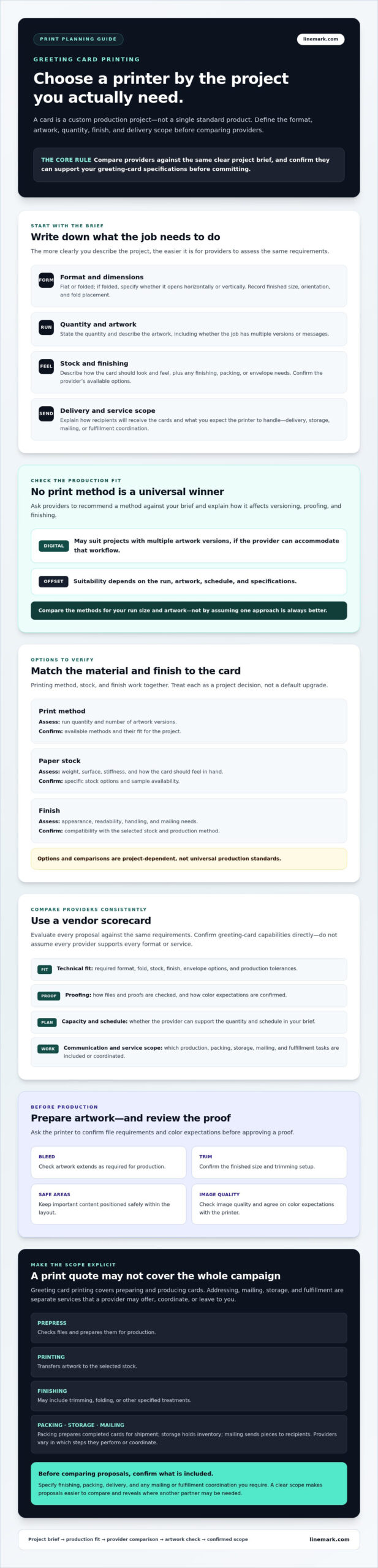
Greeting card printing is a custom production project, not a single standard product. The finished result depends on the format, artwork, quantity, stock, finishing, and delivery requirements you specify. Before comparing providers, clarify what the card needs to do, how recipients will receive it, and which production steps you expect the printer to handle.
Greeting card printing covers preparing and producing the cards; addressing, mailing, storage, and fulfillment are separate services that a provider may offer, coordinate, or leave to you. That distinction matters: a print-ready stack of cards and a coordinated campaign have different workflows. As with catalog printing services, define the required scope before you compare proposals.
For context on how card types and customs developed, see this overview of the history of greeting cards. For the production side, a catalog layout tutorial can also illustrate how page dimensions and layout decisions are handled before a job goes to print.
Watch this InDesign catalog-template tutorial for a look at the layout stage before printing:
Which greeting card formats can a buyer request?
Common examples include flat cards and folded cards, with the fold opening horizontally or vertically. These are examples, not a promise that every provider can produce every format. Finished size, orientation, and fold placement shape the artwork: they determine panel dimensions, where content sits, and how the card fits an envelope or mailing plan. Confirm available formats, envelope options, and production tolerances directly with each provider.
What does a greeting card printing provider handle?
Ask which steps fall within the proposed scope. Prepress checks files and prepares them for production; printing transfers the artwork to the selected stock; finishing may include trimming, folding, or other specified treatments. Packing prepares completed cards for shipment, while storage holds inventory and mailing sends pieces to recipients. Providers vary in which steps they perform or coordinate, so don’t assume a print quote includes campaign services.
Document the required format, quantity, finishing, packing, storage, mailing, and delivery responsibilities before requesting a quote. Then ask the provider to confirm which requirements it can support, including any greeting-card-specific capabilities. A clear scope makes proposals easier to compare and helps reveal where you may need another partner.
How paper, printing, and finishing shape greeting card results
A card’s look and feel come from the combination of printing method, stock, and finish. None is a universal upgrade: the right specification depends on quantity, artwork, intended use, mailing plan, and what a provider can confirm it supports. Treat every option as a project decision, not a default standard.
Digital or offset printing: which fits the project?
Digital printing may suit projects with multiple artwork versions, such as cards with different messages, if the provider can accommodate that workflow. Offset printing is another production approach, and its suitability depends on the run, artwork, schedule, and specifications. Ask providers to recommend a method against your brief and explain how it affects versioning, proofing, and finishing. There’s no universal winner.
| Decision | What to assess | What to confirm |
|---|---|---|
| Print method | Run quantity and number of artwork versions | Available methods and their fit for the project |
| Stock | Weight, surface, stiffness, and how the card should feel in hand | Specific stock options and sample availability |
| Finish | Appearance, readability, handling, and mailing needs | Compatibility with the selected stock and production method |
All comparisons are project-dependent, not universal production standards.
How should you choose card stock and finish?
Stock weight and stiffness affect how a card feels, handles, and holds its shape. Surface matters too: a smooth or coated finish can present artwork differently from a textured or uncoated surface. Ask for physical samples, or a representative proof, when tactile quality is central to the decision.
Finishes also involve trade-offs. A coating may change the surface appearance and affect how easy it is to write on; texture or heavy ink coverage may influence legibility. Ask the provider how a proposed finish will behave with fine text, dark areas, folds, and the chosen stock. Confirm that the finished piece fits the intended envelope and mailing plan, and that finishing options are available for the selected production method.
Before approval, ask the provider to document the agreed stock, print method, finish, and any relevant production tolerances. Linemark lists digital and offset printing, along with binding and finishing, but greeting-card-specific formats and options must be confirmed. If you’re assessing fit, review Linemark’s printing capabilities and discuss your project specifications before proceeding. The same disciplined comparison used for catalog printing services helps keep assumptions out of the proposal.
How to compare greeting card printing services before you buy
A useful comparison starts with a shared project brief. Send each provider the same requirements for format, quantity, artwork versions, stock, finish, packing, and delivery. Otherwise, proposals may describe different scopes, making a low quote or broad quality claim difficult to evaluate fairly.
Choose a greeting card printer by checking technical fit, proofing controls, communication, production capacity, and clearly defined service scope. Use those criteria as a vendor scorecard. Rate each provider against your actual needs, not against claims that aren’t tied to the proposed materials, method, and workflow.
- Technical fit: Can the provider confirm the requested format, stock, print method, and finish?
- Proofing: Is the proof format and approval process clear?
- Communication: Are questions, changes, and potential issues handled through a defined contact or process?
- Capacity: Can the provider confirm it can accommodate the specified quantity and schedule?
- Service scope: Are printing, finishing, packing, storage, mailing, and delivery responsibilities stated separately?
What should a greeting card printing quote clarify?
Check that the proposal identifies the card format and finished size, stock, color requirements, finish, quantity, and proofing steps. It should also state what the provider assumes about supplied files, packing, and delivery. If addressing, mailing, or storage is part of your plan, confirm whether those services are included, separately coordinated, or outside the proposal.
Project specifications determine the quote, so compare proposals built around the same brief rather than relying on an isolated claim about quality or value. Ask providers to identify exclusions and assumptions in writing. That makes scope gaps visible before approval and gives your team a clearer basis for comparing catalog printing services or another print project.
How can you assess quality and production confidence?
Review samples relevant to your project, then ask whether they use the proposed stock, finish, and production method. A sample can show workmanship, but it may not represent your exact combination of materials. Clarify the proof format, how corrections are submitted, who owns final approval, and how approval connects to the production schedule.
Capacity matters, but equipment claims alone don’t show how a project will be managed. Ask who communicates status, how questions or production issues are escalated, and which milestones you’re expected to approve. Clear answers help you assess the working relationship as well as technical capability. Linemark lists digital and offset printing, direct mail, and fulfillment-related services, but greeting-card-specific acceptance and capabilities need confirmation. Apply the same scorecard when discussing your specifications with any prospective provider.
How to prepare artwork and plan greeting card production
A production-ready file starts with the printer’s specifications, not a guess based on another project. Card dimensions, fold position, bleed, color setup, and file format can vary by provider and production method. Get the requirements before building or exporting the artwork, then use one documented workflow from brief to delivery.
- Define the brief. Record the finished size, orientation, fold, quantity, artwork versions, stock, finish, packing needs, and delivery plan.
- Confirm file requirements. Ask the provider for its specifications, including document dimensions, bleed, safe margins, color settings, image quality, and accepted file format.
- Build the layout. Set up panels in the correct order and place text and important artwork within the safe area.
- Check the file. Review fonts, linked assets, image quality, color settings, and fold placement. Ask whether the provider offers a preflight review, and confirm its scope.
- Review the proof. Check the correct version for text, imagery, panel order, color expectations, folds, and finishing details. Assign one approver and keep a record of requested changes.
- Confirm production and delivery. Agree on quantity, packing, storage, mailing responsibilities, and delivery timing before authorizing production.
What should be checked in greeting card artwork files?
Bleed is artwork that extends past the intended cut edge, helping prevent an unintended white sliver if trimming shifts slightly. Trim is the final cut size. The safe area keeps text and essential details away from edges and folds, where they could be trimmed or obscured. Confirm exact bleed and margin values with the provider rather than applying assumed defaults.
Check that the file uses the approved dimensions and fold position, that panels appear in the intended reading order, and that images meet the provider’s quality requirements. Confirm fonts are embedded or otherwise prepared as requested, colors follow the specified settings, and linked assets are included. The same careful handoff supports projects such as catalog printing services, but card layouts have their own fold and mailing considerations.
How should proofing and delivery planning work?
Review the proof at actual size if possible, and verify copy, placement, color, fold, and finish against the approved brief. One decision-maker should consolidate feedback so production doesn’t receive conflicting revisions. Treat proof approval as confirmation of the specific version shown, and make sure any corrections appear in the next proof before sign-off.
If cards will be mailed, verify current USPS mailing requirements and automation eligibility for the chosen format with USPS or the mailing provider. Size, shape, thickness, and addressing choices can affect planning, so confirm before locking the design. To discuss your print specifications and verify service fit, contact Linemark about your project.
How to select a greeting card printing partner and take the next step
Choose a provider based on the full job, not just the printed card. Match the project’s complexity to capabilities the provider confirms: production method, format, finishing, quantity, and any packing, storage, mailing, or distribution support you need. Ask who owns each handoff, particularly if more than one company will be involved.
A straightforward order may need only printing, finishing, and delivery of completed cards to your team. For custom invitations and card runs, dedicated print shops such as Super Printers & Wedding Cards provide practical examples of specialized card production and finishing capabilities. A campaign with multiple destinations, personalization, inventory to hold, or mailing coordination may benefit from a partner that can support more of the workflow. Linemark lists digital and offset printing, direct mail, variable data printing, and fulfillment-related services. However, its listed offerings don’t specifically confirm greeting card production, card specifications, or mailing options. Verify those capabilities directly before treating the company as a fit.
When does an integrated print and fulfillment partner make sense?
Coordination can matter when finished cards need to be packed, stored, or distributed rather than delivered as one completed print order. Before choosing a provider, clarify who handles files and recipient data, how materials move between production and fulfillment, who manages exceptions, and which party is responsible for final delivery. For broader campaign planning, consult the Direct Mail Marketing in 2026 guide alongside your project brief.
Use the same requirements when evaluating catalog printing services or a card campaign: make the scope explicit, compare confirmed capabilities, and get responsibility for each step documented in the proposal.
What should you send when requesting a project discussion?
A concise brief helps a provider assess the work and identify questions early. Include:
- The project’s purpose and intended audience
- Estimated quantity, card formats, and any artwork versions
- Artwork status, including whether files are ready for production
- Desired timing and delivery destinations
- Separate requirements for personalization, mailing, storage, packing, and distribution
Then ask the provider to confirm greeting-card availability, supported formats and finishes, quantity requirements, proofing steps, and the services it can perform or coordinate. A clear response should distinguish confirmed capabilities from items that need further review.
If you’re assessing whether Linemark fits the project, discuss your print project with Linemark and confirm greeting-card service availability and specifications. That conversation can help establish whether the required production and fulfillment workflow aligns with the capabilities listed for the company, without assuming that every card format or campaign service is available.
Move forward with a clear, confirmed project scope
A strong greeting card project starts with decisions you can verify: the format and materials, the production method suited to the brief, and the steps required between approved artwork and delivery. Compare providers using the same specifications, and make sure each proposal spells out what’s included. As with catalog printing services, clear requirements make it easier to assess fit without relying on broad quality claims.
Linemark reports more than 30 years of experience and operates a 90,000-square-foot facility, with listed capabilities that include digital and offset printing, direct mail, and fulfillment. Greeting card production isn’t specifically confirmed among its offerings, so card formats, finishes, and related services should be discussed and verified before proceeding.
Bring your project brief, artwork status, quantity, and delivery needs to the conversation. Discuss your print project with Linemark and confirm whether the required greeting card production and workflow fit its capabilities. With clear answers and a defined scope, you can move ahead with greater confidence.
Frequently Asked Questions
What should I look for in greeting card printing services?
Look for a provider that can confirm it supports your card format, quantity, artwork, stock, finishing, and delivery requirements. Ask how proofing works and whether packing, storage, addressing, or mailing is included or handled separately. Request a proposal based on a written brief so you can compare equivalent scopes. The same discipline used to evaluate catalog printing services helps separate specific production commitments from general quality claims.
Which is better for greeting cards: digital or offset printing?
Neither method is best for every greeting card project. Digital printing may fit jobs with multiple artwork versions, if the provider supports that workflow. Offset printing may suit other combinations of quantity and specifications. Share your run size, artwork variations, finish, and schedule, then ask providers to explain which method they recommend and why. Confirm that the recommended method is compatible with your chosen stock and finishing requirements.
What paper stock is best for printed greeting cards?
The best stock depends on the card’s intended use and the feel you want. Weight and stiffness affect how the card handles, while surface texture and coating influence appearance and whether recipients can write on it easily. Ask providers which stocks they can produce with your selected format and finish. If touch and stiffness matter, request physical samples or a representative proof before approving the specification.
How do I prepare artwork files for greeting card printing?
Start by getting the printer’s current file specifications, then set up the final dimensions, panel order, and fold position accordingly. Include the requested bleed beyond cut edges and keep essential text within safe margins. Check image quality, color settings, embedded fonts, and linked assets before submission. Review a proof for text, imagery, folds, color, and finishing, and have one designated approver confirm the final version before production begins.
Can a print provider also address and mail greeting cards?
Some providers may handle printing alongside addressing or mailing, while others focus on producing the cards or coordinate with a separate mailing partner. Ask which steps are included, who manages recipient data, and who is responsible for packing and delivery. If cards will enter the mail, verify that the proposed format works with current mailing requirements and confirm any applicable processing details with the mailing provider.
How much do greeting card printing services cost?
Pricing depends on the project specifications, so request a quote using a complete brief rather than relying on a generic estimate. Relevant factors can include quantity, card size and fold, stock, print method, artwork versions, finishing, proofing, packing, and delivery needs. Ask providers to identify assumptions, exclusions, and any separately coordinated services in their proposals. Comparing quotes built around the same specifications gives you a clearer view of scope.
Does Linemark offer greeting card printing?
Greeting card printing isn’t specifically confirmed in Linemark’s listed offerings, so contact the company to verify whether it accepts your project. Linemark lists commercial printing capabilities that include digital and offset printing, along with direct mail and fulfillment-related services, but that doesn’t confirm greeting-card formats, stocks, finishes, quantities, or mailing options. Share your specifications and ask which steps, if any, Linemark can support before making plans around the service.