


 09/14/2026
  Steve Bearden
A single finishing error can turn a high-stakes marketing campaign into a costly logistics failure. While most professionals recognize that tactile textures drive higher engagement, the technical nuance of spot uv vs varnish remains a common source of friction in the production cycle. You likely understand that a finish should protect and enhance, yet the fear of choosing a coating that cracks on folds or yellows over time often leads to playing it safe rather than playing it smart.
This guide provides the industrial authority you need to master these premium finishes and select the one that aligns with your specific ROI goals. We’ll demystify the chemistry behind each application and address critical compatibility concerns with various paper stocks. By the end of this professional briefing, you’ll have the confidence to specify production requirements that ensure your brochures, catalogs, or direct mail pieces stand out in a saturated market. We’ll explore everything from the subtle protection of traditional varnishes to the high-contrast sensory experience of Spot UV, positioning your brand as a leader in precision and quality. Whether you’re managing high-volume commercial runs or bespoke annual reports, our goal is to turn your technical uncertainty into a strategic advantage.
Key Takeaways
- Identify the core technical differences in spot uv vs varnish to select the ideal balance between subtle protection and high-contrast visual impact for your brand.
- Learn how the tactile “edge” of Spot UV creates a sensory experience that drives higher engagement in direct mail and premium book manufacturing.
- Assess the logistical impact of drying times and specialized finishing equipment on project lead times for high-volume, precision commercial printing.
- Use a strategic decision framework to evaluate your budget-to-volume ratio, ensuring you choose a finish that meets both aesthetic and durability requirements.
- Master paper stock compatibility and production setup to prevent common finishing issues like cracking on folds or unintended yellowing over time.
Defining the Contenders: What Are Spot UV and Varnish?
Print finishing is the critical final stage of industrial production. It transforms a standard print run into a high-impact communication tool. Understanding the chemistry of coatings is essential for any professional managing large-scale projects. When evaluating spot uv vs varnish, you are essentially choosing between two distinct chemical processes: one that behaves like a clear ink and another that functions more like a liquid plastic.
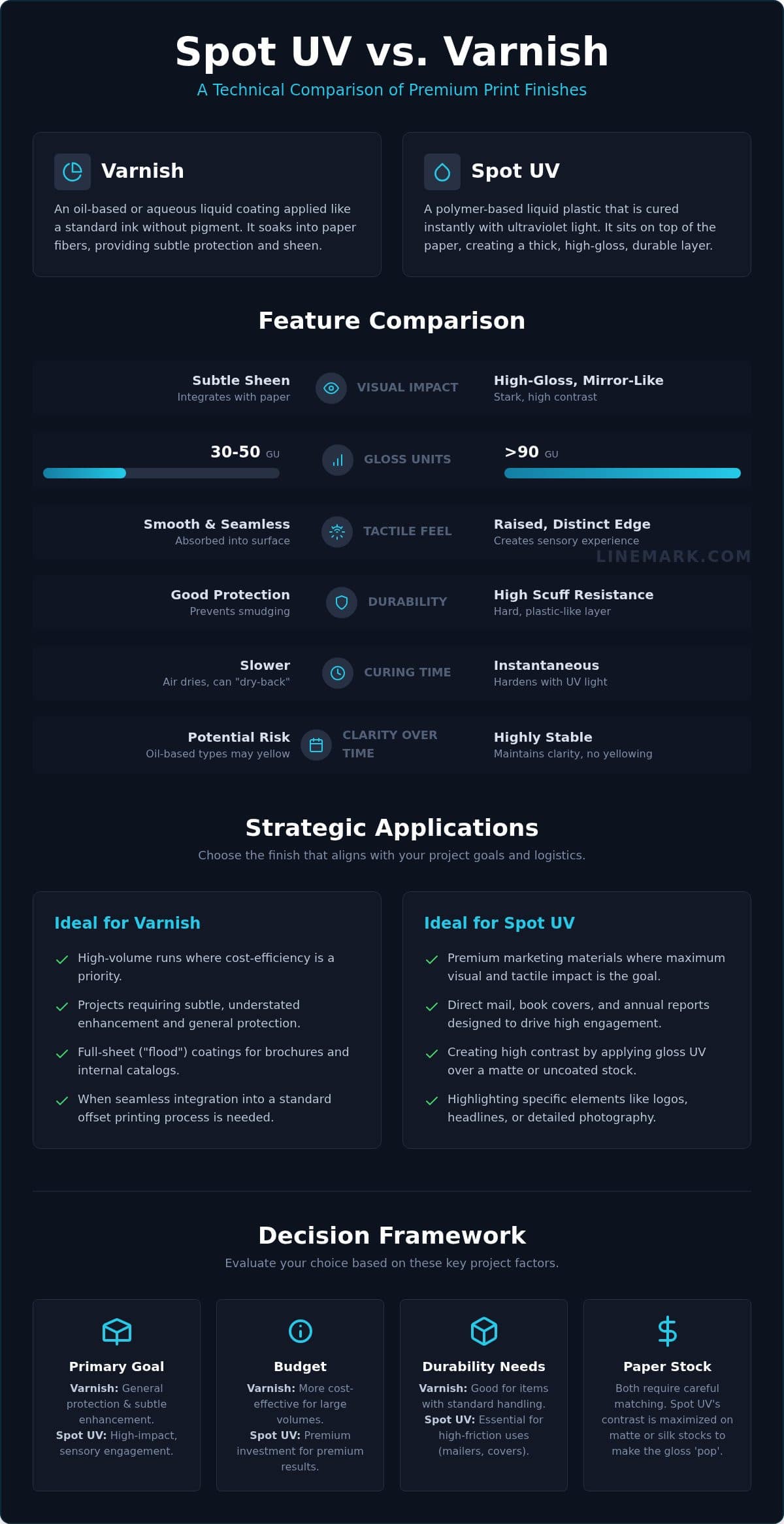
Varnish is an oil-based or aqueous liquid applied through a standard ink unit on an offset press. It is essentially an ink without pigment. In contrast, Spot UV utilizes a polymer-based UV coating that transitions from a liquid to a solid state when exposed to concentrated ultraviolet light. This fundamental difference in chemistry dictates how each finish looks, feels, and performs on the final product.
The “spot” distinction refers to the tactical application of these coatings. While a “flood” coating covers the entire sheet for general protection, a spot application targets specific design elements. You might apply it to a logo, a headline, or a high-resolution image to create a visual and tactile contrast against the rest of the page. This selective application is a strategic tool in spot uv vs varnish decisions, allowing you to guide the reader’s eye toward your most important message.
The Mechanics of Varnish
Because it runs through the same rollers as the ink, varnish offers seamless integration into the offset printing process. It’s a reliable choice for high-volume runs where subtle enhancement is the goal. You can choose between gloss, matte, satin, or neutral finishes to suit your brand aesthetic. One technical factor to monitor is “dry-back.” This occurs when the paper fibers absorb the varnish as it cures, slightly dulling the initial shine. It’s a natural part of the drying process that requires technical foresight to manage during production.
The Science of Spot UV Curing
The curing process for UV coatings is instantaneous. As the sheets pass under specialized lamps, the liquid polymer hardens into a durable, plastic-like layer. This results in a significantly higher “build” or thickness compared to varnish. The finish sits on top of the paper fibers rather than soaking into them. Modern digital and screen application methods allow for extreme precision. Even fine lines and intricate typography can be enhanced with a mirror-like gloss that feels distinct to the touch, providing the high-end finish required for premium catalogs and annual reports.
Spot UV vs. Varnish: A Comparative Analysis
Choosing the right finish involves balancing aesthetic ambition with operational reality. When comparing spot uv vs varnish, the most immediate difference is visual intensity. Varnish provides a professional, understated sheen that integrates seamlessly with the paper surface. Spot UV, however, creates a mirror-like reflection that demands attention. This high-gloss finish creates a distinct physical edge you can feel with your fingertip, adding a tactile, three-dimensional quality to the design. Color shift is another critical factor for your project. Coatings often create a “wetting” effect, making underlying inks appear darker or more saturated. While this usually enhances the vibrance of high-resolution images, it requires careful calibration during the prepress stage to ensure brand colors remain accurate.
Gloss Levels and Aesthetic Impact
In technical terms, gloss is measured in gloss units (GU). While a high-gloss varnish typically reaches 30 to 50 GU, a premium Spot UV application can exceed 90 GU. This creates the stark contrast necessary for high-impact visual storytelling. A sophisticated technique involves using a matte varnish across the entire sheet, then applying Spot UV to specific elements. This maximizes the perceived shine by providing a dull background that makes the gloss pop. Unlike oil-based varnishes that may yellow over time due to oxidation, UV polymers maintain their clarity. This ensures the long-term integrity of your commercial printing assets, keeping them as sharp as the day they were produced.
Durability for High-Volume Handling
Durability is where industrial authority meets logistical necessity. When selecting between spot uv vs varnish for high-volume projects, you must consider the physical journey of the piece. For materials like direct mail or high-use catalogs, the finish must withstand the friction of automated sorting and repeated handling. Spot UV offers superior resistance to fingerprints and moisture, acting as a protective shield for the underlying ink. Scuff resistance is defined as the ability of a printed surface to resist abrasion and the transfer of ink during shipping and handling. While varnish offers basic protection against smudging, the hardened polymer of Spot UV is the preferred choice for items moving through high-friction logistics chains. This ensures your message arrives in pristine condition, reflecting the quality of your brand at every touchpoint.
Technical Production and Cost Factors
The operational efficiency of your print run depends on the alignment between your chosen finish and the underlying machinery. Varnish is applied on-press using standard ink units. It functions essentially as a “fifth color” in the offset process. Spot UV requires a dedicated finishing station or a secondary pass through a screen or digital applicator. This additional step increases setup time and tooling requirements but delivers a level of precision that on-press varnish cannot match. When deciding between spot uv vs varnish, you must weigh these technical setup costs against the visual impact required for your specific business goal.
Substrate Selection and Coating Absorption
Substrate choice is the foundation of finish quality. For maximum impact, you should specify coated paper stocks. Porous, uncoated papers absorb liquid coatings, a phenomenon known as “sinking.” When varnish sinks into the fibers, the intended sheen disappears, leaving a mottled or uneven appearance. This technical requirement is especially critical for custom book printing, where covers must maintain a consistent, high-end look across thousands of units. Non-porous surfaces ensure the coating sits on top of the sheet, reflecting light and providing the tactile contrast your design demands.
Workflow and Turnaround Times
Production schedules are directly influenced by the curing method of each finish. Varnish uses a “wet-on-wet” application, drying naturally or through infrared heat as part of the primary print run. Spot UV requires an immediate transition to a secondary station for ultraviolet curing. While this adds a step to the workflow, it often accelerates the overall timeline for direct mail projects. This is because UV-cured sheets are fully dry and ready for immediate cutting, folding, or kitting the moment they leave the lamps. Our 90,000-square-foot facility is designed to handle these transitions with industrial precision, ensuring consistent quality whether you are producing 1,000 units or 100,000.
Budgeting for spot uv vs varnish isn’t just about the initial quote. It’s about the volume-to-value ratio. For shorter runs, the setup cost for Spot UV might represent a higher percentage of the total project spend. However, as volume increases, the cost per unit drops significantly while the visual ROI remains high. If your goal is broad protection on a tight deadline, varnish is the efficient choice. If your project demands a high-contrast sensory experience to drive engagement, the premium for Spot UV is a strategic investment in your brand’s market position.
Strategic Applications: When to Use Which Finish
Strategic application of finishes is where brand identity meets operational excellence. A finish is more than a protective layer; it’s a tactical instrument used to drive specific user behaviors. When evaluating spot uv vs varnish for your next campaign, consider the recipient’s journey from the mailbox to the boardroom. Varnish provides a professional foundation for corporate collateral, while Spot UV acts as a high-contrast highlight for premium products. These principles also extend beyond standard print into the world of large format graphics, where durability must match the scale of the visual impact.
Maximizing Direct Mail Engagement
Direct mail relies on the psychology of touch to break through digital fatigue. Spot UV is an effective tool for guiding the recipient’s eye toward a specific Call to Action (CTA). By applying a high-gloss finish to a discount code or a “Join Now” button, you create a sensory anchor that increases the “keep” time of postcards. If your project utilizes Variable Data Printing (VDP) for personalization, finishing requires even tighter registration to ensure the gloss aligns perfectly with unique text elements. You must also account for postal compliance. Avoid applying high-gloss coatings over barcode areas, as the reflection can interfere with USPS scanning equipment and delay delivery schedules.
Premium Book and Catalog Finishing
For high-volume catalogs and annual reports, the choice of finish directly impacts shelf life and perceived value. A sophisticated technique involves a flood matte varnish combined with spot gloss elements on the cover. This creates a perceived depth that makes title typography pop. In high-volume catalog production, finishing also serves a structural purpose. It protects against spine cracking, which often occurs when heavy ink coverage is folded. For internal pages with dense image areas, a neutral varnish is essential to prevent ink set-off. This prevents wet ink from transferring to the facing page, ensuring the interior of your book remains as pristine as the cover. For corporate collateral that requires a subtle, high-end feel, a satin varnish offers a smooth, glare-free surface that is resistant to fingerprints.
Ready to elevate your next project with precision finishing? Partner with Linemark to transform your high-volume print runs into high-impact marketing assets.
Decision Framework: Choosing the Right Finish for Your Brand
Selecting the optimal finish requires a balance of technical requirements and marketing objectives. In high-volume production, the choice between spot uv vs varnish dictates the ultimate ROI of your marketing spend. Efficiency is non-negotiable. You must decide whether your project requires the broad, industrial protection of a varnish or the tactical, high-contrast engagement of Spot UV. This decision matrix serves as a professional guide to ensure your final product aligns with your brand’s strategic goals.
The first step in this framework is defining the primary objective. If your priority is protecting text-heavy pages from smudging during high-frequency handling, varnish is the correct tool. If you aim to create a sensory hook that stops a prospect in their tracks, Spot UV is the superior choice. From there, evaluate your budget-to-volume ratio. Varnish is applied on-press, making it highly efficient for massive runs. Spot UV adds a secondary pass, which increases per-unit value but requires more setup time. Finally, analyze your design detail. Intricate logos and fine typography demand the precision of UV stations, while broad protective layers are best handled by traditional coating units. Always consult with a strategic production ally early in the design phase to verify substrate compatibility and prevent absorption issues.
The Varnish Selection Checklist
- Ideal for: Large text-heavy runs, subtle branding, and budget-sensitive protection.
- Best applied to: Internal pages of catalogs, newsletters, and high-volume brochures.
- Industrial Standard: Satin varnish is the standard for professional annual reports because its glare-free surface ensures maximum legibility while providing a durable, fingerprint-resistant finish.
The Spot UV Selection Checklist
- Ideal for: Luxury branding, high-contrast covers, and interactive tactile elements.
- Best applied to: Book covers, premium direct mailers, and high-end business cards.
- Strategic Tip: Combining Spot UV with soft-touch lamination creates a dramatic sensory contrast that transforms a standard print piece into a premium brand experience.
Choosing between spot uv vs varnish is a strategic decision that impacts both production timelines and market reception. Our 90,000-square-foot facility is equipped to handle these complex finishing requirements with the meticulous attention to detail your brand deserves. By following this framework, you move from a transactional print purchase to a holistic production journey that guarantees precision at every scale.
Elevating Your Brand with Strategic Precision
Mastering the technical nuances of spot uv vs varnish allows you to move beyond basic print production into the realm of strategic communications. You’ve learned that while varnish offers essential, cost-effective protection for high-volume runs, Spot UV provides the sensory contrast necessary to capture attention in a crowded marketplace. Success depends on aligning these finishes with the right substrates and production workflows to ensure a flawless final product. It’s about choosing the tool that best serves your project’s specific ROI goals.
Our 90,000-square-foot advanced production facility is engineered to handle these complex finishing requirements at scale with industrial authority. By leveraging our comprehensive MarCom On-Demand integration and nationwide distribution and fulfillment excellence, you gain a strategic ally dedicated to precision. We handle the technical logistics so you can focus on driving growth and engagement. Partner with Linemark for high-precision commercial printing and finishing to transform your next project into a premium brand experience. We’re ready to help you achieve operational excellence with every sheet.
Frequently Asked Questions
Is Spot UV more expensive than varnish for commercial print runs?
Spot UV typically carries a higher production cost than varnish because it requires a dedicated finishing pass and specialized ultraviolet curing stations. Varnish is applied as an additional ink unit during the primary offset run, making it more cost-effective for massive volume. When evaluating spot uv vs varnish for high-volume commercial projects, the decision should be based on the required visual impact and the specific engagement goals of the campaign rather than just the initial unit price.
Can I write on a surface that has been treated with Spot UV or varnish?
Most high-gloss finishes like Spot UV create a non-porous, plastic-like surface that resists standard ink, making them difficult to write on with ballpoint pens. While certain matte or satin varnishes might accept ink more readily, they still offer a level of protection that can lead to smearing. For projects like postcards or newsletters that require handwritten notes or addressing, we recommend leaving the designated area uncoated to ensure legibility and ink adhesion.
Will Spot UV cause my paper to curl or warp during production?
Paper curling is a technical risk when applying heavy UV coatings to lightweight or low-quality paper stocks. The intense heat from the ultraviolet lamps during the curing process can cause fibers to contract, leading to warping. To maintain precision in our 90,000-square-foot facility, we recommend using heavier, coated substrates. These stocks provide the structural integrity needed to withstand the curing process while ensuring a perfectly flat, professional result for your brochures and annual reports.
What is the difference between flood UV and Spot UV?
The primary difference lies in the area of coverage. Flood UV is applied across the entire surface of the sheet to provide a uniform, high-gloss protective layer. Spot UV is applied selectively to specific design elements, such as logos, headlines, or high-resolution images. This tactical application creates a high-contrast sensory experience that guides the reader’s eye, making it a powerful tool for driving engagement in direct mail and premium book manufacturing.
Does varnish protect against UV light fading for outdoor signage?
Standard commercial varnishes offer minimal protection against the ultraviolet radiation that causes ink fading in outdoor environments. For long-term durability on banners and window graphics, specialized UV-resistant coatings or laminates are required. These industrial-grade finishes are specifically formulated with inhibitors that shield the underlying pigments from sun damage. When planning large format graphics for outdoor use, consult with our production team to select a finish that ensures color longevity and environmental resistance.
Can I use Spot UV on uncoated paper stocks?
Applying Spot UV to uncoated paper is generally not recommended because the porous fibers absorb the liquid polymer before it can be cured. This results in a dull, mottled appearance rather than the intended mirror-like shine. To achieve the high-impact results expected in professional commercial printing, we advise using coated stocks. These surfaces allow the coating to sit on top of the paper, ensuring the sharpest possible detail and maximum tactile contrast for your brand.
How does Spot UV affect the recyclability of printed materials?
Modern Spot UV coatings are generally considered compatible with paper recycling processes. During the de-inking stage of recycling, the thin layer of cured polymer is typically separated from the paper fibers and removed. While regulations like the EU Packaging and Packaging Waste Regulation (PPWR) are increasing the focus on sustainability, UV and aqueous coatings are often preferred over traditional plastic laminations. This allows brands to achieve a premium finish while maintaining a commitment to environmentally responsible production cycles.
Which finish is better for preventing ink scuffing on dark colors?
Spot UV and aqueous coatings provide superior protection against scuffing, particularly on dark or high-density ink areas. Dark colors are notoriously susceptible to showing fingerprints and abrasion marks during the kitting and fulfillment process. While a matte varnish can look sophisticated, it often lacks the hardened durability needed for high-friction logistics. Using a durable UV finish ensures that your catalogs and annual reports maintain their visual integrity throughout the national distribution chain, arriving in pristine condition.