


 09/13/2026
  Steve Bearden
Did you know that direct mail response rates in 2026 are currently 37 times higher than email? While digital channels struggle with inbox fatigue, 84% of consumers still read their physical mail the same day it arrives. You likely understand the raw power of a tangible touchpoint, yet you’re probably tired of the disconnect between high-volume production and the logistical hurdles that inflate postage costs. It’s frustrating when generic mailers fail to resonate, especially as domestic postcard rates have shifted to $0.65 per piece. You need more than a vendor; you need a strategic communications ally that understands the nuances of modern logistics.
Professional postcard printing services must now function as the bridge between creative vision and data-driven execution. This article will show you how to integrate advanced direct mail logistics with variable data printing to drive measurable marketing ROI at scale. We’ll examine the latest USPS automation requirements, the impact of hyper-personalization on response rates, and the technological workflows that ensure your marketing remains both agile and impactful as your business grows. By the end, you’ll see how a unified approach to print and distribution turns a traditional medium into a high-tech catalyst for growth.
Key Takeaways
- Understand why direct mail is outperforming digital channels in 2026 and how it serves as a high-impact, tangible touchpoint for modern audiences.
- Discover how professional postcard printing services utilize Variable Data Printing (VDP) to deliver hyper-personalized messaging that drives significantly higher response rates.
- Learn the technical requirements for substrate selection and ink durability to ensure your brand’s authority remains intact throughout the postal journey.
- Explore the critical role of integrated logistics, including NCOA and CASS data cleansing, in reducing postage waste and streamlining high-volume fulfillment.
- Find out how to scale national outreach across distributed teams while maintaining strict brand consistency through a centralized MarCom On-Demand ecosystem.
The Strategic Role of Postcard Printing Services in 2026
Modern marketing in 2026 requires a return to the physical. As digital advertising costs climb and inbox fatigue reaches its peak, professional postcard printing services have evolved into a sophisticated tool for precision-targeted communication. It’s no longer about “spray and pray” mass mailers. Instead, the focus has shifted to data-driven strategies where every piece of mail is a calculated touchpoint designed to cut through the noise of an oversaturated digital environment. For non-profits, associations, and large corporations, these services provide a tangible way to maintain brand authority while achieving measurable results.
Why Physical Mail Outperforms Digital in 2026
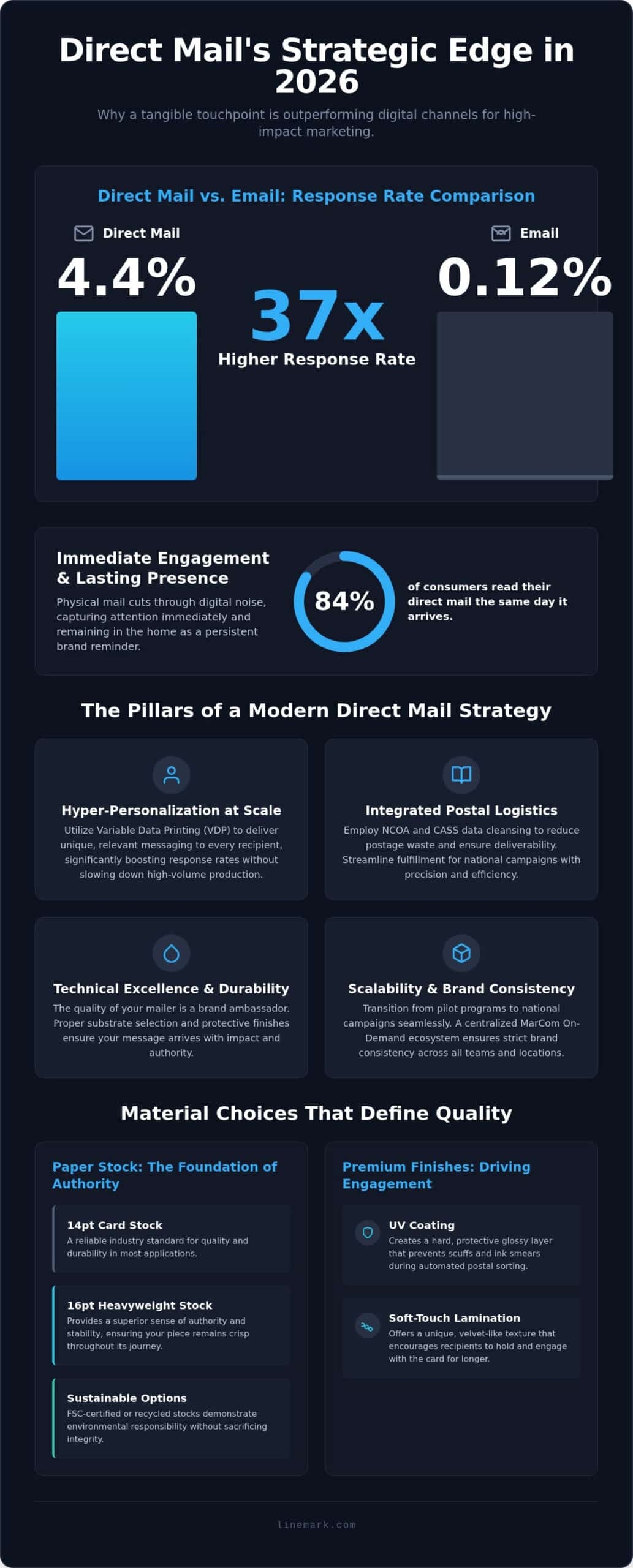
The “tactile advantage” of a physical postcard is a powerful psychological trigger. Research shows that 84% of consumers read their direct mail on the same day it arrives. This immediate engagement is a stark contrast to digital ads that are often blocked or ignored. In fact, the direct mail response rate is currently 4.4%, which is approximately 37 times higher than email’s 0.12% response rate. Postcards stay in the home longer, often resting on a kitchen counter or desk, serving as a persistent visual reminder of your message. When integrated into a multi-channel strategy, physical mail reinforces digital touches, creating a cohesive brand experience that drives higher conversion rates.
Scalability: From Pilot Programs to National Campaigns
Executing a national campaign requires more than just high-quality ink; it demands industrial-scale infrastructure. While boutique print shops might handle small batches with care, they often lack the capacity to maintain consistency across hundreds of thousands of units. High-capacity facilities, such as those operating within 90,000-square-foot production environments, provide the operational breadth needed for national distribution. These facilities utilize Variable Data Printing (VDP) to ensure that every recipient receives a unique, personalized offer without slowing down production speeds. This scalability allows organizations to start with agile pilot programs and seamlessly transition to massive, nationwide rollouts. By choosing a partner that offers on-demand production, marketers can remain responsive to market shifts, ordering brand-approved postcards that are printed and shipped with meticulous attention to detail.
Technical Excellence: Beyond Standard Paper and Ink
High-capacity postcard printing services must balance industrial speed with the meticulous detail of a boutique studio. The physical quality of your mailer acts as a silent brand ambassador. It’s the first tangible interaction a prospect has with your organization. In a high-volume environment, achieving this requires a sophisticated understanding of substrates and chemistry. Precision isn’t just a goal; it’s a requirement for postcards that must survive the high-speed sorting equipment of the modern postal system without losing their visual impact.
Selecting the Right Paper Stock for Durability
The weight of your paper stock communicates stability and intent. While a 14pt card is a reliable industry standard, moving to a 16pt heavyweight stock provides an immediate sense of authority. This thickness ensures the piece remains crisp and professional after traveling across the country. Beyond weight, the choice between gloss and matte surfaces affects how ink is absorbed and how colors resonate. Gloss stocks provide vibrant color pop, while matte finishes offer a sophisticated, non-reflective surface that’s easier to read under bright lights. For organizations prioritizing sustainability, using FSC-certified or recycled stocks demonstrates environmental responsibility without sacrificing the structural integrity required for national distribution.
Premium Finishes That Drive Engagement
Finishing techniques are the final step in securing a high ROI. UV coating is essential for high-volume mailers because it creates a hard, protective layer that prevents scuffs and ink smears during automated processing. This is particularly important for campaigns utilizing Every Door Direct Mail (EDDM), where pieces are handled frequently by sorting machinery. For a more tactile experience, soft-touch lamination offers a velvet-like texture that encourages the recipient to linger on the card, creating a psychological connection with the brand.
You can also use spot gloss to highlight specific areas, such as a QR code or a limited-time offer, guiding the reader’s eye exactly where you want it. Precision cutting and trimming are equally vital. In high-volume production, even a millimeter of deviation can result in uneven borders that diminish the professional appearance of the campaign. Ensuring your project benefits from professional binding and finishing protects your investment from the warehouse to the mailbox.
Maximizing ROI Through Variable Data Printing (VDP)
Modern direct mail is no longer a static medium. It’s a dynamic, data-driven channel that relies on sophisticated postcard printing services to deliver hyper-relevant content to every household. Variable Data Printing (VDP) is a method that leverages digital technology to change elements such as text and graphics on the fly. This capability allows organizations to move beyond generic messaging and speak directly to the individual needs of their audience. By integrating customer databases into the print workflow, businesses ensure that every postcard in a high-volume run features unique names, tailored offers, and personalized imagery.
The correlation between personalization and performance is undeniable. Industry data indicates that personalized mailings can increase response rates by up to 135% compared to static campaigns. This lift occurs because the mailer feels curated rather than intrusive. When a recipient sees their own name or a promotion based on their specific purchase history, the perceived value of the communication increases. It’s a shift from mass communication to a strategic, one-to-one dialogue that justifies the investment in high-quality production.
The Power of 1-to-1 Marketing at Scale
Scaling personalization requires a blend of technical precision and creative strategy. For instance, a national retailer can use geographic data to customize imagery on a per-recipient basis. A customer in a coastal region might receive a postcard featuring beach-themed graphics, while someone in a metropolitan area sees an urban landscape. This level of detail extends to personalized QR codes. These codes allow marketers to track individual engagement in real-time, bridging the gap between physical mail and digital analytics. It transforms a simple postcard into a tracking tool that measures ROI with granular accuracy. You don’t have to guess which segments are performing; the data tells you exactly who scanned and when.
Data Security and Processing in Commercial Printing
Handling sensitive customer data requires a partner who prioritizes security and operational excellence. The technical requirements for VDP involve seamless integration between your CRM and the printer’s automated workflows. These systems process massive data sets without human error, ensuring that the right message reaches the right address every time. Working with a high-capacity facility ensures your data is processed through secure protocols, maintaining privacy while maximizing the efficiency of your production run. This automated approach eliminates the manual bottlenecks often found in smaller shops, allowing for rapid turnaround on complex, personalized campaigns. It’s a controlled, well-oiled process that turns raw data into a powerful growth engine.
Navigating Direct Mail Fulfillment and Postal Logistics
High-performance postcard printing services are only as effective as the logistics engine behind them. Producing a beautiful mailer is the first step; ensuring it reaches the correct recipient at the lowest possible cost is where the real strategy begins. In 2026, this requires a seamless integration of print production with sophisticated data cleansing and distribution. Organizations that treat these as separate silos often face inflated postage costs and diminished ROI due to poor list management. Precision in logistics is the hallmark of a strategic communications ally.
The foundation of any successful campaign is the mailing list. We utilize National Change of Address (NCOA) and Coding Accuracy Support System (CASS) processing to scrub data before a single drop of ink hits the paper. This ensures that your postcards aren’t wasted on undeliverable addresses, protecting your budget from the $0.65 domestic postcard rate on pieces that will never be seen. Beyond data cleansing, the physical design of the card must adhere to strict USPS automation requirements. Correct barcode placement and aspect ratios allow your mail to move through high-speed sorting equipment, qualifying your campaign for the lowest possible automation rates.
Postal Optimization: Reducing Your Largest Expense
Postage is often the most significant line item in a direct mail budget. Understanding the distinction between First-Class Mail and Marketing Mail is vital for high-volume projects. While First-Class offers speed, Marketing Mail provides substantial savings for non-time-sensitive campaigns, with automation rates often ranging between $0.395 and $0.467 per piece. We leverage techniques like commingling and drop shipping to lower these costs even further. By combining your mail with other high-volume streams or transporting it closer to the final destination, we bypass unnecessary handling and secure the deep discounts typically reserved for the largest mailers in the country.
Seamless Kitting and Fulfillment Integration
Postcards frequently serve as one component of a larger marketing ecosystem. Our 90,000-square-foot facility is designed for complex kitting and fulfillment, allowing you to bundle postcards with brochures, catalogs, or promotional items in a single, cohesive package. Centralized warehousing provides the operational breadth needed to manage nationwide distribution from a single point of origin. With real-time inventory management, your recurring campaigns remain agile. You can trigger mailings based on specific customer actions, knowing the materials are staged and ready for immediate dispatch.
Efficient logistics turn a simple mailing into a scalable business solution. If you are ready to streamline your distribution and reduce your overhead, explore our integrated direct mail solutions today.
Integrating Postcards into Your MarCom On-Demand Ecosystem
For distributed enterprises, managing a national campaign while allowing for local nuance is a complex challenge. This is where MarCom On-Demand ecosystems transform the way organizations utilize postcard printing services. Instead of managing hundreds of individual print orders manually, corporate headquarters can host a centralized portal. This portal serves as a single destination where regional managers or local teams can order brand-approved postcards on an as-needed basis, ensuring that high-quality postcard printing services are accessible across the entire organization. It’s a shift from bulk storage to a lean, responsive production cycle.
This approach eliminates the waste associated with pre-printing thousands of cards that may become obsolete due to offer changes or regulatory shifts. By printing on-demand, organizations significantly reduce their storage footprint and overhead. Every piece of mail is printed for a specific purpose and sent directly to its destination. This ensures that marketing budgets are spent on active engagement rather than warehouse shelf space.
Centralized Brand Control for Distributed Teams
Maintaining brand integrity across a national footprint requires rigorous control systems. Within an on-demand ecosystem, corporate marketing teams can set specific permissions for different users within the corporate structure. Templates ensure that every postcard follows established design standards, protecting the brand’s visual identity. While the core design remains locked, local teams can customize specific fields, such as contact information or localized offers. Automated approval workflows further streamline the process. When a local user submits an order, it can be routed for immediate production or held for internal review, ensuring that no unapproved messaging ever reaches a customer’s mailbox.
Efficiency Through Automated Workflow Integration
The true power of a MarCom portal lies in its ability to connect directly with your existing technology stack. By integrating your CRM with the print portal, you can trigger postcard mailings based on specific customer behaviors or milestones. For example, a “thank you” postcard can be automatically generated and mailed the moment a purchase is logged in your system. This reduces lead times from order to mailbox, ensuring your message arrives while the brand is still top-of-mind for the recipient.
This level of integration turns your direct mail into an agile, high-tech extension of your digital marketing efforts. It creates a well-oiled machine that scales effortlessly as your business grows. Contact Linemark to see how our commercial printing services can scale your direct mail efforts and provide the strategic support your organization needs to succeed in 2026.
Scaling Your Direct Mail Impact for 2026
The evolution of direct mail has transformed it into a high-tech, data-driven channel that effectively cuts through digital noise. By leveraging professional postcard printing services, your organization moves beyond transactional mailings to strategic, one-to-one communications. You’ve seen how Variable Data Printing (VDP) and industrial-scale logistics turn a simple physical touchpoint into a measurable growth engine. Success in this landscape requires a partner who understands the nuances of technical production and postal optimization.
Linemark provides the operational breadth needed to handle complex, nationwide campaigns with precision. Our 90,000-square-foot production facility and G7 Master Qualified Printer status ensure that every piece maintains brand authority. With integrated direct mail fulfillment and kitting, we streamline the journey from the press to the recipient’s hands. It’s time to bridge the gap between your marketing data and tangible results through a unified partnership.
Partner with Linemark for Scalable Postcard Production and discover how a well-oiled machine can elevate your brand’s physical presence. Your next high-ROI campaign starts with the right strategic ally.
Frequently Asked Questions
What is the standard turnaround time for high-volume postcard printing?
High-volume production typically ranges from three to five business days depending on the complexity of your finishes and data sets. Our 90,000-square-foot facility is designed to handle massive runs with speed and precision. This timeframe includes the physical printing and finishing but doesn’t account for the mailing transit time. We prioritize operational efficiency to ensure your campaign hits the mail stream as quickly as possible without sacrificing quality.
How does Variable Data Printing (VDP) affect the cost of postcard printing?
While Variable Data Printing (VDP) may involve higher production fees compared to static offset runs, the investment is offset by significantly higher response rates. VDP allows for unique names, images, and offers on every piece. This level of personalization turns a generic mailer into a high-impact tool. The cost is a reflection of the digital technology required to change elements on the fly, providing a much higher ROI for targeted campaigns.
Can you handle both the printing and the mailing of my postcards?
Yes, we provide a comprehensive, end-to-end solution that integrates professional postcard printing services with nationwide mailing and distribution. Our team handles every step from initial production to final kitting and fulfillment. By centralizing these tasks, we reduce the logistical disconnect that often leads to errors or delays. This streamlined approach ensures your project moves seamlessly from our facility directly into the postal system for maximum efficiency.
What are the USPS size requirements for postcard mailing rates in 2026?
To qualify for the $0.65 domestic postcard rate in 2026, your mailers must meet specific USPS dimensions. The minimum size is 3.5 inches high by 5 inches long, while the maximum size for the postcard rate is 4.25 inches high by 6 inches long. Pieces larger than these dimensions are typically processed at the letter rate. We help you navigate these automation requirements to ensure your design qualifies for the most cost-effective postage category.
How do I ensure my mailing list is accurate before printing?
Accuracy is maintained through rigorous data cleansing processes, including National Change of Address (NCOA) and Coding Accuracy Support System (CASS) certification. We scrub your lists before any ink is applied to the paper. This step is vital to prevent waste and ensure your postcards reach their intended recipients. By identifying undeliverable addresses early, we protect your budget from unnecessary postage costs and improve the overall effectiveness of your campaign.
What is the difference between digital and offset printing for postcards?
Digital printing is the ideal choice for short runs and projects requiring Variable Data Printing, as it allows for immediate customization. Offset printing is best suited for extremely high-volume, static runs where unit costs must be minimized. Both methods deliver professional results, but the choice depends on your specific volume and personalization needs. We operate both technologies in our facility to provide the most efficient production model for your project goals.
How can I track the ROI of my postcard direct mail campaign?
Tracking ROI is achieved through integrated digital touchpoints like personalized QR codes, pURLs, or unique coupon codes. These elements allow you to monitor individual recipient engagement in real-time. When a customer scans a code or uses a specific offer, the data is captured in your CRM. This provides a clear line of sight from the physical mailing to the final conversion, making it easy to calculate the precise return on your investment.
What are the best paper finishes for a premium business postcard?
For a premium feel, we recommend using a 16pt heavyweight stock paired with specialized finishes. UV coating provides a high-gloss, protective layer that prevents scuffs during transit. Soft-touch lamination offers a velvet-like texture that creates an immediate psychological connection with the recipient. Spot gloss can be used to highlight specific Call-to-Action areas, ensuring your key message stands out. These choices enhance the tactile experience and reinforce your brand’s authority.