


 09/07/2026
  Steve Bearden
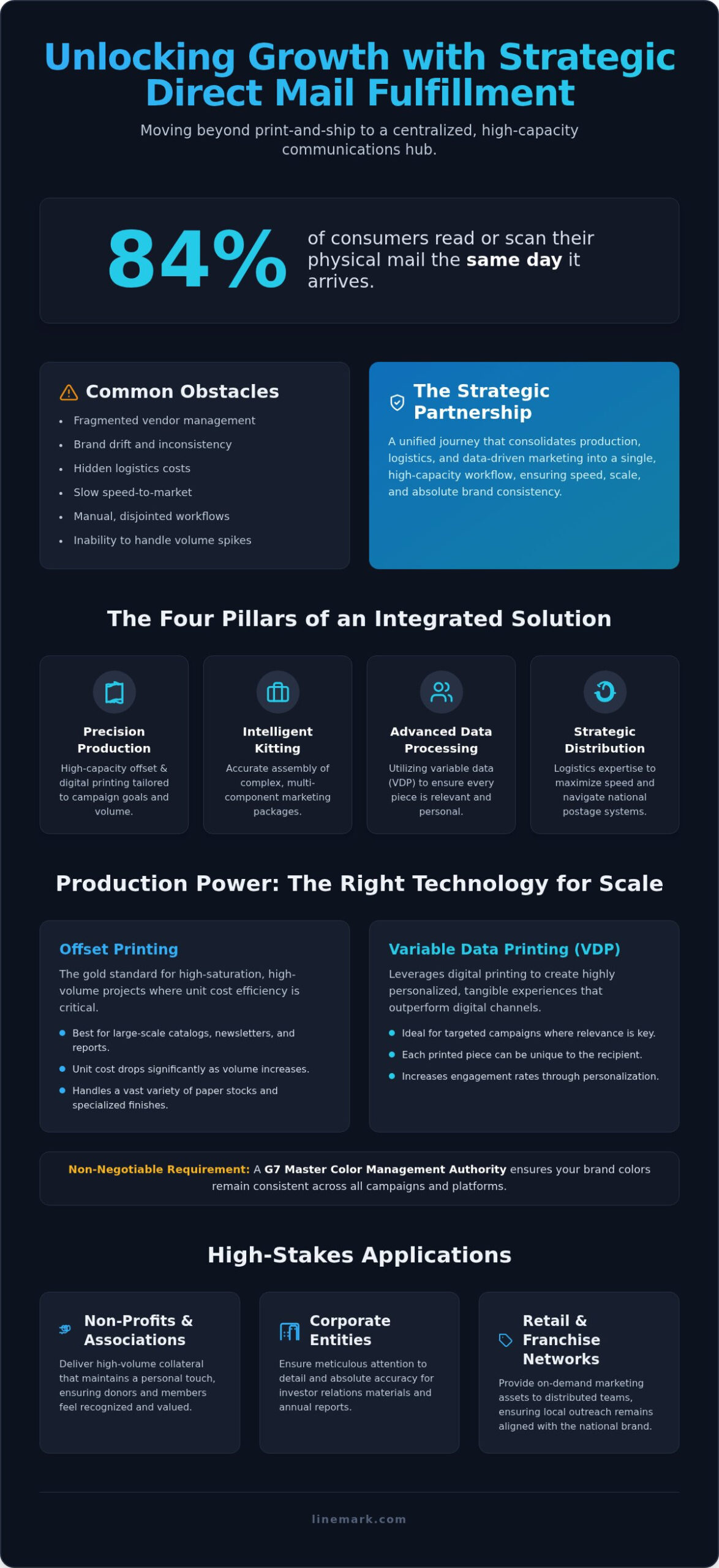
84% of consumers read or scan their physical mail the same day it arrives, proving that the most effective marketing often happens at the mailbox. You likely recognize that while engagement is high, execution is often hindered by fragmented vendor management and slow speed-to-market. Choosing from the top direct mail fulfillment companies is no longer just about finding a printer; it’s about securing a strategic ally that can eliminate brand drift and hidden logistics costs. We agree that manual workflows and disjointed production schedules are significant obstacles to your national growth.
This guide will teach you how to evaluate these partnerships to consolidate your production, logistics, and data-driven marketing into a single, high-capacity workflow. You’ll learn to move beyond transactional service models toward a unified journey that handles massive volume spikes with precision. We’ll explore the essential criteria for selecting a partner that integrates advanced technology with industrial-scale production to ensure your campaigns are both scalable and measurable. By the end of this article, you’ll have a roadmap for building a marketing engine that delivers your message with speed and absolute brand consistency.
Key Takeaways
- Understand how leading direct mail fulfillment companies transition your marketing from simple print-and-ship tasks to a centralized, high-capacity communications hub.
- Learn to optimize your unit costs by selecting the right industrial print technology to handle national campaigns without sacrificing speed or quality.
- Explore the technical advantages of Variable Data Printing (VDP) for creating highly personalized, tangible experiences that outperform digital channels.
- Streamline your distributed marketing efforts and reduce waste through automated kitting and proprietary MarCom On-Demand portal solutions.
- Master the evaluation process for a national partnership that guarantees brand consistency and meticulous attention to detail at any scale.
The Strategic Scope of Direct Mail Fulfillment Companies
Marketing at scale requires more than just a printer. It demands a sophisticated infrastructure capable of managing data, logistics, and production simultaneously. Leading direct mail fulfillment companies have moved beyond the traditional “print-and-ship” model to become centralized strategic hubs for national organizations. This evolution reflects a shift in how modern corporations approach Direct Mail; it’s no longer a standalone tactic but a critical component of a data-driven communications ecosystem. By managing the entire project lifecycle, these partners eliminate the fragmented vendor management that often leads to brand drift and operational delays.
The core of this integrated solution involves four primary pillars that work in tandem to drive ROI:
- Precision Production: High-capacity offset and digital printing tailored to specific campaign goals and volume requirements.
- Intelligent Kitting: Accurate assembly of complex, multi-component marketing packages that arrive exactly as intended.
- Advanced Data Processing: Utilizing variable data to ensure every piece is relevant to the recipient, increasing engagement rates.
- Strategic Distribution: Leveraging logistics expertise to maximize speed-to-market while navigating the nuances of national postage systems.
From Transactional Mail to Strategic Partnership
A unified partnership model transforms the vendor relationship into a strategic alliance. When production is centralized within a single, high-capacity facility, brand consistency isn’t just a goal. It’s a baseline. National organizations often struggle with color shifts or messaging discrepancies when using multiple regional vendors. By consolidating with established direct mail fulfillment companies, you secure a single point of accountability. This centralized approach allows for industrial-scale production that handles massive national spikes without the quality degradation often seen in smaller operations. It’s about moving from a series of transactions to a holistic journey that values precision at every touchpoint.
Key Industry Applications for 2026
Precision and scale are non-negotiable for high-stakes communications. National non-profits and member associations rely on this model to deliver high-volume collateral that maintains a personal touch, ensuring donors feel recognized. Similarly, corporate entities require the meticulous attention of a boutique shop for investor relations materials and annual reports, where accuracy is paramount. For retail and franchise networks, the ability to provide on-demand marketing assets to distributed sales teams ensures that local outreach remains aligned with the national brand identity. This level of coordination is only possible through a partner that understands the nuances of modern logistics and high-volume production.
Production Powerhouses: Integrating Industrial Print with Fulfillment
Technology selection dictates the financial efficiency and visual impact of your national campaigns. High-capacity direct mail fulfillment companies don’t just offer printing; they align specific press capabilities to your project’s scale and complexity. Maintaining color fidelity across diverse platforms is essential for brand integrity. This is why working with a G7 Master Color management authority is a non-negotiable requirement for national organizations. It ensures that your brand colors remain consistent whether you’re producing a million-piece mailer or a short-run targeted campaign.
The Industrial Advantage of Offset Production
Sheet-fed offset printing remains the gold standard for high-saturation, high-volume projects. The mechanics involve a precise transfer of ink from plates to rubber blankets, then onto the substrate. This process allows for a vast variety of paper stocks and specialized finishes that digital presses often can’t handle. As your volume increases, the unit cost drops significantly because the initial setup costs are distributed across more pieces. This makes offset the logical choice for large-scale catalogs, newsletters, and annual reports. It’s the engine that drives mass-market reach without compromising on industrial-grade quality.
Digital Precision and On-Demand Flexibility
Digital printing provides the agility needed for fast-moving market shifts. It eliminates the need for physical plates, allowing for “just-in-time” production that drastically reduces waste and inventory obsolescence. You can print exactly what you need when you need it. High-end digital presses now achieve 1200 DPI resolution, matching the crispness required for professional custom book printing and premium marketing collateral. This agility is particularly effective when testing small segments before a national rollout or when your data requires hyper-personalization for every recipient.
Choosing between these platforms depends heavily on your mailing strategy. If you’re targeting specific geographic regions through Every Door Direct Mail (EDDM), offset might be the more cost-effective fit for mass saturation. However, if your campaign relies on individual recipient data, digital is the clear winner. A partner with a 90,000-square-foot facility can seamlessly transition between these technologies to find the most efficient path forward. You can consult with a production expert to determine which technology best supports your current scalability goals.
Data-Driven Logistics: Variable Data and Targeted Delivery
Data is the fuel for modern production. While the previous section detailed the machinery, the logic behind the mailing determines its success. In 2026, direct mail remains a dominant high-response channel because it bridges the gap between digital precision and physical presence. Top-tier direct mail fulfillment companies leverage CRM data to transform generic mailers into highly targeted assets. This isn’t just about adding a name to a postcard; it’s about a complete 1:1 communication strategy. By integrating print with your existing data sets, you create automated triggers that send physical mail based on specific customer behaviors or milestones.
Variable Data Printing (VDP): Personalization at Scale
VDP allows for the dynamic modification of text, images, and specific offers for every individual on your list. For national non-profits, this level of personalization is transformative for donation appeals. A donor who receives a letter referencing their specific past contribution and showing an image related to their preferred cause is significantly more likely to engage. Seamless integration requires a partner capable of handling complex data sets with the precision of a 90,000-square-foot industrial facility. This ensures that the right message reaches the right person without the errors common in fragmented workflows. It’s a technical process that turns a mass mailing into a series of personal conversations.
End-to-End Direct Mail Fulfillment
True efficiency comes from a partner that manages the entire lifecycle, from data scrubbing to the final drop. Relying on in-house mailing services is critical for speed-to-market. It allows for immediate quality control and prevents the delays inherent in third-party handoffs. Professional direct mail fulfillment companies prioritize postal optimization to protect your ROI against rising delivery costs. This includes several critical steps:
- CASS Certification: Verifying address accuracy to ensure deliverability and qualify for automation discounts.
- NCOA Updates: Tracking recipient moves to reduce wasted postage and undeliverable mail.
- Intelligent Presorting: Organizing mail by zip code to bypass unnecessary postal hubs and speed up delivery.
These logistical steps aren’t just administrative; they’re financial safeguards. By utilizing these tools, you maximize your budget and ensure every dollar translates into a delivered, high-impact message. This end-to-end oversight allows you to optimize delivery windows, hitting mailboxes exactly when your digital campaigns are most active for a multi-channel surge in response rates. It’s a well-oiled machine that handles the complexities of national distribution so you don’t have to.
Optimizing the Supply Chain: Kitting, Warehousing, and On-Demand Portals
The logistics of marketing often reveal hidden financial drains that erode campaign ROI. Managing physical inventory, preventing material obsolescence, and eliminating manual kitting errors are critical tasks that many direct mail fulfillment companies treat as secondary services. In contrast, a strategic communications ally views the supply chain as a core competitive advantage. Utilizing a 90,000-square-foot facility allows for sophisticated inventory management that ensures your materials are ready for immediate deployment. Whether you’re shipping complex marketing kits or large format graphics, a centralized hub provides the oversight needed to maintain national speed-to-market.
MarCom On-Demand: Automating Brand Management
A proprietary MarCom On-Demand portal acts as a centralized digital asset library for authorized users. It empowers distributed teams and franchise partners to order materials without creating “rogue” local prints that deviate from corporate standards. Implementing a national on-demand system follows a purposeful five-step process:
- Audit: Identify and categorize all current marketing collateral.
- Centralize: Upload approved assets into the digital library.
- Permit: Define specific user permissions and budget limits.
- Integrate: Connect the portal directly to the production workflow.
- Launch: Monitor usage data to refine inventory levels and messaging.
This automation ensures that every local outreach effort remains perfectly aligned with your national brand identity while reducing internal administrative burdens. It transforms your marketing department from a fulfillment center into a strategic oversight body.
Precision Kitting and Nationwide Distribution
Complex distributions require the meticulous attention of industrial-grade kitting. When campaigns involve multiple components like brochures, training manuals, and personalized letters, manual errors can derail an entire national launch. Professional direct mail fulfillment companies leverage inventory management software to track these assets in real-time, preventing the stock-outs that delay critical communications. From a centralized production hub, your materials move through a streamlined pick-pack-ship process designed for industrial scale. This unified approach guarantees that every package arrives intact and on schedule, regardless of the destination. You can streamline your marketing supply chain today to reduce overhead and improve distribution accuracy.
Selecting a National Fulfillment Partner for Scalable Growth
Selecting the right partner among direct mail fulfillment companies is a decision that dictates your long-term operational efficiency. It’s not merely a vendor selection; it’s the acquisition of a strategic communications ally. You need a partner that understands the high-stakes nature of national campaigns and possesses the industrial infrastructure to execute them with precision. A centralized facility is the primary way to ensure that your quality control remains airtight and your communication lines remain direct. This structural unity prevents the fragmentation that often plagues distributed marketing efforts and leads to brand drift.
Evaluating Capacity and Technological Breadth
Scale dictates your speed-to-market. A 90,000-square-foot production facility provides more than just floor space; it offers the project security and turnaround speed required for massive national rollouts. When your partner brings over 30 years of industrial experience to the table, they’ve already navigated the logistical hurdles that often derail smaller, less equipped shops. Complete project control is only possible when every stage, including finishing and binding, is handled in-house. This eliminates the risks associated with third-party handoffs and ensures your final product meets the rigorous G7 Master Color standards mentioned earlier. High-volume distribution for corporate and non-profit sectors requires this level of industrial authority to maintain brand integrity across millions of touchpoints.
The Value of a Holistic Journey
The transition from an initial consultation to an integrated partnership should feel like a natural progression. You’re moving away from transactional, one-off quotes toward a long-term strategic alignment. A seasoned expert acts as an agile problem-solver, anticipating production hurdles before they impact your timeline or your budget. By consolidating your production and logistics under one roof, you eliminate the hidden costs of shipping between multiple vendors. This unified approach is the most effective way to drive national growth. It turns your fulfillment process into a well-oiled machine that scales effortlessly, allowing you to focus on high-level strategy while your ally handles the complex mechanics of delivery. Choosing from the top direct mail fulfillment companies means finding a partner that values the relationship as much as the result.
Building a Scalable Infrastructure for National Success
National marketing success in 2026 depends on the seamless integration of high-volume production and intelligent logistics. You’ve seen how the right technology, from industrial offset to personalized digital presses, drives both brand consistency and ROI. By consolidating your supply chain through proprietary MarCom On-Demand portals and precision kitting, you eliminate the hidden costs of fragmented vendor management. Choosing from the top direct mail fulfillment companies isn’t just about finding a vendor; it’s about securing a strategic ally that acts as a catalyst for your organization’s growth.
With over 30 years of high-volume production expertise and a 90,000-square-foot industrial facility, we provide the capacity and precision your projects demand. We’re ready to transform your complex marketing challenges into streamlined, high-impact results. Request a Strategic Consultation for Your Direct Mail Fulfillment Needs to begin your unified production journey. We look forward to helping you achieve your most ambitious marketing goals.
Frequently Asked Questions
What are the main benefits of using a commercial fulfillment service versus in-house mailing?
Commercial fulfillment services provide industrial-scale efficiency and advanced data processing that in-house teams often struggle to replicate. You gain access to specialized machinery for high-volume kitting and sophisticated mailing list management, which drastically reduces manual errors. Utilizing a national partner allows for significant postal optimization, ensuring your campaign ROI isn’t drained by inefficient distribution or high shipping costs. It’s about moving from a series of manual tasks to a streamlined, automated workflow.
How do I choose between digital and offset printing for my fulfillment project?
The choice depends on your volume and personalization requirements. Offset printing is the industrial standard for high-volume runs of catalogs or newsletters, offering lower unit costs as the quantity increases. Digital printing is ideal for short-run projects or those requiring hyper-personalization for every recipient. A partner with both capabilities can analyze your specific project scale and data needs to determine the most cost-effective and impactful production path for your national campaign.
What is variable data printing and how does it improve direct mail ROI?
Variable Data Printing (VDP) is a digital technique that allows you to customize text and images for every individual recipient on your mailing list. By leveraging CRM data, you can create 1:1 personalized experiences that significantly outperform generic, mass-market mailers. This level of relevance drives higher engagement and conversion rates, making it a critical tool for national non-profits and corporate teams looking to maximize their campaign’s response and measurable ROI.
Can a direct mail fulfillment company handle my campaign from data processing to delivery?
Yes, top-tier direct mail fulfillment companies provide a unified journey from the initial data scrub to the final postal drop. This integrated approach includes address verification, intelligent presorting, and real-time inventory management. By consolidating these steps with a single strategic ally, you eliminate fragmented vendor management and ensure that your brand standards are maintained throughout the entire distribution lifecycle. This end-to-end oversight is essential for maintaining speed-to-market and high-quality results.
What is a MarCom On-Demand portal and how does it help my national brand?
A MarCom On-Demand portal is a proprietary web-to-print ordering system that centralizes your digital asset library. It allows distributed teams or franchise partners to order approved marketing materials on an as-needed basis through an intuitive interface. This automation prevents “rogue” local printing and ensures every piece of collateral remains perfectly aligned with your national corporate brand standards. It effectively reduces internal administrative waste while empowering your local representatives with high-quality, on-brand assets.
What are the common kitting and fulfillment services provided by commercial printers?
Industrial printers provide sophisticated kitting services that involve the precise assembly of multi-component packages, such as training kits or membership bundles. These services often include picking, packing, and secure warehousing within high-capacity facilities. By integrating these logistics with production, you ensure that complex marketing assets are distributed accurately across the country without the delays of third-party handoffs. This level of coordination is vital for national organizations that require meticulous attention to detail at scale.
How does a national fulfillment partner ensure color consistency across different materials?
Color consistency is maintained through rigorous quality control and strict adherence to G7 Master Color management standards. This authority ensures that visual fidelity is preserved across different substrates, whether you’re producing large format graphics or standard commercial print collateral. A centralized facility with over 30 years of industrial experience uses these standards to guarantee that your brand colors remain identical across every national touchpoint. It instills confidence that your brand identity remains intact regardless of the project’s complexity.
What should I look for in a high-capacity direct mail fulfillment company?
You should prioritize direct mail fulfillment companies that operate from a large-scale industrial facility, such as a 90,000-square-foot production hub. This ensures project security and the turnaround speed required for national rollouts. Evaluation criteria must also include their history of handling high-stakes corporate projects and their ability to provide in-house finishing and binding. A seasoned expert will act as a strategic communications ally, offering the meticulous attention to detail of a boutique shop alongside industrial capacity.