

 09/02/2026
  Steve Bearden
Did you know that 84% of marketers now report that direct mail delivers their highest ROI? While the revenue potential is clear, a single technical oversight in your direct mail envelope design can stall a high-volume campaign and trigger costly USPS surcharges. You’ve likely experienced the frustration of inconsistent brand colors across different print runs or the logistical headache of envelopes failing in automated insertion machines. These aren’t just minor inconveniences; they’re significant barriers to your operational efficiency and bottom line.
We believe your correspondence should be as precise as your overarching strategy. This guide promises to help you master the technical standards and branding potential of the #10 business envelope to streamline your commercial workflows. We’ll examine the exact specifications required for 2026 postal compliance, explore advanced customization through variable data printing, and provide a framework for maintaining brand integrity at scale. It’s time to turn your high-volume mailings into a reliable, high-performance engine that drives measurable growth for your organization.
Key Takeaways
- Define the technical baseline of the #10 envelope to ensure every piece of correspondence aligns with universal industrial standards.
- Optimize your direct mail envelope design to meet strict USPS automation requirements and secure significant high-volume postage discounts.
- Select the appropriate seals and security tints to safeguard sensitive information without compromising the speed of your automated insertion machines.
- Leverage a mix of offset and digital printing to maintain perfect brand consistency across millions of impressions and diverse product lines.
- Streamline your internal procurement process by transitioning from a transactional vendor model to a strategic, high-capacity communications partnership.
What is a #10 Business Envelope? Standards and Dimensions
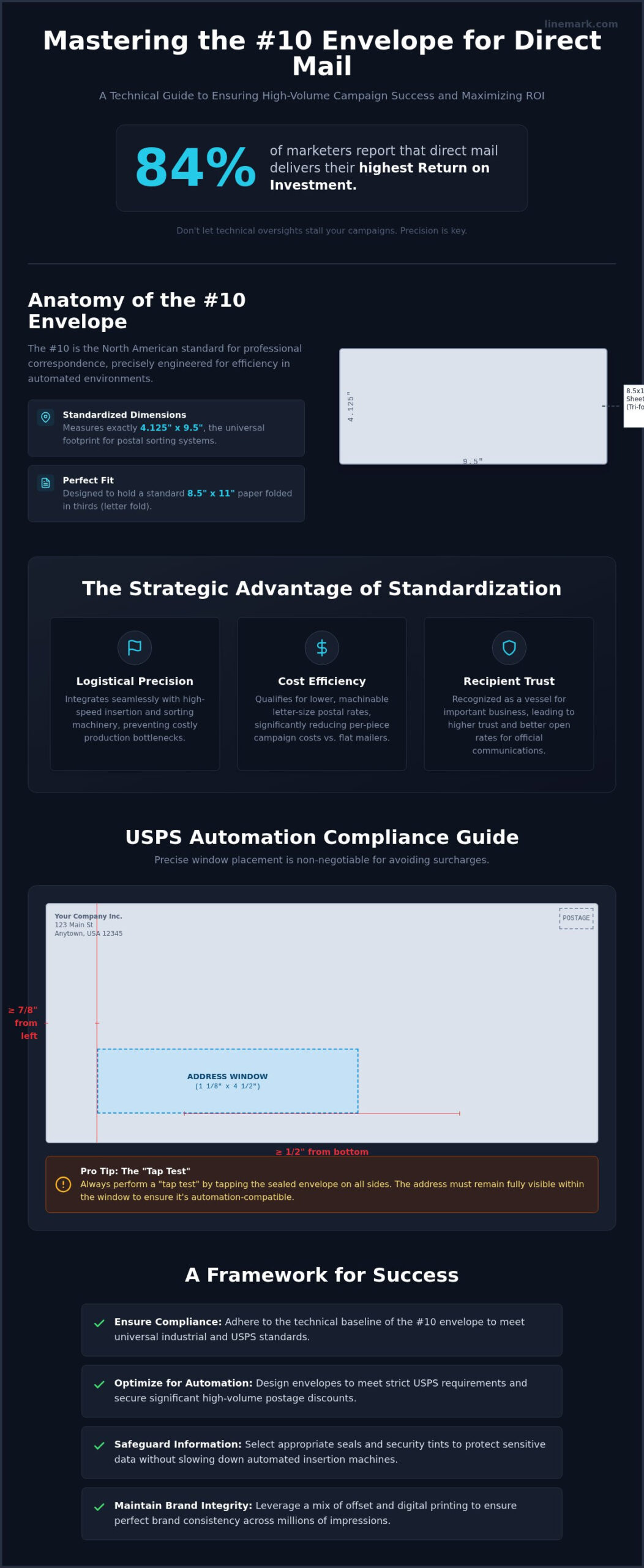
The #10 business envelope serves as the backbone of professional communication in North America. Measuring exactly 4.125 by 9.5 inches, this specific standard business envelope size is engineered to hold a standard 8.5 x 11-inch sheet of paper folded into thirds. This configuration, known as the letter fold, is the industry standard for everything from high-stakes legal documents to monthly invoicing.
Efficiency is the primary driver behind the dominance of the #10. Because its dimensions are fixed, commercial machinery and postal sorting systems are optimized for this specific footprint. For organizations managing complex marketing logistics, choosing this standard ensures that your direct mail envelope design remains compatible with high-speed production environments and automated sorting centers.
To better understand how specific mailpiece choices impact your reach, watch this helpful video from the USPS:
The Anatomy of a Standard Business Envelope
A standard #10 envelope consists of the face, where the recipient’s address and return information reside, and the back, which features the flap for sealing. Most business applications utilize a commercial flap with a contoured shape, though policy envelopes exist with the opening on the short side. Understanding these orientations is critical when aligning your mail with automated insertion equipment. The #10 envelope is the universal carrier for professional documents.
Why #10 is the Strategic Choice for Direct Mail
The #10 isn’t just a container; it’s a tool for logistical precision. It integrates seamlessly with high-speed insertion equipment, allowing for the rapid fulfillment of national campaigns without technical bottlenecks. From a cost perspective, these envelopes qualify for machinable letter-size postal rates. These rates are significantly lower than larger flat mailings, making the #10 a foundational element of any smart direct mail envelope design.
There’s also a psychological factor to consider. Recipients recognize the #10 as a vessel for important business, which often leads to higher trust and better open rates compared to oversized or flashy mailers. Whether you’re distributing annual reports or coordinating custom book printing projects, maintaining this level of professional consistency across your collateral is vital for brand authority. By sticking to these standards, you ensure your message reaches its destination without technical delays or unexpected surcharges.
Technical Specifications: Windows, Seals, and Security Tints
Precision in direct mail envelope design goes beyond external dimensions. It requires a granular understanding of how internal features like security tints and window placements affect both recipient security and machine throughput. Security tints, often a blue or grey patterned interior, are essential for protecting sensitive financial or legal data by making the envelope opaque when held to the light. This small technical detail builds immediate trust with the recipient, signaling that the contents are confidential and handled with professional care.
Window Placement and Dimensions
Standard window envelopes are engineered for efficiency, typically featuring a 1 1/8 x 4 1/2 inch window. According to USPS design standards, standard placement requires the window to be at least 7/8 of an inch from the left edge and 1/2 inch from the bottom. These clearances aren’t suggestions; they ensure the address remains readable by high-speed scanners. If your campaign utilizes advanced Variable Data Printing (VDP), you might require custom window layouts to accommodate unique document designs. Always perform a “tap test” to ensure the address remains fully visible even when the contents shift within the carrier. This ensures your mail remains automation-compatible and avoids manual sorting surcharges.
Seal Selection for High-Volume Automation
The choice of adhesive is a critical logistics decision. For high-volume projects processed through industrial inserters, moisture-activated (gummed) seals are the gold standard. They provide the most reliable bond when processed at high speeds. In contrast, self-seal or “peel and press” options are convenient for manual office use but can be problematic in a high-capacity facility. Self-seal adhesives also have a limited shelf-life, often losing tackiness after 6 to 12 months depending on climate control. For national brands managing large inventories, gummed seals offer superior longevity and performance.
The weight and brightness of the paper substrate are the final technical considerations. While 24lb white wove is the industrial standard for reliability, opting for a 70lb text weight provides a substantial, opaque feel that elevates brand perception. This tactile difference can be a catalyst for higher engagement rates. If you are looking to optimize your logistics, our team can help you select the right materials through our centralized ordering portals to ensure consistency across all departments. Choosing the right paper weight ensures your direct mail envelope design feels as premium as the message it carries inside.
Customization vs. Commodity: Elevating the Brand Touchpoint
Treating the #10 envelope as a mere commodity is a missed opportunity for brand reinforcement. While standard white wove stock is the industrial baseline, high-performing direct mail envelope design leverages color and texture to disrupt the recipient’s daily routine. Moving beyond plain white allows your organization to signal authority before the envelope is even opened. Whether you choose the tactile prestige of a linen finish or the modern smoothness of vellum, the physical substrate of your carrier is the first handshake with your audience.
Maintaining brand consistency at scale requires a sophisticated approach to production. For high-volume runs exceeding 100,000 units, offset printing remains the superior choice for precise PMS color matching. This ensures your corporate identity remains identical across every impression. For smaller, agile campaigns, digital printing provides the speed necessary for rapid market entry. By choosing the right method for your specific volume, you balance cost-efficiency with uncompromising quality.
Full-Bleed and Multi-Color Envelope Design
Achieving a full-bleed design, where the ink extends to the very edge of the paper, requires a process known as conversion. We print the design on flat sheets first and then die-cut and fold them into envelopes. This technique removes the “white border” limitation of printing on pre-made stock. It also opens up the back flap as premium real estate for logos or calls to action. However, creativity must balance with compliance. You must maintain specific clear zones for barcodes and postage to meet USPS machinable mail standards. Failure to respect these white space requirements can lead to manual sorting delays and increased costs.
Variable Data Printing (VDP) on Envelopes
The most innovative advancement in direct mail envelope design is the integration of Variable Data Printing (VDP). This technology allows us to personalize every single envelope in a high-volume run. You can address recipients by name or include targeted imagery based on their previous interactions with your brand. This level of hyper-personalization creates a unified experience that connects the envelope’s exterior to the personalized content inside. It transforms a generic mailpiece into a tailored communication, significantly increasing open rates and overall campaign ROI. Our advanced VDP capabilities ensure that even the largest national campaigns feel like a one-on-one conversation.
Direct Mail Logistics: Designing for Efficiency and ROI
Designing for postage efficiency is the most direct way to protect your marketing margins. A sophisticated direct mail envelope design ensures your mailpieces qualify for automation rates, which can reduce per-piece costs significantly. In 2026, the gap between non-machinable and automation-compatible mail continues to widen. Failing to adhere to USPS aspect ratios, which must remain between 1.3 and 2.5, can lead to unexpected surcharges that erode your ROI. Integrating these technical considerations into your broader direct mail strategy transforms the envelope from a simple container into a precision-engineered logistical tool.
Postal Compliance Checklist
To maintain machinable status, your #10 envelope must meet specific physical criteria. The thickness must be uniform, typically between 0.007 and 0.25 inches. If your contents create a bulge or if the paper stock is too thin, sorting machines may reject the piece. You must also preserve the Optical Character Reader (OCR) area. This clear zone allows high-speed scanners to read addresses and apply barcodes without interference. Weight is equally critical; exceeding the 1-ounce threshold for First-Class Mail or specific Marketing Mail tiers will trigger higher rates. We help you calibrate the total weight of your envelope and inserts to hit the most favorable postage brackets.
Streamlining Fulfillment and Kitting
Operational excellence doesn’t end at the press. Centralizing your production within a high-capacity, 90,000-square-foot facility reduces lead times by eliminating the need to transport finished envelopes to a separate mail house. Our kitting and fulfillment teams optimize the insertion process by ensuring every insert is cut precisely to fit the #10 carrier. This prevents jams in automated equipment and ensures the address remains perfectly aligned with the window. By utilizing data-driven mailing list management, we also minimize undeliverable waste. This ensures your budget is spent on reaching active prospects rather than paying for returned mail.
If you’re ready to optimize your next national campaign, partner with our fulfillment experts to secure the best possible postage rates and operational speed. Our integrated approach ensures your direct mail envelope design is as efficient as it is engaging.
Scalable Solutions: The Linemark Advantage for National Brands
High-volume organizations require more than a transactional vendor. They need a strategic communications ally capable of maintaining absolute brand integrity across every touchpoint. Whether your project involves custom book printing or complex commercial collateral, the need for consistency remains paramount. Our 90,000-square-foot facility is engineered for this level of precision, providing the high-capacity production necessary to move from concept to the post office without delay. By integrating sophisticated technology with industrial-scale printing, we simplify the procurement of #10 envelopes and other essentials, ensuring your direct mail envelope design is executed flawlessly every time.
MarCom On-Demand: Your Centralized Ordering Portal
Our proprietary marcom on-demand portal is the cornerstone of this efficiency. It provides national brands with a centralized destination for distributed marketing materials, ensuring that local teams stay within brand guidelines. This technology offers real-time inventory management, which is critical for preventing stock-outs of essential business stationery. By utilizing automated workflows and pre-approved templates, we significantly reduce administrative overhead for your procurement department. Your teams can order exactly what they need, when they need it, while you maintain total control over the brand’s visual identity. This software-driven approach eliminates the fragmentation that often plagues large organizations with multiple departments.
Partnering for Long-Term Growth
True growth requires a partner that can scale alongside your ambitions. We handle everything from small, hyper-targeted runs to national campaigns involving millions of pieces. With over 30 years of industrial experience, we’ve refined our processes to solve the most complex printing and logistics challenges. This expertise allows us to act as an extension of your marketing department, providing the agility of a boutique shop with the power of a large-scale operation. We understand that your direct mail envelope design is more than just a carrier; it’s a catalyst for client growth and a vital component of your brand’s physical presence. Our team works collaboratively with you to ensure every mailpiece is optimized for both visual impact and operational excellence. The right envelope is the first step in a successful brand journey.
Optimizing Your Brand’s Physical Reach
Mastering the technical nuances of the #10 envelope is the first step toward transforming your commercial correspondence into a high-performance marketing engine. By aligning your direct mail envelope design with strict USPS automation standards and leveraging variable data printing, you secure both logistical efficiency and significant engagement. We provide the industrial capacity and technical expertise required to execute these complex, high-volume strategies with absolute precision. These operational details aren’t just specifications; they’re the variables that determine the success of your national outreach.
Our 90,000-square-foot high-capacity production facility and G7 Master Certified status ensure that your brand colors remain consistent across every impression. We offer a holistic journey through integrated direct mail and fulfillment services, moving your project seamlessly from the press to the post office. This unified approach reduces lead times and eliminates the fragmentation often found in traditional vendor relationships. It’s time to elevate your brand’s physical presence and drive measurable growth through smarter production choices.
Ready to refine your high-volume strategy? Request a Strategic Print Consultation and Quote today. We look forward to building a powerful communications partnership with your organization.
Frequently Asked Questions
What are the exact dimensions of a #10 business envelope?
A standard #10 business envelope measures exactly 4.125 inches by 9.5 inches. This specific footprint is the North American industrial standard for carrying 8.5 x 11-inch documents folded into thirds. While other sizes exist, the #10 is uniquely optimized for high-speed postal sorting and commercial insertion machinery. It’s the most reliable choice for maintaining operational efficiency across national campaigns without technical delays.
Can I use a #10 envelope for international mail?
You can use a #10 envelope for international mail, but you must ensure it meets the specific size and weight regulations of the destination country. Many international markets utilize the DL size, which is slightly different at 110mm x 220mm. If your direct mail envelope design targets global audiences, verify that the address placement and postage zones align with international postal standards to avoid delivery failures or high surcharges.
What is the difference between a #10 and a #9 envelope?
The primary difference lies in the dimensions and intended use. A #10 envelope measures 4.125 x 9.5 inches, while a #9 envelope is slightly smaller at 3.875 x 8.875 inches. Because the #9 is smaller, it’s designed to fit perfectly inside a #10 envelope without folding. This makes the #9 the preferred choice for courtesy reply mail, allowing recipients to return payments or forms easily.
What is a security tint and when should I use it?
A security tint is a patterned design printed on the inside of an envelope to make the paper opaque. You should use it whenever you’re mailing sensitive documents like financial statements, legal contracts, or checks. The tint prevents prying eyes from reading the contents when the envelope is held up to a light source. This simple feature adds a layer of professionalism and security to your correspondence.
Are #10 envelopes compatible with all high-speed automated inserters?
While #10 envelopes are the industrial standard, compatibility depends on the specific flap style and seal type. Commercial-style flaps with moisture-activated seals are the most reliable for high-speed automated inserters. Self-seal or square-flap designs can sometimes cause jams in high-capacity machinery. We recommend testing your direct mail envelope design with your fulfillment partner’s specific equipment to ensure seamless throughput during million-piece runs.
How do I ensure my custom #10 envelope design is USPS compliant?
To ensure USPS compliance, your design must maintain an aspect ratio between 1.3 and 2.5. You must also preserve clear zones for the Optical Character Reader (OCR) and the Intelligent Mail Barcode (IMB). These zones are typically located in the bottom right corner and around the address block. Adhering to these official standards prevents your mail from being downgraded to non-machinable status, which carries significantly higher postage costs.
What is the best paper weight for a professional business envelope?
The best paper weight depends on your brand goals and budget. 24lb white wove is the industrial standard for reliability and cost-effectiveness in high-volume runs. However, if you want to project a more premium image, 70lb text weight offers a more substantial feel and better opacity. This heavier stock survives the rigors of automated postal sorting better and creates a more tactile, authoritative first impression for the recipient.
How does variable data printing work on high-volume envelope runs?
Variable data printing (VDP) uses digital technology to customize each envelope within a single production run. Our advanced systems pull information from your database to print unique names, addresses, or even personalized images directly onto the carrier. This happens at high speeds in our 90,000-square-foot facility, allowing you to personalize millions of pieces without slowing down production. It transforms a generic mailer into a targeted, high-performance communication tool.