

 08/01/2026
  Steve Bearden
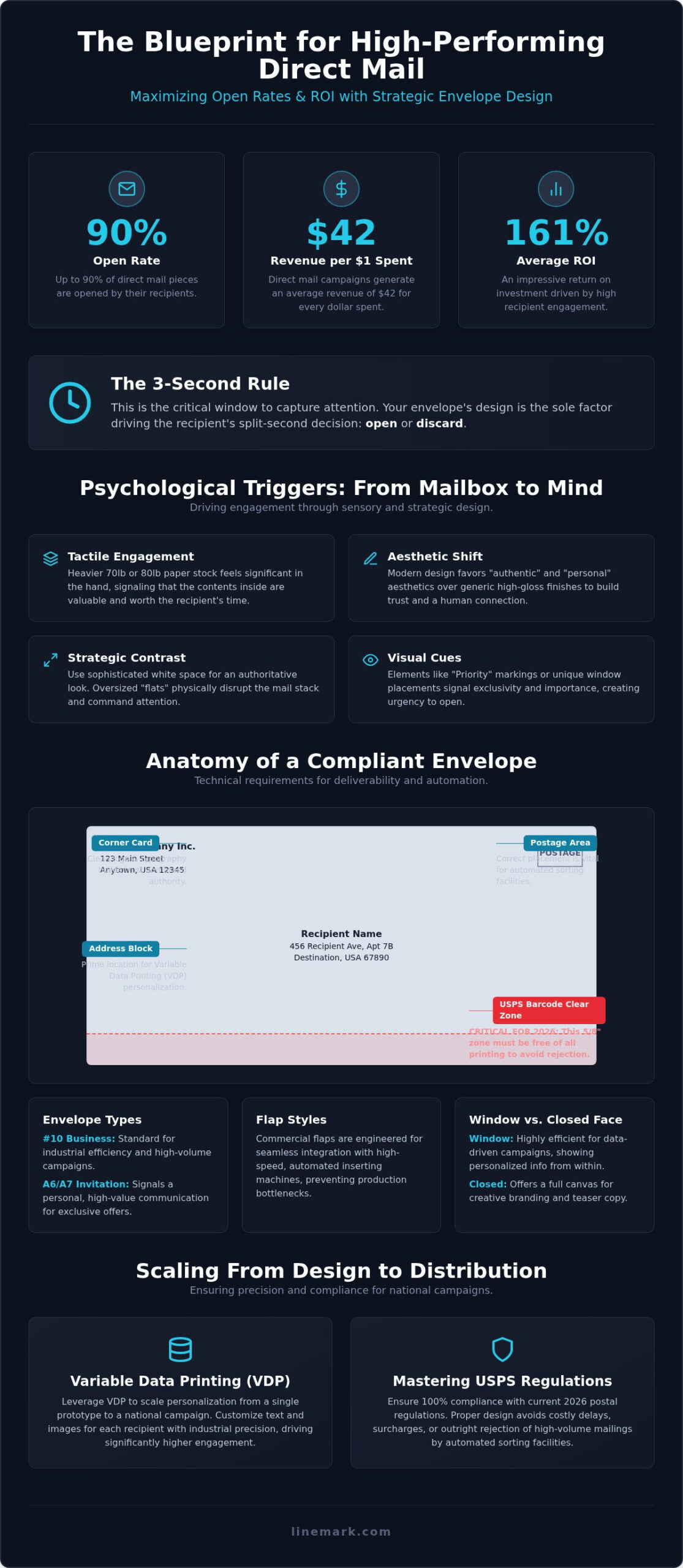
As many as 90% of direct mail pieces are opened by recipients, generating an average revenue of $42 for every dollar spent. This 161% ROI is impressive, but it depends entirely on one factor: the recipient must choose to open the piece. You’ve likely felt the frustration of a high-volume campaign that fails to deliver because the direct mail envelope design lacked impact or was rejected by the USPS for non-compliance with the latest 2026 clear zone requirements.
We view your mail as a strategic asset rather than a simple transaction. This article provides the technical and creative blueprint you need to maximize open rates while ensuring your designs pass through industrial sorting facilities without delay. We’ll examine the specific USPS labeling list revisions effective August 2026, the psychological triggers of tactile finishes, and the production workflows that reduce postage costs. You’ll learn how to move from a design challenge to a concrete, scalable solution that drives measurable growth.
Key Takeaways
- Learn to apply the “3-second rule” to transform your envelope into a high-performing advertisement that commands immediate recipient attention.
- Identify the critical technical requirements for direct mail envelope design, including barcode clear zones and aspect ratios, to prevent costly USPS surcharges.
- Discover how to balance curiosity with authority through strategic teaser copy and transparency elements that drive higher engagement rates.
- Understand how to leverage Variable Data Printing (VDP) to scale personalized campaigns from initial prototypes to national distribution with industrial precision.
- Master current 2026 postal regulations to ensure your high-volume mailings move through automated sorting facilities without technical rejection or delays.
The Psychology of the Open: Why Envelope Design is Your First Ad
Every campaign begins at the mailbox. Your recipient makes a binary choice in roughly three seconds: open or discard. This split-second decision defines the success of your entire outreach, regardless of how compelling your interior offer might be. Within the history of advertising mail, the envelope has evolved from a simple protective sleeve into the tactical lead for the interior offer. We define this as the “outer,” and its primary job is to act as the gatekeeper of your campaign ROI.
To better understand how physical shape and design influence these decisions, watch this helpful video:
In 2026, high-gloss corporate finishes are losing ground to “authentic” and “personal” aesthetics. Recipients crave transparency and a human touch. Modern direct mail envelope design focuses on sensory marketing, where the weight of the stock and the texture of the paper signal quality before a single word is read. A heavier 70lb or 80lb text weight feels significant in the hand. It suggests that the contents inside are valuable and worth the recipient’s time. This shift toward tactile engagement is a response to the digital saturation of modern life; physical weight provides a sense of permanence that an email cannot replicate.
Breaking Through Mailbox Clutter
Standing out requires a calculated use of contrast. While vibrant colors can draw the eye, strategic use of white space often provides a more sophisticated “industrial authority” look that builds trust. Size also matters. While a standard #10 envelope is efficient for high-volume logistics, oversized “flats” offer a larger canvas for visual hierarchy. These larger formats bypass the standard stack, creating a physical disruption in the daily mail routine. You can also use visual cues like “Priority” markings or unique window placements to signal exclusivity and importance to the recipient immediately.
The ROI of the ‘Outer’
The math of direct mail is precise. A 1% increase in your open rate doesn’t just improve visibility; it transforms campaign profitability by lowering your cost per acquisition. Every creative choice on the envelope must serve a broader direct mail marketing strategy. By treating the outer envelope as your first advertisement, you ensure that the industrial precision of your production matches the strategic goals of your brand. When direct mail envelope design is executed with this level of technical and psychological intent, the transition from a piece of mail to a customer conversation becomes seamless.
Anatomy of a High-Performing Envelope: Technical Design Elements
The physical structure of your mailer is the foundation of its performance. While the previous section explored the psychology behind the open, the technical execution of your direct mail envelope design determines if that piece reaches the recipient’s hands in pristine condition. Choosing between a standard #10 business envelope and an invitation style depends on your campaign’s objective. A #10 is the industrial standard for efficiency; however, invitation styles like A6 or A7 signal a personal, high-value communication that often commands a higher open rate for exclusive offers.
The corner card, or return address area, serves as your first opportunity for brand authority. It shouldn’t be an afterthought. A well-designed corner card uses professional typography and clean logos to reassure the recipient of the sender’s legitimacy. Additionally, the flap style you choose has direct implications for high-speed production. Commercial flaps are designed for seamless integration with automated inserting machines. This ensures that high-volume projects move through our 90,000-square-foot facility without mechanical interruptions or production bottlenecks.
Window vs. Closed Face Envelopes
Choosing the right face for your envelope involves balancing personalization with aesthetics. Window envelopes are highly efficient for data-driven campaigns because they allow the recipient’s address to show through from the interior document, reducing the risk of a data mismatch. You must adhere strictly to USPS design requirements regarding clear zones. If the address shifts and touches the window’s edge, it can cause machine-read errors that delay delivery. Conversely, closed-face envelopes offer a more traditional, “official” look often preferred for non-profit appeals or high-end luxury invitations. For those looking to streamline this process, our direct mail fulfillment services ensure every window and clear zone is technically perfect before production begins.
Material and Substrate Selection
The tactile experience is a primary driver of recipient perception. Standard 24lb paper is reliable for mass mailings, but stepping up to a 28lb or 32lb stock provides a noticeable increase in rigidity and quality. This physical weight suggests a level of importance that digital communications lack. Beyond weight, specialty finishes like soft-touch lamination or spot UV can create a sensory hierarchy. These direct mail envelope design choices encourage the recipient to linger on the piece, increasing the likelihood of an open. When you combine industrial-grade substrates with metallic inks or textured finishes, you transform a simple container into a premium brand experience that stands out in a crowded mailbox.
Creative Strategies: Teaser Copy, Transparency, and Curiosity
Strategic creativity bridges the gap between a recipient noticing a mailer and actually opening it. While the technical structure ensures delivery, the creative execution of your direct mail envelope design is what drives engagement. One of the most debated tactics is the use of teaser copy. You’ve got to decide whether to reveal the offer immediately or build curiosity through a “blind” envelope. Both have their merits. A full reveal works well for urgent, benefit-driven offers, while curiosity gaps often perform better for high-end relationship building and exclusive invitations.
Leveraging an “Official Mail” aesthetic can provide instant authority. This style uses minimalist layouts, specific barcode placements, and professional typography to signal importance. It’s vital to remain compliant with USPS mailpiece design standards to avoid your mailer being perceived as deceptive or non-compliant. Transparency is another powerful tool in the creative arsenal. Using die-cuts or secondary windows allows a preview of the value inside, such as a membership card or a personalized voucher. This physical preview acts as a “proof of value” before the envelope is even unsealed.
Color psychology in 2026 has shifted toward palettes that emphasize stability and trust. We’re seeing a move away from neon “attention-grabbers” in favor of deep slate, forest green, and muted terracotta. These tones suggest an industrial authority and reliability that resonates with modern consumers who are wary of overly aggressive marketing. When these colors are applied with precision, they create a visual hierarchy that guides the eye toward the most important information.
Crafting Compelling Teaser Phrases
The phrasing you choose should align perfectly with your brand’s voice. A simple “Open immediately” might drive high initial opens but can lead to recipient disappointment if the offer doesn’t match the urgency. Conversely, “Your exclusive invitation inside” sets a premium, high-touch tone. It’s effective to test curiosity-driven headlines against direct, benefit-driven ones to see what resonates with your specific audience. Personalization is a catalyst here; using variable data to mention the recipient’s name or past history in the teaser copy can significantly lift response rates.
Visual Branding Consistency
Maintaining brand integrity across 100,000+ units requires industrial precision. Your direct mail envelope design must match the interior letter or brochure perfectly. This includes exact color matching and font consistency to ensure the experience feels like a unified journey rather than a transactional exchange. Many of our partners manage this complexity through MarCom On-Demand portals. These systems allow distributed marketing teams to create personalized, brand-compliant envelopes that are then produced in our centralized facility, ensuring every piece across a national run meets our rigorous quality standards.
Designing for Deliverability: USPS Compliance and Logistics
Creative brilliance serves little purpose if your mailer never reaches the recipient’s mailbox. In the world of high-volume production, direct mail envelope design is as much an engineering challenge as it is a creative one. The USPS uses sophisticated Optical Character Recognition (OCR) and high-speed sorting machines that require absolute precision. If your design interferes with these automated systems, you risk delivery delays or, worse, significant financial penalties. We treat deliverability as a non-negotiable standard, ensuring every piece moves through our 90,000-square-foot facility and into the postal stream with industrial efficiency.
One of the most critical technical hurdles is the aspect ratio. To qualify for automated letter rates, your envelope’s length divided by its height must fall between 1.3 and 2.5. A square envelope might look modern and unique, but because it doesn’t meet these ratios, it’s classified as “non-machinable.” This classification triggers higher postage costs and manual handling. Similarly, your address block must maintain high contrast for OCR readability. Dark ink on a light, non-reflective background is the industrial standard. If you’re utilizing 2026’s trend for muted palettes, ensure your address zone remains clear of heavy textures or patterns that could confuse sorting sensors.
The Technical Clear Zones
Precision is paramount when defining clear zones. The bottom 5/8 inch of the envelope must remain entirely free of text, logos, or images. This is the Barcode Clear Zone, where the USPS sprays the routing barcode during processing. Additionally, the top right corner is reserved for postage or your custom indicia. You don’t have to settle for a generic postage box; we often help partners design custom indicia that incorporate brand elements while remaining compliant. Failure to adhere to these clear zones often results in “non-machinable” surcharges that can increase your postage costs by several cents per piece, potentially adding thousands of dollars to a national campaign’s budget.
Bleeds and Safe Zones for Production
Setting up print files for industrial-scale offset or digital presses requires a deep understanding of the conversion process. We recommend a 1/8 inch bleed for any design elements that extend to the edge of the envelope. Safe zones are equally important to account for the slight shifts that occur during high-speed folding and gluing. Furthermore, managing ink coverage (DMAX) is essential. Excessive ink in the wrong areas can lead to smudging as envelopes move through high-speed sorting belts at the post office. By optimizing these technical details early, you ensure a faster production turnaround and lower overall costs. For expert guidance on technical compliance, explore our direct mail production capabilities.
Scaling Success: From Design Concept to National Distribution
Scaling a creative concept requires more than just a printer. It demands a strategic communications ally. Moving from a single prototype to a national run of 100,000 units involves complex logistics and a commitment to operational excellence. We focus on transforming your initial direct mail envelope design into a high-performing asset that maintains its integrity across every single piece. This transition from design to national distribution is where the nuances of modern marketing meet the precision of industrial production.
Variable Data Integration
Personalization is the catalyst for modern response rates. By leveraging Variable Data Printing (VDP), we move beyond simple name-insertion to ultra-personalized 1:1 design. Your CRM data can trigger specific images, teaser copy, or color schemes on the envelope that align with the recipient’s unique history or preferences. This tech-savvy approach creates “intelligent” mailpieces that feel like a personal communication rather than a mass marketing effort. In 2026, national brands that utilize data-driven direct mail envelope design see a significant lift in engagement because the mailer addresses the recipient’s specific needs before they even break the seal.
The Linemark Advantage in Production
Operational excellence is our signature. Our 90,000-square-foot facility is equipped to handle the most complex, high-volume projects with meticulous attention to detail. We provide a seamless journey from your initial creative design to direct mail fulfillment, ensuring that the precision of the first print matches the quality of the last delivery. This centralized model eliminates the friction often found when working with multiple vendors.
We understand that your mailings are a catalyst for growth. Our 30 years of industrial print experience allow us to anticipate production challenges before they affect your timeline. By integrating design with nationwide fulfillment logistics, we streamline the entire process. This holistic journey ensures your campaign is delivered on time, within budget, and in full compliance with postal regulations. We don’t just print envelopes; we build the strategic infrastructure your brand needs to succeed in the physical mailbox.
Transforming Your Mailroom Strategy into a Growth Engine
Mastering direct mail envelope design requires a sophisticated balance between psychological triggers and industrial compliance. Success in 2026 isn’t just about a creative concept; it’s about the technical precision of USPS clear zones and the strategic use of variable data. By prioritizing these nuances, you protect your campaign from costly surcharges and ensure your message reaches its destination with maximum impact. A well-executed envelope serves as the tactical lead that determines the ROI of your entire marketing investment.
Linemark offers the high-capacity infrastructure needed to scale these complex projects across national markets. Our 90,000-square-foot production facility and over 30 years of strategic print experience provide the stability and precision your brand demands. We manage every detail of nationwide fulfillment and distribution, serving as a unified partner in your communications journey. We don’t just handle logistics; we provide the technological pride and operational excellence required to turn a business challenge into a concrete, scalable solution.
Streamline your national direct mail campaign with Linemark’s expert production services.
Your next high-volume project is in capable, steady hands. We’re ready to help you turn your next mailing into a catalyst for transformative growth.
Frequently Asked Questions
What is the most effective envelope size for direct mail?
Standard #10 envelopes are the most cost-effective for automated postage rates, but invitation-style A7 envelopes often yield higher open rates for exclusive offers. The best choice depends on your campaign’s specific goals and budget. Standard sizes ensure compatibility with industrial sorting equipment, while oversized flats provide a larger canvas for visual impact and physical disruption in the mailbox.
How much space should I leave for the USPS barcode?
You must leave a minimum of 5/8 inch at the bottom of your envelope for the USPS to spray the routing barcode. This Barcode Clear Zone must remain entirely free of text, graphics, or heavy background patterns. Encroaching on this space can result in “non-machinable” surcharges that significantly increase your postage costs and delay delivery times.
Can I use dark-colored envelopes for direct mail?
Dark-colored envelopes are permissible if you maintain high contrast in the address block for Optical Character Recognition (OCR) readability. You can achieve this by using a white knock-out box or applying a white label for the recipient’s address. This approach allows for a bold direct mail envelope design while ensuring the piece remains compliant with automated sorting technology.
What is teaser copy and should I use it?
Teaser copy consists of short phrases or headlines on the outer envelope designed to pique recipient interest or reveal a compelling benefit. You should use it when your offer is urgent or highly relevant to the target audience. However, a “blind” envelope with no teaser copy can also be effective for creating a sense of professional mystery or exclusivity.
How does paper weight affect direct mail open rates?
Heavier paper weights, such as 28lb or 32lb stock, increase the perceived value and quality of your mailer. This tactile significance encourages recipients to handle the piece longer, which positively correlates with higher open rates. While 24lb is the industrial standard for efficiency, stepping up to a heavier substrate signals that the contents are important and worth the recipient’s time.
What is an indicia and how do I design one?
An indicia is a printed postage mark that replaces a physical stamp or meter strip for high-volume mailings. To design one, you must include specific elements like the permit number, the city of mailing, and the mail class. We often help partners integrate these marks into their overall direct mail envelope design to ensure brand consistency while meeting official postal standards.
How can Variable Data Printing (VDP) be used on envelopes?
Variable Data Printing (VDP) allows you to personalize every envelope in a production run with unique names, images, or tailored offers based on your CRM data. This technology transforms a standard mailer into a 1:1 communication that resonates with the recipient’s specific history. It’s a tech-savvy way to move from mass marketing to highly targeted, intelligent mailpieces that drive better response rates.
What are the USPS clear zone requirements for 2026?
For 2026, the USPS requires a 5/8 inch clear zone at the bottom for barcodes and a 1/2 inch clear zone in the top right for postage. Additionally, the return address area in the top left must remain clear of competing graphics that might confuse sorting sensors. Adhering to these technical dimensions ensures your high-volume projects move through automated sorting facilities without rejection or manual handling fees.