

 07/22/2026
  Steve Bearden
Your high-volume catalog shouldn’t be a compromise between cost efficiency and aesthetic precision. While many see binding as a final, mechanical step, it’s actually the strategic foundation of your brand’s physical presence. Many marketing executives struggle to find reliable saddle stitch binding services that can scale from targeted regional runs to nationwide direct mail campaigns without losing that crisp, lay-flat finish.
It’s a common frustration to see a design look perfect on a monitor only to suffer from “creep” or awkward page counts once it hits the industrial production floor. You deserve a partner who treats your collateral with the meticulous attention of a boutique shop while leveraging a 90,000-square-foot facility to ensure speed and accuracy. This guide will help you master the technical and strategic nuances of professional binding so you can produce high-impact catalogs and magazines that drive growth. We’ll explore everything from calculating precise page requirements to integrating your print production with automated fulfillment and logistics for a truly seamless journey.
Key Takeaways
- Learn why saddle stitching remains the industrial standard for producing crisp, professional catalogs and brochures at scale.
- Master the technical “multiples of four” rule and design strategies to prevent “creep” in thicker booklet projects.
- Identify when to utilize professional saddle stitch binding services versus perfect binding based on your project’s page count and structural needs.
- Gain clear specifications for bleeds, safe zones, and gutters to ensure your design translates perfectly from the screen to the press.
- Discover how centralized production and integrated logistics can streamline your workflow from initial print to final distribution.
Understanding Saddle Stitch Binding Services for Professional Collateral
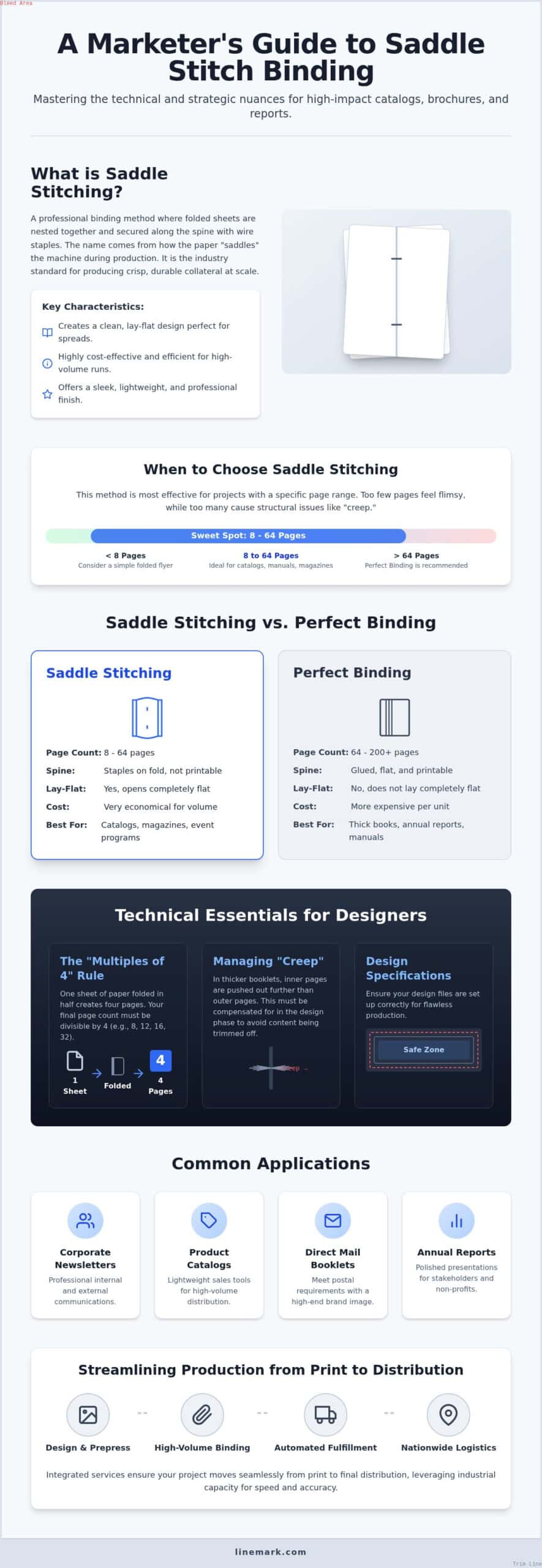
Saddle stitching is a specialized binding method where folded sheets are gathered together, one inside the other, and then secured through the fold line with wire staples. This technique, often referred to as Saddle stitch, derives its name from the way the paper “saddles” the metal frame during the stapling process. For businesses seeking reliable saddle stitch binding services, this method represents a perfect intersection of durability and economic efficiency. It remains the industry standard for high-circulation materials because it allows for rapid production speeds without compromising the structural integrity of the piece. Precision matters here. A well-executed stitch ensures that your collateral feels substantial and professional in the hands of a prospect.
One of the most significant benefits of this binding style is the “lay-flat” characteristic. Unlike glue-based methods that create a rigid spine, saddle stitching allows the booklet to open nearly flat. This is essential for visual-heavy designs, such as product catalogs or photography lookbooks, where images might span across two pages. It ensures your audience sees the full scope of your creative work without losing detail in a deep gutter. It’s a clean, functional solution. Beyond aesthetics, it’s highly cost-effective. By utilizing our high-capacity industrial equipment, you can maximize your marketing budget for high-volume runs while maintaining a premium look and feel.
When to Choose Saddle Stitching Over Other Methods
This method is most effective for projects ranging from 8 to 64 pages. If your document is too thin, it feels like a simple flyer; if it’s too thick, the staples may struggle to hold the tension. For these mid-range projects, it offers a sleeker, more agile feel compared to the bulkier aesthetic of perfect binding. It’s the go-to choice for event programs and technical manuals that need to be handled frequently. It’s durable. It’s lightweight. It’s designed for use.
Common Applications in Commercial Printing
Our 90,000-square-foot facility handles a diverse array of high-volume projects using these techniques. By integrating saddle stitch binding services with advanced digital and offset printing, we provide a streamlined path from design to delivery. Common applications include:
- Corporate Newsletters: Delivering consistent internal communication with a professional finish.
- Product Catalogs: Creating lightweight sales tools optimized for national distribution.
- Direct Mail: Producing booklets that meet strict postal requirements while maintaining a high-end brand image.
- Annual Reports: Offering a polished presentation for non-profits and stakeholders.
- Technical Engineering Manuals: Providing a durable, lay-flat reference for complex hardware; for those who visit RFLOGY for broadband microwave and millimeter-wave components, a professional printed manual is essential for managing detailed technical specifications.
Results are immediate. When your collateral is bound with industrial precision, it communicates a level of authority that loose sheets or inferior binding simply cannot match.
The Mechanics of Saddle Stitching: Page Counts, Creep, and Quality
Success in high-volume print production relies on physical laws. While saddle stitch binding services are highly accessible, they require a deep understanding of geometry to prevent common production errors. Every booklet begins as a series of large sheets that are folded and nested. This process dictates the structure of your entire project. It’s not just about aesthetics; it’s about the math of the fold. When you understand these mechanics, you can design with confidence, knowing your final product will meet industrial standards for durability and precision.
The Multiples of 4 Rule Explained
You can’t escape the math of a folded sheet. One piece of paper, when folded in half, creates four distinct surfaces. This means your final page count must be a multiple of four. If your manuscript ends on page 30, you’ll need to account for two additional pages to reach the 32-page threshold. Professional designers often use these “extra” pages for full-bleed photography, notes sections, or even a detailed index. Blank pages aren’t a failure; they’re often a structural necessity to maintain the balance of the booklet. Without a multiple of four, the binding process simply cannot function.
Managing Paper Weight and Creep
“Creep” is the physical phenomenon where the inner pages of a booklet begin to push out further than the outer pages. As you add more sheets, the thickness at the fold increases, forcing the innermost pages away from the spine. Without technical compensation, your margins will look uneven; text near the edges might even be trimmed off during the final cut. This is particularly noticeable in booklets with higher page counts or those using heavier paper stocks.
Industrial-grade saddle stitch binding services solve this during the pre-press stage. We use sophisticated software to incrementally adjust the position of content on each page, a process called shingling. This ensures that once the booklet is trimmed, the margins appear perfectly uniform across the entire document. The weight of your paper matters here too. A heavy 100lb gloss cover adds more “spring” to the spine than a standard 70lb text stock. Our team monitors the GSM and point-weight of your materials to ensure the wire staples are placed with the exact tension needed for a flush, professional edge. If you’re planning a complex project, integrating your design with our kitting and fulfillment workflow ensures that these technical details are managed from the start.
We also focus on wire gauge and staple placement. Thicker booklets require a heavier gauge wire to prevent the staples from pulling through the paper under stress. It’s a small detail that guarantees your catalogs survive the rigors of national distribution and frequent handling. This level of technical management is what separates a basic stapled document from a professional-grade marketing asset.
Saddle Stitching vs. Perfect Binding: Choosing the Right Finish
Choosing the right binding method is a strategic decision rooted in page count, distribution logistics, and brand perception. While saddle stitch binding services are the go-to for agility and cost-efficiency, perfect binding offers a different level of structural permanence. The choice isn’t just about how the booklet looks; it’s about how it performs in the field. Understanding the structural differences between staples and glue is the first step in ensuring your project meets its strategic goals.
Saddle stitching uses wire staples driven through the fold line. It’s an efficient, mechanical process that maintains the flexibility of the paper. Perfect binding, by contrast, involves grinding the spine of a gathered stack of pages and applying a strong adhesive to attach a wrap-around cover. This creates a flat, rectangular spine. If your project is between 8 and 64 pages, saddle stitching is usually the superior choice. Once you exceed that thickness, the tension on the staples becomes too great, and the booklet won’t stay closed. At that point, a glued spine becomes a structural necessity to prevent the “spring” of the paper from ruining the finish.
Aesthetic and Functional Comparison
The functional profile of your booklet should dictate the binding. Saddle stitching offers a distinct lay-flat advantage. This is vital for catalogs featuring center-spread photography or complex charts that span across two pages. You don’t lose any of the image to a deep glue gutter. However, if your publication will live on a bookshelf, perfect binding provides a printable spine that allows for easy identification.
Weight is another factor often overlooked in the design phase. Saddle-stitched booklets are lighter and more flexible. This makes them the ideal choice for direct mail campaigns where every fraction of an ounce impacts your postage costs. A stapled brochure is easier to insert into envelopes and handles the rigors of automated sorting machines with less risk of spine cracking. It’s a durable, streamlined solution for high-volume outreach.
Cost vs. Longevity Analysis
Saddle stitching is significantly more economical for high-volume production. The setup is faster, and the material costs are lower. When you’re scaling a run to 10,000 or 50,000 units, the cost-per-unit difference becomes a major factor in your overall ROI. It’s the primary engine of high-volume commercial marketing.
Turnaround time is also a major differentiator. Our industrial-grade equipment can produce stapled booklets at higher speeds than the multi-stage drying and cooling process required for adhesive binding. If you’re working against a tight deadline for a trade show or product launch, saddle stitching provides the necessary speed. For multi-year reference manuals that will be opened thousands of times, you might consider perfect binding for increased longevity. For most marketing collateral, catalogs, and newsletters, the durability of a professional wire stitch is more than sufficient to handle frequent use.
Designing for Success: Technical Specifications for Saddle Stitched Booklets
Precision in the design phase is the only way to ensure the industrial-grade results your brand requires. When utilizing professional saddle stitch binding services, your digital files must mirror the physical realities of the press. It’s a technical necessity. This means moving beyond basic layout and adopting technical specifications that account for trim, gutter, and the final mechanical assembly of the booklet. A slight oversight in the safe zone or color space can compromise a high-volume run, leading to visual inconsistencies that distract from your message.
Safe zones are critical. While we discussed the physical nature of creep in previous sections, your design must proactively account for it. We suggest a safe zone of at least 0.25 inches from the trim edge. This ensures that vital text, page numbers, or logos aren’t pushed too close to the edge or lost during the final flush trim. Your color space should always be CMYK. Designing in RGB might look bright on your monitor, but it won’t translate accurately to the physical inks used in digital and offset presses. High-resolution imagery is non-negotiable; all assets should be set to 300 DPI to maintain clarity at scale.
File Preparation and Bleed
Standard industrial printing requires a 0.125-inch bleed on all sides. This extra margin allows the trimming blades to cut through color rather than white paper, ensuring your graphics reach the very edge of the page. We recommend setting up your document as single pages in a PDF rather than reader spreads. This allows our pre-press team to handle imposition and shingling more efficiently. For high-impact results in custom book printing, always export your files as high-resolution PDFs with all fonts embedded. This creates a stable file that moves seamlessly through our automated workflow.
Advanced Customization: Variable Data and Finishes
Modern marketing requires more than a one-size-fits-all approach. By integrating variable data printing (VDP), you can personalize the content or covers of your stitched booklets for specific recipients or regions. This transformation turns a standard catalog into a targeted sales tool. Beyond personalization, the tactile feel of your booklet matters. You can choose between gloss lamination for vibrant colors, matte for a sophisticated look, or soft-touch lamination for a premium, velvet-like feel. Adding spot UV or foil stamping provides those final high-end touches that command attention in a crowded marketplace. These finishes do more than protect the paper; they reinforce the quality of your brand.
If you’re ready to move from design to production, our team is here to ensure your technical specifications align with our high-capacity equipment. Explore our options for custom book printing to see how we can bring your next high-volume project to life with precision.
Scalable Saddle Stitching Solutions: The Linemark Advantage
High-volume commercial projects require more than just a printer; they require a robust industrial infrastructure. Linemark operates from a 90,000-square-foot high-capacity production facility designed to handle the complexities of modern marketing and logistics. This scale allows us to provide saddle stitch binding services that retail-focused shops simply cannot match. With over 30 years of industrial printing experience, we’ve positioned ourselves as a strategic communications ally rather than a mere vendor. We understand that your catalogs and booklets are a catalyst for growth, and we treat every project with the precision it deserves. This is where industrial authority meets collaborative partnership.
From Press to Post: Integrated Fulfillment
Integrated fulfillment is the key to maximizing your return on investment. By maintaining the entire production journey under one roof, we eliminate the logistical friction that usually occurs between the press and the distribution center. Our workflow moves seamlessly from high-speed printing and binding into kitting and fulfillment. This centralized approach significantly reduces transportation costs and shortens your time-to-market. Whether your project involves complex marketing kits or simple catalogs, our automated systems ensure every piece is accounted for. We manage nationwide distribution for corporate and non-profit organizations, providing a streamlined, high-tech solution for even the most geographically diverse campaigns.
Technology-Driven Production
Precision is automated within our facility. We utilize high-speed digital and offset presses to maintain absolute color consistency across every run, regardless of volume. This technology is paired with advanced finishing lines that ensure perfect staples and clean, flush trims every time. It’s a well-oiled machine designed for operational excellence. Beyond the hardware, we leverage data-driven strategies to help our partners optimize their print spend. We don’t just execute a job; we look for the next advancement in production capabilities to benefit your bottom line.
Our MarCom On-Demand portal further streamlines this experience by providing a centralized digital destination for automated ordering. This portal allows your team to manage assets and trigger high-volume production with a few clicks, ensuring brand consistency across all channels. By combining industrial-grade capacity with the meticulous attention to detail of a boutique shop, we ensure your saddle stitch binding services are handled with steady, capable hands. We’re ready to scale with you.
Mastering Your Next High-Volume Booklet Project
Saddle stitching is more than a finishing touch; it’s a strategic asset for your brand’s physical outreach. By mastering the technical requirements of page counts and creep, you’ll ensure your collateral maintains a professional edge that commands respect. You’ve seen how this method offers a superior lay-flat experience and significant cost advantages for high-volume runs compared to adhesive alternatives. It’s about combining aesthetic appeal with operational efficiency.
Success depends on a partner who can bridge the gap between design and distribution. With over 30 years of industrial expertise and a 90,000-square-foot high-capacity facility, we provide the precision and scale your projects require. Our saddle stitch binding services are fully integrated with direct mail and fulfillment capabilities. This means your booklets move from the press to your audience without unnecessary delays or middleman costs. We’re ready to act as your strategic communications ally and handle the heavy lifting of your most complex campaigns.
Request a custom quote for your saddle stitch binding project today. Let’s transform your next marketing campaign into a high-impact reality with the precision it deserves.
Frequently Asked Questions
What is the minimum and maximum page count for saddle stitch binding?
Saddle-stitched booklets typically range from 8 to 64 pages. The minimum of eight pages comes from two nested, folded sheets of paper. While some lightweight stocks allow for up to 80 pages, exceeding 64 pages often results in the booklet “springing” open or staples failing to secure the bulk. If your project exceeds this threshold, perfect binding is the recommended structural alternative to ensure a flush finish.
Can I use saddle stitching for a book with a heavy cardstock cover?
You can absolutely use heavy cardstock for the cover of your booklet. This is a standard practice to enhance the tactile quality and durability of the piece. Our industrial equipment utilizes a scoring process before folding to prevent the cardstock from cracking at the spine. This ensures a clean, professional appearance even when using high-weight cover stocks for premium catalogs or annual reports.
How does the ‘multiples of 4’ rule affect my booklet design?
The “multiples of four” rule is a physical requirement because every sheet of paper folded in half creates four distinct surfaces. If your content only covers 22 pages, you must add two more to reach 24. Professional designers often utilize these extra pages for “Notes” sections, detailed indices, or full-bleed brand photography. This avoids the need for blank pages and maintains the structural balance of the saddle stitch binding services process.
What is ‘creep’ in saddle stitching and how do I avoid it?
Creep refers to the way inner pages push further away from the spine as the booklet thickness increases. You don’t have to manage this manually; our pre-press software compensates for creep through a process called shingling. However, you can help by maintaining a safe zone of at least 0.25 inches for text and page numbers. This prevents content from getting too close to the edge after the final flush trim.
Is saddle stitch binding durable enough for shipping and mailing?
Saddle stitching is exceptionally durable and is the preferred choice for high-volume direct mail. Because the wire staples are driven through the fold, the binding handles the rigors of automated postal sorting machines without cracking. Its lightweight profile also reduces postage costs compared to heavier binding methods. It’s a robust solution for catalogs and newsletters that need to travel across the country while remaining intact.
Can I include variable data or personalization in a saddle-stitched catalog?
Personalization is a core advantage of our integrated digital production. You can include variable data, such as unique recipient names or localized offers, directly within your saddle-stitched projects. This transformation turns a generic catalog into a high-impact, targeted marketing tool. Our 90,000-square-foot facility is equipped to handle complex VDP requirements alongside high-speed saddle stitch binding services to drive better engagement for your brand.
How does saddle stitching compare to perfect binding in terms of cost?
Saddle stitching is the most economical binding method for high-volume commercial printing. The mechanical process of stapling is faster to set up and execute than the multi-stage gluing and cooling required for perfect binding. This speed translates to lower unit costs, especially at scales of 10,000 units or more. It’s the strategic choice for maximizing a marketing budget without sacrificing the professional look and feel of your collateral.
What file format do I need to provide for professional saddle stitch printing?
The industry standard for file submission is a high-resolution, print-ready PDF. Your document should be set to the CMYK color space with all images at 300 DPI to ensure clarity. It’s vital to provide your file as single pages in sequential order rather than reader spreads. Include a 0.125-inch bleed on all sides to account for the final trim and ensure your graphics reach the very edge of the paper.