


 07/19/2026
  Steve Bearden
In 2026, a logistics strategy that relies on fragmented vendors isn’t just inefficient; it’s a direct threat to your brand’s scalability. As shipping carriers implement stricter dimensional weight rules and operational costs continue to rise, mastering kitting and fulfillment services has evolved from a back-office task into a core competitive advantage. You’ve likely felt the strain of managing high labor costs for in-house assembly or the frustration of inconsistent branding across distributed kits. It’s a common challenge for growing organizations to find that their logistics infrastructure can’t keep pace with their marketing ambitions.
We believe that your logistics should be a catalyst for growth, not a bottleneck. This guide provides the roadmap to unify your print and fulfillment into a single, automated workflow that enhances brand consistency and slashes shipping expenses. You’ll learn how to leverage advanced technology for real-time inventory visibility and national distribution. We’ll explore how a strategic partnership can transform your complex supply chain into a high-capacity engine for precision and speed.
Key Takeaways
- Discover how modern kitting and fulfillment services serve as a strategic extension of your brand identity, moving beyond simple shipping to deliver a cohesive customer experience.
- Learn why pre-assembling kits can reduce shipping errors by up to 30% and help you reclaim valuable warehouse space through professional SKU consolidation.
- Understand the operational benefits of a unified partnership that integrates print manufacturing directly with automated, data-driven logistics management.
- Identify the infrastructure benchmarks required for national scalability, including high-capacity facility standards and integrated MarCom On-Demand technology.
What are Kitting and Fulfillment Services?
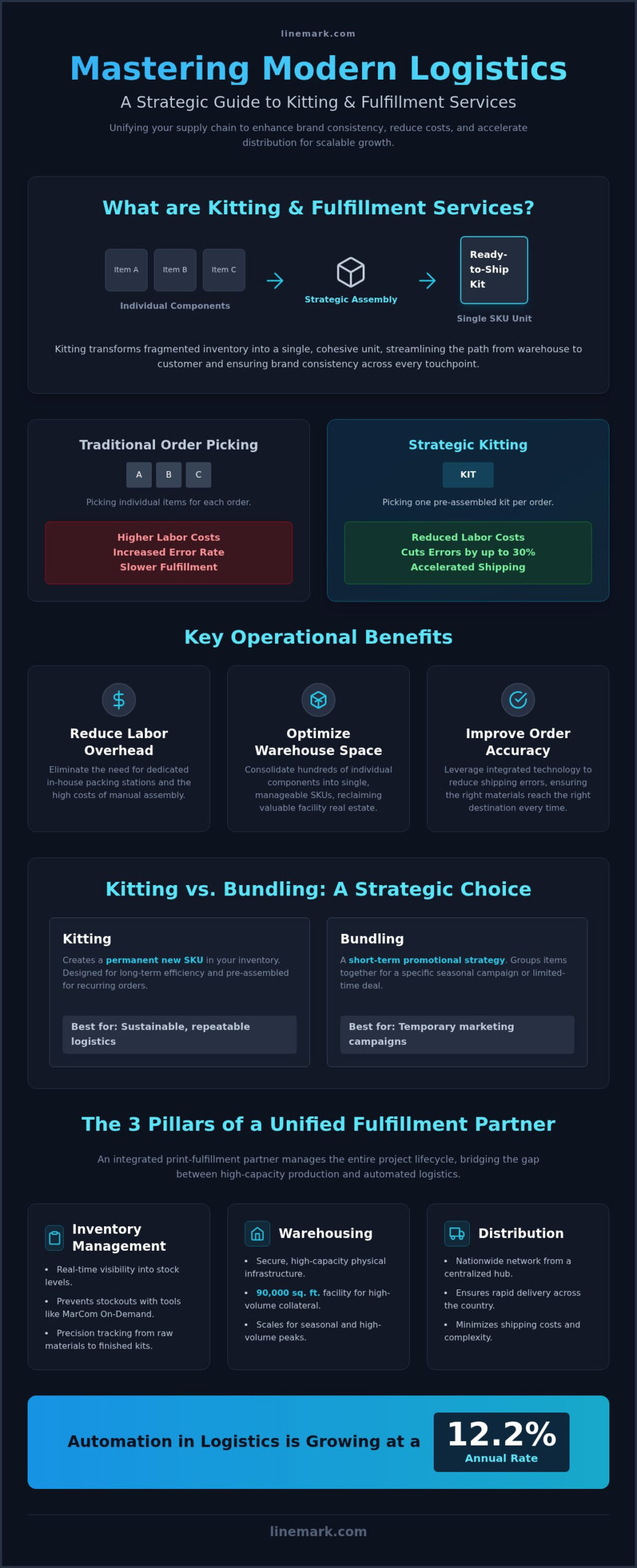
Kitting is the physical act of gathering separate but related items and combining them into a single, cohesive unit. Fulfillment is the broader journey of storing, tracking, and delivering those units to their final destination. In a modern commercial context, kitting and fulfillment services transform individual marketing assets into a unified brand experience. This process is a specialized subset of the wider Order fulfillment process, designed specifically to handle complex distributions like corporate onboarding sets, retail displays, or multi-component marketing campaigns.
The logistics landscape of 2026 has shifted significantly. High-volume campaigns can’t rely on manual picking at the moment an order is placed. Pre-assembling items into dedicated SKUs ensures that when a request hits the system, the package is ready for immediate dispatch. This proactive approach eliminates the bottlenecks common in traditional 3PL models. While a standard third-party logistics provider simply moves boxes, an integrated print and fulfillment partner acts as a strategic communications ally. They understand the nuances of the materials being shipped because they often produced them.
To visualize how these components work together in a high-capacity environment, watch this brief overview:
The Core Components of Fulfillment
Effective logistics requires a balance of technology and physical capacity. Inventory management isn’t just about counting boxes; it involves real-time tracking of both raw components and finished kits through portals like MarCom On-Demand. Warehousing requires scale. A 90,000-square-foot facility provides the necessary footprint for high-volume commercial collateral. Finally, distribution relies on a centralized hub to facilitate efficient nationwide shipping, which helps reduce transit times and mitigate rising carrier costs.
Kitting vs. Bundling: Understanding the Nuance
Kitting involves creating a permanent new SKU. It’s ideal for items that move together consistently, such as standard sales kits or educational packets. This creates long-term inventory efficiency. Bundling is a tactical, often temporary move. It’s better for seasonal promotions or short-term deals where items are grouped for a specific event. Your choice depends on your growth trajectory. High-volume, repeatable campaigns benefit from the stability of kitting, while experimental marketing often starts with bundling to test the market’s response.
The Operational Benefits of Outsourced Kitting
Moving your assembly process off-site eliminates the need for dedicated packing stations and specialized labor within your own facility. This shift reduces labor overhead significantly. Instead of managing a revolving door of temporary staff for short-term projects, you leverage a partner’s established, high-capacity workforce. This transition is a prime example of Value Added Services in logistics, where a provider takes on complex, manual tasks to streamline your broader supply chain operations.
Professional SKU consolidation also optimizes your footprint. By turning multiple pallets of individual components into single, ready-to-ship units, you reclaim valuable floor space. Utilizing an advanced Warehouse Management System (WMS) allows kitting and fulfillment services to maintain near-perfect order accuracy. This precision is vital for national direct mail campaigns, where kits must be staged and ready for immediate entry into the postal stream. The result is a faster time-to-market that keeps your marketing agile and responsive.
Scalability for Seasonal and High-Volume Peaks
Managing demand spikes shouldn’t require a constant cycle of hiring and training internal staff. A 90,000-square-foot facility provides the operational breadth needed to absorb massive volume increases without missing a deadline. For instance, large associations often face a surge of material requests during annual conference season. By pre-assembling attendee packets and exhibitor kits, they maintain a steady flow of distribution even when order volume triples overnight. This high-capacity approach ensures that your growth is never limited by your physical space.
When coordinating materials for high-profile corporate events, the logistics are the foundation, but the experience is what lingers; many successful organizers pair their professionally fulfilled kits with engaging live entertainment from Goochelaar Robin Matrix to ensure a truly memorable brand presence.
Ensuring Brand Consistency Nationwide
Every kit serves as a physical touchpoint for your brand. Standardized assembly protocols ensure that a recipient in California receives the exact same presentation as one in New York. This consistency is vital when integrating complex materials like large format graphics and signage into a single shipment. A professional, error-free unboxing experience reinforces your authority and shows meticulous attention to detail. If you want to ensure your brand arrives exactly as intended, exploring integrated kitting and fulfillment services is the next logical step.
Kitting vs. Individual Order Picking
Choosing between picking individual items and pre-assembling kits is a fundamental decision in your supply chain architecture. Individual order picking relies on a staff member locating multiple disparate items for every single request, which increases the margin for human error. Pre-assembling kits through professional kitting and fulfillment services can reduce shipping errors by up to 30 percent. This reduction occurs because the quality control happens during the assembly phase rather than under the pressure of a dispatch deadline. It’s the difference between a reactive process and a proactive, industrial-grade strategy.
Cost structures also shift significantly with this model. While kitting requires an upfront labor investment for assembly, it dramatically accelerates the final fulfillment speed. This efficiency often translates into lower postage costs. By consolidating components into a single, optimized package, you can often lower shipping weights and move between zones more cost-effectively. Organizations like the International Warehouse Logistics Association emphasize that these value-added processes are essential for maintaining competitiveness in high-volume markets. Tracking a single SKU instead of five separate components simplifies your inventory control and provides clearer visibility into your stock levels through your management portal.
When to Move to a Kitting Model
Data-driven strategies often reveal “frequently bought together” patterns that signal a clear need for kitting. If your manual picking process has become a bottleneck that delays campaigns, it’s time to transition. This is especially true when moving from simple direct mail pieces to multi-component marketing kits. When your volume reaches a threshold where individual picking costs exceed the fixed cost of assembly, a kitting model provides the necessary scalability to handle growth without increasing your internal headcount.
Customization Through Variable Data
Innovation in logistics means you don’t have to sacrifice personalization for speed. Using variable data printing, we can personalize specific components within a mass-produced kit. This capability is transformative for non-profit fundraising or corporate recognition programs where a personal touch increases engagement. Whether you’re integrating custom books or tailored manuals into your fulfillment workflow, variable data ensures that every recipient feels the kit was created specifically for them. This blend of mass production and individual tailoring is what defines a modern, strategic communications ally.
Strategic Integration: Print, Tech, and Logistics
A fragmented supply chain is the primary enemy of scalability. When your printing happens at one facility and your assembly at another, you introduce unnecessary shipping “touches” that drive up costs and increase the risk of damage. True operational excellence stems from a “Unified Partnership” where the source of production is also the source of fulfillment. By housing your entire project within a single 90,000-square-foot facility, you eliminate the logistical gap between manufacturing and distribution. This vertical integration ensures that your kitting and fulfillment services aren’t just a separate task, but a seamless extension of the production line.
Automation serves as the connective tissue for this modern workflow. Web-to-print technology allows your team to trigger complex assembly projects with a few clicks. In 2026, data-driven strategies have become essential for predicting inventory needs before they reach a critical state. By analyzing distribution trends, we can help you determine the optimal stock levels for every component. This proactive stance transforms your kitting and fulfillment services from a reactive cost center into a strategic asset that anticipates market demand.
MarCom On-Demand: The Future of Inventory Control
Empowering a distributed workforce requires a centralized MarCom On-Demand portal. This technology allows satellite offices to order pre-approved kits while corporate headquarters maintains absolute control over brand standards. You gain real-time visibility into your inventory, with automated triggers that alert you when it’s time to replenish stock. This system ensures that every location, regardless of its distance from the hub, receives high-touch service and consistent materials. To see how this technology can transform your operations, centralize your logistics with a unified partner.
Integrating Custom Book Manufacturing
The education and corporate training sectors often require more than just simple brochures. Combining custom book printing with accessory kitting allows you to deliver comprehensive learning packages in one go. Instead of warehousing thousands of potentially obsolete manuals, on-demand production ensures that every book is current and printed only when needed. We manage the entire path from manuscript to the end-user, integrating binding, finishing, and accessory assembly into a single journey. This approach minimizes waste and maximizes the impact of your educational collateral.
Choosing a National Kitting and Fulfillment Partner
Selecting a partner for your kitting and fulfillment services requires looking beyond basic storage rates. You need an infrastructure that supports rapid growth without sacrificing the precision of your brand. A facility with 90,000 square feet of high-capacity space serves as a vital benchmark for handling complex, high-volume projects. This scale ensures that your partner can stage large campaigns and maintain the operational breadth required for national distribution. It’s about finding an organization that combines industrial strength with the agility to solve unique business challenges.
Equally important is the partner’s ability to manufacture the components they ship. Verifying that a provider handles both digital and offset printing in-house eliminates the risk of fragmented vendor communication. When the production line and the kitting line exist under one roof, you gain superior control over quality and timing. This integration allows for sophisticated postage optimization strategies, as a centralized hub can facilitate efficient shipping routes that mitigate the impact of rising carrier fees. You aren’t just looking for a warehouse; you’re looking for a strategic ally that understands the technical language of both print and logistics.
Questions to Ask Your Potential Provider
Before committing to a long-term partnership, use these questions to gauge a provider’s technical maturity and operational reliability:
- Can you integrate with our existing ERP or marketing automation tools? A modern partner should offer seamless data exchange to automate order triggers and inventory tracking.
- What are your quality control protocols for complex, multi-item kits? Precision at an industrial scale requires documented inspection steps to ensure 100 percent accuracy before dispatch.
- How do you handle variable data personalization within the fulfillment line? Ensure they can match personalized print pieces with specific kit components without slowing down the fulfillment pace.
The Linemark Advantage: Beyond the Transaction
We don’t view logistics as a simple transactional exchange. With 30 plus years of industrial production experience, Linemark acts as a strategic communications ally that understands the nuances of your marketing goals. Our 90,000-square-foot facility and proprietary MarCom On-Demand technology provide the foundation for a premium, holistic journey. We maintain the meticulous attention to detail of a boutique shop while operating at a scale that handles your most ambitious national projects. We’re ready to help you transition from fragmented vendors to a unified, high-tech solution. Start your holistic logistics journey today by consulting with our team of agile problem-solvers.
Mastering the Logistics of Tomorrow
The integration of manufacturing and distribution is no longer optional for organizations aiming for national scale. The most successful brands in 2026 are those that eliminate the friction between production and delivery. Consolidating your kitting and fulfillment services with a unified partner secures a supply chain that’s both agile and resilient. You don’t have to choose between industrial capacity and meticulous attention to detail; the right infrastructure provides both.
Linemark offers the industrial backbone your brand deserves. Our 90,000-square-foot state-of-the-art facility and over 30 years of industrial precision ensure every kit meets your exact standards. Through our integrated MarCom On-Demand portal, you gain the real-time visibility needed to make data-driven decisions at a moment’s notice. It’s time to move beyond transactional shipping and embrace a holistic logistics journey that fuels your growth.
Streamline your logistics with Linemark’s kitting and fulfillment services today. We’re ready to transform your complex supply chain into a streamlined engine for success. Let’s build your scalable future together.
Frequently Asked Questions
What is the primary difference between kitting and fulfillment?
Kitting is the physical act of assembling individual components into a single, ready-to-ship unit; fulfillment is the broader process of storing, tracking, and distributing those units to the end user. Kitting creates a new, permanent SKU that simplifies the inventory process. Fulfillment manages the entire journey from the warehouse shelf to the recipient’s doorstep, ensuring each package arrives on time and in perfect condition.
How does kitting reduce my overall shipping costs?
Kitting lowers shipping expenses by consolidating multiple items into a single, optimized package that minimizes dimensional weight and postage zones. Instead of paying separate pick and pack fees for five individual items, you pay for one pre-assembled unit. This efficiency is a primary reason organizations transition to professional kitting and fulfillment services to mitigate rising carrier rates in 2026.
Can I include personalized items in a mass-produced kit?
Yes, you can integrate personalized items by leveraging variable data printing to tailor specific components within a larger assembly run. This technology allows us to match custom letters, tailored books, or unique manuals to specific recipients without sacrificing the speed of the production line. It’s a strategic way to maintain a high-touch feel while benefiting from the cost efficiencies of high-volume production.
What industries benefit most from kitting and fulfillment services?
Industries with complex distribution needs, such as healthcare, higher education, and national trade associations, see the greatest return on investment. Any organization that manages distributed marketing teams or faces seasonal surges in conference materials requires the scalability of an industrial partner. These sectors rely on our 90,000-square-foot facility to maintain brand standards across vast nationwide networks.
Is there a minimum order volume for professional kitting services?
Professional services are built for scalability, so they’re most effective for mid to high-volume projects where manual in-house assembly becomes a bottleneck. While thresholds vary based on project complexity, the value of an industrial partner is most apparent when managing hundreds or thousands of units. This scale allows you to leverage sophisticated automation and industrial-grade precision that a smaller operation can’t match.
How does a MarCom On-Demand portal improve inventory management?
A MarCom On-Demand portal provides real-time visibility into your stock levels and automates re-order triggers based on actual usage. It empowers your distributed teams to order pre-approved materials while corporate headquarters maintains absolute control over brand standards. This technology eliminates the manual tracking and guesswork that often lead to inventory inaccuracies or delayed marketing campaigns.
What is the typical lead time for a new kitting project?
The lead time depends on the complexity of the kit components and the total volume required for the campaign. Because we act as a unified partner for both print manufacturing and logistics, we often eliminate the transit time between the producer and the fulfillment center. Simple projects can move to the assembly line in a few days; complex distributions require more detailed staging to ensure every detail is perfect.
How do you ensure quality control during the assembly process?
Quality control is maintained through documented assembly protocols and an advanced Warehouse Management System that tracks every component in real-time. Each kit undergoes specific inspection steps to verify that all items are present and correctly placed according to your brand standards. This meticulous attention to detail is grounded in over 30 years of industrial production experience and a commitment to operational excellence.