

 06/11/2026
  Steve Bearden
The most sophisticated marketing strategy can be derailed by a single point of failure: the physical durability of your print collateral. Choosing between UV coating vs lamination for covers is often the difference between a project that retains its premium feel and one that arrives at its destination with a cracked spine or scuffed surface. It’s a high-stakes decision for any high-volume run where brand reputation and logistics costs are on the line.
You’ve likely felt the pressure of balancing a professional aesthetic with the harsh realities of shipping and tight budget constraints. We understand that technical jargon shouldn’t stand in the way of a superior end product. This guide provides the clarity you need to select a finish that enhances color vibrancy while ensuring structural longevity. We will break down the specific performance metrics of each option, explore the 5% USPS postage discount available for tactile finishes through June 2026, and help you navigate the latest 2026 recycling regulations to ensure your project remains both durable and compliant.
Key Takeaways
- Understand the fundamental choice between liquid polymer resins and protective plastic films to align your finish with your project’s lifecycle.
- Compare UV coating vs lamination for covers based on your specific goals for color vibrancy, tactile experience, and unit cost.
- Identify why lamination serves as the industry standard for softcover books that require maximum resistance to spine cracking and heavy handling.
- Evaluate how UV coating accelerates high-speed industrial production, making it the most efficient choice for high-volume direct mail projects.
- Discover how strategic finishing partnerships can scale your production while maintaining the meticulous detail of a high-capacity operation.
Defining the Standards: What Are UV Coating and Lamination?
In high-volume production, the choice between UV coating vs lamination for covers dictates both the tactile experience and the lifespan of the printed piece. While both methods serve to protect the substrate, they achieve this through fundamentally different technologies. One relies on chemistry and light; the other relies on physical bonding and polymer films. Because covers for books, catalogs, and annual reports face significantly more mechanical stress at the spine and edges than internal pages, these finishes must meet rigorous performance standards to prevent premature wear during shipping and handling.
A standard UV coating is a liquid polymer that is applied to the paper and then cured instantly under ultraviolet lamps. In contrast, lamination involves adhering a thin layer of plastic film, such as polypropylene or polyester, directly to the paper surface. This choice isn’t merely aesthetic. It’s a strategic decision that affects the structural integrity of your project. Covers require a higher level of durability than standard page coatings because they act as the primary shield for the content within, often enduring thousands of touches and environmental fluctuations.
To better understand the visual and structural differences, watch this helpful video:
The Chemistry of UV Coating
Modern UV coatings represent a leap in industrial efficiency. The liquid resin contains photoinitiators that, when exposed to UV light, trigger a near-instantaneous chemical reaction that transforms the liquid into a hard, non-porous shield. This process allows for either “flood” application, covering the entire surface for uniform protection, or “spot” application to highlight specific design elements with high-gloss accents. The hardness of the cured resin provides excellent scuff resistance during the high-speed sorting processes typical in direct mail. Most contemporary coatings are VOC-free, making them a preferred choice for organizations prioritizing sustainable production without sacrificing a professional sheen.
The Structure of Lamination
Lamination creates a physical “sandwich” that provides a level of rigidity and tear resistance that liquid coatings cannot match. Thermal lamination uses heat-activated adhesives to bond the film to the paper, while cold lamination relies on pressure-sensitive adhesives for more delicate digital prints. Selecting the right UV coating vs lamination for covers involves calculating the final thickness of the piece, as film thickness directly influences the weight and “hand” of the cover. While lamination offers a superior moisture barrier for items shipped through varying climates, selecting the wrong film weight can lead to cover curl. This common challenge requires precise calibration during the binding and finishing stage to ensure the final product remains flat and professional.
The Technical Breakdown: Liquid Resins vs. Protective Films
The choice between UV coating vs lamination for covers involves more than just selecting a visual style. It’s about engineering a production flow that meets strict deadlines without sacrificing final quality. While UV coating offers a fast, liquid application, lamination provides a physical layer of defense. Understanding how these materials interact with your ink and substrate is vital for any large-scale project.
UV coating thrives in high-speed industrial environments. Because the resin cures instantly under ultraviolet lamps, it can often be applied inline during the printing process. This significantly reduces the total production timeline for high-volume commercial runs. Lamination is typically an offline process that requires a secondary pass through specialized equipment. It adds a step to the workflow but provides a level of structural reinforcement that liquid cannot replicate. If you’re managing a complex rollout, our team at Linemark provides the technical oversight to ensure your finishing choice doesn’t become a bottleneck.
When it comes to the final cut, lamination adds a layer of complexity to trimming and bleeds. The plastic film must be trimmed with extreme precision to avoid silvering or delamination at the edges. UV coating behaves more like the paper itself during the trimming process, which simplifies the cutting phase. However, lamination offers a unique advantage known as the edge factor. It seals the paper fibers at the trim line, preventing moisture from seeping into the cover from the sides. UV remains strictly a surface-level barrier, leaving the raw paper edges vulnerable to environmental wear.
Modern digital printing also introduces material compatibility challenges. Many digital toners contain high levels of wax or silicone, which can prevent standard laminating films from adhering correctly. To solve this, we use specific digital-ready laminates with aggressive adhesives that penetrate the toner to create a permanent bond. UV coating vs lamination for covers also requires a look at the scoring process. UV resins are generally more flexible when scored, whereas thicker films can cause a cover to spring open if the score isn’t perfectly calibrated to the film’s tension.
Industrial Scalability and Production Flow
Scaling a project to tens of thousands of units requires automated finishing equipment that maintains consistency. High-volume operations often prioritize inline UV coating because it eliminates the need for additional handling. This efficiency is a catalyst for growth when speed to market is a primary objective. For projects requiring the premium feel of film, we integrate high-speed laminators into the workflow to maintain a steady, confident pace from the press to fulfillment.
Glue Adhesion and Binding Integrity
Binding integrity is a critical technical hurdle in book production. In perfect binding, the adhesive must bond the cover securely to the book block. Lamination can be too slick for standard glues to grip. This often requires the use of knock-outs, where the film is intentionally omitted from the spine area to allow for a direct paper-to-glue bond. While this adds a layer of planning to the prepress stage, it ensures the hinge strength remains intact for the life of the book.
Durability, Cracking, and Aesthetics: Comparing Performance
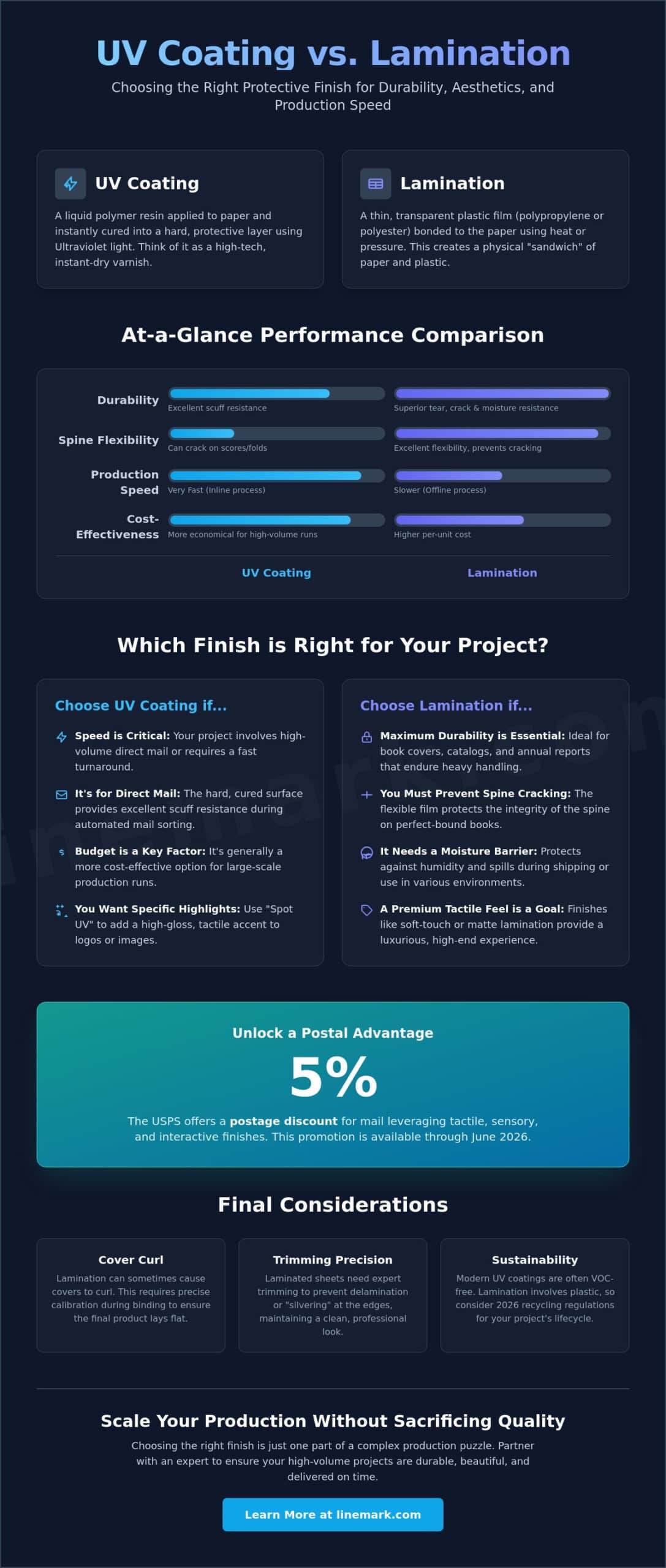
When evaluating UV coating vs lamination for covers, the most visible indicator of quality is how the spine handles repeated mechanical stress. Softcover books and catalogs often suffer from spine cracking, a phenomenon where ink and paper fibers break at the fold. Lamination serves as the gold standard for high-use materials because the plastic film acts as a flexible hinge. It holds the fibers together even under heavy use. UV coating provides a hard shield but is inherently more brittle. While we utilize precision scoring to mitigate cracking in UV applications, the structural resilience of film is often the superior choice for manuals or frequently referenced catalogs.
Surface hardness also varies significantly between these two technologies. UV coating creates a very hard surface that resists scuffs during high-speed sorting. However, once a UV surface is scratched, the mark is often permanent and highly visible. Lamination films are more resilient. They tend to absorb minor impacts and distribute pressure, which prevents the underlying ink from being damaged. This resilience makes film an excellent choice for items that will spend time in a backpack, a briefcase, or a shipping envelope.
Visual impact is another area where the choice between UV coating vs lamination for covers can transform your brand’s perception. Gloss finishes in both technologies make colors pop and deepen black tones, giving images a high-definition appearance. Tactile branding has also become a significant differentiator. Soft touch lamination offers a velvety feel that can increase brand recall and perceived value. Utilizing these sensory elements is not just a design choice; it’s a strategic move. The USPS offers a 5% postage discount through June 30, 2026, for mailings that incorporate these tactile or sensory finishes.
Longevity and Environmental Resistance
Lamination provides a comprehensive barrier against fingerprints, skin oils, and moisture. This makes it essential for materials used in damp environments or industrial settings. While UV coating offers some moisture resistance, it doesn’t seal the edges of the paper. Lamination provides a complete encasement that prevents the substrate from absorbing humidity. This stability is vital for preventing yellowing and fading during long-term shelf storage, ensuring your annual reports or catalogs look pristine years after production.
Visual Finishes: Beyond High Gloss
- Matte and Satin: These finishes provide a sophisticated, non-glare surface that improves the readability of text-heavy professional reports.
- Specialty Textures: We can use spot UV coating to create raised or tactile sensory elements that highlight specific logos or graphics.
- Brand Alignment: Matching the finish to your brand’s personality ensures a consistent message across all physical touchpoints.
Our team understands that every project requires a tailored approach. We balance these performance metrics against your specific logistics needs to deliver a result that is both beautiful and durable. This collaborative process ensures your finish is a catalyst for your brand’s growth rather than a compromise.
Beyond print collateral, maintaining this consistency across all physical assets, such as the custom signage and visual displays from Phoenix Signs & Graphics, ensures a unified experience for your audience.
Practical Selection: Choosing the Right Finish for Your Project
Selecting the optimal finish requires a strategic assessment of how your audience will interact with the final product. Choosing between UV coating vs lamination for covers involves a trade-off between immediate production speed and long-term structural integrity. For mass-market newsletters or promotional postcards, UV coating is typically the winner. It provides a professional sheen and scuff resistance without adding significant weight or cost to a high-volume run. It’s an efficient solution that keeps your project moving through the production pipeline without delay.
Premium catalogs and annual reports benefit from the high-end brand value signaled by lamination. The physical weight and velvety texture of a laminated cover communicate a level of sophistication that liquid coatings can’t replicate. When you’re producing educational materials or reference handbooks, the budget equation shifts. While lamination has a higher per-unit cost than liquid coating, its ability to prevent spine cracking and survive years of handling makes it the more cost-effective choice over the document’s lifecycle. We view these finishing choices as an investment in your brand’s physical presence.
This focus on physical quality is shared by specialized publications like Head2Toe Magazine, which prioritizes professional finishing to ensure their print issues provide a premium look and feel for their readers.
Project-Based Decision Matrix
A simple decision matrix helps clarify the best path forward for your specific project. Consider the “Fold” test: if your cover design features heavy ink coverage or dark colors across the spine, lamination is the safer bet to avoid unsightly white cracks. Think about the end-user’s journey. Is this a “throwaway” piece for a one-time event, or a “keep-forever” resource? We often recommend UV for the former and lamination for the latter. If you’re ready to see how these finishes can elevate your next project, you should request a custom print sample kit to feel the difference firsthand.
Direct Mail Considerations
In the logistics of direct mail, every fraction of an ounce matters. UV coating’s advantage lies in its thin profile, which helps keep pieces within lower postage tiers while maintaining machineability in high-speed sorting equipment. A thick laminate can sometimes push a mailer into a more expensive weight category or cause issues with automated folding machines. To stay ahead of shifting regulations and postal incentives, review our insights on direct mail marketing in 2026. Our team ensures your choice of UV coating vs lamination for covers aligns with the most current USPS requirements to maximize your campaign’s reach and ROI.
Strategic Partnership: Scaling Production with Linemark
Selecting between UV coating vs lamination for covers is a technical decision that carries significant weight for your brand’s physical identity. Navigating these nuances requires more than just a service provider; it requires a strategic communications ally that understands the intersection of marketing aesthetics and industrial logistics. At Linemark, we operate from a 90,000-square-foot facility equipped with the latest advancements in technical production. This high-capacity environment allows us to handle complex, high-volume projects with the meticulous attention to detail of a boutique shop while maintaining the scalability your growth demands.
Our collaborative approach ensures that your finishing choice isn’t made in a vacuum. We evaluate your project’s end goals to determine which finish optimizes both ROI and final impact. By integrating complex finishing directly into a seamless, high-volume production workflow, we eliminate the friction often found in multi-vendor print cycles. This unified process moves your project from the press to our kitting and fulfillment department without losing momentum. We don’t just deliver a printed product; we manage a holistic journey that ends with precise, nationwide distribution.
Advanced Technology in Finishing
Precision is the hallmark of our finishing department. We utilize advanced scoring and binding equipment specifically designed to handle the tension of various substrates. This technology is vital for minimizing the risk of cracking in UV resins, a challenge we solve through mechanical calibration rather than design compromise. For organizations managing a diverse library of assets, our MarCom On-Demand portals simplify the procurement of pre-finished collateral. This system ensures that every catalog or handbook maintains a consistent, professional look. To understand how these finishing standards fit into a larger manufacturing strategy, explore our custom book printing guide.
Scalable Solutions for Every Industry
We support national associations and major corporations by providing consistent, high-quality finishes across thousands of units. Our centralized production model reduces the total cost of ownership by eliminating the inefficiencies of fragmented logistics. Whether you are producing annual reports that require the premium feel of lamination or direct mail that demands the efficiency of UV coating, our team provides the technical oversight to ensure success. Partner with Linemark to elevate your next high-volume print project and experience the confidence that comes with a well-oiled production machine. We are ready to act as the catalyst for your next major marketing rollout.
Elevating Your Brand Presence Through Professional Finishing
Selecting the right UV coating vs lamination for covers is a strategic decision that bridges the gap between creative vision and logistical reality. Your choice determines how a project handles the rigors of shipping, how it feels in a customer’s hands, and how it performs in high-speed sorting environments. Whether you prioritize the rapid, cost-effective application of liquid resins or the unmatched structural longevity of protective films, the goal is a finished product that reinforces your brand’s authority.
With over 30 years of commercial printing expertise, Linemark serves as a strategic partner for corporations and non-profits nationwide. Our 90,000-square-foot high-tech production facility is engineered to handle complex, high-volume projects with precision and speed. We don’t just print; we provide the technical oversight and agile problem-solving necessary to scale your communications effectively. We invite you to request a custom quote for your next high-volume print project and see how our integrated services can act as a catalyst for your organization’s growth. We look forward to building a unified partnership that brings your most ambitious projects to life.
Frequently Asked Questions
Is UV coating or lamination more waterproof for book covers?
Lamination provides superior waterproofing because it acts as a non-porous plastic barrier that encapsulates the entire surface. Unlike UV coating, which is a liquid application that remains surface-level, lamination can be trimmed to seal the paper fibers at the edge. This prevents moisture from seeping into the substrate from the sides. It is the essential choice for materials exposed to high humidity or outdoor environments.
Why does UV coating sometimes crack at the spine of a book?
UV coating sometimes cracks at the spine because the cured resin is inherently brittle and lacks the elasticity of plastic film. When the paper fibers are folded, the hard shield of the coating cannot flex with the movement. This often results in visible white lines where the ink has broken. While precision scoring helps, lamination remains the preferred solution for high-use softcover books that require a flexible hinge.
Can you write on a UV coated or laminated cover?
Standard ballpoint pens and markers typically won’t adhere to high-gloss UV or laminated surfaces. The non-porous nature of these finishes causes ink to smear rather than dry. If your project requires a writable surface, such as a workbook or a postcard, we recommend using a matte lamination or a specialized writable coating. These options provide enough tooth for the ink to bond securely to the cover.
Which finish is more cost-effective for a 5,000-unit print run?
UV coating is typically the more cost-effective option for a 5,000-unit run, particularly for direct mail or brochures. Because it can be applied inline during the printing process, it eliminates the additional labor and setup time required for offline lamination. When comparing UV coating vs lamination for covers at this volume, UV offers a professional sheen at a lower price point per unit. It is the ideal choice for budget-conscious, high-capacity projects.
What is ‘Soft Touch’ and is it a coating or a laminate?
Soft Touch is available as both a specialized liquid coating and a premium laminating film. In professional book production, the laminate version is more common because it provides a more consistent, velvety texture and increased durability. It offers a sophisticated, non-glare finish that enhances the tactile experience of catalogs and annual reports. This finish is also eligible for specific USPS postage discounts through June 2026.
Does lamination make the cover paper feel thicker or more rigid?
Lamination significantly increases the physical thickness and rigidity of the cover paper. By bonding a layer of polypropylene or polyester film to the substrate, you are creating a composite material that is much harder to bend or tear than standard paper. This added heft signals high-end brand value and provides the structural support needed for thicker catalogs or manuals. UV coating adds almost no measurable thickness to the piece.
Can I use spot UV coating on top of a matte laminate?
You can absolutely apply spot UV coating on top of a matte laminate. This combination is a popular design strategy used to create high-contrast visual and tactile effects. The dull, non-glare surface of the matte laminate makes the high-gloss spot UV elements appear to pop off the page. It is an effective way to highlight logos or specific graphics while maintaining the premium feel and durability of a laminated cover.
How do these finishes affect the recyclability of the printed piece?
UV coating is generally more compatible with standard paper recycling processes because the resin breaks down more easily during the pulping stage. Lamination involves a plastic film that must be mechanically separated from the paper; many facilities cannot handle this. New regulations, such as California’s SB 343, require at least 60% of the population to have access to specific recycling facilities for a material to be labeled as recyclable in that state.