

 06/07/2026
  Steve Bearden
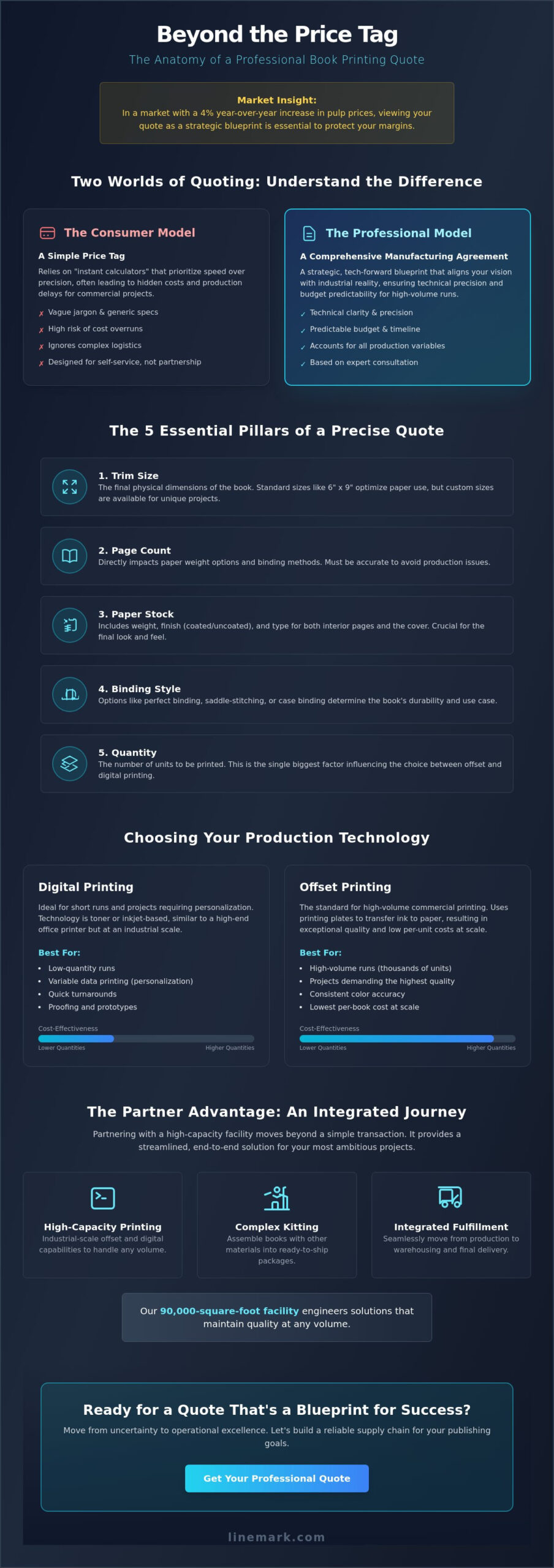
Many high-volume print buyers treat a quote as a simple price tag, but in a 2026 market where pulp prices have already risen 4% year-over-year, viewing a quote as a strategic blueprint is the only way to protect your margins. Understanding how to get a book printing quote that is both transparent and technically sound is essential for any professional managing commercial-scale projects. You’ve likely faced the headache of vague jargon or the anxiety of hidden costs that only appear once the presses start running. It’s a common challenge, especially when you’re balancing complex fulfillment logistics with the need for consistent quality across thousands of units.
This guide will provide the technical clarity you need to move from uncertainty to operational excellence. We’ll show you exactly how to define your project requirements to ensure every estimate you receive is precise and scalable. You’ll learn to navigate modern binding and finishing options while positioning your organization to work with a partner who understands the nuances of industrial production. We are moving beyond the transaction to help you build a reliable, tech-forward supply chain for your most ambitious publishing goals.
Key Takeaways
- Learn why viewing your quote as a comprehensive manufacturing agreement ensures technical precision and budget predictability for high-volume runs.
- Master the five essential pillars, including trim size, page count, paper stock, binding style, and quantity, to eliminate hidden production costs.
- Understand the operational differences between offset and digital production to choose the right technology for your specific commercial goals.
- Discover how to get a book printing quote that remains accurate by finalizing file readiness and technical pre-flighting early in the process.
- Identify the advantages of partnering with a high-capacity facility that integrates printing, kitting, and fulfillment into one streamlined journey.
The Fundamentals of Securing a Professional Book Printing Quote
A professional quote serves as much more than a preliminary estimate; it’s a comprehensive manufacturing agreement that aligns your vision with industrial reality. When you research how to get a book printing quote, you’re looking for a roadmap that accounts for every technical variable from ink coverage to final logistics. In a high-volume commercial environment, a quote isn’t just about the cost of paper and ink. It’s a strategic document that ensures your project moves through the production cycle without friction. This precision is what separates a successful launch from a project plagued by unexpected delays.
To better understand the nuances of the quoting process, watch this helpful video:
Many online platforms offer “instant” calculators that appeal to the consumer market, but these tools often miss critical commercial specifications. They prioritize speed over precision. For a marketing executive or business professional, relying on a generic calculator can lead to unexpected production delays or cost overruns when the actual complexity of the job is realized. High-volume production demands a level of industrial authority that simple web forms cannot provide. To better understand how industrial standards are evolving, Print It ZA print and packaging provides an analysis of the retail packaging trends shaping the 2026 market.
What is a Professional Printing Quote?
At its core, a professional quote details the exact specifications of your project, including trim size, page count, and specialized bookbinding methods. It outlines firm turnaround times and complex logistics requirements that a transactional estimate simply ignores. Accuracy at this initial stage is vital. It prevents the hidden costs that often plague projects when technical pre-flighting reveals discrepancies between the initial request and the actual files. A strategic manufacturing plan considers the entire lifecycle of the book, from the first press sheet to the final delivery at your warehouse.
Commercial vs. Consumer Quoting Models
Professional organizations require a higher level of scrutiny than a standard web-to-print form can provide. Securing custom book printing at scale requires a partnership with a production expert who can optimize your project for efficiency. It’s the difference between a self-service kiosk and a dedicated communications ally. Expert consultation ensures you aren’t just getting a price, but a scalable solution tailored to your growth goals.
Linemark’s 90,000-square-foot facility is built to handle this level of complexity. Our infrastructure supports high-capacity quoting that integrates variable data, complex kitting, and diverse finishing options. This industrial breadth allows us to provide quotes that aren’t just guesses; they’re actionable blueprints for success. We don’t just print books. We engineer solutions that maintain quality at any volume, ensuring your brand message is delivered with precision and impact.
5 Essential Specifications Required for a Precise Printing Quote
Securing a precise estimate requires more than just a title and a rough idea of length. To understand how to get a book printing quote that holds up throughout the production cycle, you must define five technical pillars. These specifications transform a vague concept into a predictable manufacturing project. By providing specific data early, you ensure your budget remains stable and your production timeline stays on track. It’s about moving from a guess to a guarantee through technical clarity.
Trim Size and Final Page Count
Trim size is the final physical dimension of the book after the pages have been bound and the edges have been sheared to their finished size. While standard industry sizes like 6″ x 9″ offer cost efficiencies due to paper sheet optimization, custom dimensions are often necessary for specialized annual reports or luxury catalogs. Your page count directly dictates your paper weight options. A high page count may require a thinner stock to ensure the spine doesn’t exceed the capacity of specific binding equipment, making early collaboration with your printer essential.
Paper Stock and Binding & Finishing Options
Choosing between coated and uncoated stocks depends on the visual impact you want to achieve. Coated stocks enhance color vibrancy for image-heavy catalogs, while uncoated stocks provide a tactile, premium feel for text-heavy journals. Navigating these choices is easier when you reference a professional Glossary of Print Terms to ensure your request matches industry standards. Your choice of binding & finishing, such as perfect bound or case bound, significantly influences the final quote. Specialized finishes like spot UV, soft-touch matte, or high-gloss lamination add a layer of sophistication but require additional setup time on the press.
Volume, Scale, and Variable Data
Quantity is the most significant lever in shifting the unit cost of your project. However, modern production allows for more than just static high-volume runs. We specialize in incorporating variable data printing, which allows you to personalize individual books for specific members or donors. This data-driven approach turns a standard book into a high-value, personalized communication tool. For recurring needs, integrating your project into a MarCom On-Demand system allows for efficient reordering without the need to figure out how to get a book printing quote for every small batch. Finding a seasoned industrial printing partner who can manage these variables is the key to a successful, scalable project.
Analyzing Offset vs. Digital Printing for Your Quote
Choosing between offset and digital production is the most critical decision in the quoting process. It determines whether your project is priced as a high-volume manufacturing run or an agile, on-demand solution. When you evaluate how to get a book printing quote, you will find that the “break-even” point is usually between 500 and 1,000 units. This threshold depends on the complexity of your finishing requirements. The technology you choose dictates the entire financial structure of your project, shifting costs between initial setup and per-unit production.
When to Request an Offset Printing Quote
Offset printing remains the gold standard for high-volume commercial runs. This process uses metal plates to transfer ink to a rubber blanket, which then applies the image to the paper. While the initial labor and material costs for plate creation are higher, the speed of the press makes the per-unit cost drop dramatically as volume increases. Offset technology is ideal for large-scale corporate branding where color consistency must be absolute across thousands of copies. It is the same industrial precision we apply to large format graphics, ensuring your brand maintains a unified presence across all physical media.
The Flexibility of Digital Printing Quotes
Digital printing functions much like a high-end industrial inkjet system, skipping the plate-making process entirely. This results in significantly faster lead times and lower minimum order quantities. It is the perfect choice for niche association reports or test marketing where you only need a few hundred copies. Understanding these technical differences is part of What You Need to Know Before Approaching a Printer. It ensures you aren’t overpaying for technology that doesn’t align with your specific goals. Digital quotes typically feature a higher per-page cost but eliminate the heavy setup fees associated with traditional presses.
The true power of digital production lies in its integration with personalized communications. Because there are no plates, we can change images or text on every page without stopping the press. This capability allows us to seamlessly connect book production with targeted direct mail campaigns. When you are determining how to get a book printing quote for a personalized member guide or a donor-specific annual report, digital technology is the only scalable solution. It turns a standard book into a high-value, data-driven tool that speaks directly to the individual reader.
Our 90,000-square-foot facility houses both technologies, allowing us to act as a strategic ally rather than a single-service vendor. We analyze your volume and distribution needs to recommend the most efficient path forward. This holistic approach ensures that your quote reflects the best balance of quality, speed, and cost-effectiveness for your unique project.
Preparing Your Project for a Final Production Quote
Moving from an initial estimate to a firm production quote requires a transition from theoretical planning to technical validation. When you finalize how to get a book printing quote, you’re essentially providing the green light for a complex manufacturing process to begin. This stage is where the precision of your preparation directly correlates with the efficiency of the output. It’s about ensuring that every technical detail is locked in before the first press sheet is pulled, protecting both your timeline and your budget.
Technical File Readiness and Pre-Flight
A successful production run starts with impeccable source files. Pre-flight is the technical audit of digital files before they hit the press. This process involves checking for proper bleed settings, verifying that all imagery is at least 300 DPI, and ensuring all fonts are embedded correctly. Professional file review acts as a safeguard against costly re-prints. By identifying potential issues before production begins, we maintain the integrity of your brand and the predictability of your budget. Our team treats this as a collaborative checkpoint to ensure your vision translates perfectly to the printed page.
Kitting, Fulfillment, and Distribution Logistics
A professional quote is incomplete if it only covers the printing process. For high-volume commercial projects, the journey doesn’t end when the books are bound. You must consider how those books will be stored, packaged, and distributed to their final destinations. Integrating these services into your initial quote prevents the logistical fragmentation that often occurs when using multiple vendors. A centralized destination for printing and kitting & fulfillment provides a unified view of your inventory and streamlines the entire supply chain from a single point of industrial authority.
In the 2026 market, where distribution costs and paper availability can fluctuate, securing your logistics plan early is a strategic necessity. Nationwide distribution requirements should be factored into the total project budget from the start. This allows for more accurate shipping forecasts and better inventory management, especially for projects that require recurring shipments or variable data components. We invite you to request a comprehensive quote that covers every aspect of your project’s lifecycle, from pre-flight to final delivery.
Leveraging Linemark’s Industrial Capacity for Your Book Project
Linemark has spent over 30 years refining the intersection of industrial production and marketing logistics. When you’re determining how to get a book printing quote that reflects true commercial readiness, our expertise becomes your greatest asset. We operate as a strategic communications ally, ensuring that every technical specification discussed in earlier sections is executed with pinpoint accuracy. This isn’t just about ink on paper; it’s about a unified partnership that prioritizes your project’s long-term success and operational efficiency.
Scale and Technology: The Linemark Advantage
Our 90,000-square-foot integrated facility is designed to handle high-volume projects while maintaining the meticulous attention to detail usually reserved for boutique shops. We don’t just print books. We implement advanced data-driven strategies that allow for high levels of personalization without sacrificing speed. This industrial capacity ensures total brand consistency across your entire portfolio, whether you’re producing books, direct mail campaigns, or large format signage. Our facility acts as a centralized engine for your marketing needs, reducing the friction often found when managing multiple specialized vendors.
Reliability is built into our infrastructure. By housing diverse technologies under one roof, we eliminate the communication gaps that lead to production errors. Our team understands that for high-volume commercial projects, precision at scale is the only acceptable standard. We’ve invested in the next advancement of technical production capabilities to ensure your brand message remains sharp and impactful across every unit produced.
From Quote to Nationwide Distribution
The journey from an initial estimate to final delivery is a complex process that requires a seasoned industry leader. As a privately held organization, we offer a level of stability and accountability that is rare in modern production. We specialize in streamlining the entire lifecycle of your printed products, moving beyond the press to manage kitting, fulfillment, and nationwide distribution from a single location. This holistic approach is further enhanced by our marcom on-demand portals, which provide your team with the tools to manage distributed marketing assets with ease.
Advancing Your Publication Strategy with Industrial Precision
Mastering how to get a book printing quote is the foundation of a successful, high-volume production cycle in 2026. By prioritizing technical specifications like trim size and paper stock while aligning your project with the correct printing technology, you eliminate the risks of budget creep and production delays. We’ve explored how a strategic manufacturing plan, paired with rigorous pre-flighting and integrated logistics, transforms a simple print job into a scalable business asset. These technical steps ensure your brand’s message is delivered with absolute consistency across every unit produced.
Linemark stands ready to serve as your strategic communications ally. With over 30 years of industrial printing expertise and a 90,000-square-foot high-capacity facility, we provide the infrastructure needed for complex, high-volume projects. Our integrated kitting and nationwide distribution services allow you to manage the entire lifecycle of your book from one centralized destination. We invite you to Request Your Custom Book Printing Quote from Linemark today. Let’s build a partnership that turns your creative vision into a high-impact reality that grows with your business.
Frequently Asked Questions
What information is absolutely required to get a book printing quote?
You must provide the trim size, total page count, paper stock specifications, binding method, and total quantity to understand how to get a book printing quote that is accurate. These five pillars form the technical foundation of your project. Providing these details upfront ensures that we can assess machine availability and material costs with precision. This clarity helps us act as a strategic ally for your manufacturing plan.
How does the choice of binding affect my printing quote?
Binding choice is a primary cost driver because it determines the specific equipment and labor required for finishing. Options like perfect binding are highly efficient for large-scale commercial catalogs; however, case binding or spiral options involve different manufacturing pathways and assembly times. When you are researching how to get a book printing quote, selecting the right binding early ensures that the quote reflects a scalable solution tailored to your brand’s functional needs.
Is offset or digital printing better for my high-volume book project?
Offset printing is generally the most cost-effective choice for high-volume projects where unit costs decrease as the run size increases. It offers superior color consistency for corporate branding at scale. Digital printing is better suited for shorter runs or projects that require rapid speed to market. We analyze your distribution goals to recommend the technology that optimizes your budget while maintaining the meticulous attention to detail your project deserves.
Can I include fulfillment and mailing services in my book quote?
We provide a unified journey by including kitting, fulfillment, and direct mail services directly in your project quote. This centralized approach eliminates the logistical friction of managing multiple vendors for a single book project. By integrating distribution from our 90,000-square-foot facility, you gain a more transparent view of your total project budget. This model ensures that your books move seamlessly from the press to your audience’s hands.
What is the typical turnaround time once a quote is approved?
Turnaround times depend on the specific technical requirements and the volume of your project. Digital production typically offers shorter lead times for urgent marketing needs. High-volume offset projects with complex binding and finishing require a more structured production schedule to ensure industrial-grade quality. We provide firm timelines during the quoting stage, giving you the security of knowing your project is in capable, steady hands from start to finish.
Does Linemark provide assistance with technical file preparation?
Our team conducts a technical pre-flight audit on all digital files to ensure they are press-ready before production begins. We check for proper bleed settings, high-resolution imagery, and embedded fonts to prevent expensive re-prints. This collaborative process is part of our commitment to operational excellence. It allows us to identify and solve technical challenges early, ensuring your final product meets the sophisticated standards of your brand.
How do variable data options impact the cost of my book?
Variable data options transform a standard book into a personalized communication tool, which typically requires a digital quoting structure. Instead of the static setup fees associated with offset plates, variable data projects are priced based on the complexity of the personalized content. This technology allows you to speak directly to individual donors or members. It is an innovative way to increase engagement while leveraging our high-capacity digital production capabilities.
Why should I choose a commercial printer over a self-publishing platform?
Commercial printers provide the industrial scale, specialized paper options, and integrated logistics that consumer self-publishing platforms cannot match. We focus on being a strategic communications ally for businesses that require precision at high volumes. Our facility handles complex kitting and nationwide distribution that retail-focused platforms aren’t built to support. This expertise ensures your project is managed with the meticulous care of a boutique shop backed by large-scale production power.