

 05/10/2026
  Steve Bearden
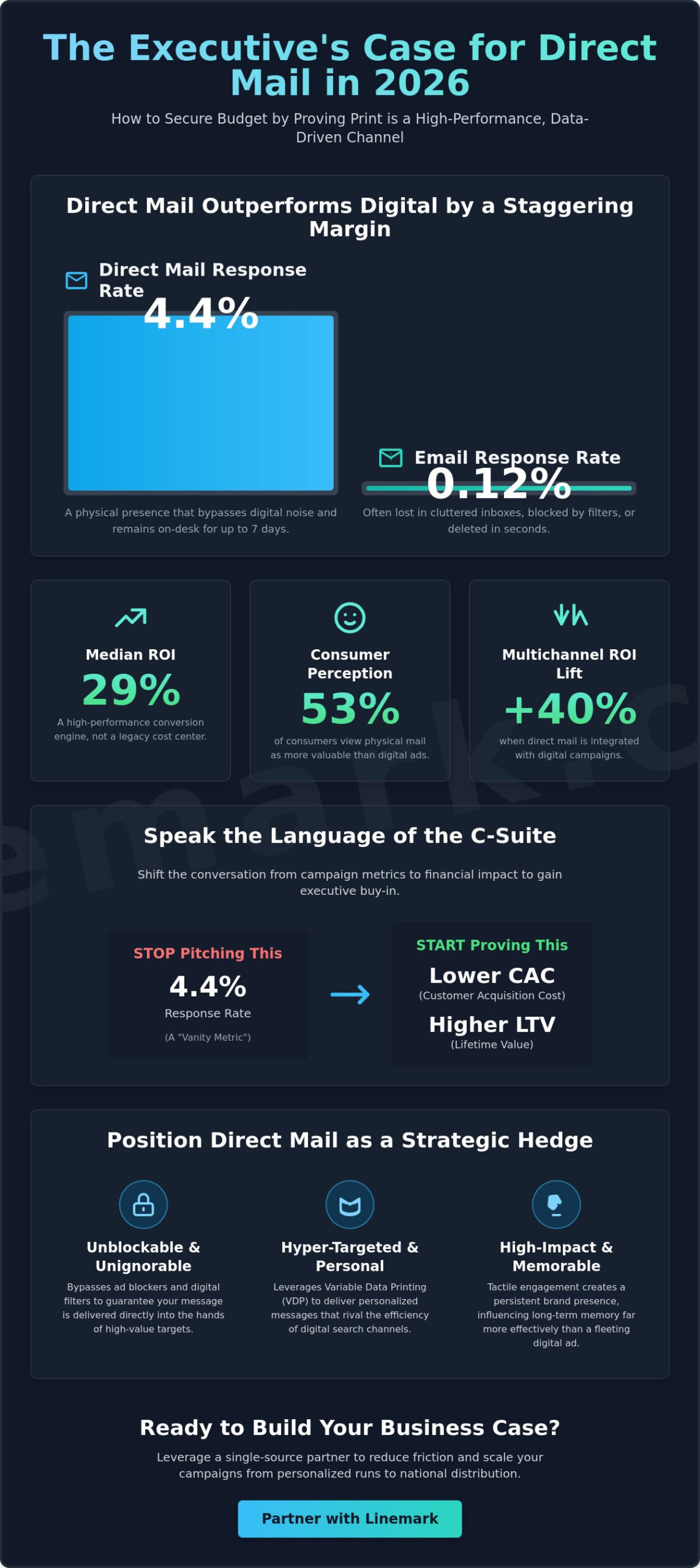
Why should your CFO approve a 5.1% postage rate increase on July 12, 2026, when digital impressions seem cheaper? The reality is that direct mail generates a 4.4% response rate, outperforming email’s 0.12% by a staggering margin. You’ve likely struggled to explain how to get executive buy-in for direct mail when leadership views print as a legacy cost rather than a strategic engine. It’s difficult to justify upfront expenses, which often range from $0.30 to $3.00 per piece, when your team can’t easily attribute offline conversions to digital budgets.
This guide changes that dynamic by positioning print as a high-performance, data-driven channel with a 29% median ROI. You’ll learn to present a clear framework that treats mail as an unblockable asset, especially since 53% of consumers now view physical mail as more valuable than digital clutter. We provide the roadmap to secure your 2026 budget by integrating variable data and automated fulfillment into your existing digital workflows. By the end, you’ll have the data-backed arguments needed to prove that a multichannel approach can increase your total ROI by 40%.
Key Takeaways
- Position direct mail as a “strategic hedge” against rising digital costs and algorithm volatility to reach high-value targets effectively.
- Master how to get executive buy-in for direct mail by translating campaign metrics into the financial language of Customer Acquisition Cost (CAC) and Lifetime Value (LTV).
- Dismantle the “junk mail” myth by presenting a business case for hyper-targeted Variable Data Printing (VDP) that rivals the efficiency of digital search channels.
- Establish a concrete attribution loop using a five-step pilot framework that proves how physical touchpoints drive measurable online conversions.
- Leverage a single-source partner to reduce the friction of execution, ensuring your campaign scales seamlessly from personalized runs to national distribution.
Why Direct Mail is a Strategic Priority in 2026
In 2026, the average B2B decision-maker faces a relentless stream of digital noise. This saturation has led to significant digital fatigue, making it nearly impossible to capture attention through traditional digital-only channels. Success requires a more sophisticated approach. Understanding how to get executive buy-in for direct mail begins with framing it as a strategic hedge against algorithm volatility and rising digital costs. By moving away from third-party cookie dependence, brands can use physical touchpoints to secure a permanent place in the customer’s environment. Using direct mail as a primary driver for engagement allows you to bypass the digital clutter and reach high-value targets directly.
To better understand how this channel bridges the gap to leadership, watch this helpful video:
The Rise of Digital Saturation
Digital CPMs have continued to climb, yet engagement rates are plummeting. While email response rates have bottomed out at 0.12%, physical mail has maintained a robust 4.4% response rate as of May 2026. This unblockable media is gaining ground in executive circles because it bypasses ad blockers and cluttered inboxes. It functions as a critical component of a holistic omni-channel strategy, ensuring your brand isn’t just a fleeting pixel on a screen but a physical presence in the office. Executives are increasingly receptive to this because it provides a predictable, privacy-compliant way to deliver messaging without relying on volatile tech stacks.
Direct Mail as a High-Impact Impression
Tactile engagement influences long-term memory in ways digital pixels cannot. While a digital ad might get two seconds of thumb-stop time, a well-designed postcard often remains on a prospect’s desk for seven days or more. This creates a persistent brand presence that reinforces your digital messaging. Direct mail acts as a data-driven physical touchpoint for the modern CRM, allowing you to trigger high-impact impressions based on real-time online behavior; for instance, when targeting professionals in the resource sector, you can discover MiningIR to stay updated on the news they care about. When 53% of consumers report that physical mail feels more real and valuable, the transition from a digital-only mindset to a physical-digital hybrid becomes a competitive necessity for any serious marketing budget.
Translating Direct Mail Metrics into Executive Language
Executives speak the language of growth and efficiency. To succeed in how to get executive buy-in for direct mail, you must pivot from vanity metrics like response rates to financial indicators like Customer Acquisition Cost (CAC) and Lifetime Value (LTV). While the 4.4% average response rate is a strong starting point, leadership needs to see how that translates into a scalable revenue model. You aren’t just buying paper and postage; you’re investing in a high-performance conversion engine that bypasses digital noise.
The “cost-per-touch” argument often stalls because it looks high on paper. However, when you compare it to the “cost-per-conversion,” the narrative shifts. High-intent physical mailings often deliver a lower CAC than competitive PPC keywords that suffer from click fraud and low conversion rates. Presenting these figures within the context of The Direct Mail Revival helps frame print as a modern, “tradigital” solution that aligns perfectly with corporate objectives for market share expansion.
The Direct Mail ROI Framework
Calculating a break-even response rate is the first step toward building financial credibility. If your average customer LTV is $5,000, a campaign costing $2.50 per piece only needs a fraction of a percentage in response to reach profitability. Executives prioritize LTV because it justifies the higher upfront investment required for physical media. Integrating this data into your existing Business Intelligence (BI) tools ensures that print is viewed as a high-tech asset rather than an isolated, manual expense. This level of transparency is exactly what leadership needs to approve a 2026 budget increase.
Proving Attribution in a Physical World
Proving the “Attribution Bridge” is where many marketers falter. Use unique QR codes, personalized URLs (pURLs), and dedicated offer codes to track every physical touchpoint back to a digital conversion. Match-back analysis allows you to link specific mail drops to online purchase data, even if the customer doesn’t use the provided code. This visibility proves the “halo effect,” where adding direct mail to your marketing mix can boost the ROI of digital channels by up to 40%.
By demonstrating that direct mail makes your email and social spend work harder, you position it as a multiplier for the entire department. LineMark serves as a single-source partner that simplifies this integration, providing the technical precision needed to close the loop between offline activity and digital reporting with absolute confidence.
Overcoming the ‘Digital-First’ Bias and Cost Objections
The “junk mail” stigma is a relic of the past. Executives who prioritize digital-first strategies often overlook the fact that mass-blast mailings have been replaced by hyper-targeted Variable Data Printing (VDP). To successfully navigate how to get executive buy-in for direct mail, you must demonstrate that modern print is as agile and data-driven as any social media algorithm. By leveraging first-party data, brands can deliver physical touchpoints that feel personal rather than intrusive. This shift in perception is critical for securing a 2026 budget that reflects the actual behavior of your high-value targets.
Precision Targeting through Variable Data Printing (VDP)
VDP transforms a standard postcard into a 1:1 communication tool. Instead of generic messaging, each piece can feature specific imagery, offers, and text based on a customer’s previous online behavior or purchase history. Research from May 2026 indicates that 64% of consumers are more likely to engage with personalized messaging. Even more striking, campaigns utilizing personalized imagery have seen response rates climb by 135%. By linking VDP directly to your CRM, you can trigger automated mailings based on specific events, such as a missed renewal or a high-value cart abandonment, ensuring your brand remains top-of-mind during key decision windows.
The Total Cost of Ownership (TCO) Argument
Leadership often fixates on the upfront cost of postage and paper. However, a strategic business case must account for the Total Cost of Ownership, which includes fulfillment, warehousing, and distribution. While digital ads might appear cheaper per impression, the conversion quality of direct mail is often significantly higher. You’re not just paying for a stamp; you’re paying for a physical presence on a decision-maker’s desk that lasts for days. To streamline these operational expenses, many firms utilize MarCom On-Demand. This platform allows for distributed marketing while maintaining strict brand control and reducing the friction of execution.
Choosing a single-source partner like LineMark eliminates the logistical overhead that often scares off executives. We handle everything from digital printing and offset printing to complex kitting and fulfillment. This integrated approach ensures that your direct mail program scales as effortlessly as a PPC campaign. By centralizing your inventory management and binding services under one roof, you reduce lead times and eliminate the hidden costs of managing multiple vendors. This operational excellence is the final piece of the puzzle in proving that direct mail is a scalable, modern asset for any 2026 marketing strategy.
Building the Business Case: A 5-Step Framework
Securing a 2026 marketing budget requires more than just enthusiasm; it demands a structured, risk-mitigated plan. When you’re determining how to get executive buy-in for direct mail, you must present a roadmap that looks less like a creative experiment and more like a scalable financial model. Leadership respects frameworks that prioritize data integrity and operational efficiency. By following a five-step approach, you can transform a conceptual idea into a concrete business initiative that aligns with high-level corporate goals.
- Step 1: Identify the high-value segment. Don’t pitch a mass-market drop. Focus on first-party data to target the top 20% of your audience that drives 80% of your revenue.
- Step 2: Define the attribution loop. Establish exactly how you’ll track every postcard back to a CRM record. This eliminates the “offline black hole” that often kills budget approvals.
- Step 3: Present a tiered budget. Offer a low-risk pilot phase followed by a performance-based scaled phase. This makes the initial investment feel manageable.
- Step 4: Align with digital workflows. Show how direct mail will trigger based on digital signals, such as a website visit or an abandoned cart, ensuring it’s not a siloed effort.
- Step 5: Select a scalable production partner. Prove that you have the infrastructure to execute without draining internal resources.
Designing the Pilot Program
A pilot program is your most effective tool for reducing executive anxiety. By starting with a small, highly targeted list, you can prove the 4.4% average response rate without committing to a massive national run. Set clear “Success Gates” to trigger the next phase of funding. If the pilot achieves a specific CAC target, the budget for a larger rollout is pre-approved. Use this phase for A/B testing creative formats. Does a high-gloss self-mailer outperform a personalized postcard? Finding these answers early ensures that your scaled investment is optimized for maximum ROI.
The Executive Pitch Deck Essentials
Your pitch deck must visualize the entire customer journey, highlighting the physical touchpoint as the “unblockable” moment that cuts through digital fatigue. Include competitor benchmarks to show that industry leaders are already leveraging the 53% consumer trust rate associated with physical mail. Conclude your presentation by framing LineMark as the single-source partner that transforms complex logistics into a streamlined, high-tech advantage. This positioning moves the conversation away from “printing costs” and toward “strategic communication excellence.”
Ready to build a data-backed case for your 2026 budget? Contact our team to request a consultation and see how our integrated fulfillment and variable data capabilities can support your pilot program.
Partnering for Scalability: The Linemark Advantage
LineMark acts as the strategic communications ally that bridges the gap between a marketing vision and industrial-scale execution. A primary hurdle in how to get executive buy-in for direct mail is the perceived complexity of managing physical logistics. By positioning LineMark as your single-source partner, you present a solution that eliminates vendor fragmentation and reduces the “friction of execution” that often stalls budget approvals. We operate as a high-capacity, well-oiled machine, handling everything from digital and offset printing to intricate binding and finishing under one roof. This centralized approach ensures that your brand’s precision is maintained across every touchpoint, whether you’re sending 500 custom books or 500,000 postcards.
Our role is to provide the industrial authority and technological pride required to instill confidence in your leadership team. We don’t just print; we integrate with your data to ensure that every mail piece is a high-performance asset. With over 30 years of fulfillment and logistics expertise, we mitigate the risks associated with large-scale distribution. This experience allows us to move seamlessly from boutique, personalized runs to national commercial distribution without sacrificing the meticulous attention to detail your high-value targets expect.
Integrated Fulfillment and Logistics
Effective direct mail in 2026 requires more than just a press; it requires a sophisticated logistics hub. Our 90,000-square-foot facility serves as the centralized engine for nationwide distribution, offering the kitting and fulfillment capabilities necessary for multi-component campaigns. This infrastructure allows you to manage inventory with absolute precision, preventing the waste and overspending that executives fear. For a deeper look at how these moving parts create a unified customer experience, consult our Direct Mail Strategic Guide.
The Future of Print-on-Demand
The MarCom On-Demand portals we provide give leadership the level of control they crave over both brand and budget. These platforms facilitate real-time inventory management and distributed marketing, allowing local teams to trigger mailings while the head office maintains strict brand standards. This technology integration bridges the gap between your CRM data and the physical press, enabling automated, event-triggered mailings that respond to customer behavior instantly. By providing this level of scalability and visibility, you prove that direct mail is a modern, tech-savvy investment rather than a legacy expense. Contact Linemark to build your direct mail business case today.
Secure Your 2026 Marketing Budget with Data-Driven Print
Success in 2026 requires moving beyond digital saturation to embrace high-impact, physical touchpoints. By shifting the conversation from “junk mail” to high-conversion metrics like LTV and CAC, you demonstrate a sophisticated understanding of modern marketing logistics. Mastering how to get executive buy-in for direct mail is about proving that print is a scalable, unblockable asset that boosts digital ROI by 40%. You’ve seen the framework for building a risk-mitigated business case; now it’s time to execute with precision.
LineMark provides the industrial authority and technical infrastructure to turn your strategy into a measurable success. With 30+ years of commercial printing expertise and a 90,000-square-foot high-tech production facility, we operate as your single-source partner for print, fulfillment, and distribution. We handle the complexity so your team can focus on growth. Partner with Linemark for your next high-impact direct mail campaign and transform your outreach into a high-performance revenue engine. Your 2026 goals are within reach, and we’re ready to help you achieve them with absolute confidence.
Frequently Asked Questions
How do I prove direct mail isn’t ‘junk mail’ to my CEO?
Proving quality starts with the data. You should highlight that direct mail maintains a 4.4% average response rate as of May 2026, which is nearly 37 times higher than email’s 0.12%. Explain that modern campaigns use Variable Data Printing (VDP) to deliver 1:1 personalized content based on first-party data. This isn’t a mass-blast approach; it’s a precision strike that reaches decision-makers in a physical environment where they can’t use an ad blocker.
What is the average ROI for direct mail in 2026?
Direct mail currently delivers a median ROI of 29% across all industries. For campaigns targeting house lists, this figure can climb as high as 161% because the audience already has an established relationship with the brand. These numbers provide the financial justification needed to offset the higher upfront costs of physical production compared to digital impressions.
Can direct mail be integrated with our existing CRM like Salesforce or HubSpot?
Yes, modern print workflows utilize API integrations to trigger mailings directly from your CRM. This automation is a critical component of how to get executive buy-in for direct mail because it aligns print with your existing digital tech stack. You can set triggers for specific customer milestones, such as a contract renewal date or a high-value website interaction, ensuring the mail piece arrives at the exact moment of peak interest.
How much should a direct mail pilot program cost?
Average costs for a campaign in 2026 range from $0.30 to $3.00 per piece, depending on the complexity of the design and the postage class selected. A pilot program should be sized to achieve statistical significance rather than total market coverage. By keeping the initial run targeted, you minimize the financial risk while gathering the performance data required to justify a larger, national rollout.
What is the best way to track offline-to-online conversions?
The most effective tracking methods include unique QR codes, personalized URLs (pURLs), and match-back analysis. QR codes provide an immediate digital bridge that you can track in real-time within your analytics dashboard. Match-back reporting allows you to compare your mailing list against your sales data to identify customers who converted online after receiving a physical touchpoint, even if they didn’t use a specific offer code.
Is direct mail more effective than email for executive outreach?
Direct mail is often more effective for high-level outreach because it solves the problem of digital fatigue. While an executive might receive 120 emails a day, they likely receive only a few pieces of high-quality physical mail. The tactile nature of a well-designed mailer creates a 7-day lifespan on a desk, whereas a digital ad or email is often dismissed or deleted in under two seconds.
How long does it take to see results from a direct mail campaign?
Most campaigns see the bulk of their responses within 7 to 21 days after the drop date. This timeline accounts for the USPS delivery window and the time a recipient spends interacting with the piece before taking action. Unlike digital ads that provide instant but often low-quality clicks, the results from mail tend to be more deliberate and involve higher-value conversions.