

 05/05/2026
  Steve Bearden
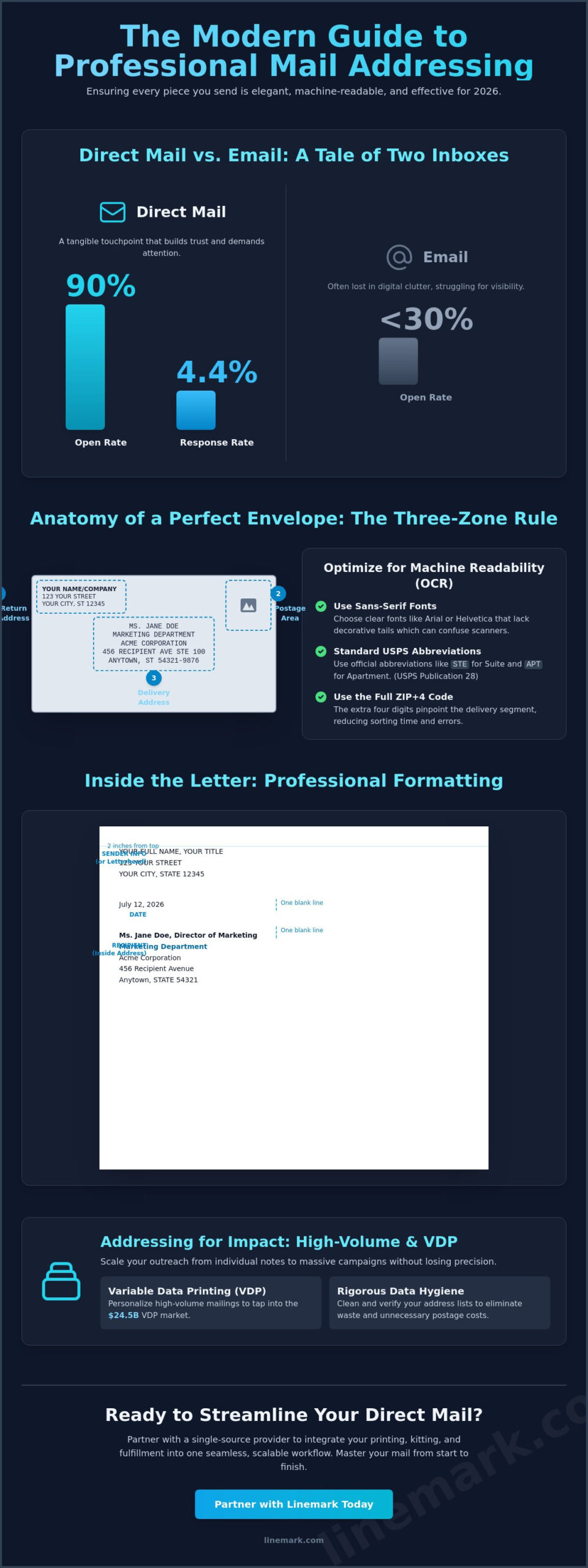
Did you know that 80% to 90% of direct mail is opened by recipients, while email often struggles to reach a 30% open rate? In an increasingly digital marketplace, the physical letter remains a powerful tool for building trust and driving a 4.4% average response rate. You likely recognize the value of a tangible touchpoint, but you also know the frustration of seeing critical correspondence returned due to a minor technical oversight. A single error in your address for a letter format can disrupt your entire communication chain and waste valuable resources.
Modern sorting machines thrive on clarity and contrast. To achieve peak efficiency, you should use sans-serif fonts like Arial or Helvetica, as these lack the decorative tails that can confuse OCR sensors. USPS guidelines from the April 6, 2026, Domestic Mail Manual (DMM) recommend using all-caps and omitting punctuation whenever possible. For example, “123 MAIN ST STE 400” is processed faster than “123 Main St., Suite 400.” You must also maintain a “clear zone” of 5/8 of an inch at the bottom of the envelope. This space is reserved for the barcode that machines print during the sorting process. If your design or text encroaches on this area, the piece may require manual handling, which delays delivery and increases costs. For businesses that manage their own labeling, sourcing professional-grade supplies from DymoOnline can help ensure the high contrast and precision needed for these automated systems.
We’ll show you how to master professional addressing standards for 2026, ensuring every piece you send is both elegant and machine-readable. This guide provides clear templates for business letters and explains the latest USPS requirements from the April 6, 2026, Domestic Mail Manual. You’ll gain the technical precision needed to scale your outreach, from individual executive notes to high-volume campaigns that leverage the $24.50 billion variable data printing market. Mastering these standards is the first step in transforming your mail from a simple delivery into a strategic asset with Linemark as your partner.
Key Takeaways
- Master the three-zone rule and standard USPS abbreviations to ensure your mail is machine-readable and reaches its destination without delay.
- Implement the modern full block address for a letter format to maintain a consistent and professional aesthetic across all business communications.
- Leverage Variable Data Printing and rigorous data hygiene to personalize high-volume campaigns and eliminate unnecessary postage costs.
- Partner with a single-source provider to integrate your printing, kitting, and fulfillment into one seamless, scalable workflow.
The Anatomy of an Address: Internal Letter Formatting
Precision starts before the envelope is even sealed. While many focus on the external delivery, the internal layout of a document serves as the first impression for your recipient. A correctly structured address for a letter format signals that your organization values detail and adheres to established business letter formats. This internal framing isn’t just about etiquette; it creates a logical flow for the reader and ensures that your contact information is immediately accessible for future reference.
To better understand the foundational steps of mailing, watch this helpful video:
Formatting the Sender’s Information
The sender block acts as the cornerstone of your professional identity. If you’re utilizing custom corporate letterhead, you should omit your individual name from this section to avoid redundancy. However, if you’re writing on plain paper, include your full name and title to establish authority. In 2026, professional standards require the sender’s address to be positioned at the top of the page, either flush left or centered depending on your chosen style. This block provides the recipient with the necessary context to categorize your correspondence immediately.
Following the sender information, the dateline serves as a chronological anchor. The standard US format remains Month Day, Year, such as July 12, 2026. You should place the date one line below the sender’s address. If you’re using letterhead, the date usually sits two inches from the top of the page or one line below the printed header. This simple line of text is vital for record-keeping and time-sensitive business transactions.
The Recipient Block (Inside Address)
The inside address identifies the recipient and must be aligned with the left margin. Accuracy here is paramount. In 2026, courtesy titles such as Mr., Ms., or Dr. remain the standard for formal outreach. When you’re contacting a large corporate entity, always include the specific department name on a separate line below the recipient’s title. This ensures that the document reaches the correct desk even if it’s separated from its envelope. This level of detail mirrors the precision required in modern address for a letter format standards used across the industry, particularly in sensitive sectors like legal advocacy. For instance, Marker Law emphasizes such accuracy to ensure that critical correspondence for injury victims and workers’ compensation claimants is never delayed by technical errors.
Maintaining a clean, professional aesthetic requires strict adherence to vertical spacing. Leave one blank line between the date and the recipient block. Then, leave another blank line before the salutation. These white spaces aren’t just decorative; they improve legibility and provide the breathing room that characterizes high-end business communications. Precision in these small details reflects the same operational excellence that drives successful logistics and communication strategies.
Envelope Address Placement and USPS Standards
Precision on the page must translate to precision on the envelope. While the internal letter layout establishes your professional tone, the external addressing determines whether your message arrives at all. The United States Postal Service (USPS) utilizes high-speed Optical Character Recognition (OCR) systems that process thousands of pieces per hour. To ensure your mail moves through this system without friction, you must adhere to the three-zone rule. This rule divides the envelope into distinct areas: the return address in the top-left, the postage in the top-right, and the delivery address centered in the primary “read zone.”
Technical accuracy in your address for a letter format relies heavily on standardization. You should always consult the official USPS addressing standards, specifically Publication 28, to verify abbreviations for secondary unit designators like Suite (STE) or Apartment (APT). Using the full ZIP+4 code is equally vital. This four-digit add-on identifies a specific delivery segment, such as a floor or a group of apartments, which significantly reduces sorting time and minimizes the risk of mail being returned as undeliverable.
Optimizing for Machine Readability
Modern sorting machines thrive on clarity and contrast. To achieve peak efficiency, you should use sans-serif fonts like Arial or Helvetica, as these lack the decorative tails that can confuse OCR sensors. USPS guidelines from the April 6, 2026, Domestic Mail Manual (DMM) recommend using all-caps and omitting punctuation whenever possible. For example, “123 MAIN ST STE 400” is processed faster than “123 Main St., Suite 400.” You must also maintain a “clear zone” of 5/8 of an inch at the bottom of the envelope. This space is reserved for the barcode that machines print during the sorting process. If your design or text encroaches on this area, the piece may require manual handling, which delays delivery and increases costs.
Return Address Etiquette
The return address is your safety net against “Undeliverable as Addressed” (UAA) mail. It should be placed in the top-left corner and include the sender’s name, company, and full address. Proper return formatting allows the USPS to return the piece to you if the recipient has moved without a forwarding address, providing you with critical data to clean your mailing list. For organizations looking to scale these technical requirements, our team offers specialized Direct Mail Marketing solutions that automate every detail. By integrating these standards into your workflow, you transform a simple envelope into a precision-engineered delivery vehicle. If you’re managing complex projects, partnering with a seasoned expert can ensure your address for a letter format remains compliant with the latest 2026 regulations.
Choosing Between Block, Modified Block, and Indented Styles
The selection of an address for a letter format is a strategic decision that influences both production speed and recipient perception. While modern business favors speed, certain high-value interactions still benefit from traditional layouts. You must ensure that your choice is consistent across the entire document. A mismatch between the address block and the body text creates a disjointed, unprofessional appearance that can undermine your message. Selecting the right style is about balancing your operational needs with the specific expectations of your audience.
Full Block: The Industry Standard
Full Block style has become the definitive modern standard for corporate communications. In this layout, every element, from the sender’s information to the closing, is flush with the left margin. This structure is highly efficient for digital templates and automated workflows. According to a comprehensive business letter writing guide, this lack of indentation simplifies the reader’s visual path. For organizations managing high-volume mailings, block formatting is essential. It minimizes alignment errors in variable data printing by removing the need for complex tab stops. This is especially critical in a global VDP market projected to reach $24.50 billion by late 2026. By utilizing this format, you ensure that every personalized piece remains perfectly aligned during high-speed production cycles.
When to Use Modified Block or Indented
Modified Block and Indented styles offer a more traditional alternative for executive correspondence or “boutique” communications. In a Modified Block layout, the date and the closing are aligned toward the right side of the page, while the rest of the content remains left-justified. Indented or Semi-Block styles go a step further by indenting the first line of every paragraph. These formats are often preferred for high-touch marketing where a handcrafted feel is desired. There is a psychological weight to these traditional styles; they signal a level of personal attention that standard block letters might lack. This meticulous attention to detail is similar to the precision required in custom book printing, where layout serves as a key indicator of quality and authority.
Consistency is the final piece of the puzzle. If you select a specific address for a letter format, that choice must dictate the spacing and alignment of the entire letter. Mixing styles suggests a lack of oversight. For example, using an indented address block with a full block body creates a visual conflict that can distract the recipient. By maintaining a uniform style, you project the image of a seasoned expert who values precision. This steady approach builds a sense of security, making the reader feel that their relationship with your brand is in capable hands.
Addressing for Impact: High-Volume and Variable Data Printing
Scaling from a single executive letter to a national marketing campaign requires a fundamental shift from manual entry to automated precision. In 2026, the US direct mail industry is projected to reach a market value of $73.57 billion, a growth driven by the integration of sophisticated data and high-speed production. While a standard address for a letter format serves individual correspondence well, high-volume projects utilize Variable Data Printing (VDP) to merge complex customer databases with design templates. This technological synergy ensures that every recipient receives a piece tailored to their specific profile without compromising the structural integrity of the mailpiece.
The Role of Variable Data in Direct Mail
VDP technology allows our automated systems to pull unique address records directly into pre-set layouts with surgical accuracy. This ensures that the technical standards we’ve established, such as machine readability and OCR optimization, remain consistent across a run of 100,000 pieces as easily as ten. For distributed marketing teams, our marcom on-demand portals provide a single-source solution for managing these complex data sets. By automating the address for a letter format through these platforms, you eliminate the risk of human error during the data entry phase. This level of automation is essential in a global VDP market estimated to be valued at $24.50 billion by the end of 2026.
Data Standards for National Distribution
Clean and accurate data is the only defense against rising postage costs. With the price of a First-Class Forever stamp scheduled to increase to 82 cents on July 12, 2026, minimizing undeliverable mail is a financial imperative. We utilize CASS (Coding Accuracy Support System) certification to verify every address against the latest USPS data before production begins. Additionally, NCOA (National Change of Address) updates ensure your mailing list accounts for the millions of Americans who move each year. These hygiene practices don’t just prevent waste; they unlock presorted mail discounts that significantly lower your total investment.
True impact is achieved when you balance this technical precision with a focus on the recipient. Research indicates that adding a name to direct mail can increase response rates by 135%. We often pair this personalization with digital bridges, such as QR codes placed near the address block, to drive traffic to customized landing pages. This is a proven strategy, as 44% of customers visit a brand’s website after receiving a physical mailer. If you’re ready to enhance your outreach, our team can help you leverage Direct Mail Marketing solutions that combine industrial capacity with meticulous detail.
Streamlining Your Direct Mail with Linemark’s Fulfillment Solutions
Mastering the technical nuances of an address for a letter format is only the first step in a successful communication strategy. The real challenge lies in executing those standards across thousands of unique pieces without a single deviation in quality. This is where the Linemark experience transforms a complex logistical hurdle into a streamlined success. As your single-source partner, we bridge the gap between initial design and final distribution. We ensure that every professional standard discussed in this guide is applied with industrial precision, regardless of whether you’re sending a dozen executive summaries or a national marketing campaign.
Our approach centers on operational excellence that extends far beyond the printing press. We don’t just print your documents; we optimize them for the entire mailing lifecycle. With postage costs continuing to adjust under the “Delivering for America” plan, there’s no room for formatting errors that lead to returned mail or manual processing surcharges. Our team integrates your data with the correct postal zones and machine-readable fonts to secure the lowest possible rates and the fastest delivery times. This strategic alignment between formatting and fulfillment is what sets a professional campaign apart from an amateur effort.
Precision in Every Print Run
Operating out of our 90,000-square-foot facility, we have the capacity to manage national distribution projects that require meticulous attention to detail. Every commercial project we handle undergoes a rigorous quality control process to verify that the address for a letter format complies with the latest USPS standards. This Linemark difference means your high-volume campaigns maintain the same sophisticated look as a hand-addressed executive note. We combine the high-capacity production of an industrial leader with the meticulous care of a boutique shop, ensuring your brand identity remains intact across every zip code.
Ready to Scale Your Communications?
Transitioning your outreach from manual processes to automated workflows reduces administrative overhead and eliminates the risk of human error. We provide expert consulting on letter layout and formatting to maximize delivery success before the first sheet of paper hits the press. Whether you’re sending annual reports or complex direct mail marketing campaigns, our technology-driven solutions provide the scalability your growth demands. Our integrated fulfillment and inventory management systems allow you to focus on your core business while we handle the nuances of modern logistics. Partner with Linemark for your next direct mail campaign to experience a seamless, high-tech journey from concept to mailbox.
Elevating Your Outreach with Technical Precision
Consistency in your physical correspondence is more than a matter of etiquette; it is a vital component of your brand’s operational integrity. By mastering the technical address for a letter format, you ensure that every piece of mail reinforces your professional authority. We have examined how adhering to USPS standards and choosing the right layout style can prevent delivery delays and reduce resource waste. These small adjustments in formatting are the building blocks of a robust communication strategy that bridges the gap between traditional reliability and modern efficiency.
Linemark stands ready to serve as your strategic communications ally, bringing over 30 years of industrial printing expertise to your most complex projects. From our 90,000-square-foot high-tech production facility, we act as a primary partner for national non-profits and major corporations seeking precision at scale. Our team understands that the success of your outreach depends on the seamless integration of data and design. Let Linemark handle your high-volume direct mail and fulfillment needs to ensure your message reaches its destination with perfect clarity. Your project is in capable, steady hands, and we are committed to driving your continued growth.
Frequently Asked Questions
Do I need to include the recipient’s name if I have their job title?
Including a name is essential for establishing a direct connection and establishing professional rapport. While a job title ensures the letter reaches the correct office, adding a specific name can increase response rates by 135% according to industry data. If you’re unsure of the name, you should prioritize the department title to ensure the document is routed correctly within the organization’s internal mail system.
Is it mandatory to use all capital letters on an envelope in 2026?
Using all capital letters isn’t strictly mandatory, but it’s the preferred standard for the United States Postal Service in 2026. Sorting machines process all-caps text with greater speed and accuracy than mixed-case text. By adopting this address for a letter format on your envelopes, you minimize the risk of manual sorting delays and ensure your mail moves through the system with maximum efficiency.
What is the correct way to format an international address for a letter?
International addresses require the recipient’s country name to be written in all capital letters on the very last line. For example, if you’re sending a 1-ounce letter at the $1.75 rate effective July 12, 2026, the country name should stand alone. The rest of the address should follow the standards of the destination country, typically listing the city and postal code above the country line.
Where does the attention line go in a business letter format?
The attention line should be placed on the first line of the address block, appearing before the recipient’s name or company name. This ensures that mailroom staff identifies the specific intended reader immediately upon delivery. In a professional address for a letter format, the attention line serves as a critical routing instruction that prevents your correspondence from being delayed in a general corporate inbox.
How do I address a letter to multiple people at the same company?
You should list multiple recipients on separate lines in alphabetical order by their last names. If the recipients have significantly different job ranks, you may list them by seniority instead. For groups larger than three people, it’s often more efficient to use a collective title, such as “Marketing Department Executive Team,” to maintain a clean and professional appearance on the envelope.
What font size is best for an address on a standard #10 envelope?
A font size between 10 and 12 points is ideal for a standard #10 envelope. This range ensures that the text is large enough for OCR sensors to read while remaining small enough to fit within the designated delivery address zone. You should avoid decorative or condensed fonts, as these can trigger sorting errors that result in your mail being diverted for manual processing.
Should I include a phone number or email in the address block?
You should generally omit phone numbers and email addresses from the external address block. These elements can confuse sorting machines that are programmed to look for specific delivery data like street numbers and zip codes. It’s better to place your secondary contact information within the letterhead or the signature block of the document itself to maintain a professional and uncluttered presentation.
How does a ZIP+4 code actually speed up my delivery?
A ZIP+4 code identifies a specific delivery segment, such as a single floor in a high-rise or a specific group of houses. By providing this extra detail, you allow USPS machines to sort your mail directly to the individual mail carrier’s route. This precision eliminates several manual sorting steps at the local post office, which can shave hours or even a full day off the total delivery time.