

 05/04/2026
  Steve Bearden
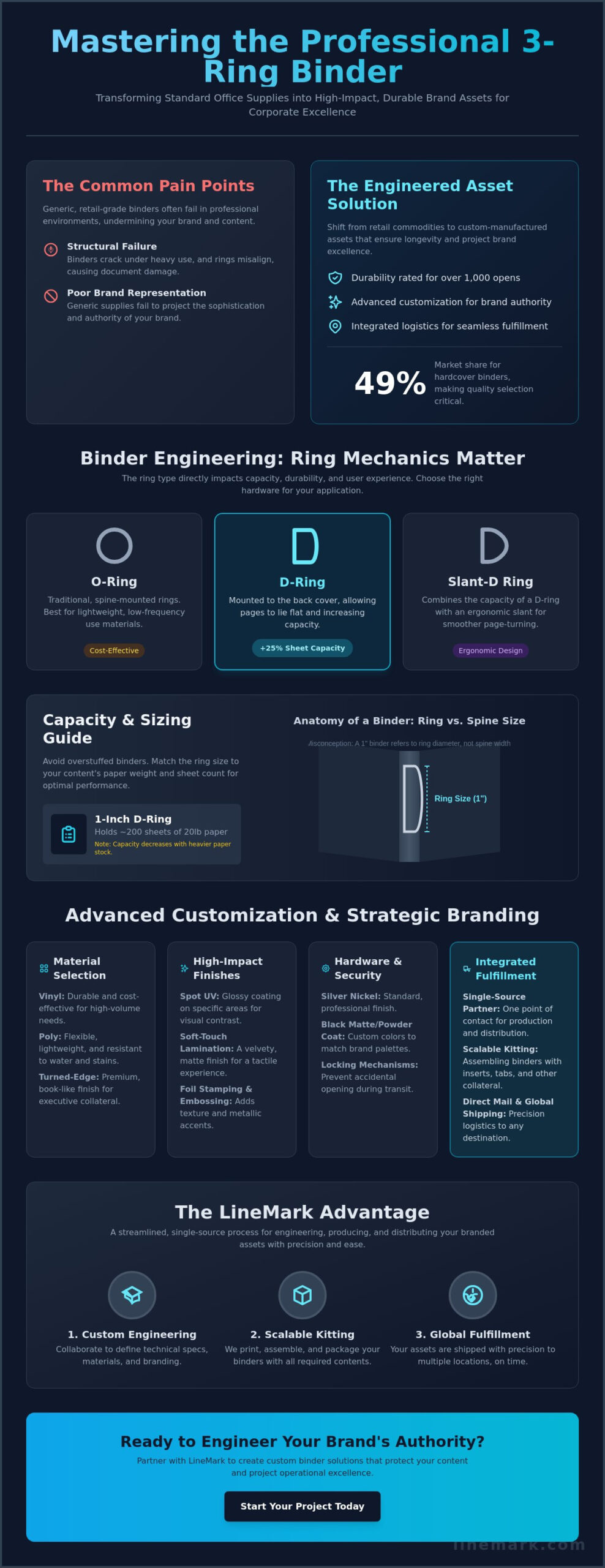
Hardcover binders account for 49% of the total market share as of 2025, yet many organizations still struggle with generic supplies that fail under pressure. You recognize the frustration of investing in high-quality content only to have it housed in a 3 ring binder that cracks during heavy use or arrives at its destination with damaged inserts. It’s a common pain point for professionals who need their physical collateral to mirror the sophistication of their brand while managing the complexity of global fulfillment.
We agree that your corporate materials should be as durable as they are professional. This guide promises to help you master the technical specifications and customization options required to select high-volume binders that protect your content and project absolute brand authority. We will explore how angled D-rings increase sheet capacity by 25% and show you how the LineMark experience simplifies the logistics of kitting and shipping your branded assets to multiple locations with precision and ease. As your single-source partner, we ensure your technical manuals and annual reports maintain their integrity from the production line to the boardroom.
Key Takeaways
- Learn how to evaluate ring mechanics and durability ratings to ensure your document lifespan exceeds 1,000 opens in high-frequency corporate environments.
- Identify the ideal material for your 3 ring binder by matching vinyl, poly, or turned-edge solutions to specific end-user environments and 2026 environmental standards.
- Explore advanced customization techniques like spot UV and soft-touch lamination that transform standard organizational tools into high-impact marketing canvases.
- Streamline your national distribution by integrating direct mail logic and scalable kitting through a single-source partner model.
- Transition from purchasing retail commodities to engineering custom-manufactured assets that project brand authority and operational excellence.
Defining the Professional 3-Ring Binder for Business Success
A professional 3 ring binder is far more than a simple office supply; it’s a heavy-duty organizational tool engineered for high-frequency access and brand representation. In 2026, the shift from retail commodities to custom-manufactured corporate assets is driven by the need for durability and precise brand alignment. While the History of the ring binder highlights its origins as a basic filing solution, modern enterprises now view it as a strategic communication tool. High-capacity operations require binders that don’t just hold paper but also protect intellectual property and project a sense of industrial authority.
Selecting a single-source partner for binder production ensures that your technical specifications align with your logistics requirements. This collaborative approach eliminates the friction often found when coordinating between multiple vendors for printing, assembly, and distribution. By treating the binder as a custom asset, you secure a product that can withstand the rigors of a warehouse or a medical facility while maintaining the aesthetic standards of a boardroom. Binders remain the preferred choice for training and compliance manuals in 2026 because they provide a tactile, reliable reference that digital alternatives can’t always replicate, especially in high-stakes environments.
The Role of Binders in Modern Corporate Communication
Physical binders facilitate hands-on training in complex industrial and medical sectors where trainees need to flip through pages quickly without relying on a battery or an internet connection. For executive leadership, a custom binder provides a high-authority reference for board meetings and annual reports, offering a tangible sense of stability and permanence. In environments where digital access is restricted for security or practical reasons, such as clean rooms or remote field sites, the physical binder ensures information longevity and immediate availability.
Capacity Planning: Matching Size to Content
Precision in capacity planning prevents the common issue of overstuffed rings that damage document holes. You must calculate sheet capacity based on specific paper weights; for example, a 1-inch ring typically holds 175 to 200 sheets of standard 20lb bond paper, but that capacity drops significantly when using premium 80lb gloss stock for high-end catalogs. It’s also vital to understand the “Spine vs. Ring” size misconception. A 1-inch ring size refers to the internal diameter of the ring itself, while the actual spine of the binder will be wider, often measuring 1.25 to 1.5 inches, to accommodate the hinge mechanics and cover thickness. Whether you’re utilizing standard 8.5 x 11 dimensions or specialty sizes for unique documentation, getting these technical measurements right is the first step toward operational excellence.
Binder Engineering: Comparing Ring Types and Mechanics
Engineering a 3 ring binder requires a deep understanding of the physics of page turning. Every time a user flips a document, the friction between the paper and the metal ring creates stress. For high-frequency environments, we specify hardware rated for 1,000+ opens to prevent the mechanical fatigue that leads to misalignment. Beyond basic functionality, the ring serves as the core of The Ring Binder as an Ordering Device, ensuring that complex information systems remain intuitive and intact during years of operation.
Hardware finish options provide the final touch of professional authority. While standard silver nickel is common, black matte or custom powder-coated rings can match specific brand palettes. For binders used in transit, locking mechanisms are essential. These triggers require a deliberate action to open, preventing accidental document spills if the binder is dropped. This level of mechanical precision is a hallmark of the LineMark approach to durability, where every component is selected for its performance under pressure.
O-Ring vs. D-Ring vs. Slant-D
The O-Ring is the traditional, cost-effective choice for lightweight reference materials. However, because the rings are mounted to the spine, pages must travel over the curve, which can cause document curling. The D-Ring is a superior alternative for high-volume projects. By moving the straight edge of the ‘D’ to the back cover, you increase sheet capacity by up to 25% compared to O-rings of the same size. Slant-D rings offer the best ergonomic experience for heavy manuals. The angled design reduces stress on paper holes and allows for the smoothest page transition available in modern binding.
Mounting Options: Back-Lid vs. Spine
Mounting location dictates how a binder behaves when opened and how it appears on a shelf. Back-lid mounting is the professional standard because it allows the binder to lay completely flat. This prevents the ‘page lift’ that occurs with spine-mounted rings, where the documents are forced upward by the curvature of the spine. While spine mounting is a traditional method, it’s often prone to ‘ring gap’ issues over time as the weight of the paper pulls on the mechanism. Furthermore, back-lid mounting leaves the spine entirely smooth. This provides a clean, unobstructed surface for branding and titles, ensuring maximum visibility and a cohesive look when binders are stored in rows.
Material Selection: Vinyl, Poly, and Turned-Edge Solutions
Material selection is a strategic decision that dictates how your brand survives in the field. In 2026, the global market for polypropylene has reached a valuation of $157.8 billion, reflecting a massive shift toward durable, industrial-grade plastics. However, material choice isn’t just about strength; it’s about matching the 3 ring binder to its specific end-user environment. While a laboratory requires chemical resistance, a corporate boardroom demands a tactile experience that projects authority. Environmental considerations are also at the forefront. Eco-friendly paperboard binders are currently growing at a CAGR of 6.4%, now holding 54% of the material share as companies move away from traditional plastics to meet new sustainability regulations.
Choosing the right substrate ensures your information remains accessible for years. We help you evaluate the trade-offs between cost, durability, and aesthetics to find a solution that fits your specific scale. Whether you’re deploying thousands of manuals to a warehouse or presenting a high-stakes annual report, the material is the foundation of the LineMark experience.
Vinyl Binders: The Versatile Standard
Vinyl remains the most frequent choice for high-volume distribution of training materials. It’s highly cost-effective and offers a wide variety of colors to match corporate palettes. The clear-view pockets allow for easy insert swaps, making them ideal for dynamic content. You should be aware of ‘cold crack’ in extreme temperatures below freezing and the potential for ink transfer from printed inserts if non-copy-safe vinyl isn’t specified. It’s a reliable workhorse for controlled office environments.
Polypropylene (Poly) Binders: Industrial Strength
Polypropylene is virtually indestructible and lightweight, making it the superior choice for field manuals and heavy machinery guides. It’s resistant to water, grease, and stains; it’s also highly resilient against chemical exposure in laboratory settings. While branding is typically limited to screen printing, the material’s longevity is unmatched. If your binders will be used outdoors or in high-moisture areas, poly is the industrial solution that won’t fail.
Turned-Edge (Litho-Wrap) Binders: The Premium Choice
Turned-edge binders provide the ultimate branding canvas by wrapping custom-printed sheets around heavy-duty binders board. This construction creates a ‘hardcover book’ feel that immediately elevates your brand’s perceived value. You have unlimited design potential with full-color offset printing and specialized finishes like soft-touch lamination. By integrating custom book printing techniques, we create a cohesive brand look that bridges the gap between a standard binder and a luxury publication.
Advanced Customization and Strategic Branding
Internal branding is equally critical for a cohesive user experience. We often recommend printed liners and custom-cut index tabs to ensure your brand identity remains front and center even when the binder is in active use. This is where the LineMark difference becomes apparent. As a single-source partner, we integrate MarCom On-Demand logic into your production cycle. This allows for localized customization, ensuring that a binder delivered to a regional office in Seattle feels just as relevant and branded as one sent to your headquarters. You can consult with our specialists to explore how these advanced finishes can elevate your next project.
Variable Data Printing (VDP) for Personalization
Digital printing technology has evolved to allow for deep personalization through Variable Data Printing (VDP). You’re no longer limited to identical copies for every recipient. Instead, you can customize individual binders with the names of specific employees, unique department codes, or regional data sets. Including a personalized welcome letter or a data-driven regional insert directly into the binder assembly increases employee engagement and information retention. It shows a level of investment in the individual that generic, mass-produced materials simply can’t match.
Digital Asset Management for Binders
Managing brand consistency across national offices is a complex logistical challenge. Our web-to-print portals simplify this by providing a centralized hub for all your digital assets. This system ensures that every 3 ring binder produced meets your exact brand standards, regardless of where it’s ordered. By automating the reorder process for high-turnover materials like training manuals, you eliminate the risk of stockouts. Printing and assembling on-demand also reduces the waste associated with bulk inventory that might become obsolete before it’s ever used. It’s an agile approach to traditional logistics that values both efficiency and precision.
The Linemark Advantage: Scalable Fulfillment and Kitting
Retailers often treat the binder as a standalone item, but for a high-capacity operation, the binder is only half of the equation. True operational excellence requires a single-source partner that can bridge the gap between manufacturing and final delivery. We integrate the same precision found in our direct mail operations into national 3 ring binder distribution. This ensures that every kit is tracked, verified, and delivered with the same data-driven accuracy used in high-volume mailing campaigns. For organizations facing the March 2, 2026 deadline for OSHA injury and illness data submissions, this level of fulfillment precision is vital for maintaining compliance documentation across multiple sites.
Comprehensive Kitting and Assembly
Our facility handles both automated and manual kitting for complex sets. Whether your project requires simple collated pages or the inclusion of value-add items like branded USB drives, pens, or supplemental brochures, we manage the assembly with meticulous detail. We apply specialized expertise in binding & finishing to ensure that the internal contents are as durable and professional as the binder itself. This integrated model eliminates the risk of coordinating between separate printers and fulfillment houses, saving you time and reducing the margin for error.
National Logistics and Distribution Excellence
Distribution is where scale meets precision. We utilize advanced data processing to manage multi-location shipping, providing real-time inventory management for large-scale corporate programs. You can monitor your stock levels and track shipments through our tech-forward portals, giving you total visibility into your project’s progress. The LineMark experience is built on this foundation of transparency and reliability. We don’t just ship products; we manage a transformative journey that guarantees your brand authority is maintained from the moment a 3 ring binder leaves our facility until it reaches the hands of your end-user.
Engineering Your Brand for Long-Term Performance
Selecting the right 3 ring binder is a technical decision that impacts both your operational efficiency and brand perception. You’ve learned how D-ring mechanics increase capacity by 25% and why material choice must align with your specific end-user environment. Transitioning from a retail commodity to a custom-engineered asset ensures your documentation remains protected for years. By integrating advanced customization with scalable fulfillment, you transform a simple organizational tool into a powerful communication catalyst.
LineMark brings 30+ years of commercial printing expertise to every project. Our 90,000-square-foot high-capacity facility handles complex kitting and national distribution with industrial precision. As a G7 Master Qualified Printer, we guarantee color accuracy that maintains your brand integrity across every location. Experience the LineMark difference today. You can request a custom binder production and fulfillment quote from LineMark to secure a partner dedicated to your growth. We look forward to building a durable solution that represents your brand with absolute authority.
Frequently Asked Questions
What is the most durable type of 3-ring binder for industrial use?
Polypropylene (poly) binders are the most durable choice for industrial environments. These binders are virtually indestructible and resist water, grease, and stains; they’re also highly resilient against chemical exposure. In 2026, poly’s market dominance is driven by its ability to survive in warehouses and field sites where standard vinyl might crack or peel. We recommend this material for heavy machinery guides and safety manuals that face daily physical stress.
How do I calculate the sheet capacity for a 2-inch D-ring binder?
A 2-inch D-ring binder holds approximately 450 to 500 sheets of standard 20lb bond paper. This specific ring style provides 25% more capacity than a standard round ring of the same size. You must adjust your calculations if you’re using heavier stock; for instance, 80lb gloss paper will reduce total capacity by roughly 30%. Precise capacity planning ensures your 3 ring binder functions smoothly without damaging document holes during frequent use.
Can I customize the interior liners of a turned-edge binder?
You can fully customize the interior liners of a turned-edge binder with full-color offset or digital printing. This technique allows your brand identity to extend across the entire surface, creating a cohesive and high-end aesthetic. Many organizations use this space for mission statements, quick-reference charts, or regional contact information. It’s a standard feature of the LineMark experience that transforms a simple tool into a premium corporate asset.
What is the difference between a view binder and a non-view binder?
The primary difference lies in the cover construction; a view binder has clear plastic pockets for interchangeable inserts, while a non-view binder features a solid surface with permanent branding. View binders are ideal for high-turnover projects where titles change frequently. Non-view binders utilize screen printing, foil stamping, or litho-wrap for a more permanent and professional appearance. Choosing the right style depends on whether your content is static or dynamic.
How does a MarCom portal simplify ordering binders for multiple offices?
A MarCom portal simplifies ordering by centralizing your brand assets in a secure, web-to-print environment. This system allows regional managers to order a custom 3 ring binder on-demand, ensuring 100% brand consistency across every office. It eliminates the need for large local inventories and reduces the risk of using obsolete materials. Our single-source partner model integrates this technology to streamline your national distribution and logistics.
What are the benefits of back-lid ring mounting versus spine mounting?
Back-lid ring mounting is the superior choice because it allows the binder to lay completely flat when opened. This prevents the “page lift” and curling often associated with spine-mounted rings, where the documents are forced upward by the spine’s curvature. Back-lid mounting also leaves the spine unobstructed for clean, professional branding. This mechanical detail is essential for manuals that require frequent hands-on reference in professional settings.
How long does it take to manufacture a custom run of 1,000 binders?
Manufacturing a custom run of 1,000 binders typically requires 10 to 15 business days following final proof approval. This timeline covers the precision printing, board cutting, and hardware assembly stages in our 90,000-square-foot facility. If your project includes complex kitting or specialized finishes like spot UV, we may adjust the schedule to ensure every detail meets our G7 Master Qualified standards. We prioritize operational excellence to meet your specific distribution deadlines.
Is it possible to integrate variable data printing on binder covers?
It is entirely possible to integrate variable data printing (VDP) on binder covers to personalize each unit for specific recipients. Using our advanced digital printing capabilities, we can include individual names, unique department codes, or regional data sets on every cover in a single production run. This level of personalization increases user engagement and makes each binder a more effective communication tool. It’s an agile solution for organizations that value precise, data-driven marketing.