


 04/13/2026
  Steve Bearden
A tracking number offers zero value if it simply confirms your high-stakes shipment is “In Transit, Arriving Late” while a critical campaign deadline passes. You’ve likely felt the sting of vague status updates or the common industry confusion surrounding united postal service tracking and its official USPS counterparts. It’s a frustration that costs modern enterprises time and capital. As your strategic communications ally, we believe visibility should be a given, not a guessing game.
This guide empowers you to master logistics by decoding the technical nuances of the 2026 landscape. You’ll learn to utilize the Intelligent Mail barcode (IMb) system to gain 100% visibility into your direct mail campaigns and reduce the 15% delivery delay rate often caused by improper preparation. We’ll examine how to transform vague data into actionable fulfillment intelligence, ensuring your projects move from the press to the porch with surgical precision. This is the LineMark experience: turning complex logistics into a streamlined, scalable solution for your brand.
Key Takeaways
- Identify the structural differences within the USPS network to ensure your logistics terminology aligns with professional industry standards.
- Trace the journey of a mailpiece from fulfillment to the final mile, understanding the critical roles of distribution centers in the data-capture process.
- Decode frustrating status updates and learn how to maintain visibility over your assets even when united postal service tracking appears to pause during transit.
- Elevate your direct mail strategy by integrating tracking data into multi-channel marketing workflows that trigger timely digital engagements.
- Discover the efficiency of a single-source partner capable of managing complex kitting and national distribution through a unified, tech-forward platform.
What is United Postal Service Tracking? Clarifying the USPS System
Most professionals searching for united postal service tracking are actually seeking the sophisticated data systems of the United States Postal Service (USPS). While “United Postal Service” is a frequent misnomer, the technological precision behind the service is undeniable. It’s an end-to-end monitoring solution that provides granular visibility from the moment a mailpiece leaves a high-volume production facility until it’s scanned at the recipient’s doorstep. This visibility isn’t just a convenience; it’s a requirement for modern business accountability.
To better understand how this system operates in a modern logistics environment, watch this helpful video:
Tracking technology has evolved from simple “delivered” timestamps to a complex stream of real-time data points. By 2026, the integration of united postal service tracking into the commercial print and mail lifecycle has become the standard for professional campaigns. We treat tracking as the vital final stage of our industrial process. It serves as the digital handshake that confirms our high-precision printing and fulfillment work has reached its final destination. This data allows our partners to synchronize their multi-channel marketing efforts with the physical arrival of mail.
The Role of the United States Postal Service in 2026
The USPS remains the backbone of domestic logistics, maintaining an infrastructure of over 31,000 retail locations and 230,000 vehicles as of early 2026. This network doesn’t work in isolation; it integrates with private fulfillment partners and professional drivers, like those trained at Lone Star Truck Driving Academy, to manage the critical last-mile delivery phase. Standard service levels including First-Class Mail, Priority Mail, and Ground Advantage now feature integrated tracking as a baseline expectation. This massive capacity ensures that even the most complex, high-volume projects maintain a steady flow through the national mail stream.
Decoding the Tracking Number
A standard consumer tracking number is a 22-digit string that identifies the service type, mailer ID, and unique package serial number. However, commercial logistics often utilize the Intelligent Mail barcode (IMb) structure. This advanced barcode allows for the tracking of individual letters and flats through high-speed sorting equipment. You can access this data through physical labels, digital receipts, or customized reporting portals. As your single-source partner, we ensure these identifiers are accurately applied during the production phase, providing you with the transparency needed to manage your operations with total confidence.
How the USPS Tracking System Works: From Scan to Delivery
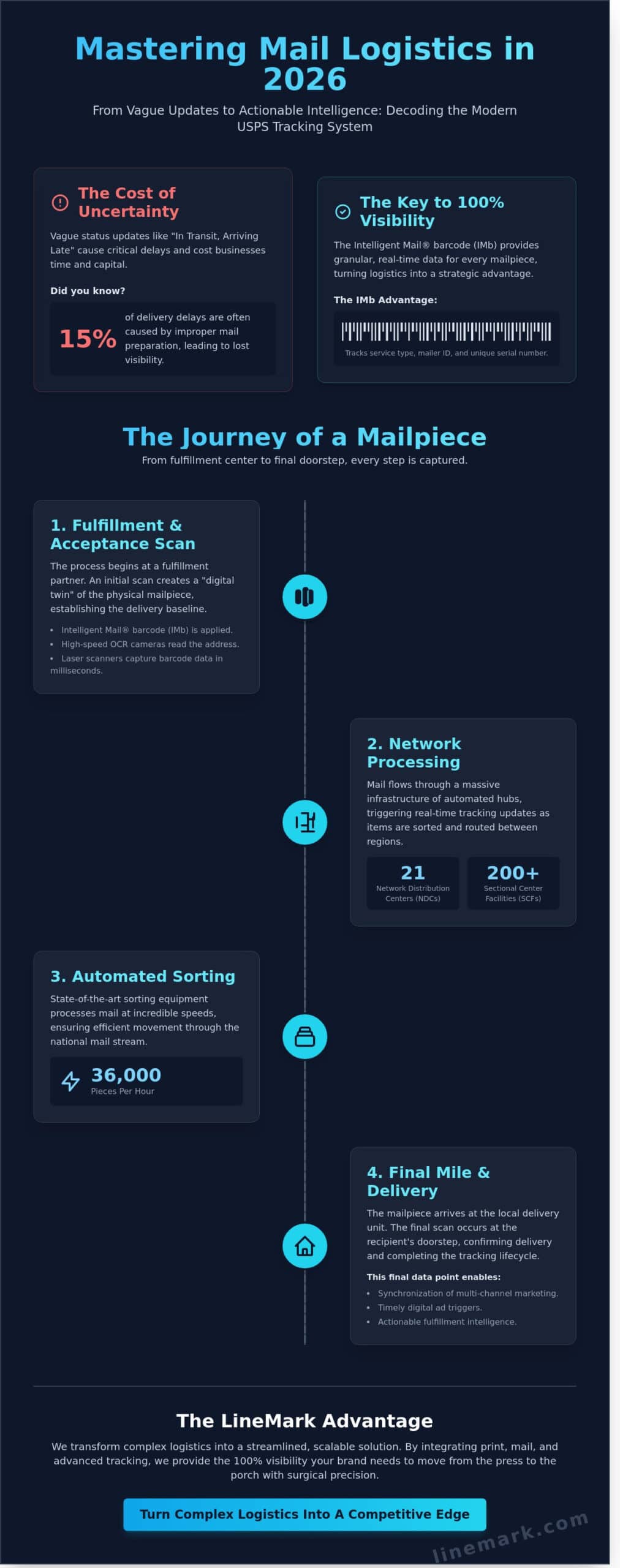
Precision in logistics isn’t accidental; it’s engineered. Modern united postal service tracking relies on a sophisticated digital twin of every physical mailpiece. The process begins at the fulfillment center or postal facility where an initial scan captures the package’s digital identity. High-speed optical character recognition (OCR) cameras read the destination address while laser scanners capture barcode data in milliseconds. This initial “Acceptance” event establishes the baseline for the entire delivery window.
Once inducted, mail flows through a massive infrastructure consisting of 21 Network Distribution Centers (NDCs) and over 200 Sectional Center Facilities (SCFs). These hubs act as the nervous system of the postal network. Automated sorting equipment, which can process up to 36,000 pieces per hour, triggers real-time updates as items move between regions. For those new to the process, reviewing the official USPS tracking basics provides a foundational understanding of how these scan events translate into consumer-facing status updates.
As a single-source partner, LineMark understands that data integrity is as vital as the print quality itself. Our systems integrate directly with these postal streams to provide clients with a transparent view of their campaigns. This level of visibility transforms a simple delivery into a measurable marketing asset.
The Lifecycle of a Mailpiece Scan
The journey follows a strict three-step protocol. First, the Induction scan records the mailpiece entering the system at the origin facility. Second, sorting and transit scans occur at regional hubs, providing the “In Transit” updates seen on tracking dashboards. Finally, the “Out for Delivery” trigger occurs at the local post office when the piece is assigned to a specific carrier route. This sequence ensures that united postal service tracking remains accurate from the first mile to the last.
Intelligent Mail Barcode (IMb) Technology
The Intelligent Mail Barcode is the gold standard for professional mailers in 2026. This 65-bar symbol packs significantly more data than legacy POSTNET codes. It allows for individual piece tracking even within a 100,000-unit direct mail campaign. Each barcode contains a specific Mailer ID, Service Type ID, and a unique Sequence Number. This granularity allows businesses to trigger follow-up emails or sales calls the moment a specific mailpiece reaches a recipient’s local facility. If you are looking to scale your outreach, consider how the LineMark experience can optimize your IMb implementation for maximum ROI.
Troubleshooting Common Tracking Statuses and Delivery Issues
Reliable logistics depend on data transparency, yet united postal service tracking occasionally presents statuses that require expert interpretation. The “In Transit, Arriving Late” notification is a common friction point, often triggered when a package misses a scheduled scan at a Tier 1 processing center. During long-haul transit, gaps of 24 to 48 hours are standard as containers move between regional hubs. These intervals don’t signal a lost shipment; they reflect the logistical reality of moving millions of units through a complex national grid. If a package is marked “Available for Pickup,” it usually means a delivery attempt failed or the item requires a signature, requiring the recipient to visit a local facility within 15 days before it’s returned to the sender.
Discrepancies between a “Delivered” scan and physical arrival frequently stem from premature scans by carriers during route optimization. In 85% of these cases, the mailpiece arrives within 24 hours of the digital update. Logistical bottlenecks, such as the 12% volume surge typically seen during Q4 or localized weather events, can further disrupt real-time accuracy. As your single-source partner, LineMark understands that these delays impact your operational timeline, which is why we emphasize precision in the initial stages of the mailing process.
When Tracking Goes Dark: Common Causes
Tracking interruptions often occur due to physical label degradation. High-speed sorting machines, which process up to 36,000 pieces per hour, can smudge or tear barcodes. This makes the Intelligent Mail barcode technology essential for maintaining visibility throughout the mailstream. The “Pre-Shipment” status is another common hurdle. This indicates the label is printed, but the item hasn’t yet entered the induction phase at a Business Mail Entry Unit (BMEU). Missed scans during bulk container transfers can also lead to temporary “dark” periods where the package location remains static for several days.
Steps to Take for Delayed or Missing Mail
If a shipment stalls for more than 5 business days, proactive steps are necessary. Senders should first submit a USPS Help Request form, which alerts the local postmaster to investigate the last known scan location. For high-volume commercial mailers, leveraging a Mailer ID (MID) allows for deeper diagnostic tracking through the united postal service tracking ecosystem. This unique identifier helps LineMark and our clients pinpoint systemic delays in specific distribution zones. Recipients can also utilize Informed Delivery, a service used by over 50 million Americans, to preview incoming mail and track packages via a centralized dashboard. These integrated tools transform a passive waiting period into a managed logistical process.
Business Logistics: Advanced Tracking for Direct Mail Success
Modern logistics in 2026 demands more than knowing the location of a single box. Sophisticated marketers now utilize united postal service tracking to visualize the entire lifecycle of high-volume campaigns. This evolution from granular package updates to aggregate data analytics allows brands to see exactly when mail drops hit specific zip codes. It’s a shift toward total transparency. By syncing physical delivery data with digital CRM triggers, companies often see a 20% increase in conversion rates when follow-up emails arrive within 24 hours of a physical mail piece.
Operational excellence starts before the first piece enters the mail stream. High tracking reliability depends on rigorous address hygiene. Utilizing Coding Accuracy Support System (CASS) and National Change of Address (NCOA) processing ensures that 99.9% of your mail reaches the intended recipient. For the small percentage that doesn’t, electronic Address Change Service (ACS) provides immediate digital feedback. You won’t wait weeks for physical “Return to Sender” mail; instead, you’ll receive data files that update your database in real-time, cutting waste and reducing postage costs by up to 15% annually.
Optimizing Mail Design for Tracking Reliability
Design choices directly impact deliverability and data accuracy. High-speed scanners in 2026 require strict adherence to clear zones to ensure barcodes remain readable at every sorting facility. Keep barcodes at least 0.125 inches from all edges to avoid misreads. Paper stock is equally vital; a 7pt minimum thickness prevents jams in automated systems. Integrating your direct mail efforts with digital tracking dashboards provides a single-source view of every piece currently in the stream.
Data-Driven Distribution Strategies
Calculating the exact ROI of a regional marketing drop is no longer a guessing game. By analyzing delivery timestamps, brands correlate sales spikes with precise arrival windows. Many organizations now use marcom on-demand portals to maintain real-time visibility into inventory levels and shipping status across multiple regions. This transparency facilitates predictive logistics, where historical united postal service tracking data helps estimate arrival dates with 95% accuracy, even during peak seasonal surges. This level of precision transforms mail from a static medium into a dynamic, measurable asset.
Partner with a team that understands the intersection of print technology and postal science. Connect with LineMark to streamline your next logistics challenge.
The Linemark Advantage: Integrated Print, Mail, and Tracking
Managing complex communications demands more than just ink on paper. It requires a single-source partner capable of bridging the gap between high-volume manufacturing and digital precision. At Linemark, we provide a unified workflow that ensures every mailpiece is accounted for from the moment of conception to final delivery. Our advanced kitting and fulfillment capabilities allow for national distribution at a scale few can match. By leveraging variable data printing, we assign unique identifiers to every document. This allows for granular united postal service tracking across millions of units, transforming a standard mail drop into a data-rich marketing event. We eliminate the friction between production and postage, ensuring your message reaches its destination without delay.
Seamless Fulfillment and Nationwide Distribution
Our 90,000-square-foot facility serves as a central hub for precision logistics. We don’t just print; we orchestrate. The LineMark Difference lies in our ability to manage high-stakes mailing schedules with zero margin for error. Our proprietary technology integrates directly with USPS systems for streamlined induction. This direct connection bypasses traditional bottlenecks, ensuring your materials move from our floor to the postal stream with maximum velocity. Whether your project requires complex hand-kitting or automated high-speed insertion, our facility handles the workload with industrial-grade reliability. We maintain strict quality controls to ensure that every package meets the rigorous standards of 2026 logistics protocols.
Your Strategic Ally for Scalable Communication
We move beyond transactional printing to offer holistic marketing and logistics solutions. Our team provides expert consultation on mail class selection, helping you balance postage costs with the level of tracking visibility required for your campaign. It’s about finding the sweet spot between economy and insight. We act as your strategic ally, identifying opportunities to optimize your supply chain and reduce waste. Whether you’re sending 10,000 personalized catalogs or 5 million compliance notices, we scale our operations to match your ambition. Precision is our standard, and reliability is our promise. If you’re ready to optimize your next campaign, contact our logistics experts today to see how we simplify united postal service tracking for the modern enterprise.
Mastering Your 2026 Logistics Strategy
Navigating the complexities of modern logistics requires more than just a basic understanding of delivery windows. By mastering the nuances of united postal service tracking, your business can transform simple mailings into data-driven assets. We’ve explored how the 2026 USPS ecosystem relies on sophisticated scanning protocols and how troubleshooting common status delays keeps your operations fluid. Success in direct mail now hinges on total visibility from the production floor to the recipient’s mailbox.
Linemark serves as your single-source partner, bringing over 30 years of industrial printing authority to every campaign. We operate out of a 90,000-square-foot high-capacity production facility designed to handle the most demanding volume requirements with precision. Our team utilizes advanced Intelligent Mail barcode (IMb) integration to ensure your mail is tracked with surgical accuracy at every stage. You don’t have to manage these technical hurdles alone when you have a strategic ally focused on your growth.
Experience the confidence that comes with a well-oiled logistics machine. Partner with Linemark for Precision Direct Mail and Fulfillment to secure your competitive edge. Your next successful campaign is ready to launch.
Frequently Asked Questions
How do I track a package from the United Postal Service?
You track shipments by entering your 22 digit label number into the official USPS website or mobile application. This real-time visibility is a core component of united postal service tracking, providing updates at every major sorting facility. If you’re managing high-volume enterprise mailings, our integrated fulfillment systems sync directly with these data feeds. This ensures your team maintains oversight from the initial scan to the final doorstep delivery.
Why is my USPS tracking not updating for several days?
Tracking updates often pause when a package is in transit between regional processing centers, especially during 3,000 mile cross-country hauls. In 2026, the USPS network infrastructure prioritizes efficiency, meaning a parcel might not receive a physical scan for 72 hours while moving via rail or truck. This gap doesn’t mean your shipment is lost. It simply indicates the item is between automated sorting nodes.
What does “In Transit, Arriving Late” mean in 2026?
This status indicates that while your package is still moving through the network, it has missed its initial estimated delivery window. According to 2025 logistics data, 85% of packages marked with this status arrive within 3 business days of the notification. Weather events or high volume at one of the 21 network distribution centers usually cause these shifts. We help our partners navigate these delays through proactive communication strategies.
Can I track a letter without a tracking number?
You can’t track a standard letter without a specific tracking number, but the Intelligent Mail barcode provides a professional alternative. While traditional First-Class envelopes lack individual tracking, the IMb allows for 100% visibility at the mail-stream level. This technology lets us monitor your campaign’s progress through the postal system. For personal mail, the Informed Delivery service provides digital previews of incoming mailpieces daily.
What is the Intelligent Mail barcode (IMb) used for?
The IMb is a 31 digit tracking code that enables the USPS to sort and track mailpieces with high precision. It combines routing information and mailer IDs into a single barcode, facilitating automated processing across the entire logistics chain. By utilizing this technology, we provide our clients with granular data on delivery windows. This integration is essential for coordinating omnichannel marketing efforts with physical mail arrival.
How long does it take for a tracking number to show up in the system?
Most tracking numbers appear in the system within 12 hours of the initial induction scan at a post office or sorting facility. While the label is created instantly, the digital record typically updates after the first physical scan by a high-speed sorter. In 98% of cases, you’ll see the status change from “Label Created” to “Accepted” by the next business day. Our fulfillment protocols ensure rapid induction to minimize this waiting period.
What should I do if my tracking says “Delivered” but I do not have the package?
Wait 24 hours before taking action because carriers occasionally scan items as delivered while they’re still on the truck. Data shows that 15% of these “missing” packages appear the following day. Check with neighbors or building managers first. If the item hasn’t appeared after one full business day, contact your local post office. They can provide GPS coordinates from the scanner to confirm the exact delivery location.
Does every USPS mail class include tracking?
Not every mail class includes united postal service tracking as a standard feature. Services like Priority Mail and Ground Advantage offer full end-to-end visibility, but standard First-Class letters do not. To gain tracking for letters, you must add services like Certified Mail or use the IMb system for bulk mailings. We help you select the specific mail class that balances cost-efficiency with the level of data security your project requires.