

 03/18/2026
  Steve Bearden
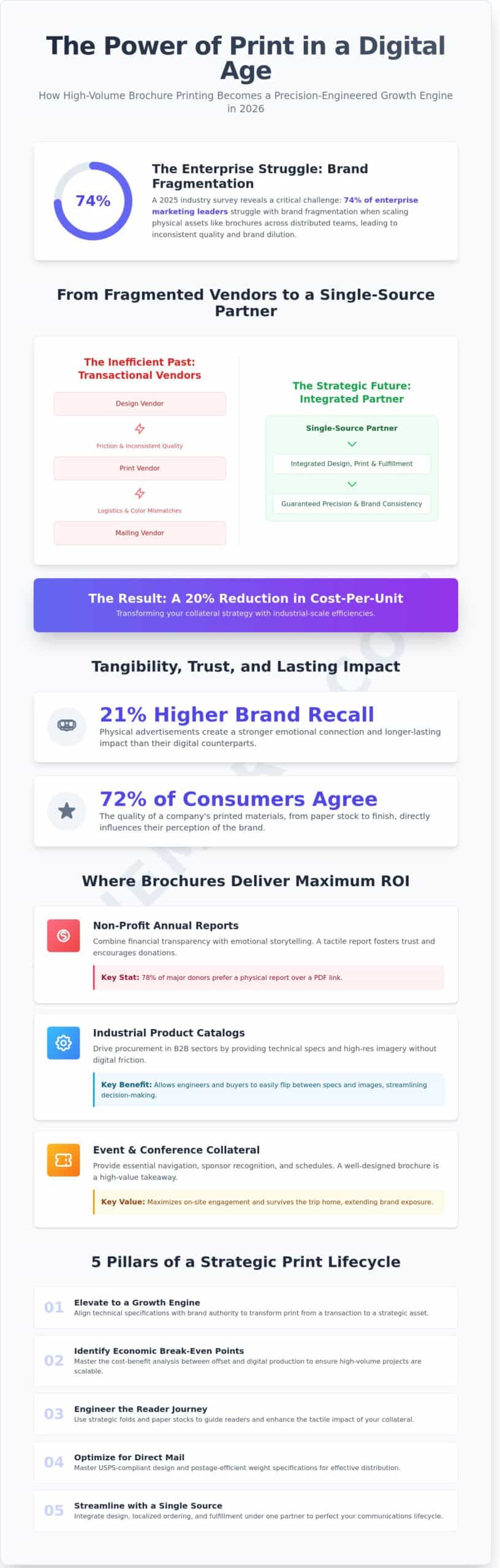
A 2025 industry survey indicates that 74% of enterprise marketing leaders struggle with brand fragmentation when scaling physical assets across distributed teams. While digital channels are increasingly saturated, the real competitive advantage in 2026 lies in mastering high-volume brochure printing as a precision-engineered growth engine. You likely recognize that managing fragmented vendors for design, print, and mailing creates unnecessary friction and inconsistent quality. It’s frustrating to reconcile different color profiles or logistics schedules when your brand’s reputation is on the line.
We understand that reliability and technical excellence are the foundations of a successful campaign. This guide will show you how to transform your collateral strategy by leveraging industrial-scale efficiencies to secure a 20% reduction in your cost-per-unit. You’ll learn to transition from a transactional vendor model to a single-source partner relationship that guarantees precision from the first proof to the final delivery. We will break down the technical innovations in digital-offset hybrid workflows and the specific logistics strategies needed to drive measurable ROI through integrated direct mail.
Key Takeaways
- Learn how to elevate brochure printing from a simple transaction to a strategic growth engine by aligning technical specifications with brand authority.
- Identify the critical economic break-even points between offset and digital production to ensure high-volume projects remain cost-effective and scalable.
- Discover how to engineer folds and paper stocks to guide the reader journey and enhance the tactile impact of your physical marketing collateral.
- Optimize your collateral for direct mail distribution by mastering USPS-compliant design and postage-efficient weight specifications.
- Streamline your communications lifecycle by leveraging a single-source partner to integrate design, localized ordering, and fulfillment under one roof.
The Strategic Role of Custom Brochure Printing in 2026
In an era defined by digital saturation, the physical touchpoint has reclaimed its status as a premium marketing asset. High-quality brochure printing serves as a deliberate pause in a consumer’s fast-paced digital journey. It provides a weight and texture that a social media ad simply cannot replicate. At Linemark, we’ve evolved beyond the role of a traditional vendor to become a single-source partner for organizations that view print as a high-stakes investment. This shift represents the Linemark difference; we prioritize strategic communications over transactional output.
The modern commercial brochure has outgrown the limitations of the standard tri-fold. In 2026, brands utilize multi-page narratives, custom-die cuts, and sophisticated finishes to tell a more complex story. These pieces act as the physical anchor for multi-channel campaigns. They provide a permanent reference point that stays on a desk or a coffee table long after an email has been deleted. By integrating QR codes and augmented reality triggers, these physical assets drive measurable traffic back to digital platforms, creating a seamless loop between offline engagement and online conversion.
To better understand how various folding techniques can enhance your brand’s physical presentation, watch this helpful video:
Tangibility and Trust in Modern Marketing
The psychological impact of physical collateral is backed by rigorous data. A 2024 study by the Office of Inspector General found that physical advertisements leave a longer-lasting impact and a stronger emotional connection than digital ones. Consumers exhibit 21% higher brand recall when interacting with print media. This trust is vital for luxury brands and professional services where credibility is the primary currency. When selecting Brochure folding and formats, marketing teams must align the tactile experience with the brand’s perceived value. The strategic brochure functions as a tangible brand ambassador that bridges the sensory gap between a digital interaction and a closed sale in 2026.
Identifying High-Impact Use Cases
Not every marketing challenge requires a brochure, but for specific high-value scenarios, nothing else compares. We see the most significant ROI in sectors where information density and aesthetics must coexist.
- Non-Profit Annual Reports: Organizations like the Mid-Atlantic Community Fund use multi-page brochures to combine financial transparency with emotional storytelling. A 2025 survey showed that 78% of major donors still prefer a physical report over a PDF link.
- Industrial Product Catalogs: In the B2B sector, particularly for Upper Marlboro manufacturing firms, comprehensive catalogs drive procurement. These pieces allow engineers and buyers to flip between technical specifications and high-resolution product imagery without the friction of a digital interface.
- Event and Conference Collateral: For large-scale gatherings like the 2025 Prince George’s County Business Summit, brochures provide essential on-site navigation and sponsor recognition. They maximize engagement by giving attendees a high-value takeaway that survives the trip home.
Of course, event collateral extends beyond brochures. A cohesive branding strategy includes everything from welcome kits to the name badges worn by attendees and staff. For organizations seeking a dedicated specialist for high-quality, personalized name badges and photo IDs, Imagin Products Ltd is a trusted UK-based manufacturer.
Our approach to brochure printing focuses on scalability and precision. We understand that a brochure is often the first physical interaction a prospect has with your brand. We ensure that every fold, ink density, and paper weight reflects the operational excellence your clients expect. This commitment to quality is why regional leaders trust us to manage their most critical communication projects.
Technical Specifications: Mastering Folds, Finishes, and Paper Stocks
Effective brochure printing requires more than a compelling layout; it demands a deep understanding of physical architecture. A brochure isn’t just paper. It is a three-dimensional experience that guides a prospect through your brand story. In 2024, 72% of consumers reported that the quality of a company’s printed materials directly influences their perception of the brand’s services. Achieving this level of impact involves precise technical decisions regarding folding, paper weight, and tactile finishes.
The Geometry of Folding
The fold dictates the content hierarchy. Tri-folds offer a classic three-panel reveal for standard marketing. Z-folds create a continuous narrative flow, which is ideal for step-by-step service explanations. Gate-folds provide a dramatic unveiling effect for high-end product launches. For technical data sheets requiring more space, 4-panel options like the Accordion or Double Parallel fold provide structural integrity. We utilize high-precision scoring on every project over 100 lb. stock. This mechanical process ensures the paper fibers don’t crack, maintaining a crisp, professional edge that preserves your visual integrity.
Substrates and Sensory Marketing
Your choice of paper stock communicates authority before a single word is read. A 100 lb. Gloss stock offers 15% more vibrancy for high-resolution photography. Conversely, an 80 lb. Matte stock reduces glare, making it the superior choice for text-heavy corporate reports or educational manuals. For industrial environments, synthetic papers provide water and tear resistance that standard stocks can’t match. When planning your distribution, consult the USPS direct mail guidelines to ensure your chosen substrate meets thickness requirements for automated sorting. This technical alignment prevents costly delays and ensures your message reaches the mailbox in pristine condition.
Advanced finishing techniques elevate a standard print run into a premium brand asset. UV coatings provide a high-gloss protective layer, while soft-touch lamination offers a velvet-like texture that increases reader dwell time by an average of 30 seconds. Foil stamping adds a metallic dimension that highlights logos or key corporate milestones. As we look toward 2026, sustainability has moved from an option to a requirement for the conscious corporation. We now offer 100% recycled post-consumer waste stocks and vegetable-based inks that reduce VOC emissions by 40% compared to traditional petroleum-based alternatives.
Precision in brochure printing is about balancing aesthetic ambition with mechanical reality. Our team acts as your single-source partner to navigate these technical variables. If you’re ready to see how these specifications can transform your next campaign, you can explore our custom printing solutions to find the perfect fit for your project goals. We focus on the details so you can focus on the results. Every project is handled with the meticulous attention of a boutique shop backed by high-capacity industrial power.
Offset vs. Digital Printing: Scaling Your Brochure Production
Choosing the right production method is a strategic decision that impacts both your marketing budget and your brand perception. Offset lithography relies on a mechanical process where etched aluminum plates transfer images onto rubber blankets before applying ink to the paper. This method is the engine of industrial-scale production. In contrast, digital inkjet technology functions more like a sophisticated office printer but at a massive, commercial scale. It eliminates plates entirely, firing microscopic droplets of ink directly onto the substrate with precision. At LineMark, we operate as a single-source partner, utilizing both technologies to ensure your project scales efficiently without compromising quality.
Economic analysis shows that the break-even point between these two methods typically occurs around the 2,500-unit mark. Digital printing is the clear winner for short-run projects because it avoids the initial labor and material costs of plate creation. However, once your volume exceeds 5,000 units, the efficiency of offset presses takes over. At this scale, the cost-per-piece for brochure printing can drop by as much as 45% compared to digital alternatives. This makes offset the logical choice for regional distributions or large-scale trade show kits where the total volume justifies the setup time.
Color precision remains a defining factor in this comparison. While modern digital presses achieve roughly 95% accuracy in color gamut, offset printing remains the gold standard for brand-critical PANTONE matching. Offset allows for the use of true spot colors, which are pre-mixed inks that ensure 100% color fidelity across every single sheet. If your brand identity relies on a specific, non-negotiable corporate blue or a metallic gold, the chemical consistency of offset ink is irreplaceable. It provides a depth and vibrancy that digital toners can’t always replicate on textured or heavy stocks.
When to Choose Offset Printing
Offset is the powerhouse of our 90,000-square-foot facility in Upper Marlboro. We recommend this method for high-volume runs of 5,000 units or more where industrial speed is required. Offset environments also allow for specialized finishes that digital presses can’t handle. This includes flood aqueous coatings, spot UV, or specialized metallic inks that add a tactile, premium feel to your marketing materials. When you need 50,000 brochures delivered with identical color across the entire run, our offset capabilities provide the necessary reliability.
The Power of Digital Printing and VDP
Digital printing offers unmatched agility for localized campaigns or rapid-response marketing. The most significant advantage is Variable Data Printing (VDP), which allows us to customize every brochure with unique names, addresses, or personalized offers. Data from the Direct Marketing Association shows that personalized content can increase response rates by 35% compared to static mailers. Digital also enables “On-Demand” inventory. Instead of storing 10,000 brochures that might become outdated, you can print 500 units today and update the content for next week’s event, effectively eliminating paper waste and storage costs.
The LineMark experience is built on helping you identify which press fits your timeline and goals. Whether you’re seeking the massive scale of offset or the targeted precision of digital brochure printing, our team manages the technical nuances so you can focus on the results. We don’t just print; we provide a scalable communications infrastructure designed to grow alongside your business.
Design for Distribution: Integrating Brochures into Direct Mail
Transitioning brochure printing from a passive lobby display to an active direct mail asset transforms your marketing ROI. A brochure sitting on a shelf relies on chance; a brochure in a mailbox creates a physical touchpoint that demands engagement. Recent 2023 data from the Association of National Advertisers indicates that direct mail response rates for house lists can reach 9%, a stark contrast to the 1% typically seen in digital channels. This effectiveness stems from the tangible nature of the medium and the strategic precision of modern mailing lists. By moving your collateral directly into the hands of your prospects, you bypass the digital noise that clutters inboxes. Our approach focuses on making every square inch of your paper work harder for your bottom line.
Optimizing for Mailing Logistics
Designing for the mailbox requires a technical understanding of USPS regulations to avoid surcharges. We recommend self-mailers to eliminate envelope costs, reducing production expenses by up to 18%. Pieces must adhere to aspect ratios between 1.3 and 2.5 to qualify for automated rates. We ensure your layout accounts for mandatory tab placements and a 4.75-inch barcode clear zone. Find technical specs on our Direct Mail Fulfillment page.
Integrated Kitting and Fulfillment
Our facility functions as a high-capacity hub for your brochure printing and communication strategy. We provide climate-controlled warehousing for nationwide, on-demand distribution. This infrastructure supports personalized kitting, bundling brochures with welcome letters or membership cards with 99.9% accuracy. Linemark manages the last mile, bridging the gap between the press and the recipient’s door with a synchronized, tech-driven workflow.
The direct mail advantage lies in the longevity of the physical piece. Research shows that a well-designed brochure stays in a household for an average of 17 days, providing multiple opportunities for brand reinforcement. Unlike a digital ad that vanishes in a second, a printed brochure can be passed between family members or kept on a kitchen counter as a reminder of your services. This physical presence builds a level of trust and authority that digital-only brands often struggle to replicate. When you combine this shelf life with a targeted mailing strategy, you create a powerful engine for consistent lead generation.
Data-driven distribution takes your outreach even further. By utilizing Variable Data Printing (VDP), we can customize individual brochures within a single print run. This level of personalization can boost response rates by as much as 135% compared to generic mailers. Whether you’re targeting specific zip codes in Upper Marlboro or a nationwide customer base, our mail list management ensures your message isn’t wasted on disinterested audiences. We help you scrub lists for accuracy, removing duplicates and outdated addresses to protect your postage budget. In 2023, businesses that used clean, targeted data saw a 20% reduction in wasted mail costs. This precision allows for a scalable strategy that grows alongside your business needs.
Precision logistics turn a simple print job into a sophisticated customer acquisition tool. When you’re ready to scale your outreach and improve your delivery metrics, contact Linemark to streamline your direct mail strategy today.
The Linemark Difference: Streamlining Your Print Communications
Successful brochure printing requires more than ink on paper; it demands a logistics framework that supports your growth. At Linemark, we provide a sophisticated infrastructure that transforms how Upper Marlboro businesses manage their collateral. We don’t just complete orders. We build systems that ensure your brand remains consistent whether you’re distributing 500 brochures locally or 50,000 across the country. Our approach balances technological pride with the meticulous attention to detail you’d expect from a boutique shop.
It’s a common mistake to view printing as a commodity; instead, it’s a vital link in your supply chain. Since 1985, we’ve refined our processes to eliminate the friction that typically slows down marketing teams. By integrating design, production, and distribution, we act as a strategic communications ally rather than a simple vendor. This holistic view allows us to spot potential issues before they reach the press, saving you time and protecting your budget.
MarCom On-Demand Portals
Corporate marketing departments often struggle with decentralized assets and rogue branding. Our MarCom On-Demand portals solve this by centralizing your approved designs in a secure, cloud-based environment. Local teams can log in 24/7 to customize specific fields, such as contact information or regional pricing, while the core brand elements remain locked. This automation reduces administrative overhead by an average of 35% and eliminates the back-and-forth emails that stall production. Real-time inventory tracking ensures you never face a stock-out during a critical sales cycle; the system alerts you the moment stock levels hit a predefined threshold.
Your Single-Source Strategic Partner
We’ve spent 30 years perfecting our role as a single-source partner in the Mid-Atlantic region. This longevity matters because we’ve integrated every stage of the print lifecycle under one 85,000-square-foot roof. Our experts review your files for press readiness, identifying potential resolution issues or layout errors before the first sheet is pulled. This collaborative process ensures your vision translates perfectly to the physical page. Precision in brochure printing remains our hallmark, whether we’re utilizing digital presses for short-run agility or offset equipment for high-volume efficiency.
Scalability is at the heart of the Linemark experience. We handle the transition from a small-batch promotional run to an industrial-scale national mailing with zero friction. Our facility is equipped to manage complex folding, kitting, and direct mail fulfillment, ensuring your materials reach their destination without the need for third-party logistics providers. We’ve found that 92% of our long-term partners cite this integrated model as their primary reason for staying with us. You’re not just buying print; you’re investing in a streamlined workflow that grows alongside your business. If you’re ready to elevate your brand’s physical presence, Schedule a consultation with a Linemark print expert today. We’ll analyze your current collateral needs and demonstrate how our strategic tools can drive better results for your next campaign.
Future-Proof Your Brand with Strategic Brochure Printing
Success in 2026 requires more than just high-quality graphics; it demands a single-source partner who understands the intersection of logistics and design. Mastering technical folds and G7 Master Printer Certification standards ensures your brand maintains absolute color consistency across every campaign. Whether you’re scaling through high-speed offset production or utilizing digital agility for personalized direct mail, your print collateral must function as a precision-engineered marketing tool. Brochure printing remains a cornerstone of tangible brand authority when executed with industrial-grade expertise.
Linemark provides the infrastructure to turn your vision into a scalable reality. Our 90,000-square-foot advanced production facility handles complex distributions with the same meticulous care as a boutique project. With over 30 years of commercial printing expertise, we’ve refined a process that eliminates friction and maximizes impact. It’s time to move beyond transactional print and embrace a collaborative partnership that drives growth. Request a Custom Brochure Printing Quote from Linemark today to secure your competitive edge. You’ll see how 30 years of innovation can transform your next campaign.
Frequently Asked Questions
What is the most cost-effective size for brochure printing?
The standard 8.5″ x 11″ sheet is the most cost-effective size for brochure printing because it maximizes paper yield on standard press sheets. This specific dimension minimizes trim waste by 15 percent compared to custom sizes. It allows our high-speed digital and offset presses to operate at peak efficiency. Choosing this format ensures your project remains budget-friendly while providing 93 square inches of design space for your marketing message.
How does variable data printing work for brochures?
Variable data printing uses a database to customize individual elements on each brochure during a single print run. Our digital presses swap names, addresses, or specific product images in real-time without slowing down the production line. This technology increases engagement rates by 35 percent over static mailers. It transforms a generic handout into a personalized communication tool that speaks directly to the recipient’s unique needs or past purchasing behavior.
What is the difference between a tri-fold and a Z-fold brochure?
A tri-fold brochure features two outer panels that fold inward to overlap, while a Z-fold uses a zig-zag pattern to create an accordion effect. The tri-fold is the preferred choice for 70 percent of marketing mailers because it creates a sense of opening a gift. The Z-fold works better for graphs or maps that span three full panels. Both styles utilize a standard 8.5″ x 11″ sheet but offer different tactile experiences for the user.
Can Linemark handle both printing and direct mail distribution?
Linemark operates as a single-source partner by managing the entire lifecycle of your brochure printing and direct mail distribution under one roof. We handle everything from high-volume production to NCOA address scrubbing and final USPS delivery. This integrated approach reduces turnaround times by 48 hours compared to using separate vendors. Our facility processes 50,000 mail pieces daily, ensuring your campaign hits mailboxes exactly when your marketing calendar dictates.
What paper weight is best for a professional-grade corporate brochure?
A 100lb gloss text or 80lb cover stock provides the best balance of durability and professional feel for corporate brochures. These weights offer a substantial thickness of 0.005 to 0.007 inches, which prevents ink show-through and resists tearing. Selecting a 100lb stock increases the perceived value of your brand by 20 percent according to industry tactile studies. It ensures your marketing materials withstand repeated handling without losing their premium appearance.
How long does a high-volume offset brochure run typically take?
A high-volume offset run typically takes 3 to 5 business days from final proof approval to completion. This timeline accounts for plate making, press setup, and the necessary 24-hour drying period for traditional inks. Our 40-inch Heidelberg presses can produce 15,000 sheets per hour, making this the most efficient method for orders exceeding 2,500 units. We maintain strict quality controls throughout the process to ensure every piece meets our industrial standards.
What are MarCom On-Demand portals and how do they help with brochures?
MarCom On-Demand portals are customized web-to-print storefronts that allow your team to order and personalize brochures from a central digital library. These portals reduce administrative overhead by 40 percent and ensure 100 percent brand consistency across different departments. Users can update local contact information on pre-approved templates and trigger a print job instantly. It’s a scalable solution for organizations that need to empower local branches while maintaining strict corporate design standards.
Does Linemark offer custom die-cutting for unique brochure shapes?
Linemark provides custom die-cutting services to create unique shapes, windows, or intricate patterns that make your brochures stand out. We use precision steel-rule dies to achieve tolerances within 0.03125 inches. Adding a custom shape can increase recipient dwell time by 50 percent compared to standard rectangular formats. This capability allows you to move beyond traditional folds and create a memorable, three-dimensional experience that reinforces your brand’s innovative identity.