

 03/08/2026
  Steve Bearden
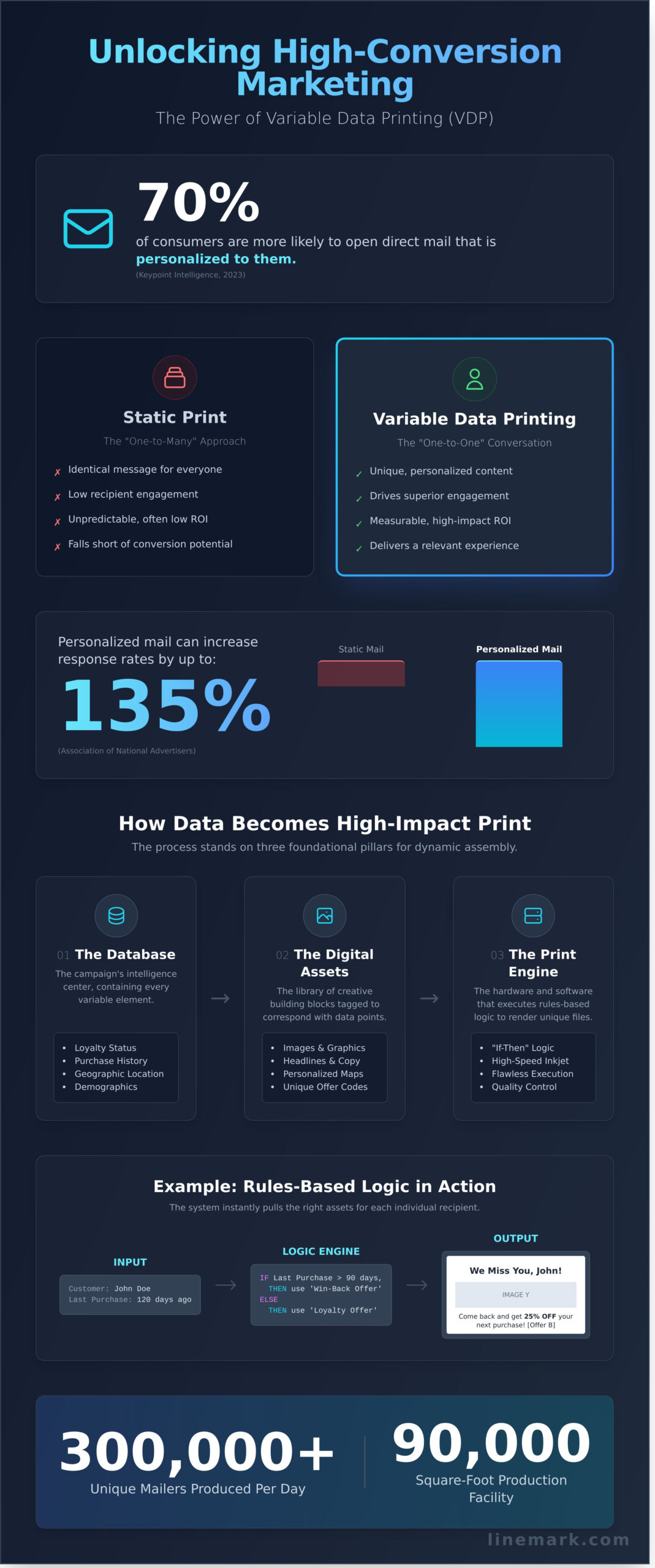
According to a 2023 study by Keypoint Intelligence, 70% of consumers are more likely to open direct mail that is personalized to them. Yet, how many of your own campaigns fail to connect, falling short of their conversion potential before they’re even opened?
You’re right to be frustrated with the diminishing returns of generic mailings. We understand the challenge: managing massive customer databases is daunting, and the fear of a costly data error in a high-volume print run can paralyze even the most ambitious marketing teams. It’s a constant battle between the potential of personalization and the operational risks involved.
This strategic guide is your blueprint for overcoming these obstacles. We will demonstrate how to leverage the precision of variable data printing to transform your static marketing into dynamic, high-conversion communications that drive measurable ROI. You’ll discover how to move beyond simple name changes to full-scale, data-driven customization with complete confidence.
From seamless data integration to automated workflows and flawless execution, we will outline the definitive process for achieving professional, high-quality personalized branding at scale by 2026.
Key Takeaways
- Differentiate between static mass production and dynamic mass customization to understand how personalized print drives superior engagement and ROI.
- Master the three core components that power variable data printing, transforming raw customer data into high-impact, relevant communications.
- Pinpoint high-value use cases where VDP delivers the most significant impact, including personalized direct mail and custom book manufacturing.
- Learn essential best practices for structuring data and design files, ensuring your VDP projects are executed with flawless precision from the start.
What is Variable Data Printing and Why Does it Outperform Static Print?
At its core, variable data printing (VDP) is a digital printing method that allows for the customization of elements-such as text, graphics, and images-from one printed piece to the next. Unlike traditional offset printing, which excels at mass production of a single, identical document, VDP facilitates mass customization. It transforms a static mailer into a dynamic, one-to-one conversation with each recipient. You’re no longer just sending a message; you’re delivering a personalized experience.
This technology represents a fundamental shift from transactional printing to strategic, data-driven communications. By integrating customer data from a database or external file, each piece is tailored to the individual’s specific interests, purchase history, or demographic profile. As outlined in Wikipedia’s overview of VDP, this process merges a master design template with variable information to create unique documents. Executing this level of customized communication for high-volume campaigns requires immense technological and operational capacity. Our 90,000-square-foot facility is engineered for precisely this challenge, housing the advanced digital presses and integrated systems needed to manage complex VDP projects with precision and scale.
The Evolution from VIP to Modern VDP
Variable Information Printing (VIP) laid the digital groundwork decades ago, but today’s technology operates on an entirely different level. Our high-speed, full-color digital presses customize every single piece with intricate data without sacrificing production speed. The process has evolved from simple mail merges-changing a name and address-to deploying complex business logic that alters images, offers, and entire layouts based on a customer’s unique profile and purchasing behavior. It’s a sophisticated tool for modern marketing.
The Statistical Case for Personalization
The numbers don’t lie. Industry data from the Association of National Advertisers (ANA) shows personalized direct mail can increase response rates by up to 135% compared to static mailings. This lift isn’t just a number; it’s the result of creating a moment of relevance that builds brand loyalty. A generic brochure is a blanket statement with a low, unpredictable ROI. A data-driven catalog, however, is a targeted conversation with a measurable, significantly higher return on investment.
The Mechanics: How Data Becomes High-Impact Print
Transforming raw data into a personalized, tangible mail piece is a feat of digital orchestration. At its core, the process relies on a sophisticated interplay between data, design, and state-of-the-art production technology. Successful variable data printing isn’t a simple mail merge; it’s a dynamic assembly line where every single component is unique. This entire operation stands on three foundational pillars.
- The Database: This is the campaign’s intelligence center. It’s not just a list of names and addresses, but a structured file containing every variable element: customer loyalty status, previous purchase categories, geographic location, or even a preferred brand color. The depth and accuracy of this data directly dictate the level of personalization possible.
- The Digital Assets: These are the creative building blocks. A library of pre-approved images, headlines, body copy blocks, personalized maps, and unique offer codes is prepared. Each asset is tagged to correspond with specific data points in the database.
- The Print Engine: This is the powerful hardware and software combination that executes the logic. It reads the database, follows the pre-set rules to select and place the correct digital assets for each recipient, and renders a unique, press-ready file in milliseconds.
The “magic” happens through a series of “if-then” commands, or rules-based logic. For example, a rule might state: IF a customer’s ‘Last Purchase’ was less than 30 days ago, THEN print ‘Offer A’ and ‘Image X’. If their last purchase was over 90 days ago, the system instead pulls ‘Offer B’ and ‘Image Y’ to create a compelling win-back message. This logic is applied instantly as the job runs on high-speed inkjet and toner-based digital presses, which can produce over 300,000 unique letter-sized mailers per day.
Maintaining brand integrity across millions of unique variations is a significant challenge. Colors, fonts, and logo placements must remain perfectly consistent, regardless of the variable content. This level of precision is why leading brands rely on professional commercial printing services that have calibrated equipment and rigorous quality control protocols built for high-volume, high-variability work.
Data Processing and Hygiene
The most creative variable campaign will fail if its foundation-the data-is flawed. According to USPS data from 2022, over 6.6 billion mailpieces were classified as Undeliverable As Addressed (UAA), representing immense waste. A strategic partner cleanses your data, running it through deduplication processes and National Change of Address (NCOA) updates before a single page is printed. This critical step, often managed by expert direct mail fulfillment companies, can improve deliverability rates by as much as 12%.
Secure Data Handling in 2026
In an era of heightened privacy concerns, protecting customer data isn’t optional. For industries like healthcare or finance, communications must adhere to strict HIPAA and SOC 2 Type II compliance standards. At Linemark, all client data is processed in a secure, audited environment. Our “single-source” advantage means your sensitive data never leaves our facility. It is ingested, imaged, printed, and inserted into a sealed envelope all under one roof, dramatically reducing the risk of a breach.
Executing a campaign of this complexity demands a seamless integration of data science and industrial-scale print production. Discover how a single-source partner can provide the security and scalability your next variable data printing project requires.
Strategic Use Cases: Where VDP Drives the Most Value
Understanding the theory behind variable data printing is one thing; deploying it as a strategic asset is another. The technology’s true power is unlocked when it’s applied to solve specific business challenges, transforming generic communications into precision-targeted, high-impact assets. From driving marketing ROI to streamlining enterprise operations, VDP delivers measurable value across multiple sectors.
The most effective applications go far beyond simply inserting a customer’s name. They leverage data to create a truly one-to-one experience that feels personal, relevant, and compelling. This level of customization is what separates a message that gets noticed from one that gets discarded.
Direct Mail and Fulfillment Integration
Nowhere is the impact of VDP more pronounced than in direct mail. By integrating customer data, brands can dramatically increase engagement. According to a 2022 study by Compu-Mail, adding a recipient’s name and full color to a mailpiece can increase the response rate by 135% compared to a static piece. Using variable imagery, such as showing a homeowner a picture of a car model they recently configured online, creates an immediate, personal connection. This technology also closes the attribution gap by printing unique PURLs (Personalized URLs) or QR codes on each piece, allowing you to track exactly who responds to a campaign and measure ROI with digital precision. As a single-source partner, LineMark integrates this printing capability with logistics, offering:
- Streamlined Kitting: We can print a personalized welcome letter, package it with branded merchandise, and assemble a complete campaign kit for each unique recipient.
- Targeted Fulfillment: Data drives the entire process, ensuring the right version of the right materials gets to the right person, every time.
- Scalable Distribution: Our infrastructure is built to handle complex, variable campaigns from 1,000 to 1,000,000+ pieces without sacrificing accuracy.
For non-profits, this same technology revolutionizes fundraising. Instead of a generic annual report, VDP enables the creation of a version unique to each donor. Imagine a report where page three details that donor’s specific giving history, highlights the exact project their last contribution funded with a photo, and presents a personalized “ask” to fund the next phase. This data-driven approach demonstrates impact, builds loyalty, and has been shown to increase subsequent donation amounts by over 20% in some campaigns.
Corporate portals represent another high-value use case, empowering decentralized teams while maintaining brand control. A national company with a distributed sales force can use a VDP-powered web portal to generate customized collateral on demand. A sales representative can log in, select a brochure template, and instantly generate a version with their name, local office address, and a curated set of case studies relevant to their specific client’s industry. This provides local agility without compromising brand compliance.
VDP for Custom Book Printing
The principles of VDP extend seamlessly into publishing and education. The ability to produce unique versions of a single title at scale opens new possibilities for custom book printing. A global manufacturer, for instance, can create training manuals for a new piece of equipment where each version is tailored to a specific country, containing localized safety regulations and text in the native language. On a consumer level, this technology powers the market for personalized children’s books and photo journals, where every single copy printed is a one-of-a-kind product. The LineMark difference is our ability to scale high-quality binding and finishing for these variable-length digital runs, ensuring every unique book meets the same exacting quality standards as a traditional offset run.
Best Practices for Designing and Preparing VDP Files
Executing a successful variable data printing campaign hinges on meticulous preparation. The transition from a powerful marketing concept to a tangible, personalized mailpiece is a technical process where precision is paramount. A flawed file or a poorly structured database can compromise an entire print run, leading to budget overruns and diluted impact. The Linemark difference is rooted in a proactive approach, ensuring every file is optimized for flawless digital output before it ever reaches the press.
Your foundation is the master document. This is your project’s blueprint, created in a design application like Adobe InDesign. Within this file, you must clearly delineate static and variable zones. Static elements, like your company logo, core brand messaging, and legal disclaimers, form the consistent framework. Variable zones are the dynamic placeholders for names, offers, images, and other personalized content. This separation is the critical first step for an efficient workflow.
Data integrity is non-negotiable. According to a 2022 Gartner report, poor data quality costs organizations an average of $12.9 million annually. To prevent this, your data must be standardized in a clean CSV or Excel file before ingestion. Use unambiguous headers like F_NAME, ADDRESS_1, or IMAGE_PATH. This simple discipline eliminates mapping errors and ensures the correct data populates the correct field every time. Before any full run, it’s essential to stress-test your files with extreme data cases:
- The entry with the longest name or address to check for text overflow.
- A record with a missing or empty data field to see how the template responds.
- A data entry that points to a missing image file.
- The shortest possible name to ensure the design doesn’t look empty or awkward.
File Preparation for Digital Success
Brand integrity is maintained through technical excellence. All variable images must be supplied at a minimum of 300 DPI (dots per inch) at their final print size to avoid pixelation. We recommend using the PDF/VT file format, an ISO standard (16612-2) designed specifically for transactional and variable printing. This format can decrease Raster Image Processor (RIP) times by over 40% on complex jobs, accelerating production and reducing processing bottlenecks. This is where collaboration with your single-source partner becomes invaluable for pre-flight data and file checks.
Design for Dynamic Content
Effective VDP design anticipates variability. A layout must include sufficient white space to accommodate the longest possible text string without compromising readability or aesthetics. For maximum cost efficiency on high-volume projects, consider a hybrid approach. Combine offset-printed “versioned” shells for static elements common to large segments of your audience, then digitally overprint the unique variable data. This strategy leverages the strengths of both printing technologies. Finally, ensure brand colors are perfectly matched by providing correct CMYK or calibrated Pantone values for our digital presses, guaranteeing consistency across every single piece.
Perfecting these technical details is what transforms a good campaign into a great one. Ensure your VDP files are flawlessly executed from the start. Partner with Linemark’s pre-press experts today to validate your data and optimize your design for maximum impact.
The Linemark Difference: Scaling VDP with a Single-Source Partner
Executing a successful variable data printing campaign requires more than just powerful software. It demands an infrastructure built for precision, security, and scale. At Linemark, we merge over 30 years of industry leadership with a 90,000-square-foot production facility to create an unparalleled single-source solution. We don’t just print your materials; we build the secure, streamlined workflow that powers your entire communications strategy from data intake to final delivery.
Choosing a single-source partner for your personalized marketing isn’t a matter of convenience; it’s a strategic decision that directly impacts your bottom line and data security. By managing every step of the process under one roof, we eliminate the risks and delays that plague multi-vendor projects. This integrated approach provides tangible benefits:
- Reduced Transit Times: Our centralized production and logistics can slash coast-to-coast delivery times by an average of 25-40% compared to fragmented supply chains.
- Enhanced Data Security: We eliminate the vulnerabilities of transferring sensitive customer data between vendors. Our entire workflow operates within a secure, SOC 2 Type 2 compliant environment, ensuring your data’s integrity from start to finish.
- Absolute Quality Control: With printing, finishing, and mailing managed by a single expert team, your brand consistency is never compromised.
MarCom On-Demand: VDP on Autopilot
Our proprietary MarCom On-Demand platform puts the power of sophisticated personalization directly into the hands of your team. Through customized corporate portals, local branches or sales agents can instantly order materials with pre-approved variable fields, like contact information or unique offer codes. This system ensures 100% brand compliance while delivering tailored assets on demand, seamlessly integrating inventory management with real-time production.
National Scale, Local Precision
From our strategic Mid-Atlantic hub, we execute complex nationwide distributions with unmatched efficiency. This centralized location allows us to optimize logistics and leverage postal discounts through advanced mail commingling, often reducing our clients’ postage costs by 15% or more on large-scale campaigns. It is the fusion of high-capacity industrial printing with the surgical precision of data-driven personalization. Your message reaches the right person, at the right time, for the right price.
Your data holds the key to building stronger customer relationships. It’s time to partner with an expert who can unlock its full potential. Let’s work together to transform your communications from static to strategic. Contact Linemark today to discover how our integrated VDP solutions can elevate your brand.
Master Mass Customization: Your VDP Strategy for 2026 and Beyond
The path to genuine customer connection isn’t a mystery; it’s built on personalization at scale. Effective variable data printing transforms customer data into tangible, high-impact marketing assets that static campaigns simply can’t match. Success, however, depends on more than technology. It requires meticulous data management and a production partner capable of flawless execution.
This is the Linemark difference. For over 30 years, we have mastered the complexities of high-volume, customized communications. Our 90,000 sq. ft. high-tech production facility and integrated MarCom On-Demand portal technology provide the infrastructure and control you need to scale with confidence. We aren’t just a printer; we are your strategic, single-source partner in communication.
Ready to move from theory to tangible results? Partner with Linemark for Your Next Variable Data Campaign.
Let’s create communications that don’t just reach your audience, but resonate with them.
Frequently Asked Questions About Variable Data Printing
How much does variable data printing cost compared to traditional printing?
Variable data printing has a higher per-piece cost but delivers a superior return on investment, often lowering your cost-per-acquisition. While a static offset piece may cost $0.50, a VDP piece might cost $0.85. However, VDP eliminates plate costs, which run $200-$500 per plate, making it more efficient for targeted runs. Campaigns utilizing VDP have shown response rate increases from 34% to over 50%, more than justifying the initial unit cost.
What kind of data file do I need to provide for a VDP project?
You’ll need to provide two key components: a static design file and a variable data file. The design file, typically a high-resolution PDF or Adobe InDesign package, contains the fixed layout and graphics. The variable data file is a spreadsheet or database, most commonly a .CSV, .TXT, or .XLS file. Each row in this file corresponds to one recipient, and each column represents a variable field, like a name or offer.
Can VDP be used for images, or is it only for text like names and addresses?
Yes, VDP absolutely supports variable images and graphics, not just text. This capability allows for deep personalization that significantly boosts engagement. For example, a university can send alumni a fundraising mailer featuring a photo of the specific building where they studied. A car dealership can send a service reminder that includes an image of the customer’s exact vehicle model, creating an immediate and powerful connection.
What is the minimum order quantity for a variable data printing run?
There is no technical minimum order quantity for a VDP run; we can produce a single, unique piece. For cost-effectiveness, most clients find that projects starting at 100 to 250 pieces see the best results. This is a strategic advantage over traditional offset printing, where minimums often exceed 1,000 units due to the high initial setup costs of creating printing plates. VDP provides unmatched flexibility for highly targeted campaigns.
How does VDP help with tracking the ROI of my direct mail campaigns?
VDP is instrumental in tracking ROI by embedding unique identifiers on each printed piece. We can print a unique QR code, a personalized URL (PURL), or a distinct promotion code for every recipient in your campaign. When a recipient uses their code online or in-store, you can attribute the conversion directly back to the specific mailer they received. This provides 1-to-1 tracking, giving you precise campaign performance data.
Is my customer data secure when I send it to a commercial printer?
Your customer data is secure when you work with a certified, single-source partner like LineMark. We adhere to rigorous data security protocols, including SOC 2 compliance, to ensure your information is protected at every stage. All data transfers occur via secure FTP (SFTP) servers, and your files are encrypted and stored in a protected environment, accessible only by authorized personnel. We treat your data with the same level of security as our own.
Can I use variable data printing for custom book covers or annual reports?
Certainly. Variable data printing is an excellent solution for high-value communications like custom book covers and annual reports. For a non-profit’s annual report, we can print a personalized cover for each of your top 100 donors, featuring their name and a specific message about their impact. For a corporate book, we can create unique editions for key executives, integrating their name or division into the cover art for a truly bespoke presentation.
What is the difference between VDP and versioning in printing?
The key difference is the level of customization. VDP customizes on a piece-by-piece basis, where every single item in the print run can be unique. In contrast, versioning involves creating multiple batches of a static design, where each batch has a minor change. For instance, a 20,000-piece postcard run might have four versions of 5,000, each with a different store address. VDP would allow all 20,000 postcards to have a unique name.