


 03/07/2026
  Steve Bearden
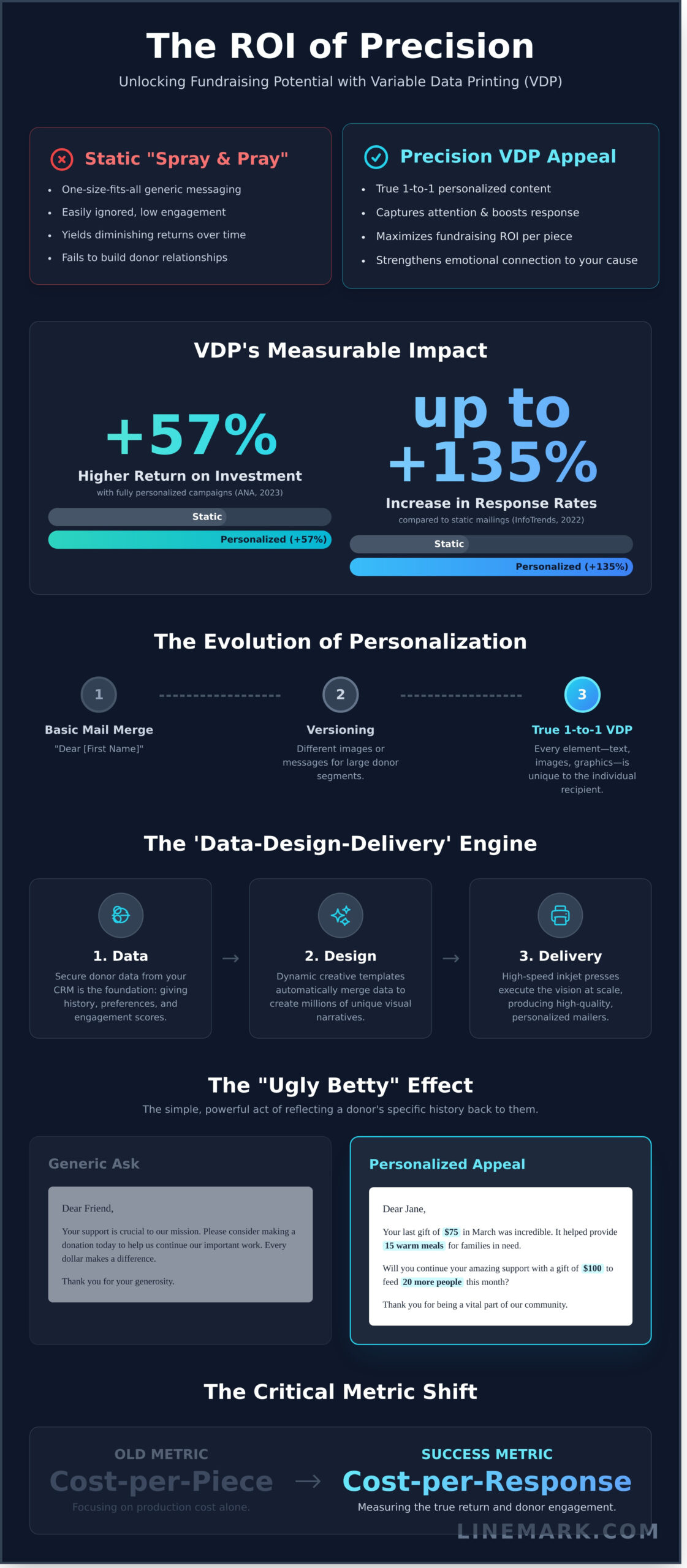
According to a 2023 report from the Association of National Advertisers, direct mail campaigns with full personalization see a 57% higher return on investment than their static counterparts. It’s a frustrating reality for many development directors. You meticulously manage a complex donor database, yet your one-size-fits-all mailers yield diminishing returns and fail to forge the strong emotional connections that drive repeat giving.
This is where precision changes the equation. This 2026 guide will demonstrate how strategic variable data printing for fundraising moves beyond a simple name swap to create deeply resonant, data-driven appeals. We’ll show you how to transform your outreach into a high-conversion engine that strengthens donor relationships and elevates your ROI per mail piece. From advanced data segmentation and secure processing to creating dynamic content that speaks directly to each supporter, you’ll gain a clear roadmap for implementing a powerful, ‘hands-off’ fulfillment process that delivers measurable results.
Key Takeaways
- Transition from inefficient ‘spray and pray’ mailings to precision-targeted appeals that resonate with individual donors and significantly boost engagement.
- Master the ‘Data-Design-Delivery’ framework, a synchronized process that transforms raw donor data into compelling, high-impact physical mail.
- Evaluate the true ROI of variable data printing for fundraising by shifting focus from cost-per-piece to the more critical cost-per-response metric.
- Implement the ‘Clean Data’ mandate to ensure campaign success by identifying and correcting common data pitfalls before they impact your results.
What is Variable Data Printing for Fundraising in 2026?
In 2026, the era of generic, one-size-fits-all fundraising mail is officially over. The “spray and pray” approach, where thousands of identical letters are sent in the hope of a small return, no longer delivers the ROI that development departments require. This is where Variable Data Printing (VDP) becomes a mission-critical tool. At its core, VDP is a digital printing method that allows for the modification of elements like text, graphics, and images from one printed piece to the next without stopping or slowing down the printing process. By leveraging donor data, what is Variable Data Printing? becomes a question of strategic personalization, transforming a simple mailer into a powerful, one-to-one conversation with each supporter.
The challenge for modern nonprofits is cutting through the overwhelming digital noise to capture a donor’s attention. With the average office worker receiving over 120 emails per day, a tangible, personalized piece of mail has more impact than ever. It creates a moment of focused engagement that a fleeting digital ad cannot. This is the new frontier of variable data printing for fundraising: using technology to create authentic connections at scale. The LineMark difference lies in our unique ability to merge industrial-scale production with this boutique level of personalization. We provide the high-capacity, integrated solutions needed to manage complex campaigns while ensuring every single piece feels uniquely crafted for its recipient.
The Evolution of Personalized Appeals
Personalization has evolved far beyond the simple mail-merged “Dear [First Name].” Early VDP introduced versioning, where a campaign might have several versions of an image or message tailored to different donor segments. Today, true 1-to-1 personalization is the standard. Advanced digital press technology, particularly high-speed production inkjet, has closed the quality gap with traditional offset printing. This innovation makes it economically viable to produce large-scale, fully customized campaigns with rich, vibrant color and crisp detail, a capability once reserved for only the most premium, small-batch projects.
Why Static Mail is Failing Your Development Team
As donors develop “inbox blindness” from a constant barrage of digital asks, the value of a physical touchpoint skyrockets. A static, impersonal letter, however, is just as easily ignored. It fails to acknowledge the donor’s unique relationship with your cause and leaves significant funds on the table. A 2022 InfoTrends report confirms that personalized direct mail campaigns can increase response rates by up to 135% compared to static mailings. This directly impacts your ability to secure that crucial second gift and improve long-term donor retention.
This dramatic lift is often driven by what we call the “Ugly Betty” effect. It’s the simple, powerful act of reflecting a donor’s specific financial history back to them. An appeal that says, “Your last gift of $75 in March helped provide 15 meals,” is infinitely more compelling than a generic request for support. It validates their past contribution and creates a psychological trigger to continue their pattern of giving, proving that data-driven personalization isn’t just a tactic; it’s the foundation of modern fundraising success.
The Mechanics of a Personalized Fundraising Campaign
A successful personalized appeal doesn’t happen by accident. It’s the result of a meticulously synchronized process built on the ‘Data-Design-Delivery’ triad. Each component is critical; if one fails, the entire campaign’s effectiveness is compromised. Your donor data provides the intelligence, the design translates that intelligence into a compelling visual narrative, and the delivery mechanism executes the vision at scale. This integrated system is the engine that drives response rates and deepens donor relationships.
The entire operation begins with your Customer Relationship Management (CRM) platform. It serves as the single source of truth, feeding the print engine with the rich data necessary for true 1:1 personalization. This isn’t just a mailing list; it’s a strategic asset containing giving history, communication preferences, demographic segments, and engagement scores. The quality of this data directly dictates the campaign’s potential. From there, our digital presses ingest the data and merge it with a dynamic design template, creating millions of unique documents in a single print run. Executing this level of variable data printing for fundraising requires immense operational capacity, which is why our 90,000-square-foot, single-source facility is essential for handling high-volume, deadline-driven projects without sacrificing an ounce of quality.
Data Security and SOC Compliance
In 2026, donor privacy isn’t just a best practice; it’s the foundation of trust. We recognize that you’re entrusting us with your organization’s most valuable asset. That’s why our workflows are built on industrial-grade security protocols, including SOC 2 Type II compliance. All data transfers occur via secure FTP with PGP encryption, and our internal data processing workflows are designed to protect sensitive donor information at every stage, ensuring complete integrity from file receipt to mail-stream entry.
This commitment to security and trust often extends beyond just donor data. Many non-profits also protect their reputation and the communities they serve by thoroughly vetting volunteers and staff. For organizations seeking reliable screening services, resources like Background Check Solutions provide comprehensive options to ensure safety and maintain trust.
Mapping Data to Design
This is where raw data becomes a relationship-building tool. We work with your team to establish a series of ‘Logic Rules’ that connect specific data points to creative elements. These are simple but powerful conditional statements that guide the personalization engine.
- Example Logic Rule: If Donor_Type = ‘Alumni’ AND Last_Gift_Year < '2015', then Image = 'Nostalgic_Campus_Photo.jpg' and Salutation = 'It’s been a while, [FirstName]'.
These rules ensure every component, from the hero image to the salutation, feels relevant. We also deploy ‘Ask Strings’ to dynamically suggest donation amounts based on a donor’s past giving patterns. As leading industry publications confirm, these dynamic Personalization Strategies in Direct Mail are proven to resonate more effectively than static asks. Ask Strings are a powerful tool for systematically increasing the average gift size by anchoring donation suggestions to a donor’s demonstrated capacity. Building these sophisticated rule sets is a core part of the LineMark integrated solution, turning your fundraising appeal into a truly personal conversation.
Maximizing ROI: Static vs. Variable Data Printing Analysis
The traditional metric for direct mail, cost-per-piece, is an outdated relic of the offset printing era. In today’s competitive fundraising environment, the only number that truly matters is your cost-per-response. A static, one-size-fits-all appeal might cost $0.50 per piece to produce and mail, but if it yields a 0.5% response rate, your cost to acquire a single donation is a staggering $100. Conversely, a highly personalized VDP piece might cost $1.25, but a 4% response rate drops your acquisition cost to just over $31. That’s a 69% improvement in efficiency.
This ROI calculation becomes even more critical when you factor in waste. Every irrelevant appeal sent to the wrong donor segment isn’t just a wasted printing and postage cost; it’s a negative brand interaction that trains your audience to ignore future communications. Effective variable data printing for fundraising eliminates this waste by ensuring the message, imagery, and ask amount resonate with each specific recipient. You send fewer, better pieces that land with impact.
This strategy of targeted efficiency is no longer optional. With USPS First-Class Mail prices increasing by over 30% since 2019, the financial logic of “spray and pray” has collapsed. By 2026, the winning fundraising strategy will be defined by mailing intelligence, not volume. Sending fewer, hyper-personalized appeals isn’t just smart marketing; it’s a necessary adaptation to escalating operational costs.
Consider the impact of simple segmentation. A recent university alumni campaign we managed used VDP to tailor appeals by graduation decade. The 10-year reunion class received mailers referencing a popular campus spot from their era, while the 50-year class saw images of the university’s original architecture. This simple change, combined with decade-specific giving goals, resulted in a 22% increase in the average gift size from those targeted segments compared to the previous year’s static campaign.
Calculating the Real Cost of Your Appeal
Every static campaign carries the hidden “Cost of Ignored Mail,” an expense that encompasses the materials, production, and postage for every piece that goes directly into the recycling bin. VDP minimizes this by elevating relevance. This financial efficiency is amplified when working with a single-source partner like LineMark. Our integrated data management, printing, and mailing fulfillment eliminates the logistical overhead and potential for error that comes from juggling multiple vendors, further reducing your true campaign cost.
Measuring Success Beyond the Response Rate
A sophisticated variable data printing for fundraising program moves beyond single-campaign metrics to build long-term value. By tracking the right key performance indicators, you can measure the true, compounding return on your investment.
- Lifetime Donor Value (LDV): Personalized stewardship makes donors feel seen and valued, dramatically improving retention. Nonprofits that personalize follow-up communications see up to a 50% higher retention rate for first-time donors, which is the foundation of a strong LDV.
- Digital Engagement Attribution: By embedding unique PURLs (e.g.,
give.yournonprofit.org/Jane-Doe) and QR codes in each mail piece, you create a seamless, trackable bridge from print to digital. This provides clear, 1-to-1 attribution, proving the direct impact of your mail on online giving. - Average Gift Size: VDP enables data-driven ask strings tailored to a donor’s giving history and capacity. Instead of a generic `[$50, $100, $250]` ask, a major donor might see `[$1,000, $2,500, $5,000]`. This simple personalization consistently increases average gift size by 15-30% across campaigns.
Practical Guidance: Preparing Your Donor Data for VDP
The sophisticated technology behind variable data printing is only half of the equation. Your campaign’s ultimate success rests entirely on the quality and organization of your donor data. A flawed spreadsheet directly translates into flawed mailers, wasted postage, and missed opportunities to connect. Think of your data not as a simple list, but as the architectural blueprint for a highly personalized fundraising appeal.
Before launching any campaign, addressing common data pitfalls is a non-negotiable first step. Issues like duplicate records for the same household, inconsistent name casing (“jane” vs. “Jane”), and outdated addresses can undermine even the most creative VDP strategy. According to the USPS, over 6.5 billion mailpieces were classified as Undeliverable-as-Addressed in 2022 alone. Clean data isn’t just about accuracy; it’s about fiscal responsibility and protecting donor relationships.
Step-by-Step Data Hygiene Checklist
A systematic approach to data hygiene ensures every dollar of your budget is maximized. This pre-flight check is essential for any serious variable data printing for fundraising initiative, preventing costly and embarrassing errors before they ever reach the press.
- NCOA Processing: Running your list through the National Change of Address (NCOA) database is the single most effective way to reduce undeliverable mail. This process updates the addresses of donors who have moved, increasing deliverability and ensuring your message reaches its intended recipient.
- Standardize Critical Fields: Avoid awkward automated greetings like “Dear Mr. John” by separating data into discrete, standardized fields. Your database must have distinct columns for ‘Salutation’ (Mr., Ms., Dr.), ‘First Name’, ‘Last Name’, and a custom ‘Formal Salutation’ (e.g., Mr. Smith) to allow for flexible, error-free personalization.
- Implement Deduplication Strategies: Sending two identical appeals to a husband and wife at the same address appears wasteful. Implement a “householding” process to identify and merge records for multi-donor households, allowing you to send a single, consolidated piece addressed to “The Smith Family” or “John and Jane Smith.”
Advanced Segmentation Strategies
With a clean, verified list, you can move to the most powerful stage: segmentation. This is where you leverage donor insights to create messages with profound emotional resonance. Instead of a one-size-fits-all appeal, VDP allows you to speak directly to what motivates each specific donor group.
- Segment by Interest: Does your CRM track which programs a donor has supported in the past? Use that data. A donor who consistently gives to your animal rescue program should receive an appeal featuring a compelling photo of a dog, while a supporter of your literacy initiatives receives one with an image of a child reading.
- Segment by Recency and Frequency: A donor who hasn’t given in 18 months requires a different message (“We miss your support”) than a loyal monthly sustainer (“Your consistent generosity is changing lives every day”). Acknowledge their specific relationship with your organization.
- The ‘Milestone’ Approach: Celebrate loyalty. Use VDP to automatically generate a special appeal for a donor’s five or ten-year giving anniversary. A simple message like, “Thank you for a decade of partnership,” transforms a standard appeal into a moment of genuine appreciation, significantly boosting retention.
Executing this level of data preparation requires precision and powerful tools. LineMark’s integrated Direct Mail Fulfillment Services handle these complexities seamlessly, ensuring your data is not just clean, but strategically deployed for optimal results.
Ensure your next campaign is built on a foundation of flawless data. Consult with a LineMark data expert today to optimize your donor list for maximum impact.
Linemark: Your Single-Source Partner for Fundraising Success
Executing a sophisticated direct mail strategy requires more than a powerful donor database. It demands a partner capable of bridging the gap between complex data and flawless physical production. Linemark is that bridge. We are a single-source partner, engineered to transform your fundraising goals into tangible results, all from our integrated 90,000-square-foot facility where design, data processing, print, and fulfillment converge.
We understand the challenges national non-profits face with decentralized chapters. That’s why we developed our MarCom On-Demand portal. This customized platform empowers your regional fundraising teams to order pre-approved, brand-compliant materials, allowing for localized personalization while maintaining national brand integrity. It’s centralized control with decentralized execution, streamlining your entire operation.
Our approach is built on a foundation of technology and strategy. We don’t just print what you send us; we consult with you to optimize every component of your campaign for maximum impact and postal efficiency. This holistic view is the core of the Linemark difference.
Scalability for National Non-Profits
Whether your campaign is a 2.5 million-piece nationwide appeal or a 5,000-piece high-touch mailing to major donors, our systems deliver the same level of precision. The “LineMark Experience” means proactive partnership. We identify potential data or design issues before they hit the press, saving you time and money. From our strategic Mid-Atlantic hub in Upper Marlboro, MD, we manage nationwide distribution with unparalleled efficiency, ensuring your appeals arrive on schedule.
This seamless integration of technology and logistics is what makes our approach to variable data printing for fundraising so effective. By managing every step of the process, from data hygiene to mail-stream entry, we eliminate the friction points that commonly derail complex campaigns. Our clients don’t have to coordinate between a data house, a print shop, and a mail house. They have one team and one point of accountability: Linemark.
- End-to-End Control: We handle data processing, digital and offset printing, and complete mailing and fulfillment services in-house.
- Technological Edge: Our state-of-the-art equipment ensures high-quality personalization on every single piece, regardless of volume.
- Strategic Logistics: Our location provides optimal access to major distribution networks, reducing transit times and costs.
Get Started with Your 2026 Fundraising Strategy
Your next fundraising cycle begins with a strategic conversation, not a simple print quote. Let’s discuss how data-driven personalization can elevate your 2026 appeals. We make integration easy, with proven workflows for connecting with major CRM platforms like Blackbaud, Salesforce, and DonorPerfect. Let’s build a smarter campaign together. Your mission is too important for anything less.
Consult with a Linemark VDP Expert Today
Transform Your Appeals with a Proven VDP Partner
As we move through 2026, the path to fundraising success is paved with personalization. Generic appeals don’t capture donor attention. The evidence is clear: successful campaigns are built on clean data and a strategic approach to variable data printing for fundraising, a method proven to drive higher engagement and ROI than traditional static mailings. Executing this requires more than just technology; it demands a partner with proven expertise.
For over 30 years, Linemark has been that single-source partner for non-profits. Our SOC-compliant data handling ensures your donor information is secure, while our 90,000 sq. ft. high-capacity production facility guarantees your appeal is executed flawlessly and on schedule. We provide the integrated solutions you need to connect with every donor on a personal level.
Streamline your next appeal with Linemark’s VDP solutions.
Your most successful campaign is waiting.
Frequently Asked Questions
Is variable data printing more expensive than traditional printing?
Yes, the per-piece cost for VDP is higher, but the return on investment consistently outperforms static printing. Campaigns using variable data printing for fundraising often see a 30-50% lift in response rates because the personalized message resonates more deeply with each donor. This increased engagement and higher average gift size means your net revenue from the campaign is significantly greater, making it a more profitable strategy in the long run.
How much data do I need to start a VDP fundraising campaign?
You can launch a powerful VDP campaign with just a donor’s first name and address. Even this simple level of personalization makes a noticeable impact. However, the true power is unlocked by adding just 3-4 more data points. Incorporating a last donation amount, the date of their last gift, or their specific area of interest allows for messaging that is exponentially more relevant and effective at driving donations.
Can VDP handle different languages for international donor lists?
Absolutely. Our digital printing technology is engineered to manage multiple languages and character sets seamlessly within a single, high-volume print run. Your donor database simply needs a field to indicate the preferred language (e.g., ‘EN’ for English, ‘ES’ for Spanish). Our system then automatically populates the correct pre-translated text blocks for each recipient, ensuring every donor receives a message in their native language without complicating the production process.
What is the typical turnaround time for a high-volume VDP project?
A standard high-volume project, such as a 100,000-piece direct mail appeal, is typically completed in 5-7 business days following final proof approval. This comprehensive timeline includes our secure data processing, digital printing, all finishing services like folding or inserting, and preparation for postal induction. We build scalable production schedules to ensure your critical campaign deadlines are met with precision, every time.
Do I need a special designer for variable data printing projects?
You don’t need a specialized VDP designer, but your creative team must know how to prepare files for variability. The designer creates a static template and uses placeholder text or boxes to indicate where variable elements like names, images, or ask amounts will be placed. Our expert pre-press team then collaborates directly with your designer to review the files, ensuring a flawless integration of data and design before printing begins.
How does Linemark ensure my donor data stays secure during printing?
We protect your sensitive donor data using stringent, SOC 2 Type II certified security protocols. All data is transferred to us via secure, encrypted FTP channels and is handled exclusively within our access-controlled facilities. Once your project is completed and mailed, we follow a strict data destruction policy to permanently erase your files from our systems, providing a secure, closed-loop process from start to finish.
Can I use VDP for non-profit annual reports as well?
Yes, VDP is a powerful tool for transforming generic annual reports into personalized stewardship pieces. Imagine a report where the opening letter addresses the donor by name and references their years of support. You could include a personalized infographic that visually represents the direct impact of their specific 2025 donation. This level of customization makes donors feel seen and valued, strengthening their connection to your mission and encouraging future giving.
What are ‘Ask Strings’ and how do they work in VDP?
Ask Strings are variable, data-driven donation suggestions printed on a reply device. Instead of a generic set of amounts, each donor sees a custom array based on their giving history. A common formula uses the donor’s last contribution amount (LCA) to generate options like 1.5x LCA, 2x LCA, and 3x LCA. This data-informed approach is proven to increase average gift size by up to 25% by presenting a personally relevant and challenging request.