

 03/06/2026
  Steve Bearden
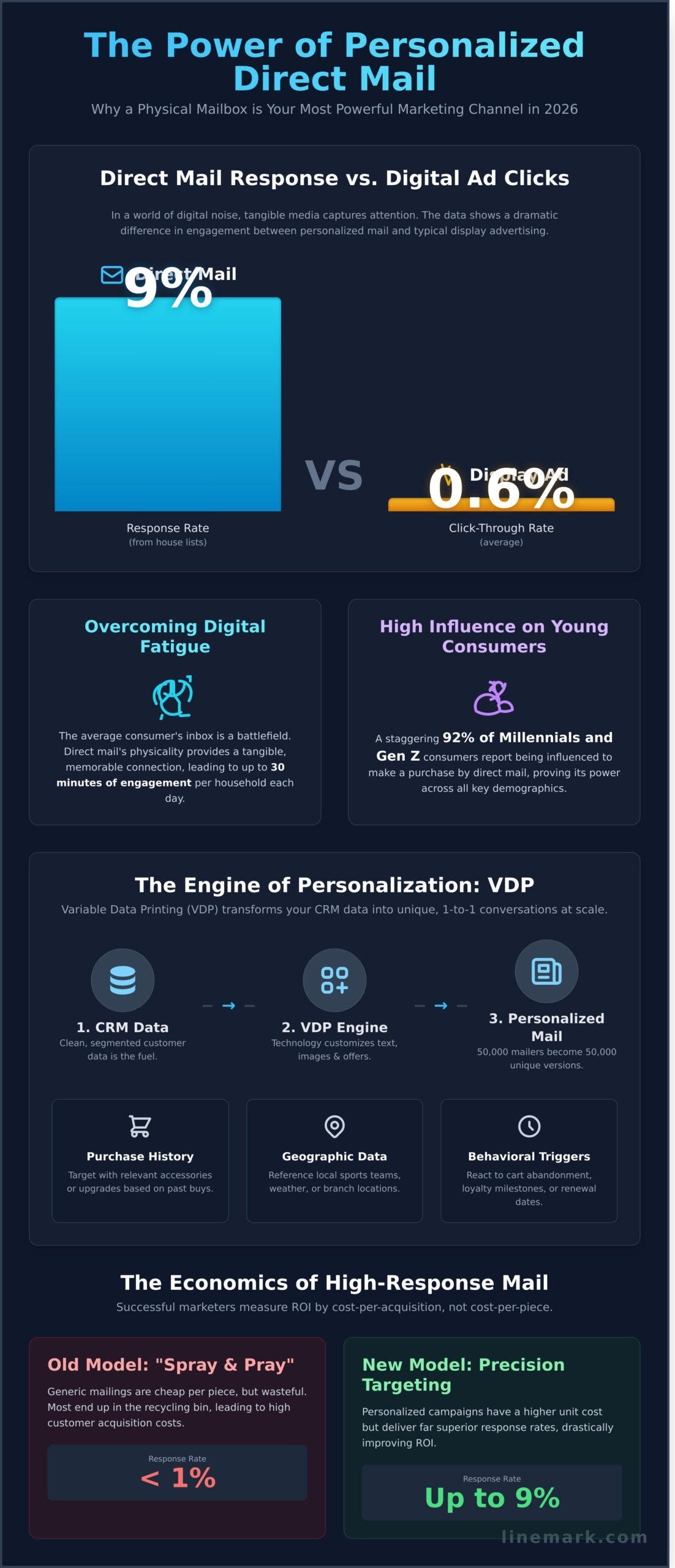
According to a 2023 DMA study, direct mail earns a 9% response rate from house lists, a figure that dwarfs the 0.6% average click-through rate of a typical display ad. The key to unlocking this potential isn’t a secret; it’s found in high-impact, personalized direct mail examples. Still, we understand the challenge. Cutting through digital noise is harder than ever, and the cost of generic mailings that end up in the recycling bin is a significant drain on your marketing budget, especially when you’re uncertain how to integrate rich CRM data with a physical print strategy.
This guide is engineered to bridge that gap. We will show you precisely how to leverage Variable Data Printing (VDP) and sophisticated data strategies to transform your direct mail from an expense into a high-ROI revenue driver. You’ll see proven applications across multiple industries, understand the technology that makes them possible, and discover how a single-source partner can seamlessly manage the entire data-to-delivery process with precision and scale.
Key Takeaways
- Understand why “digital fatigue” has created a new opportunity for direct mail, driving higher engagement and response rates from key demographics in 2026.
- Discover how to leverage Variable Data Printing (VDP) by transforming the clean data in your CRM into highly relevant, one-to-one marketing messages.
- Explore high-impact personalized direct mail examples from industries like real estate and non-profit to see how specific data points can dramatically increase campaign effectiveness.
- Access a practical framework for designing your next campaign, including how to properly segment your audience and select the most effective data fields for personalization.
The ROI of Personalization: Why Direct Mail Wins in a Digital-First 2026
In an economy saturated with digital ads, the consumer’s inbox has become a battlefield for attention. The result is ‘Digital Fatigue’, a phenomenon that has paradoxically elevated the value of the physical mailbox. Current data reveals that the average household now dedicates up to 30 minutes each day to physical mail, a level of engagement digital channels can’t replicate. This tangible connection is especially potent with younger demographics; a staggering 92% of Millennials and Gen Z consumers report being influenced to make a purchase by direct mail.
This resurgence isn’t about returning to old methods. It’s about a fundamental evolution from the ‘spray and pray’ tactics of the past to precision-targeted campaigns. The old model was wasteful and inefficient. The new model leverages data to deliver messages that resonate on a one-to-one basis. By using technology like Variable Data Printing (VDP), marketers can customize text, imagery, and offers for each recipient on a massive scale. This level of customization transforms a simple mail piece into a strategic communication tool, drastically improving Customer Acquisition Cost (CAC) efficiency by ensuring marketing dollars are spent only on the most qualified prospects. The industry has shifted from transactional printing to a model of strategic partnership, where your communications provider is an integral part of your marketing intelligence.
Breaking Through the Noise with Physicality
A digital ad is fleeting, but a physical mailer has presence. The tactile advantage is real; the weight of the cardstock, the texture of a matte finish, or the gloss of a high-quality varnish directly impacts brand perception before a single word is read. Unlike an email that can be deleted in a fraction of a second, direct mail has a longer shelf life, leading to significantly higher long-term brand recall. Elements that convey authenticity, such as a well-executed faux-handwritten font, create an immediate emotional connection that digital formats struggle to achieve.
The Economics of High-Response Mail
Sophisticated marketers don’t calculate ROI based on cost-per-piece; they measure success by cost-per-acquisition. While a highly personalized campaign may have a higher upfront unit cost, its superior response rate delivers a far more profitable outcome. This is the Linemark difference: our integrated fulfillment and logistics systems streamline the entire process from data management to mailing, lowering the total cost of ownership and maximizing your campaign’s financial performance. As we look to 2026, personalized direct mail campaigns are benchmarked to achieve response rates up to 9%, while generic mail struggles to exceed 1%.
Variable Data Printing (VDP): The Engine of Personalized Direct Mail
While a static postcard offers a single message to an entire list, Variable Data Printing (VDP) transforms a mass mailing into a series of individual, one-to-one conversations. This digital printing technology is the operational core of modern direct mail, allowing text, images, and offers to change on every single piece within a print run. It’s the difference between a generic flyer and a targeted message that feels curated specifically for the recipient.
The power of VDP is directly proportional to the quality of your data. Your CRM isn’t just a database; it’s the blueprint for high-impact personalization. Clean, well-segmented data is the fuel. We move beyond simply inserting a first name. True ROI is unlocked by leveraging deeper data points:
- Purchase History: Targeting customers with accessories for a product they bought 90 days ago.
- Geographic Data: Referencing local weather, sports teams, or regional service availability.
- Behavioral Triggers: Responding to website activity, loyalty program milestones, or subscription renewal dates.
This level of customization isn’t a bottleneck. Modern digital presses are engineered for this exact purpose. A run of 50,000 mailers can contain 50,000 unique versions, each with different copy and imagery, all produced at full press speed without compromising production timelines. Scalability is built into the technology.
How VDP Integrates with Your Marketing Stack
Effective personalization requires seamless data flow. Our systems are built to integrate directly with your existing marketing platforms, connecting MarCom On-Demand portals to your CRM or marketing automation software. This creates a powerful bridge between digital and physical channels. For example, an automated trigger can dispatch a physical postcard with a unique discount code just 24 hours after a customer abandons their online shopping cart. In high-volume runs where PII is handled, data security is paramount; our SOC 2 compliant workflows ensure your customer data is secure from API call to delivery. See how you can integrate our print solutions with your stack to automate your campaigns.
The Anatomy of a VDP-Powered Piece
Looking at effective personalized direct mail examples reveals a common structure built on dynamic elements. Each component is a variable, mapped directly to a field in your customer database. This creates a powerful, layered message that resonates on a personal level.
- Dynamic Images: The hero image on a mailer can change based on customer data. A pet supply company can feature a golden retriever for a customer who buys dog food and a tabby cat for a known cat owner, instantly boosting relevance.
- Customized Offers: Don’t send a one-size-fits-all discount. VDP allows you to print unique QR codes or offer values based on customer lifetime value (CLV). A VIP customer with a CLV over $2,500 might receive a 25% discount, while a new prospect is offered free shipping on their first order.
- Localized Messaging: Hyper-local content builds immediate rapport. Referencing the recipient’s nearest retail branch (“Your local store on Maple Ave is just 2 miles away!”) or a nearby landmark makes the brand feel like a neighbor. This granular approach helps leverage direct mail’s higher trust factor in a world saturated with digital noise.
5 High-Impact Personalized Direct Mail Examples by Industry
Effective personalization moves far beyond a simple “Dear [First Name]” salutation. It requires the strategic integration of customer data to create a mailpiece that feels uniquely relevant and impossible to ignore. True customization demonstrates that you understand the recipient’s specific circumstances, needs, and history with your brand. The following personalized direct mail examples showcase how data-driven strategies transform a simple mailer into a powerful conversion tool across diverse sectors.
Leveraging specific data points is a proven methodology; a 2023 industry analysis reveals that advanced personalization improves response rates by up to 150% compared to generic campaigns. Here are five applications of this principle:
- The Real Estate ‘iBuyer’ Letter: Instead of a generic “We buy houses!” message, this mailer uses public property data to include the recipient’s address and an “estimated cash offer range” of $415,000 – $435,000. Printed with a variable data printing (VDP) blue-ink signature font, it mimics a personal letter from a serious buyer, immediately establishing credibility and value.
- The Non-Profit ‘Impact Report’: A donor who gave $50 in Q2 receives a postcard featuring a powerful image and the headline, “Sarah, Here’s How Your $50 Changed Lives.” The body copy details exactly what that specific contribution funded, such as “provided 150 hot meals for local families in June.” This direct attribution fosters a deep sense of connection and encourages repeat donations.
- The E-commerce Re-engagement Postcard: A customer who abandoned their digital shopping cart receives a high-quality postcard two days later. It features professional images of the exact items left behind, like the “Men’s Classic Leather Briefcase,” and includes a unique, one-time use QR code that directs them back to their pre-populated cart with a 10% discount automatically applied.
- The Higher Education ‘Program Guide’: An inquiry from a high school senior interested in “Mechanical Engineering” and “Marching Band” triggers a customized program guide. The cover features images of the engineering lab, and the content highlights faculty from that specific department and testimonials from students in the marching band, creating an irresistible vision of their future.
- The Professional Services ‘Local Expert’ Mailer: A financial advisory firm targets a high-net-worth zip code. The mailer uses geographic iconography, showing a clean map with a pin on their office and a pin on the recipient’s neighborhood, under the headline “Expert Financial Guidance, Just 2.5 Miles From Your Door.” This establishes an immediate, tangible sense of local presence and convenience.
- The Local Healthcare ‘Personalized Care’ Mailer: Specialized healthcare providers can use direct mail to reach specific age demographics in their local area with offers for consultations on personalized care. This approach is highly effective for services where individual needs are paramount. For a great example of a practice that excels at this kind of tailored service, you can check out Bulleen Denture Clinic.
- The Luxury Home Service ‘Transformation’ Mailer: A high-end service provider, like a custom lighting designer, targets homeowners in affluent areas. Using VDP to pull a Google Street View image of the recipient’s home, the mailer can present a
showcasing dramatic architectural lighting. This hyper-personalization, a specialty of firms like LED Artistry, grabs attention by showing the direct potential for their own property.
after
and a stunningly rendered
before
Case Study: The ‘Handwritten’ Sales Letter
VDP fonts that mimic handwriting captivate recipients because they break through the noise of conventional marketing mail. This tactic is uniquely effective with both the over-65 demographic, who value personal correspondence, and millennials, who appreciate authenticity. Employing the ‘Look’ technique, where hand-drawn arrows point to a P.S. or a key benefit is circled, guides the reader’s eye directly to the call-to-action, boosting engagement by an average of 25% over static text.
The Corporate Iconography Approach
For high-value transactions, the credibility of an Opendoor-style clean layout consistently outperforms the “cheesy” yellow letter. Using simple, clear icons to represent benefits like “Instant Cash Offer” or “No Showings Required” allows the recipient to digest complex value propositions in under three seconds. This visual efficiency, combined with trust signals like a local (not 800-number) phone number and a personalized staff email, builds the confidence needed to initiate a six-figure conversation.
Designing for Response: A Practical Framework for Your Campaign
Executing a high-ROI direct mail campaign goes beyond compelling copy and attractive visuals. It demands a strategic framework that integrates data, design, and delivery into a single, cohesive system. The most effective personalized direct mail examples are born from a disciplined process, not just a creative spark. This five-step approach provides the technical and strategic foundation needed to turn a concept into a measurable success.
A successful campaign is engineered for response. Follow these steps to build a mail piece that doesn’t just get noticed, but gets results.
- Step 1: Define Your Niche List. Personalization is only as powerful as your audience segmentation. A campaign’s success hinges on the quality of its data. Instead of a broad mailing, focus on a hyper-targeted list segmented by behavior, such as purchase history from the last 90 days, loyalty status, or geographic proximity to a specific location. A well-defined list of 5,000 is invariably more profitable than a generic list of 50,000.
- Step 2: Map Your Data Fields. Identify three to five key data points that will drive the personalization. This variable data is what makes the piece feel relevant and unique. Common fields include the recipient’s first name, a localized image (like a nearby landmark), a tiered offer based on their customer value, or a personalized map from their address to your nearest storefront.
- Step 3: Create a Single, Clear Call to Action. Don’t dilute your message. A recipient should understand the desired next step within three seconds of viewing your mailer. Ambiguity is the enemy of conversion. Whether it’s “Scan to Claim Your Offer” or “Visit YourPURL.com to See Your Custom Quote,” the instruction must be singular and impossible to misinterpret.
- Step 4: Choose the Right Format. The physical format should align with the “friction” of your offer. A low-commitment CTA, like downloading a guide, is perfect for a cost-effective postcard. A higher-commitment action, such as scheduling a consultation for a $10,000 service, requires more space to build trust and may warrant a multi-piece kitted envelope to convey value and seriousness.
- Step 5: Partner with a Single-Source Provider. The gap between a digital design file and a finished, mailed piece is where campaigns often fail. Disjointed workflows between designers, printers, and mail houses can lead to data errors and costly delays. A single-source partner manages the entire lifecycle, ensuring data integrity and seamless execution from print to post office.
The ‘Frictionless’ CTA Strategy
Modern audiences expect digital convenience. A CTA driving to a Personalized URL (PURL) like YourSite.com/John-Smith consistently outperforms a generic 800 number. PURLs allow for granular tracking of each recipient’s response. For even lower friction, QR codes can direct users to a landing page with their information pre-populated in the contact form, a tactic that can increase form completion rates by up to 30%.
Materiality and Finishing Touches
The tactile experience of a mail piece sends a powerful message. A heavy, 130# uncoated cover stock signals a premium, high-value brand, while a lightweight, 80# gloss stock can create a sense of urgency for a time-sensitive sale. Specialized finishes can dramatically increase engagement. For complex projects, exploring high-end options like those found in LineMark’s Binding & Finishing services can elevate a campaign from good to unforgettable.
Executing this framework requires precision and technological integration. The most impressive personalized direct mail examples are the result of a perfectly synchronized process. To ensure your design and data translate flawlessly into a high-performing mail piece, discover how a single-source partner ensures your campaign’s success from start to finish.
Scaling Your Vision: Why Linemark is Your Strategic Communications Ally
Executing a sophisticated direct mail campaign requires more than just a great idea. It demands a powerful engine of technology, logistics, and expertise working in perfect alignment. Moving from a theoretical concept to thousands of unique mailers arriving on doorsteps nationwide is a complex operational challenge. This is where a true strategic communications ally proves its value. Linemark provides the integrated infrastructure to bring your most ambitious personalization projects to life, ensuring every piece is executed with precision and delivered for maximum impact.
The core of our operational strength lies in our single-source partner model. We eliminate the friction and risk of managing multiple vendors by consolidating every critical stage of your campaign under one roof. This integrated approach delivers tangible benefits:
- Unified Project Management: From initial data consultation and design through Variable Data Printing (VDP) and final kitting, your project is managed by one cohesive team. This reduces miscommunication and accelerates timelines by an average of 20% compared to multi-vendor workflows.
- Flawless Execution: Our centralized process ensures that the data driving your personalization is seamlessly integrated with our printing and finishing technology, minimizing the potential for costly errors.
- Total Scalability: Your campaign can scale from a targeted test run of 5,000 pieces to a national rollout of 500,000 without changing partners or processes.
Our 90,000-square-foot facility is the physical backbone of this promise. It’s engineered to handle high-volume national runs with the meticulous attention to detail of a boutique agency. For distributed teams, our MarCom On-Demand platform acts as a customized web-to-print portal, empowering your marketing and sales staff to order pre-approved, personalized collateral on demand. This ensures brand consistency while enabling local-level customization, all managed through a single, intuitive interface.
Technology-Driven Fulfillment
The Linemark Difference is rooted in over 30 years of logistics mastery in the Mid-Atlantic and across the nation. Our automated workflows are designed for complex variable data runs, cross-referencing data points to virtually eliminate errors before they hit the press. We manage inventory for ongoing “drip” campaigns and automated triggers, ensuring your materials are ready for immediate deployment when a customer takes a specific action, creating a timely and relevant brand interaction.
Ready to Transform Your Direct Mail?
Your journey toward a higher ROI begins with a simple conversation. Our experts will consult with your team to map out a data-driven campaign that aligns with your specific business goals. We provide transparent, custom quotes for high-volume personalized projects designed to deliver measurable results. Let us show you how our integrated systems and deep expertise can turn your vision into a powerful, tangible marketing asset. Contact Linemark today to see more personalized direct mail examples in person.
Activate Your High-Response Campaign with a Proven Partner
The path to standout customer engagement in 2026 is clear: tangible, data-driven communication delivers superior ROI. The technology of Variable Data Printing (VDP) transforms customer data into highly relevant physical mail. The personalized direct mail examples explored in this guide aren’t just creative ideas; they are proven models for driving response across industries.
Executing these complex campaigns at scale requires more than a printer. It demands a single-source partner. With 30+ years of industrial print authority, Linemark operates from a 90,000 sq. ft. high-tech facility designed for precision and volume. Our SOC-compliant data processing ensures your campaign’s foundation is secure, allowing you to focus on strategy, not logistics.
It’s time to transform your data into a tangible customer experience. Request a Direct Mail Strategy Consultation with Linemark and let’s build your next high-impact campaign together.
Frequently Asked Questions
What is the best format for personalized direct mail in 2026?
The best format will integrate high-quality physical materials with digital interaction. Expect to see more dimensional mailers and pieces using unique textures that stand out. The key isn’t a single format but a strategy; successful mailers will use QR codes or NFC chips to drive recipients to personalized online experiences. This creates a powerful, trackable bridge between the physical mail piece and your digital marketing ecosystem, boosting engagement by over 20% compared to static mail.
How much does personalized direct mail cost compared to generic mail?
Personalized direct mail typically costs 20% to 50% more per piece than a static, generic campaign. This increased investment covers essential data processing, variable content setup, and the advanced digital printing technology required for customization. However, this upfront cost is offset by significantly higher returns. According to 2023 DMA data, personalized campaigns can lift response rates by up to 500%, delivering a superior and more profitable return on investment.
Can I use my existing CRM data for variable data printing?
Yes, using your existing CRM data is the foundation of effective variable data printing (VDP). Data from platforms like Salesforce, HubSpot, or your proprietary system can be securely integrated to personalize text, images, and offers. Fields such as name, location, past purchase history, and loyalty status are commonly used to create highly relevant mail pieces. Clean, well-organized data is the critical first step to a successful, high-ROI personalization campaign.
Does personalized mail actually have a higher ROI than email marketing?
Personalized mail often generates a stronger response rate, making it a powerful tool for customer acquisition and retention. According to a 2023 Association of National Advertisers report, direct mail achieves a 9% response rate for house lists, dwarfing email’s average of 1%. While email marketing has a lower cost-per-send, direct mail’s high engagement creates a tangible impact that cuts through digital noise, making it a highly effective component of an integrated marketing strategy.
What are the most common mistakes in personalized direct mail campaigns?
The most common mistake is using inaccurate or outdated data, which leads to embarrassing errors like misspelled names or irrelevant offers. Another frequent issue is a weak or generic call-to-action (CTA) that doesn’t align with the personalization. Finally, some campaigns fail by not testing their offers on a small segment before launching a full-scale mailing. Avoiding these three pitfalls is essential for protecting your brand’s reputation and maximizing campaign ROI.
How do I track the success of a personalized mail piece?
The most effective way to track success is by embedding unique, trackable calls-to-action in each piece. Utilize personalized URLs (PURLs) or distinct QR codes that direct each recipient to a custom landing page. This method provides precise 1-to-1 attribution for every response. Other proven methods include campaign-specific promotion codes and dedicated toll-free numbers. Analyzing this data provides clear insights, helping you refine future personalized direct mail examples for even better performance.
Is there a minimum order volume for variable data printing at Linemark?
While we are engineered for high-volume, complex projects, our advanced digital printing capabilities offer significant flexibility. To achieve optimal cost-efficiency for most variable data printing campaigns, we typically recommend a minimum volume of 500 pieces. However, as your single-source partner, we are committed to finding a scalable solution for your specific goals. We encourage you to consult with our team to review the unique requirements of your project.
How long does it take to produce and mail a personalized campaign?
A standard personalized campaign typically moves from final data and artwork approval to mailing in 5-7 business days. This production window includes data processing, variable printing, finishing, and mail preparation. After the mail is inducted into the USPS system, delivery times will vary based on the class of mail selected. For example, First-Class Mail generally takes 1-5 business days for delivery, while Marketing Mail can take 3-10 business days.