

 03/23/2026
  Steve Bearden
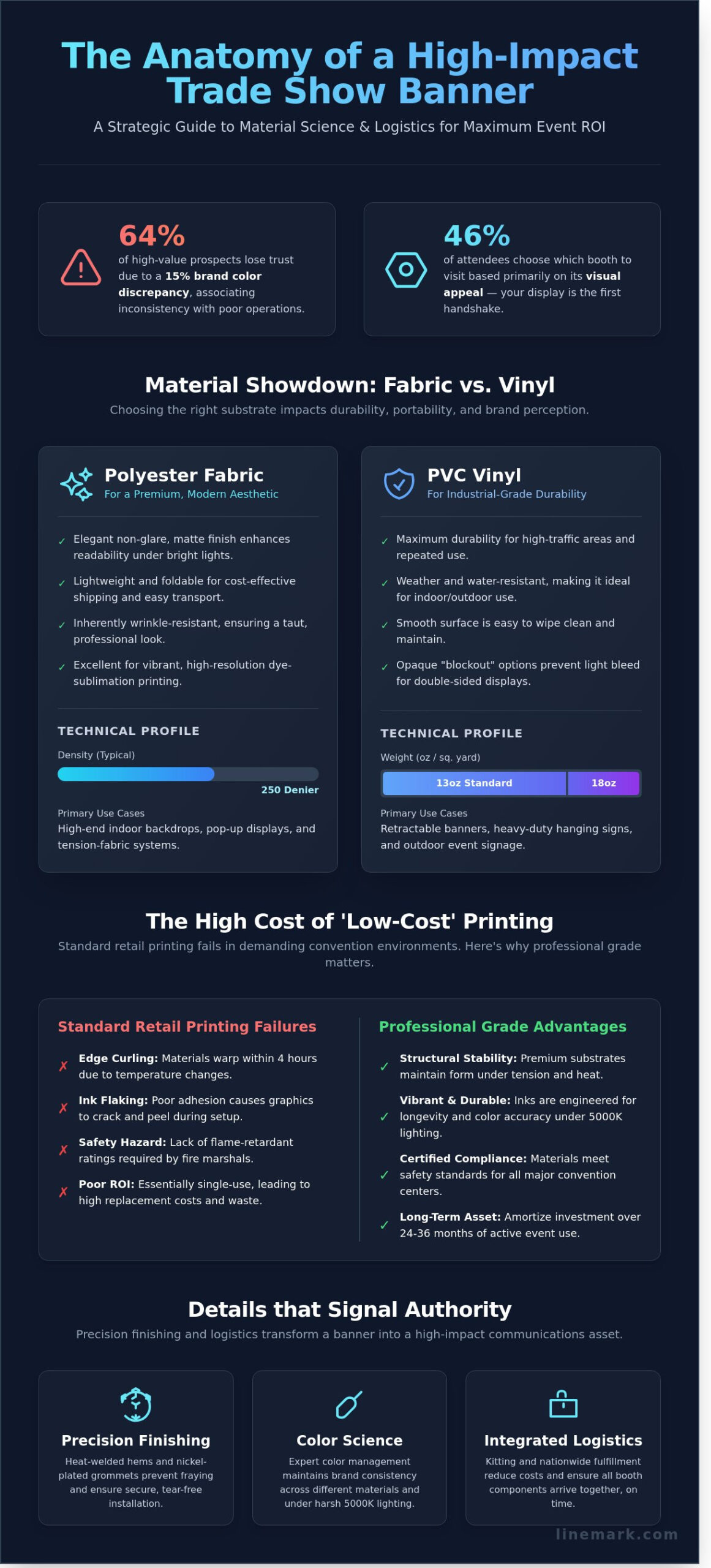
A 15% discrepancy in brand color across your display materials doesn’t just look unprofessional; it actively erodes trust with 64% of high-value prospects who associate visual consistency with operational excellence. You understand that the trade show floor is a high-stakes environment where second chances don’t exist. You’ve likely dealt with the frustration of unboxing a banner only to find it’s wrinkled, off-brand, or arriving two hours after the doors open. High-quality trade show banner printing requires more than just a digital file; it demands a strategic approach to material science and logistical precision.
We’re here to help you master these nuances so your brand stands out with absolute precision and industrial-grade durability. This guide provides a strategic roadmap for achieving vibrant, color-accurate displays that justify your 2026 marketing investment. You’ll discover how to move beyond transactional vendors to find a single-source partner capable of managing complex distribution for multiple locations. We’ll examine the specific material standards and fulfillment strategies required to transform your booth into a high-impact communications asset that performs flawlessly every time.
Key Takeaways
- Understand why your display serves as the “first handshake” with leads and how professional quality impacts your total event ROI.
- Evaluate the durability and aesthetic advantages of fabric versus vinyl to ensure your materials align with your brand’s portability needs.
- Navigate the structural requirements for diverse booth configurations using high-impact trade show banner printing techniques.
- Solve the technical challenges of large-scale design by mastering vector resolution and maintaining color consistency across multiple substrates.
- Reduce hidden operational costs by leveraging integrated kitting and nationwide fulfillment to simplify booth setup and logistics.
The Role of Professional Trade Show Banner Printing in Event ROI
Trade show banner printing involves more than just applying ink to a substrate. It’s the strategic production of custom, large-format graphics engineered to command attention within high-traffic exhibition halls. These displays act as your brand’s first physical handshake with a prospect. Data from a 2023 study by the Center for Exhibition Industry Research (CEIR) shows that 46% of attendees identify a booth’s visual appeal as the primary factor in their decision to visit a display. When a graphic looks professional, it builds immediate trust.
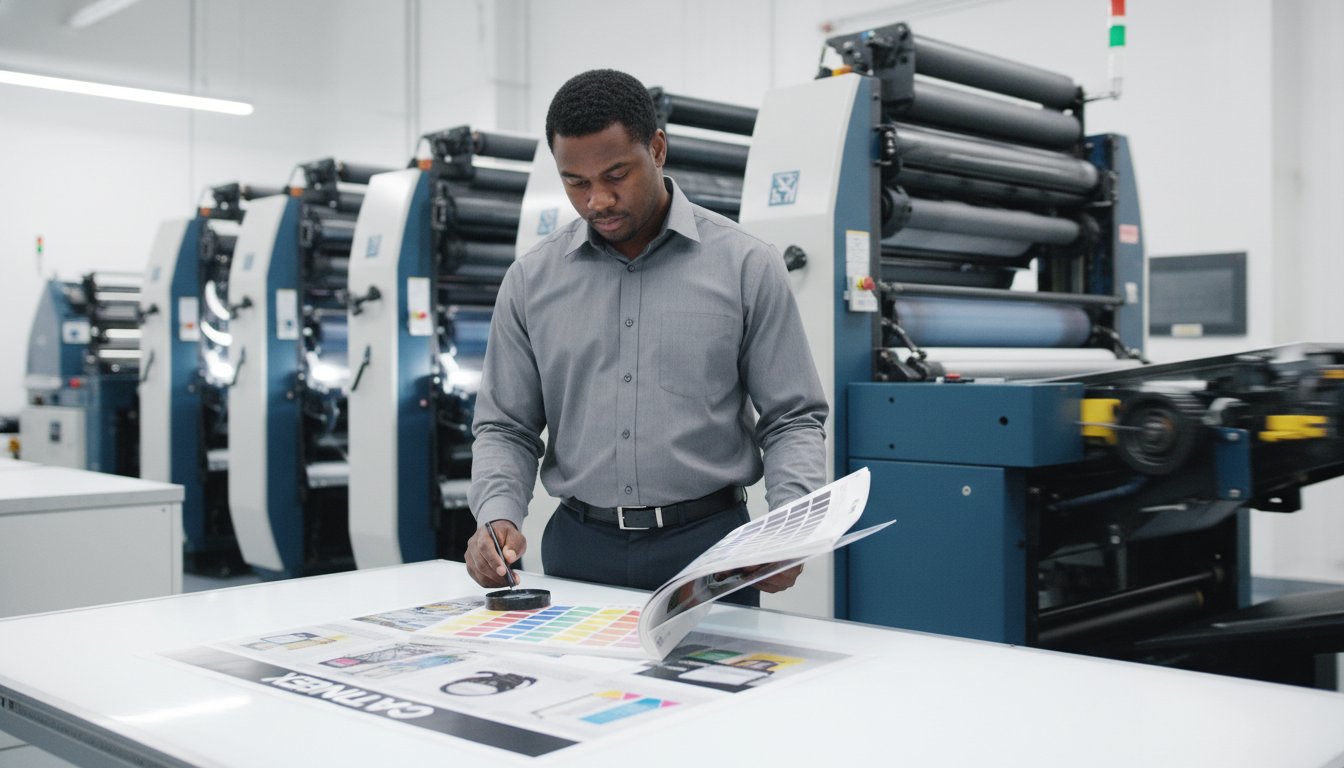
To see how high-impact visuals come to life in a professional production environment, watch this helpful video:
The psychology of a display relies heavily on precision finishing. Elements like heat-welded hems, nickel-plated grommets, and high-tension frames aren’t just hardware; they’re signals of brand authority. A sagging banner suggests a disorganized operation. By choosing premium vinyl banner materials that resist light bleed and maintain color vibrancy under 5000K convention center lighting, you elevate your brand from a temporary participant to an industry leader.
Effective trade show banner printing transforms signage into durable environmental graphics. Instead of treating banners as single-use disposables, savvy marketing teams invest in materials that withstand the rigors of shipping and repeated assembly. This shift allows organizations to amortize their marketing spend over 24 to 36 months of active event usage, significantly increasing the long-term return on investment.
Why One-Size-Fits-All Printing Fails at Trade Shows
Standard retail printing often fails in the demanding environment of a convention center. Cheap materials are prone to edge curling within 4 hours of installation due to temperature fluctuations. Ink flaking and structural instability can ruin a $10,000 exhibit’s appearance instantly. For a 2026 marketing strategy, professional-grade substrates are essential. They provide the opacity and flame-retardant ratings required by modern fire marshals while ensuring your brand colors remain consistent across every square inch of the floor.
The Linemark Approach to High-Volume Event Collateral
Our team leverages 30 years of industrial experience to deliver commercial-grade production for every client. We act as a single-source partner, ensuring that your brand messaging remains consistent from the first banner to the last brochure. This integration allows us to scale production rapidly for national tours or association-wide events. We focus on customized solutions that solve the logistical headaches of multi-city exhibits, providing a seamless experience that allows your sales team to focus on closing leads rather than fixing displays.
Choosing the Right Materials: Fabric vs. Vinyl vs. Mesh
Selecting a substrate isn’t just about color; it’s a technical decision that impacts logistics and brand perception. For effective trade show banner printing, the choice between polyester fabric and PVC vinyl determines how your message survives the rigors of the convention floor. Linemark approaches this selection through the lens of durability and visual fidelity. Our role as a single-source partner involves guiding you through these material nuances to ensure your display remains pristine from the first lead to the final teardown.
Material weight is measured in ounces per square yard for vinyl and denier for fabric. A standard 13oz vinyl offers a balance of strength and portability, while 18oz blockout vinyl is necessary for double-sided displays to prevent light bleed. In the fabric category, a 250-denier polyester provides the opacity and “hand” required for a premium feel. Adhering to printing industry standards ensures that these technical specifications translate into visual excellence across every square inch of your display. This precision prevents common failures like edge curling or image distortion during high-tension installation.
Safety is non-negotiable in the events industry. Approximately 95% of major US convention centers require NFPA 701 certification for all hanging materials. This fire-retardant standard isn’t a suggestion; it’s a mandatory safety protocol that our production team verifies for every project. By 2026, we anticipate a 40% increase in the adoption of PVC-free substrates as exhibitors prioritize sustainability. Recyclable polyester and biodegradable mesh are becoming the new benchmarks for eco-conscious brands looking to reduce their carbon footprint without sacrificing impact.
Tension Fabric: The Modern Standard for Booth Graphics
Tension fabric has revolutionized the exhibit space through dye-sublimation technology. This process bonds the ink directly into the fibers, creating a wash-safe finish that won’t crack or peel over time. It’s the ideal choice for high-resolution photography because the matte surface eliminates the glare often caused by harsh overhead convention lighting. For frequent travelers, wrinkle-resistant 100% polyester allows you to fold graphics into compact cases, reducing shipping costs and setup times. If your display requires a seamless, high-end look, you might consult with a logistics partner to explore custom-fit fabric solutions that scale with your needs.
Heavy-Duty Vinyl: When Durability is the Priority
Vinyl remains the workhorse of trade show banner printing for specific high-impact applications. Scrim vinyl, reinforced with an internal polyester mesh, provides the tensile strength needed for large-scale outdoor banners or floor-level displays in high-traffic zones. Smooth vinyl is the preferred choice for close-range viewing, as it lacks the visible texture of scrim. We often recommend blockout vinyl for retractable banner stands to ensure that backlighting from booth LEDs doesn’t wash out your graphics. Its rugged nature makes it resistant to spills and scuffs, ensuring a long lifecycle for multi-city tours. This attention to detail defines the Linemark difference, where technical precision meets marketing strategy.
Popular Trade Show Banner Formats and Their Applications
Selecting the correct display format isn’t just about aesthetics; it’s a logistical calculation based on booth dimensions and traffic flow. In a standard 10×10 exhibit space, 74% of exhibitors prioritize floor-standing graphics that permit easy movement. Larger 20×20 island configurations require a shift toward verticality. These massive setups often utilize overhead hanging banners constructed from 1-inch clear-anodized aluminum tubing to ensure visibility from across the convention center floor. This strategic use of trade show banner printing transforms a flat space into a three-dimensional brand environment that commands attention from every aisle.
Structural requirements differ significantly between floor-based and aerial displays. Floor stands rely on weighted bases and internal tension rods to maintain a taut appearance. Hanging banners, however, must meet strict fire rating standards and include certified rigging points to satisfy venue safety protocols. Modern exhibit design has moved toward modularity; 62% of corporate exhibitors now integrate high-tension fabric banners with aluminum hard-wall systems. This hybrid approach offers the stability of a permanent structure with the shipping efficiency of lightweight textiles. It’s a scalable solution that adapts to varying floor plans.
When evaluating hardware, the cost-benefit analysis favors premium components for recurring schedules. An economy stand might cost $145, but these units frequently fail after three uses due to spring fatigue or base warping. Investing $425 in professional-grade hardware ensures a lifespan of 15 or more shows. This durability reduces your long-term cost per lead by 30% and eliminates the risk of equipment failure during a live event. As your single-source partner, we focus on providing hardware that reflects the precision of your brand.
Retractable Banner Stands: The Workhorse of the Exhibit Hall
The 33-inch retractable stand remains the industry standard for its 5-minute setup time. Choosing a 48-inch wide model provides a more commanding presence, but it can restrict booth entry points if not placed with precision. We recommend interchangeable cassettes for brands with frequent product cycles. This allows you to swap graphics in under 60 seconds without replacing the base unit. Our team advises investing in high-quality retractors to avoid mechanical failure mid-show. A jammed spring can render your primary messaging invisible when you need it most.
Step and Repeat Banners and Large Backdrops
Media walls require technical precision during the design phase. Logos should be spaced 8 to 12 inches apart to ensure at least one full brand mark appears in every social media photo. While vinyl pop-ups are a traditional choice, 250gsm tension fabric has become the preferred medium in 2024. It eliminates camera flash glare and assembles 40% faster than magnetic rail systems. For trade show banner printing projects exceeding 10 feet in width, we utilize discrete ultrasonic welding for seams. This ensures the graphic remains perfectly flat and the transition between panels is invisible to the naked eye. This attention to detail defines the LineMark experience.
Large Format Design and Brand Consistency at Scale
Scaling a brand identity from a handheld brochure to a 20-foot exhibit requires more than just enlarging a digital file. It demands a rigorous understanding of substrate physics and light reflection. When executing trade show banner printing, the primary technical challenge lies in maintaining color fidelity across diverse materials. A logo printed on 13oz matte vinyl reflects light differently than the same logo dyed into a tension fabric display. Without precise calibration, companies often see a 12% to 15% variance in color saturation between their different assets. At Linemark, we mitigate this by using G7-certified processes to ensure that your corporate navy looks identical whether it is on a polyester knit or a rigid PVC board.
Resolution remains the leading cause of production delays and failed prints in the large format world. Designers frequently make the mistake of using raster images pulled from web assets, which pixelate aggressively when scaled to booth proportions. Vector graphics are essential for logos and typography because they rely on mathematical paths rather than fixed pixels; this allows for infinite scaling without loss of clarity. If a raster image is necessary, it must be captured at a high enough bit-depth to survive the expansion process. We look for specific file structures that prevent the stair-stepping effect common in low-quality trade show banner printing.
Designing for a crowded convention center also requires a strategic approach to visual hierarchy. In a hall with 500 competing exhibitors, your message must be legible from a distance of at least 20 feet. This means your primary headline should sit in the top 30% of the banner to avoid being obscured by foot traffic or furniture. We recommend a minimum font height of 3 inches for every 10 feet of viewing distance to ensure your value proposition is clear before a prospect even reaches your booth.
Preparing Files for Large Format Production
Precision begins in the pre-press phase. Large format prints require specific bleed and safety zones, typically extending 1 inch beyond the trim line to account for hem stitching or grommet placement. For a 10-foot banner viewed from a 5-foot distance, an effective resolution of 100 to 150 DPI at full output scale provides the optimal balance of visual crispness and manageable file size. Our team calibrates CMYK profiles to specific output devices, such as our high-speed EFI VUTEk printers, to prevent the muddy “heavy black” builds that often plague unmanaged print runs.
Managing Branding Across Multiple Locations
Maintaining a unified brand voice is difficult when marketing teams are spread across different regions. Linemark solves this through MarCom On-Demand portals, which centralize approved assets and allow local teams to order materials that meet global standards. This system ensures the specific Pantone 286 C on your business card perfectly matches the 20-foot banner backdrop arriving at the convention center. The Linemark difference lies in our automated workflow integration; we synchronize your digital assets with our physical production line to eliminate manual entry errors. This high-touch service model ensures that every piece of collateral, from the smallest flyer to the largest hanging sign, reinforces a single, powerful brand image.
Ready to ensure your brand remains consistent across every square inch of your exhibit? Contact our large format specialists to start your next project with precision.
Logistics, Kitting, and Nationwide Fulfillment
Successful trade show banner printing is only half of the equation; the remaining challenge lies in the physical movement and management of those assets. Logistics, shipping, and storage fees often account for 20% of an exhibitor’s total event budget. These hidden costs escalate quickly when materials are stored in expensive office corridors or shipped via unmanaged third-party carriers. We solve this by transforming the printing process into a comprehensive supply chain solution. Our facility manages the heavy lifting, allowing your marketing team to focus on lead generation rather than freight manifests.
Kitting services provide a strategic advantage for national field teams. Instead of receiving disparate boxes of banners, stands, and brochures, your representatives receive a single, organized kit. This turnkey approach reduces booth setup time by approximately 45 minutes per event. For organizations managing 10 or more recurring shows annually, professional inventory management is a necessity. We track every component of your display, ensuring that every retractable banner and fabric wall is inspected, cleaned, and accounted for before it moves to the next venue. This level of oversight prevents the common 12% loss rate of small-scale display hardware seen in unmanaged programs.
Durability during transit is another critical factor. We utilize professional-grade crating and custom-fitted cases to shield your investment. Standard cardboard packaging fails in 15% of long-haul shipments; our reinforced solutions ensure your graphics arrive without the creases or hardware failures that can ruin a brand’s first impression. By treating your displays as high-value assets rather than disposable prints, we extend the lifecycle of your environmental graphics by two to three years.
Streamlining Event Logistics with a Single-Source Partner
Partnering with a single-source partner eliminates the friction of multi-vendor coordination. We warehouse your displays in our climate-controlled facility, freeing up your valuable office space. When an event approaches, we handle direct-to-venue shipping, including the complex navigation of drayage and convention center logistics. Our tracking systems provide real-time reporting, so you know exactly where your assets are located 24 hours a day. This transparency removes the anxiety of “dock-to-booth” transfers at major venues.
Getting Started: Your Trade Show Production Timeline
Execution requires a disciplined schedule. We recommend an ideal lead time of 21 to 28 days for design, proofing, and production. This 3 to 4 week window allows for the creation of physical proofs, which are vital for high-stakes environmental graphics where color accuracy must be absolute. While digital proofs are fast, a physical sample ensures your brand colors remain consistent across different substrates. Once approved, our high-capacity production line moves your project into fulfillment with industrial precision. To ensure your next event is a logistical success, Partner with Linemark for your next high-impact trade show project. We bring the technical expertise and the logistical infrastructure to make your brand stand out on the floor.
Scale Your Brand Impact for the 2026 Trade Show Season
Maximizing your event ROI requires a strategic approach to trade show banner printing that balances high-impact visuals with operational precision. Choosing the right substrates, like tension fabrics for portability or mesh for outdoor durability, ensures your message remains crisp and professional in any environment. Beyond the design, your success depends on a logistical framework that handles kitting and nationwide fulfillment without a single error. It’s about ensuring your brand looks exactly the same in Las Vegas as it does in Orlando.
LineMark provides the industrial authority you need as a single-source partner. Our 90,000-square-foot high-capacity production facility is equipped to handle complex, high-volume projects while maintaining the meticulous detail of a boutique shop. Because we’re a G7 Master Qualified Printer, you’ll see perfect color consistency across every display, whether you’re shipping to one venue or fifty. We’ve built our reputation on being a strategic communications ally that understands the nuances of modern marketing and logistics. It’s time to move past transactional printing and embrace a collaborative partnership that delivers results.
Request a Custom Quote for Your Trade Show Graphics
We’re ready to help you transform your booth into a high-performing asset that stands out on a crowded floor.
Frequently Asked Questions
What is the best material for a trade show banner?
13oz blockout vinyl is the industry standard for durability and opacity in most environments. If you prefer a premium, non-glare finish, 250gsm tension fabric provides a sophisticated look for trade show banner printing. These high-quality materials ensure your graphics remain vibrant and professional under the harsh lighting of a convention hall. We’ll help you select the exact weight that balances portability with long-term resilience.
How far in advance should I order my trade show banners?
You should place your order at least 14 business days before your event’s move-in date. This timeframe allows our team to perform precise color matching and thorough quality control checks before shipping. While we offer 48-hour rush production for tight deadlines, planning ahead secures the most reliable logistics rates. We want to ensure your brand’s first impression is flawless and arrives on your schedule.
Can I reuse my trade show banner hardware with new graphics?
You can swap graphics on 95% of professional retractable stands and modular banner frames. Our technicians carefully remove the existing 15oz vinyl and install your updated artwork to maximize your hardware investment. This sustainable approach reduces your equipment costs by roughly 40% when compared to purchasing entirely new display units. It’s a smart way to keep your messaging fresh without unnecessary waste or hardware accumulation.
What resolution do my images need to be for large format printing?
Your digital files must be 150 DPI at 100% of the final print size for optimal clarity. Large format printing requires high-resolution assets to prevent visible pixelation when attendees view your booth from 3 feet away. We recommend using vector formats like PDF or EPS for all logos and typography to maintain perfect edges. Our prepress experts review every file to ensure your brand looks sharp and professional.
Do I need special fire-resistant banners for convention centers?
Yes, most major venues require banners to meet NFPA 701 fire safety standards for indoor displays. We provide certified fire-retardant materials for every trade show banner printing project to comply with strict municipal fire marshal codes. We’ll include the necessary flame-resistant certificates with your shipment to prevent any setup delays. This proactive step ensures your booth remains compliant with local safety regulations throughout the entire event.
How do I transport large banners without damaging them?
Transport your banners in 4-inch diameter heavy-duty shipping tubes or hard-sided molded cases to prevent physical damage. You should never fold your vinyl banners, as this creates permanent creases that diminish the professional appearance of your display. Rolling the graphic with the print side facing out protects the ink and keeps the surface smooth. Our rugged cases provide 100% protection during transit through various shipping hubs.
What is the difference between dye-sublimation and UV printing for banners?
Dye-sublimation uses heat at 400 degrees Fahrenheit to bond ink into fabric fibers for a permanent, washable finish. UV printing utilizes 395nm LED lamps to instantly cure ink on the surface of various substrates. While UV printing is incredibly efficient for rigid materials, dye-sublimation offers the superior color depth and soft texture required for high-end fabric displays. Both methods deliver the precision that the LineMark experience promises.
Can Linemark handle shipping my banners directly to the convention center?
Linemark acts as your single-source partner by managing direct shipping to any of the 250 major US convention centers. Our integrated logistics team handles the complex labeling requirements and drayage paperwork necessary for a smooth delivery to your specific booth. This comprehensive service ensures your materials arrive exactly when your team begins setup. We take the stress out of event coordination so you can focus on your leads.