

 03/09/2026
  Steve Bearden
Your brand’s biggest threat isn’t the competition; it’s the well-intentioned creativity of your decentralized teams. You’ve meticulously crafted a powerful brand identity, yet the daily reality is a constant battle against rogue marketing assets. Off-brand flyers from a regional office, outdated brochures pulled from a storage closet, and endless manual proofing cycles for simple business cards all chip away at brand integrity and consume valuable resources. These small deviations create significant logistical friction and financial waste.
It’s time to reclaim control. This guide demonstrates how a modern web-to-print portal serves as a strategic, integrated solution, transforming chaotic marketing logistics into a streamlined, brand-compliant production engine. We will show you precisely how to establish a single source of truth for all your marketing collateral. We will explore the framework for eliminating brand drift, accelerating turnaround times for localized materials, and gaining transparent reporting on every dollar spent, preparing your brand for scalable growth through 2026 and beyond.
Key Takeaways
- Learn the strategy to eliminate “brand drift” across distributed teams and franchises, ensuring total brand consistency.
- Get a clear roadmap for implementing a web-to-print portal, including how to establish locked brand assets versus editable fields for customization.
- Recognize the critical difference between a standalone software and a fully integrated solution that connects your digital interface to physical production.
- Discover how centralizing print procurement can significantly reduce administrative overhead and streamline your marketing logistics.
What is a Web-to-Print Portal? Defining the Modern MarCom Engine
At its core, a web-to-print portal is a centralized, cloud-based platform engineered to manage, customize, and order branded marketing materials. It’s the digital command center for your physical brand assets. While the underlying Web-to-print (W2P) technology once brought to mind B2C services for photo gifts, its evolution by 2026 is firmly rooted in the B2B enterprise space. Today’s portals are sophisticated engines built for scale, control, and efficiency, serving complex organizations with distributed teams.
To see how this technology streamlines brand management for multi-location businesses, watch this brief overview.
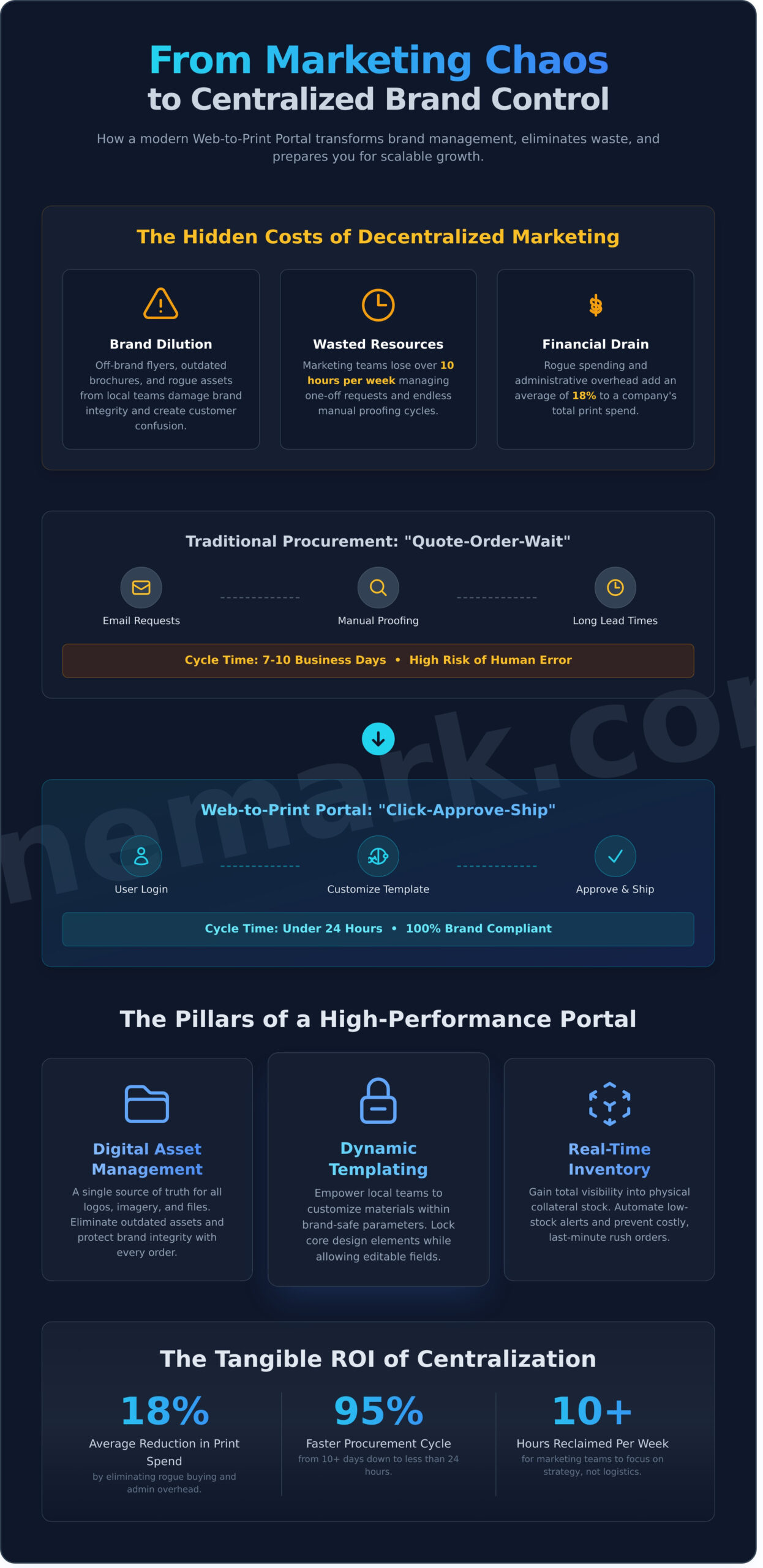
For any high-growth organization, relying on a static library of PDFs stored on a shared drive is no longer a viable strategy. This outdated method invites brand dilution, version control errors, and significant administrative bottlenecks. Marketing teams can lose up to 10 hours per week managing one-off requests and confirming asset versions. A modern portal solves this by transforming your marketing collateral into a dynamic, on-demand resource. It’s a foundational component of the ‘Single-Source Partner’ model, creating a direct, transparent link between your marketing strategy and our production and fulfillment capabilities.
Key Components of a High-Performance Portal
A truly effective portal is more than a simple online catalog. It’s a powerful integration of technologies designed for precision and control. The best platforms are built on three pillars:
- Digital Asset Management (DAM) Integration: This ensures every user across your organization has access to the most current, on-brand assets. By centralizing logos, imagery, and approved files, you eliminate the risk of outdated materials entering the market, protecting brand integrity with every order.
- Dynamic Templating Engines: Empower local teams, franchisees, or sales agents to customize materials within brand-safe parameters. A user can add their contact details to a business card or localize a flyer for a regional promotion without ever compromising the core design, fonts, or colors set by corporate marketing.
- Real-time Inventory Tracking: Gain complete visibility into your stock of physical collateral. The system provides live inventory counts and can be configured with automated low-stock alerts, ensuring you never run out of critical materials and preventing costly, last-minute rush orders that can delay campaigns by weeks.
The Evolution of Print Procurement
The implementation of a dedicated web-to-print portal fundamentally re-engineers the procurement process. It marks a decisive shift away from inefficient, manual workflows toward a streamlined, digital-first model. This evolution delivers measurable gains in speed, cost-effectiveness, and global operational capacity.
Traditional print buying is a cycle of back-and-forth emails: ‘Quote-Order-Wait’. This process can take 7-10 business days and is prone to human error. A portal transforms this into a ‘Click-Approve-Ship’ workflow, reducing the procurement cycle to under 24 hours. More importantly, it eliminates the hidden costs of traditional print buying. A 2024 analysis by the Business Printing Association found that rogue spending and administrative overhead add an average of 18% to a company’s total print spend. A portal eradicates these costs through controlled budgets, user permissions, and consolidated invoicing. For global marketing teams, the 24/7 accessibility means a manager in Singapore can order materials at the end of their day, and a director in New York can approve it first thing in the morning. Your marketing operations don’t stop when your office closes.
Why Your Brand Needs a Centralized Print Portal in 2026
As brands expand across regions and channels, maintaining brand integrity becomes a complex operational challenge. By 2026, the decentralized creation of marketing materials will no longer be a sustainable model. It leads to brand dilution, administrative bottlenecks, and significant waste. A modern web-to-print portal isn’t just a convenience; it’s a strategic imperative for scalable growth. It provides the central nervous system for your brand’s physical communications, ensuring every flyer, brochure, and sign is perfectly on-brand, every time.
The core value lies in solving four critical business challenges simultaneously:
- Eliminating ‘Brand Drift’: Ensures every regional office, franchisee, and remote employee uses the most current, approved assets.
- Reducing Administrative Overhead: Industry data shows automation through a portal can cut administrative tasks related to print procurement by up to 60%.
- Enabling ‘Just-in-Time’ Production: Allows teams to order what they need, when they need it, slashing waste from obsolete inventory.
- Empowering Local Teams: Gives local marketers the autonomy to customize materials within strict, pre-defined corporate guidelines.
Solving the ‘Print Traffic Cop’ Problem
Marketing leaders often spend a disproportionate amount of time policing brand guidelines and managing one-off print requests. A centralized portal automates this entire workflow, freeing your most valuable talent for strategic initiatives. Customized permission levels ensure a new sales associate can only order standard business cards, while a regional manager can access and customize a new campaign mailer. With centralized billing and cost-center tracking, accounting becomes a streamlined, transparent process instead of a chaotic paper chase.
This shift from manual oversight to automated governance is fundamental. It protects your brand’s visual identity with digital precision, ensuring consistency across hundreds or even thousands of locations. This level of control was once a logistical nightmare, but today’s technology makes it standard practice. Even established media giants have long recognized the need to integrate technology into their print workflows as digital media marches on, proving that smart technology is key to managing physical assets in a digital-first world.
Variable Data Printing (VDP) at Scale
In the hyper-competitive market of 2026, personalization is non-negotiable. Consumers expect communications tailored directly to them. Variable Data Printing (VDP) achieves this by customizing text, images, and offers for each recipient in a single print run. According to McKinsey & Company, this level of personalization can lift revenues by 5-15%. Yet, executing complex VDP campaigns has traditionally been a heavy lift for corporate marketing teams. A sophisticated web-to-print portal makes it simple. Your local teams can upload a customer list, and the portal’s pre-built templates automatically populate each piece with the correct data, turning a complex technical process into a simple, three-click order.
This integration of data and print transforms your direct mail from a broadcast medium into a precision tool for engagement. It’s the kind of scalable, high-impact solution that turns a single-source partner into a genuine extension of your marketing department. To see how these customized platforms drive growth for enterprise-level brands, you can explore our integrated portal solutions and discover the LineMark difference.
Software vs. Solution: Why the Production Loop Matters
Many businesses invest in a slick digital interface, believing they have acquired a complete web-to-print solution. In reality, they’ve only purchased the software, the digital storefront. This creates a dangerous disconnect. An order placed online is just the beginning of a complex physical journey, and a ‘SaaS-only’ model leaves the most critical parts of that journey—production and fulfillment—to chance. The gap between digital order and physical execution is where brand consistency breaks down and supply chains fail.
A true web-to-print portal is not just code; it’s an integrated system. It’s the seamless connection between your team’s clicks and the calibrated machinery on the production floor. At Linemark, we don’t just provide the software. We are the production floor. Our 90,000-square-foot facility is the engine that powers the portal, ensuring every order is executed with precision under one roof. This single-source advantage transforms a simple ordering tool into a strategic asset. You aren’t managing vendors; you’re collaborating with one dedicated partner for software, print, and fulfillment. This unified approach is central to understanding the functionalities and workflow for web-to-print systems that deliver genuine ROI. Integrated logistics prevent the ‘lost in transit’ syndrome, because your materials never leave our chain of custody until they are on their way to the final destination.
The Pitfalls of Third-Party Fulfillment
When your software vendor outsources production, you inherit their logistical headaches. This fragmented model introduces multiple points of failure that directly impact your brand and budget. Common issues include:
- Communication Breakdowns: A simple file query can turn into a 48-hour delay as messages pass between your team, the software company, and an unknown third-party print shop.
- Inconsistent Quality Control: With jobs brokered out to a network of printers, color profiles can vary by up to 15% from one run to the next. The paper stock you approved may be substituted without notice, compromising brand standards.
- Increased Lead Times: A job printed in one state, shipped to another for finishing, and then sent to a third for distribution adds days to your timeline and multiplies the risk of damage or loss at each handoff.
The Linemark Production Advantage
The Linemark difference is rooted in our vertically integrated production loop. Your digital order becomes a direct command to our in-house systems, eliminating the variables that plague disconnected supply chains. We provide total oversight and accountability.
- Direct-to-Press Automation: Portal orders are automatically pre-flighted and routed to the correct press, reducing manual file prep errors by over 95% and accelerating speed to market.
- In-house Binding and Finishing: From complex die-cutting to perfect binding and kitting, every finishing process is handled on-site by our expert teams, guaranteeing quality from the first piece to the last.
- Nationwide Distribution Hub: Our strategic Mid-Atlantic location in Upper Marlboro, MD, places us within a 2-day ground shipping network of 60% of the U.S. population, ensuring your materials arrive on time, every time.
Implementing a Web-to-Print Portal: A 5-Step Roadmap
Transitioning to a centralized print-on-demand system isn’t a simple flip of a switch. It’s a strategic initiative that, when executed with precision, delivers compounding returns in efficiency and brand integrity. A successful implementation requires a clear, methodical approach that aligns technology with your operational goals. This five-step roadmap provides the framework for transforming your scattered print procurement into a streamlined, scalable asset.
The entire process begins with a meticulous audit of your current state. You must analyze what your teams are ordering, from whom, and at what cost. We consistently find that over 75% of a company’s print requests are for the same 10-15 core assets, such as business cards, sales brochures, and direct mail postcards. These are your high-impact targets for immediate automation. This phase is also the ideal time to consolidate your vendors into a single-source partnership, which can reduce procurement costs by an average of 18%, according to a 2025 analysis by the Print Industries of America. Your final step is defining what success looks like with hard metrics. Don’t be vague; establish clear key performance indicators (KPIs).
- Turnaround Time: Reduce average production and shipping from 8 business days to 3.
- Cost Per Unit: Decrease the cost of a standard 500-count business card order by 22%.
- Brand Compliance: Achieve 100% compliance on all marketing materials ordered through the portal by Q3 2026.
Phase 1: Building the Digital Asset Library
The foundation of your web-to-print portal is a well-organized library of brand-compliant templates. This isn’t just about uploading PDFs. It’s about engineering intelligent, dynamic documents. We establish ‘locked’ zones for critical brand elements like logos, legal disclaimers, and core messaging. Then, we designate ‘editable’ zones with dynamic fields that pull data for localization, such as a sales representative’s name, phone number, and office address. This structure ensures brand consistency while empowering local teams with necessary customization.
Phase 2: Integration and Workflow Automation
A standalone portal is useful; an integrated one is transformative. The true power of this technology is unlocked when it connects directly to your existing systems. By integrating the portal with your CRM, like Salesforce or HubSpot, your sales team can launch a personalized direct mail campaign to a target list with three clicks, eliminating manual data exports that introduce a 5% error rate on average. Hierarchical approval workflows are then built on top of this. For example, any order over $1,000 can be automatically routed to a regional manager for approval, providing complete budget control without creating bottlenecks.
With the system live, you’ll begin collecting powerful performance data. Your portal’s dashboard becomes a command center for optimizing print spend. You can instantly see which materials are most effective, which departments are ordering the most, and where inventory is located. This data-driven insight allows for smarter budgeting and strategic decisions. One national logistics client used this data to identify that 30% of their trade show banners were being discarded after a single use, prompting a shift to more durable, reusable signage that saved them over $85,000 in the first year.
Executing this roadmap requires a partner with deep integration and logistics experience. Partner with LineMark to build your strategic web-to-print solution and unlock scalable growth.
MarCom On-Demand: The Linemark Difference
Choosing a technology partner is a critical business decision. While many platforms can manage print orders, a true strategic asset integrates seamlessly into your operational fabric, driving efficiency and protecting brand integrity. Linemark’s MarCom On-Demand is engineered to be that asset. It’s more than a tool; it’s a centralized command center for your entire marketing supply chain, built on a foundation of industrial-strength technology and personalized, high-touch service.
This isn’t a one-size-fits-all solution. Our platform is designed for dynamic scalability, serving organizations of every size with the same level of precision. We empower a 20-person non-profit to manage its fundraising collateral with the same robust control as a national healthcare association coordinating materials across its 250 chapters. The core architecture of our web-to-print portal adapts to your complexity, ensuring that as you grow, your brand control and logistical capabilities grow right alongside you.
The true Linemark difference, however, lies in the human element. Every MarCom On-Demand client is paired with a dedicated account manager who becomes an extension of your team. They don’t just answer tickets; they learn your business, understand your objectives, and proactively optimize the portal to meet your goals. This collaborative partnership transforms the platform from a simple ordering system into a responsive engine for your marketing operations.
Data-driven decisions are no longer an aspiration; they are a requirement. Our advanced reporting suite provides granular insights that directly impact your bottom line. You can move beyond simple order tracking to genuine business intelligence. Clients typically identify direct cost savings of 15-20% within the first year by leveraging reports that highlight:
- Budget Adherence: Track spending by user, department, or geographic location against pre-set budgets.
- Inventory Optimization: Monitor real-time stock levels to eliminate waste from obsolete materials and avoid shortages of critical assets.
- User Engagement: Analyze which marketing pieces are ordered most frequently, providing valuable data for future content strategy.
- ROI Analysis: Link collateral usage to specific campaigns or sales territories to measure effectiveness.
Beyond Print: Kitting and Fulfillment Integration
MarCom On-Demand extends far beyond static print jobs. Our integrated kitting and fulfillment module allows your teams to build custom kits for any purpose, from new hire onboarding packages to complex trade show shipments. See exactly what’s on the warehouse shelf with real-time inventory data, then assemble, pack, and ship with confidence. This is the Linemark experience: flawless execution from a digital order to a physical delivery, every single time.
Getting Started with Linemark
Transitioning to a modern web-to-print portal should accelerate your business, not disrupt it. Our implementation specialists manage the entire migration process, from asset uploads to user permissions, ensuring a seamless switch from legacy systems in as little as 30 days. We handle the technical complexities so you can focus on your brand. Ready to see how a true single-source partner can transform your marketing logistics? Experience the Linemark difference with a custom MarCom On-Demand demo.
Take Command of Your Brand’s Future
The path to scalable brand management in 2026 is clear. A modern web-to-print portal is no longer a simple tool; it’s the central engine for maintaining brand integrity and empowering your teams with on-demand access to approved collateral. True success, however, isn’t found in software alone. It’s realized through a strategic partnership that integrates technology with a complete production and fulfillment loop. This is the LineMark difference. With over 30 years of industrial print authority, we’ve engineered a seamless process. Our proprietary MarCom On-Demand technology, powered by a 90,000-square-foot state-of-the-art facility, transforms your marketing operations into a strategic asset.
Ready to build a more efficient future? Streamline your marketing with a MarCom On-Demand Portal and partner with the single-source provider engineered for growth. Your brand’s potential is waiting.
Frequently Asked Questions
What is the difference between a web-to-print portal and a standard online print shop?
A web-to-print portal is a private, branded storefront for your organization, while a standard online print shop is a public retail site. The key difference is control. Your portal features pre-approved, brand-compliant templates that your team can customize within set parameters. This system prevents the brand dilution common with public print shops and is designed for corporate efficiency, unlike the open B2C model of a standard shop.
Can a web-to-print portal integrate with my existing CRM like Salesforce?
Yes, our portals are built for seamless integration with major CRMs, including Salesforce, HubSpot, and over 30 other platforms via API. This connection allows your sales teams to order personalized collateral directly from the CRM, pulling customer data to populate fields automatically. This streamlines workflows, reduces manual entry errors by up to 95%, and ensures every communication is both personalized and brand-compliant.
How does a portal help maintain brand consistency across different locations?
A portal centralizes all marketing assets, acting as the single source of truth for your brand. It locks down critical brand elements like logos, color palettes with specific PMS values, and typography while allowing local teams to customize designated fields like contact information. This system eliminates rogue marketing materials and ensures every piece of collateral, from a business card in Boston to a banner in Berlin, adheres to your corporate standards.
Is a web-to-print portal cost-effective for mid-sized organizations?
Absolutely; a web-to-print portal drives significant cost savings, with our mid-sized clients reporting an average 22% reduction in print-related spending within the first year. The savings come from eliminating design revision cycles, reducing waste from obsolete materials, and leveraging bulk purchasing power through aggregated orders. By empowering users to self-serve, you also reclaim hundreds of hours for your central marketing team to focus on strategic initiatives.
What kind of products can be managed through a MarCom On-Demand portal?
A MarCom portal manages a vast array of products, from standard printed collateral to promotional items and apparel. Our clients typically manage over 500 unique SKUs, including business cards, brochures, direct mail campaigns, trade show banners, and branded merchandise like pens and embroidered polos. If it carries your brand, it can be centralized, ordered, and fulfilled through your custom portal, making us a true single-source partner.
How long does it typically take to set up and launch a custom portal?
The standard implementation timeline for a custom portal is between 4 to 6 weeks from project kickoff to launch. This timeframe includes a 1-week discovery phase, 2-3 weeks for portal configuration and asset loading, and a final week for user acceptance testing (UAT) and team training. For clients with fewer than 50 assets and basic workflow needs, we offer an expedited 3-week launch process to get you running faster.
Does the portal handle shipping and fulfillment tracking automatically?
Yes, automated fulfillment and real-time tracking are integral components of the portal’s logistics engine. Once an order is placed, users receive automated email notifications at key stages: order confirmation, shipment, and delivery. Within the portal, they can access a dashboard with carrier information and live tracking numbers from partners like FedEx and UPS, providing 100% visibility from click to delivery.
What security measures are in place to protect our digital assets and data?
Our portals are built on a secure infrastructure featuring SOC 2 Type II compliance and 256-bit SSL encryption for all data. We implement role-based access controls, ensuring users only see assets relevant to their function. The platform also undergoes quarterly penetration testing by third-party security firms to proactively address vulnerabilities. Your brand assets and user data are protected with enterprise-grade security protocols, giving you complete peace of mind.