

 06/17/2026
  Steve Bearden
A wall mural is far more than a large-scale decorative element. It is a critical component of your brand’s architectural infrastructure that fails the moment a single seam lifts or a color shifts. You understand that a stunning digital design loses its impact if the physical execution cannot withstand the daily rigors of a high-traffic commercial environment. Achieving a flawless, high-impact finish requires more than just an adhesive. It demands a professional wall mural installation rooted in technical precision and material science. When the stakes involve your brand’s reputation and long-term facility maintenance, the margin for error is nonexistent.
We agree that managing multiple vendors while worrying about bubbling, peeling, or fire code violations is a logistical headache you don’t need. This guide promises to demystify the expert processes required to ensure your large-format graphics serve as a durable, seamless extension of your brand. You’ll gain a clear understanding of the strategic path from digital file to physical wall. We will cover essential factors like ASTM E84 fire safety classifications, ADA compliance for walkways, and the specific wall preparation timelines necessary for a permanent, high-quality bond.
Key Takeaways
- Understand how professional wall mural installation secures your ROI by preventing structural failures like delamination and seam-splitting.
- Identify the critical environmental factors, from wall porosity to humidity levels, that must be analyzed to ensure a permanent adhesive bond.
- Discover the specialized techniques and industrial tools experts use to achieve invisible seams and a flawless, paint-like finish.
- Learn how to select the optimal substrate, such as Type II Vinyl, based on the specific traffic and durability needs of your commercial space.
- Explore the logistical benefits of a centralized production and installation model to maintain brand consistency and streamline project timelines.
Why Professional Wall Mural Installation is Critical for Commercial ROI
Commercial spaces demand a level of durability that standard residential applications cannot match. While the history of murals spans centuries of artistic expression, modern environmental graphics function as high-performance branding tools. A successful professional wall mural installation ensures that your investment remains a permanent asset rather than a maintenance liability. When a large-format graphic fails, it isn’t just an aesthetic issue; it’s a breakdown in your strategic communication. Precision matters because your walls are a direct reflection of your operational standards.
To better understand the technical requirements of this process, watch this helpful video:
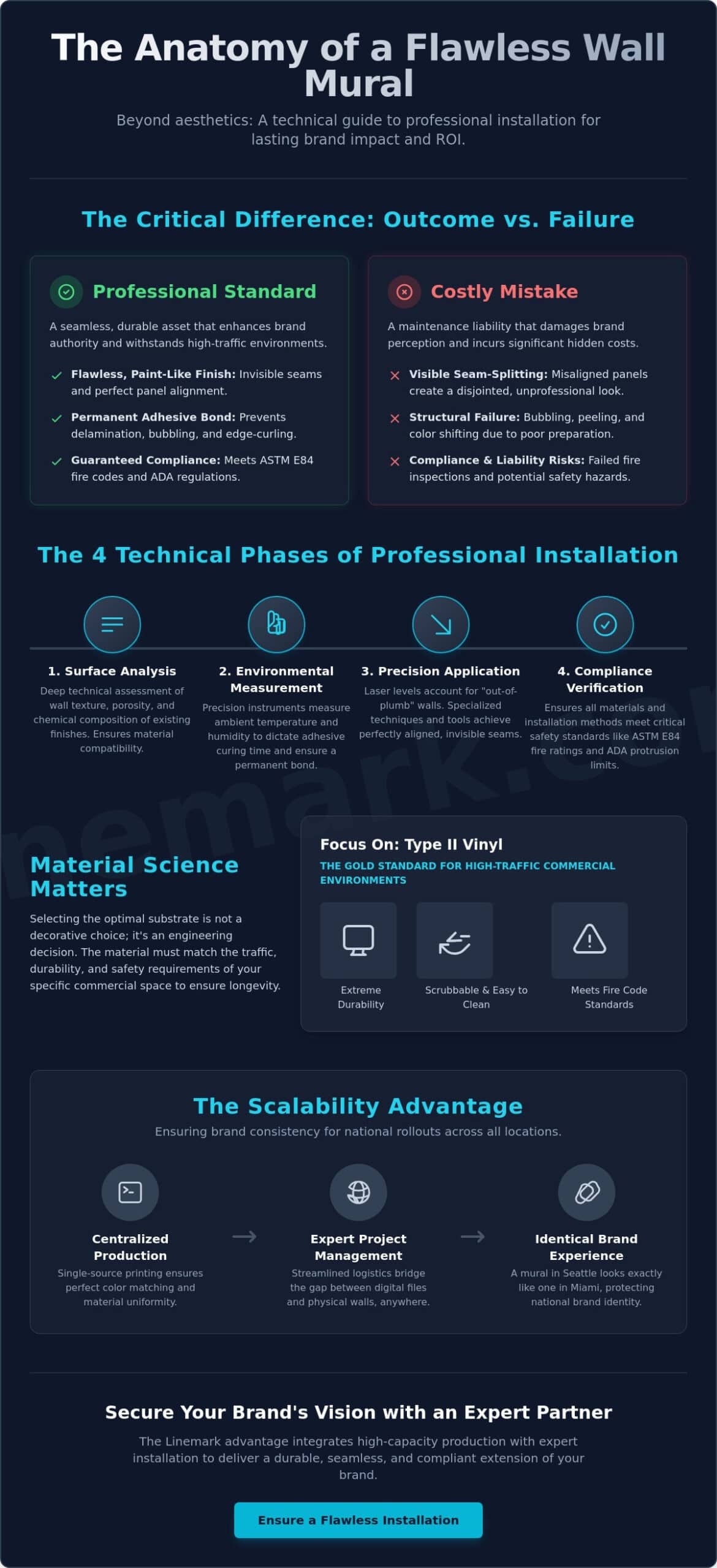
Achieving structural integrity requires adhering to strict substrate protocols. Professional installers protect your manufacturer’s warranty by verifying that the wall surface, adhesive chemistry, and environmental conditions align with technical specifications. Without this oversight, common failures like edge-curling, delamination, and seam-splitting become inevitable. These defects don’t just look poor; they compromise the physical material, leading to premature replacement costs. Expert execution ensures the panels align perfectly, maintaining a seamless finish that reinforces your brand authority.
The Cost of Installation Failure in High-Traffic Areas
In public corporate environments, the physical state of your facility directly reflects your brand’s attention to detail. Peeling or bubbling graphics suggest a lack of operational excellence. Beyond perception, the hidden costs of DIY or non-specialized installation are substantial. Re-printing and re-installing graphics due to initial errors can quickly drain your marketing budget. There is also a significant liability risk. Using installers who aren’t familiar with commercial safety standards, such as ASTM E84 fire ratings or ADA protrusion limits, can lead to failed inspections and costly forced removals in public walkways.
Scalability for National Brand Rollouts
For organizations managing multiple geographic locations, consistency is the primary challenge. A professional wall mural installation must look identical in a Seattle office as it does in a Miami lobby. Centralized production is the solution to this logistical hurdle. By controlling the print process in a single high-capacity facility, you ensure color matching and material uniformity before any panels arrive on-site. Expert project management then bridges the gap between digital files and physical walls. This unified approach eliminates the variability that comes with managing disparate local vendors, providing a streamlined deployment that protects your national brand identity across every square foot of your footprint.
The Technical Phases of Professional Wall Mural Preparation
The success of a professional wall mural installation is determined during the preparation phase. While many assume preparation is merely cleaning a surface, industrial-grade graphics require a deep technical analysis of the architectural environment. This process involves a rigorous assessment of wall texture, porosity, and the chemical composition of existing finishes. Professionals rely on the ASTM classification for commercial wall coverings to ensure the selected materials match the intended serviceability of the space. Failure to align material specs with wall conditions is the leading cause of project failure.
Environmental conditions play a decisive role in adhesive performance. Installers use precision instruments to measure ambient temperature and humidity levels. These factors dictate the curing time and bond strength of the graphic. Additionally, laser levels are employed to account for “out-of-plumb” variances. Most commercial walls are not perfectly square; failing to map these architectural irregularities results in skewed graphics and misaligned brand elements. Utilizing industry-specific primers and sealers creates a controlled surface that ensures both a permanent bond and a clean removal years later.
Wall Surface Compatibility and Outgassing
One of the most common causes of graphic failure is outgassing. When walls are freshly painted, they release gases as they cure. If a mural is applied too soon, these gases become trapped, leading to unsightly bubbles or total adhesive failure. Industry standards generally recommend waiting at least ten days for paint to fully dry before beginning a professional wall mural installation. Modern low-VOC and “scrubbable” paints often contain additives that repel traditional adhesives. Professionals perform a standardized adhesion test to verify substrate compatibility before production begins. For complex surfaces, integrating expert site analysis ensures the correct material chemistry is selected for the specific wall type.
Architectural Surveying and Mapping
Blueprints often differ from the finished reality of a building. Digital site surveys are essential for identifying real-world obstructions such as HVAC vents, light switches, and emergency exit signs. Installers map this data directly into the design files. This precision mapping ensures that critical brand elements, like logos or core messaging, aren’t inadvertently cut off by a doorway or obscured by trim. By adjusting file layouts based on laser-verified measurements rather than architectural drawings, the final installation appears as a seamless part of the environment rather than an afterthought. This meticulous mapping is what separates a generic graphic from a truly integrated environmental brand experience.
Professional Installation vs. In-House Maintenance: A Comparison
The temptation to treat environmental graphics as a simple facilities task often leads to costly rework. While some manufacturers claim their products are designed for anyone to apply, a professional wall mural installation requires technical skills that go far beyond standard maintenance capabilities. Commercial projects frequently involve spans of 50 feet or more, where even a one-millimeter misalignment at the start can result in a massive deviation by the end of the wall. Professionals manage these complexities through a blend of mechanical precision and specialized experience that in-house teams simply don’t possess.
A defining mark of expert work is the “Double-Cut” technique. In this process, installers overlap two panels and cut through both layers simultaneously with a single, steady stroke. This creates a mirror-image edge on both panels, resulting in an invisible seam that appears as a continuous, paint-like surface. Achieving this level of accuracy across complex geometric patterns or high-resolution photography is nearly impossible without years of specialized training. Professionals also utilize heat guns to conform vinyl to wall textures, ensuring the graphic looks like a part of the architecture rather than a sticker applied to it.
Tooling and Technology for Flawless Finishes
The difference between a mediocre result and a flawless finish often lies in the equipment. Professional installers don’t rely on standard utility knives; they use surgical-grade blades that are snapped off after every few feet to ensure a snag-free cut. They also employ infrared thermometers to verify the wall surface is in the “tack zone.” This ensures the adhesive reaches its optimal bonding temperature. Specialized rollers and industrial-grade squeegees are used to remove micro-bubbles that are invisible during the initial application but can expand and cause delamination as temperatures fluctuate.
Risk Mitigation and Insurance
Hiring a professional wall mural installation team is as much about risk management as it is about aesthetics. Expert installers carry specific liability insurance that covers commercial property damage, protecting your facility from accidental gouges or adhesive mishaps. Many also hold certifications from organizations like the Professional Decal Application Alliance (PDAA). These designations signal a mastery of substrate chemistry and installation physics. When you partner with certified experts, your contract typically includes a guarantee on the workmanship, providing a layer of security for your marketing investment that an in-house “best effort” cannot match. This streamlined approach minimizes business disruption and ensures the project is completed correctly the first time.
Selecting Substrates for High-Impact Commercial Environments
A successful professional wall mural installation relies as much on the chemical properties of the material as it does on the skill of the installer. In commercial settings, standard residential wallpaper is insufficient. Professionals prioritize Type II vinyl, which serves as the industry standard for high-traffic areas like hospitals and hotels. This material is categorized by its weight and durability, offering superior resistance to scuffs and tears. Choosing between fabric-backed and paper-backed substrates depends largely on the existing wall condition. Fabric-backed options provide a more robust structural layer. This is essential for concealing minor surface irregularities and withstanding heavy corridor traffic.
Modern material science allows for multifunctional surfaces. Acoustic wallcoverings now integrate sound-dampening technology with high-resolution graphics, solving auditory challenges in open-plan offices or crowded lobbies. To protect these assets, various lamination options are available. Gloss and matte finishes alter the visual depth, while anti-graffiti coatings provide a critical layer of defense in public spaces. These coatings ensure that environmental graphics can be cleaned without damaging the underlying print. This extends the lifecycle of the installation and preserves the initial brand impact.
Material Science for Durability and Fire Safety
Safety regulations dictate substrate selection in public corporate spaces. The ASTM E84 standard, also known as the Steiner Tunnel Test, is the required metric for permanently installed wall coverings. Achieving a Class A fire rating is necessary for most public buildings to ensure minimal flame spread and smoke development. It’s vital to distinguish this from the NFPA 701 standard, which applies only to hanging textiles. Using UV-curable inks further enhances durability by preventing fading in sun-drenched atriums. For projects requiring a long-term brand presence, permanent adhesives are the default choice. To ensure your project meets all regulatory and aesthetic requirements, consult with our substrate experts before finalizing your design.
Texture and Aesthetics
Substrate choice profoundly impacts how light interacts with your brand colors. Textured vinyls, such as sand, canvas, or plaster finishes, add a tactile dimension to the wall while hiding architectural imperfections. These textures break up light reflections. This is useful in offices with intense overhead lighting. For organizations pursuing LEED certification or eco-conscious goals, PVC-free substrates are becoming the preferred alternative. These materials provide high-impact visual results without the environmental footprint of traditional plastics. The right substrate ensures that the final professional wall mural installation delivers the exact color depth and finish your brand vision requires.
The Linemark Advantage: Integrating Production and Installation
Most organizations view installation as a separate, disconnected transaction. This fragmented approach creates a dangerous gap where brand colors can shift and panel alignments can fail. At Linemark, we eliminate this risk by treating professional wall mural installation as the final, critical step of an integrated production workflow. Our 90,000-square-foot facility serves as a high-capacity hub where industrial production meets boutique precision. This centralized control ensures that the digital vision you approved is the exact reality that appears on your architectural surfaces. We don’t just provide a service; we act as a strategic communications ally that understands the nuances of modern logistics.
The Unified Large-Format Workflow
High-impact environmental graphics require a direct, real-time line of communication between the pressroom and the field team. Our production specialists work alongside installers to verify panel overlaps, adhesive chemistry, and substrate compatibility long before any material leaves our dock. For deeper insights into our technical production capabilities, explore The Ultimate Guide to Large Format Graphics: High-Impact Solutions for 2026. By streamlining file processing and in-house finishing under one roof, we significantly reduce lead times. This internal efficiency allows us to handle complex, high-volume rollouts with a level of agility that smaller shops cannot match.
Comprehensive Project Management
Our commitment to your brand encompasses a holistic journey from the initial site survey to the final walkthrough. We manage the heavy lifting of nationwide distribution and logistics, ensuring that oversized materials are kitted correctly and shipped safely. This process removes the headaches of managing multiple vendors for print and install. Our team oversees the entire deployment, ensuring that every panel is accounted for and every deadline is met. This steady, controlled pace builds a sense of security for marketing executives managing multi-site brand transitions across the country.
Scalability remains a core component of our partnership model. You can seamlessly integrate your wall murals with other physical assets, such as catalogs or signage, through our MarCom On-Demand portal. This centralized destination simplifies distributed marketing, allowing your team to maintain absolute brand consistency across any number of geographic locations. Every professional wall mural installation we perform is backed by our operational excellence and a proactive spirit. Ready to transform your corporate environment? Contact Linemark for a professional installation consultation today.
Secure Your Brand’s Architectural Legacy
Environmental graphics represent a significant investment in your brand’s physical identity. Throughout this guide, we’ve examined how technical precision and strategic substrate selection transform standard walls into high-performance communication tools. A professional wall mural installation is more than a final task; it’s the culmination of a rigorous, integrated workflow designed to protect your ROI and ensure long-term durability. By prioritizing industrial-grade materials and expert architectural mapping, you guarantee your space remains a flawless reflection of your operational standards.
Linemark brings over 30 years of industrial printing experience to every partnership. Our 90,000-square-foot high-capacity facility provides the production power needed for complex national rollouts. We manage the entire journey, including nationwide distribution and installation management, to provide a steady, reliable hand for your brand’s evolution. Ready to elevate your commercial environment with precision-engineered graphics? Request a Quote for Professional Wall Mural Installation today. Let’s build a space that inspires confidence and drives growth.
Frequently Asked Questions
How long does a professional wall mural installation typically take?
Most single-wall commercial installations are completed within four to eight hours. Larger projects involving multiple surfaces or complex architectural obstructions require a multi-day schedule. Our team provides a precise timeline after the initial site survey to ensure minimal disruption to your daily operations. Efficiency is a hallmark of our process; we coordinate closely with your facility management to hit specific project milestones without sacrificing technical precision.
Do I need to prep the wall myself before the installers arrive?
You don’t need to perform the final technical preparation, though the wall must be free of existing fixtures and heavy debris. Our installers conduct a thorough surface analysis upon arrival to address texture and porosity. If the wall was recently painted, it’s critical to allow at least ten days for outgassing to prevent adhesive failure. We handle the specialized priming and sealing necessary to create a high-performance bond for the graphic.
Can wall murals be installed over textured walls or wallpaper?
We recommend removing existing wallpaper to ensure a stable foundation for the new graphic. Installing over old material risks delamination if the original adhesive fails. For textured surfaces like brick or stucco, we utilize high-tack vinyl substrates and heat-conformity techniques. These specialized materials allow the professional wall mural installation to grip the contours of the wall, creating a seamless, paint-like finish that standard adhesives cannot achieve.
What is the difference between a wall mural and standard wallpaper?
The primary difference lies in the scale of the design and the durability of the substrate. Standard wallpaper typically features repeating patterns and is often intended for residential use. Commercial murals are custom-engineered for your specific architectural dimensions and utilize Type II vinyl for superior scuff resistance. These graphics are designed to meet Class A fire safety standards, making them suitable for high-traffic public environments like lobbies and healthcare facilities.
How do I clean and maintain a professionally installed wall mural?
Maintenance is straightforward and involves using a soft cloth with mild soap and warm water. You should avoid abrasive sponges or harsh chemical solvents that could degrade the protective laminate. For high-traffic corridors, we often apply an anti-graffiti or scratch-resistant coating during production. This added layer of protection ensures that the environmental graphic maintains its color depth and structural integrity for years despite frequent cleaning cycles.
Are commercial wall murals easy to remove if our branding changes?
Commercial graphics are designed for clean removal when the correct priming protocols are followed. By using industry-specific sealers during the initial professional wall mural installation, we ensure the adhesive releases without damaging the underlying drywall. This flexibility allows your organization to update branding or campaign messaging as your marketing strategy evolves. Our team can manage the decommissioning of old graphics to prepare the surface for your next visual deployment.
What kind of warranty comes with a professional installation?
Our projects are backed by a dual-layered protection model covering both material performance and installation craftsmanship. The specific duration depends on the substrate selected, but we typically provide a one-year warranty on the physical application. This covers issues like premature peeling or seam separation. Because we integrate production and installation, we also protect the manufacturer’s warranty by adhering to the strict technical protocols required for commercial-grade vinyl and adhesives.
Can you install murals in high-humidity areas like bathrooms or kitchens?
Installation in high-humidity zones is entirely possible when using moisture-resistant substrates and specialized adhesives. We select materials specifically engineered to withstand temperature fluctuations and ambient moisture without losing bond strength. During the environmental testing phase, we measure the humidity levels of the space to determine the optimal curing environment. This technical oversight ensures that murals in hospitality or culinary environments remain secure and vibrant despite challenging atmospheric conditions.